

8 Deli Items You Should Consider Skipping

You're late for the party, and you've just remembered it's a potluck and you're supposed to bring a side dish. The simple solution to this timeless problem: Stop by your local grocery store deli, pick up some potato salad, and arrive with your obligations fulfilled.
Unfortunately, showing up to the potluck with deli food may be an easy way to keep your promise, but there's no guarantee your dish will be the star of the party. Deli food may look delicious, but it doesn't always taste delicious (or even good). If you're going to buy your potluck dish at the deli, it's best to stick with the items you purchase regularly so you can be sure people will actually eat what you brought. And if deli foods aren't something you purchase regularly, it's worth finding out which ones have a general reputation for being bland-tasting or not-as-promised, and which ones don't really hold up after an hour or two in the deli case. And if health is a factor in your food purchasing choices, know that a few deli options stand out as riskier (or just worse for you) than others.
To make this list, I relied on my own personal experiences along with more generalized customer opinions. But everyone's opinion is different, and some delis are better than others. Yours may be an exception, and your tastes may be different than mine, too, so as always, take what I say with a grain of salt.
1. Fried chicken
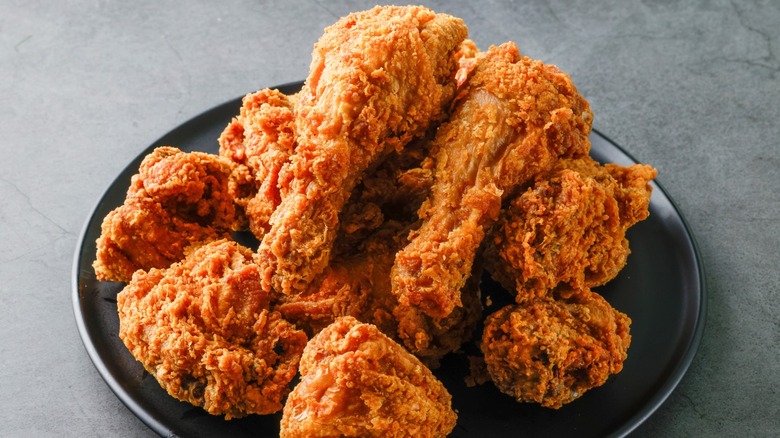
This is more of a timing problem—usually, though, the quality of the breading and seasonings can also vary quite a bit from one deli to another. But honestly, unless you're lucky enough to be present when it comes out of the fryer, supermarket deli fried chicken is usually just Not Good.
Breaded, fried food in general has a short lifespan. The oil seeps into the breading pretty quickly, especially if the cook didn't give it time to drain. And steam gets trapped inside that plastic or Styrofoam container during transport, which means even if you do buy your chicken right out of the fryer, by the time you get home, it's going to be mushy. So, unless your supermarket has a seating area or you're okay with lunching in your parked car, you might want to pick something that's not deep-fried.
That's not the only reason why you might want to skip the fried chicken. Sometimes, deli fried chicken is more breading than meat, and the breading may not be crispy all the way through. And unless the batter is well seasoned, it can taste of nothing except the oil it was fried in. And, if you're concerned about your health, know that a lot of supermarket delis still use seed oils in their deep fryers. Though controversial, some people argue that the high levels of omega-6 fatty acids in seed oils make them unhealthy compared to other oils.
2. Sliced turkey
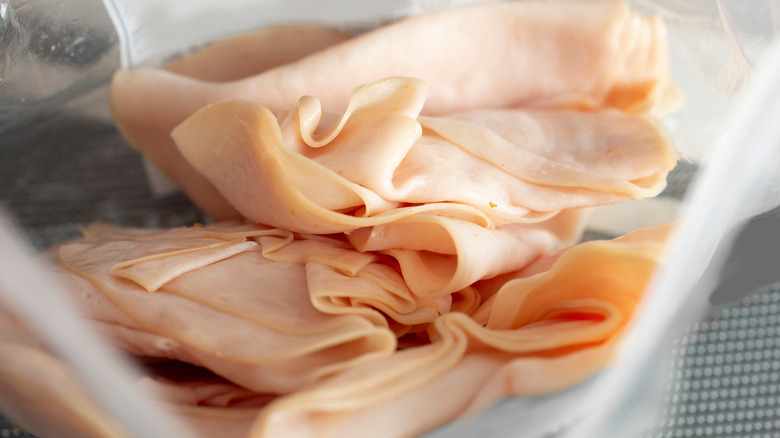
Deli meat, in general, is just terrible for you. I probably don't have to repeat any of the health warnings that have been circulating about processed meats in the last few years, but I'm gonna. The World Health Organization has labeled processed meat as a Group 1 Carcinogen, which means there isn't just anecdotal evidence that it might cause cancer, there's "sufficient evidence from epidemiological studies." And if that's not convincing enough, the quality of deli sliced deli meat is really hit or miss, especially for the turkey. Some deli customers—like this Redditor—report buying deli turkey with an unpleasant slimy texture. The causes of deli meat slime aren't always the same, but a common one is bacterial biofilm. That's the sciency way of saying your lunch meat is covered in a community of bacteria.
Now, there are living bacteria in a lot of the things we eat (yogurt, kimchi, and our favorite daily tea drink, kombucha, for example), and not all bacteria are harmful to humans, but still. There's a difference between foods that are cultured with bacteria and foods that are coated in a thick layer of bacterial slime by accident.
On the flip side, deli sliced turkey can also be really dry, just like that turkey you tried to cook on Thanksgiving, only it also has nitrites, extra sodium, and a much higher risk of listeriosis (a foodborne illness caused by a bacterium called Listeria monocytogenes that is sometimes found in deli meats).
3. Liverwurst
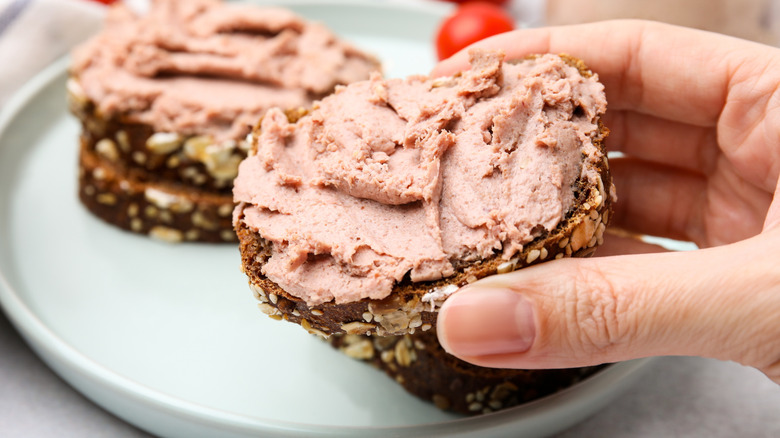
I'm not singling out you liverwurst lovers. I know you exist out there, somewhere, and that you've developed and refined your taste for the stuff over many years of being brainwashed by your parents. Seriously, though, liverwurst is a German food that came to America in the early 1900s. It's traditionally made from ground calf or pork livers and can be spread on sandwiches, kind of like peanut butter. You either love it or hate it. A lot of people fall into the latter category because if you didn't grow up eating liverwurst, you might find the pasty texture unpleasant, especially since most American meat doesn't tend to be spreadable, and the idea can be hard to get used to. It's also very high in fat and sodium, so if you're trying to cut calories or reduce your blood pressure, it's not a great choice.
But even if you love liverwurst and you're not too fussed about healthy eating, you might want to avoid buying at a supermarket deli, given that it's prone to bacterial contamination and that the risk of cross-contamination in a deli setting is higher than it is at, say, your house. In 2024, Boar's Head liverwurst was recalled due to the presence of Listeria monocytogenes. After that, Boar's Head stopped making liverwurst altogether.
Listeria outbreaks happen with other foods, but liverwurst and other deli meats are more prone to it because they're ready to eat (cooking destroys the bacteria), have high moisture (listeria likes that), and have a long shelf life (more opportunities for breeding).
4. Olive loaf
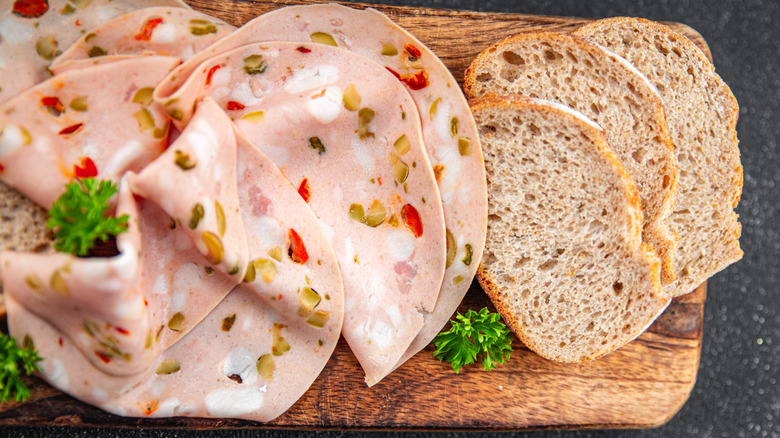
Like liverwurst, olive loaf is an old-school deli meat that people either love or hate. Unlike liverwurst, olive loaf has no long, culturally important history. Despite an exhaustive internet search, I was unable to uncover its origin story, but it appears to be an American invention that peaked in popularity sometime between the 1940s and the 1970s. If its existence is news to you: It's basically bologna that has somehow had pimentos and green olives injected into it.
Also, like liverwurst, people who grew up eating it are more common than people who discovered it as adults. The stuff does appear to have a bit of a following, if this Reddit post can be believed. The original poster was trying hard to get someone to agree with their assessment of its disgustingness, and most of the replies were along the lines of "love it." Even if you are amongst those who think olive loaf is a delicious warm hug of nostalgia, I will argue that there are still reasons why you should skip it.
While nutritionists agree that pimentos and olives are good for you (minus the sodium), they do not agree that bologna is good for you, and it's the bologna that is really the bulk of olive loaf's problem. A two-ounce serving of olive loaf has a whopping 15 grams of fat and almost 500 mg of sodium with pretty much no other nutrients, so even the presence of the peppers and olives doesn't do much to recommend it.
5. Macaroni and cheese
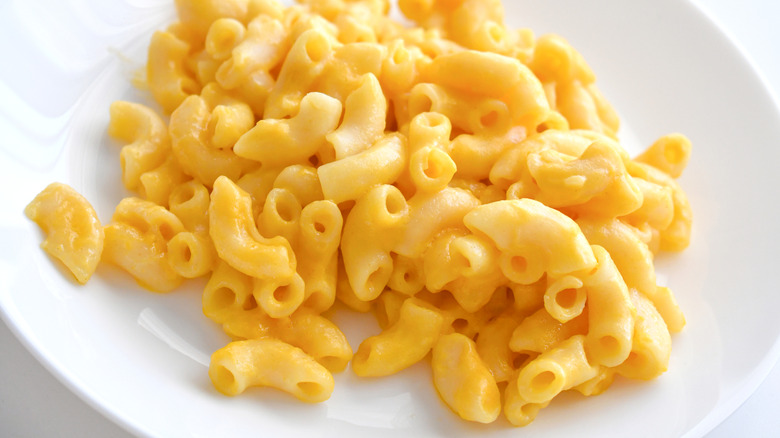
I have yet to buy deli macaroni and cheese that wasn't bland. Maybe this is just me and my bad luck, or maybe I lack proper macaroni and cheese-tasting genes (I also find that a very high percentage of macaroni and cheese sold in sit-down restaurants is bland to the point of inedibility).
It isn't really that hard to make mac and cheese. Boil some noodles, make some cheese sauce, and add some seasonings. But not every deli makes its mac and cheese from scratch, which is frankly just wild. Safeway, for example—at least according to the photo in this Reddit post—gets theirs sent to them in a bag. And while some people say it's still perfectly edible (some even say it's good), it's still wet mac and cheese that was poured out of a plastic bag and heated up.
If that's not enough to convince you to avoid deli mac and cheese, it's also super high in fat and calories. Four ounces of the aforementioned Safeway macaroni and cheese, for example, contains 400 calories, 25 grams of fat, and 10 grams of saturated fat, which is like half the daily recommended allowance for someone who isn't trying to reduce their cholesterol levels. That serving will also give you nearly half your recommended sodium for the day, so you know, not an all-around heart-healthy option. And, honestly, if I'm going to eat something that's super high in fat and calories, I want it to actually taste good.
6. Potato salad
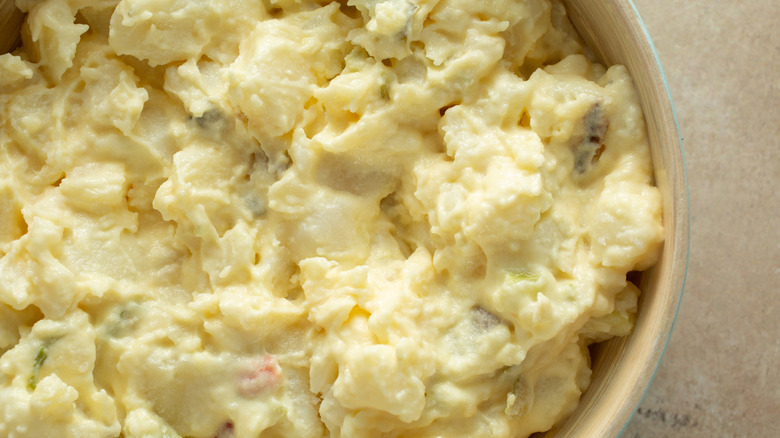
Deli potato salad can be really hit or miss, so if you did sign up to bring it to the potluck, it's probably better to spend 30 minutes at home making it from scratch than it is to spend 30 minutes picking up store-bought potato salad. Sometimes the potatoes are undercooked; sometimes they're so overcooked they're barely identifiable as potatoes. Sometimes the mustard and mayo to potato ratio is skewed way too much in favor of the mustard and mayo. Sometimes you get promised boiled eggs that do not exist, which is frankly borderline criminal. And it's often loaded with added sugars, which can make it taste weirdly sweet.
You probably wouldn't put sugar in your own potato salad, so why do grocery stores do it? Sugar does act as a preservative, which may have some value for foods that spend a lot of time in the deli case, but the larger reason is that the sweet flavor is more broadly appreciated. Sugar makes food more palatable, which is why you find it in a lot of processed foods, even foods that are supposed to be savory.
Potato salad is a little lighter on calories than mac and cheese (a four-ounce serving of Safeway Signature CAFE potato salad is 250 calories), but it's still super high in fat (15 grams), and it contains six grams of sugar.
7. Chicken salad
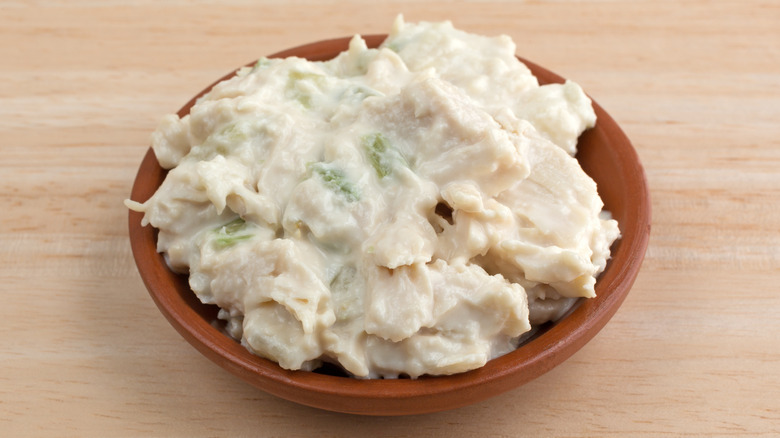
Chicken salad is like the trifecta of bad. It has practically no nutritional value, it contains a ton of fat and calories, and it often tastes bland and boring. Four ounces of Safeway's deli chicken salad, for example, has 290 calories and 25 grams of fat. It's also got protein and calcium, but not much else in the way of good, including flavor.
This trend continues with other brands of deli chicken salad. Costco makes its chicken salad from rotisserie chickens. Now I'm not against making things out of rotisserie chickens. Those little bagged wonders are great when you need to add protein to a five-minute recipe. But if you've ever left a cut-up rotisserie chicken in the refrigerator for a couple of days and then tried to use it in a pasta dish or to top a green salad, it really doesn't hold its texture very well. It gets kind of mushy, even a little pasty, bordering on liverwurst pasty after like three days. I don't know what the turnover is on Costco's chicken salad, but if it's more than a day old, it must be pretty ew.
The unpopularity of Costco's rotisserie chicken is borne out by this Reddit post, where the original poster called it "just gluey" and another noted that the rotisserie chicken used to make the salad has a taste "that doesn't taste like food." Your local deli might be doing something different, but for the most part, we think it's worth leaving behind.
8. Sushi
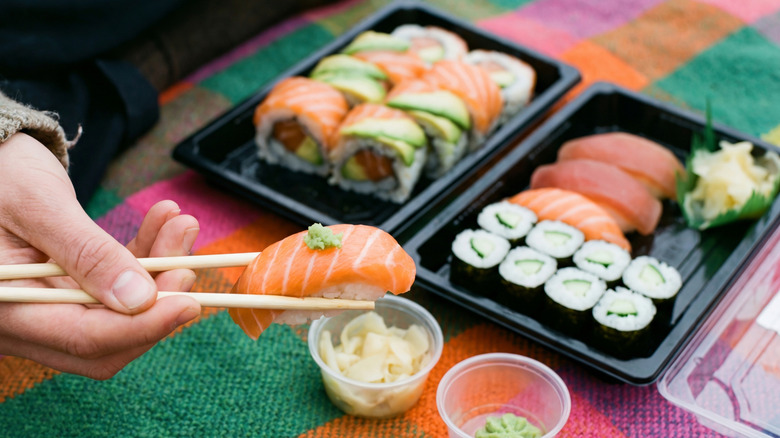
I'll be very honest up front and say that I totally eat grocery store sushi even though I once got salmonella from it. I shall name no supermarket names, but if you do get sushi from a supermarket deli, it's worth knowing which days of the week the sushi chef takes off. At my local supermarket, that's a Sunday. I bought sushi on a Sunday—sushi that had been sitting in the case for longer than a day—and paid the price.
Even if your day-old deli sushi does not house a colony of pathological bacteria, raw fish does not hold up under the test of time. It gets mealy and/or slimy, it tastes fishy (fish should never actually taste fishy, especially when it's raw), and it even kind of looks like it's collapsing, the way a dead fish that's washed out of a lake might start to collapse after a day or two.
Because I still personally eat deli sushi even after having that terrible experience with it, I can say that the quality of deli sushi is very specific to the store that sells it, so this is one food purchasing decision that requires some research. I guarantee you, if someone has been food-poisoned by the sushi at your local supermarket, that's going to be in a review somewhere. When in doubt, check Yelp. When not in doubt, check Yelp anyway. Better safe than spending the next 48 hours within four steps of your bathroom.
9. Methodology
Above, I briefly mentioned my criteria for singling out the items on this list of skippable deli foods. I've fallen prey to many a delicious-looking but not delicious-tasting deli item, so I feel at least somewhat qualified to provide advice. But I did also consult online sources—primarily Reddit—where my opinions were corroborated. I also took into account some factual information, like the nutritional content (or lack thereof) and certain items' (albeit often anecdotal) predisposition for causing intestinal ailments. However, I do want to also reiterate that not all delis are created equal, and all taste buds are different. Just because I dislike the mac and cheese my local deli sells does not mean that all deli mac and cheese is bad.