

12 Classic California Foods To Put On Your Foodie Bucket List, According To A Local
California is known for Hollywood films, golden-sand beaches, and a booming tech industry, but the state's heart lies in its food. The Golden State feeds the nation, producing one-third of the United States' vegetables and two-thirds of its nuts and fruits. We Californians feel fiercely proud of our agricultural bounty, and we're very happy to share.
But our state's culinary culture isn't just about the healthy stuff. Yes, we love smoothie bars and vegan bistros, but our food landscape is wildly diverse. California has more Michelin-starred restaurants than any other state, but it also has thousands of taco stands, burger joints, noodle houses, food trucks, and old-school steakhouses with leather booths and moody lighting.
How do I know? I'm a 50-year resident who has made my living writing about California. I've interviewed local chefs, farmers, fisherman, foragers, and cheesemakers, and I've noshed my way around the state's cities, byways, and backroads. When I'm not eating, I spend a lot of time thinking about the Golden State's food, and I can say with authority there's no "short list" of quintessentially Californian cuisine. This is a different list, one that celebrates 12 foods that Californians are passionate about. These are heritage foods: Some flourish in our farm fields and ocean waters, some were invented here, and all are too delicious to pass up. I hope you'll try them on your next trip to California.
1. Artichokes
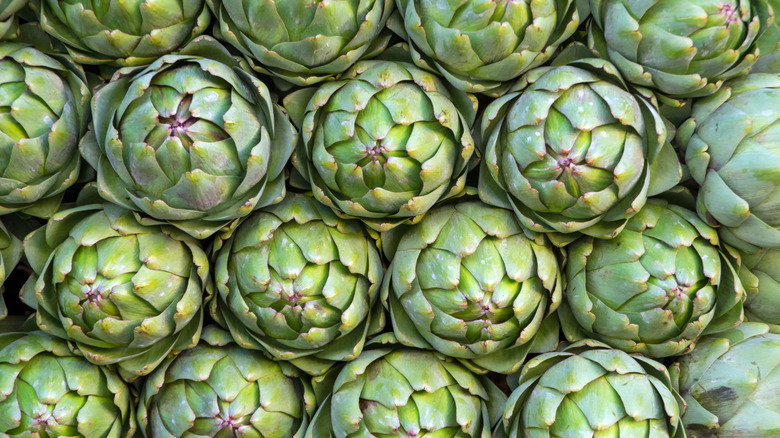
The Golden State produces nearly 100% of all artichokes sold commercially in the United States, and the vast majority grow in the fog-enshrouded fields of Monterey County — specifically around Castroville, the self-proclaimed Artichoke Capital of the World. Most Americans have eaten these prickly thistles only one way — roasted, boiled, or steamed, then dipped into drawn butter or aioli. While there's nothing wrong with this tasty dish, California chefs have come up with many other ways to cook our official state vegetable.
Stop in to Castroville's Pezzini Farms, where workers have been growing, harvesting, and packing heirloom Green Globe artichokes for more than 80 years. Its food truck, "The Choke Coach," serves artichoke cupcakes and deep-fried artichokes, which have a perfectly seasoned crunch on the outside and soft heart on the inside. A couple of miles away, the kitschy Giant Artichoke Restaurant also serves deep-fried hearts, but a bigger attraction is the 20-foot-tall concrete artichoke in its parking lot (nab your selfies here).
An hour's drive up the coast in Pescadero, two artichoke foods are worth a detour: At Duarte's Tavern, a stagecoach stop built in 1894, the creamy artichoke soup is the hands-down favorite. A couple of blocks away, Arcangeli Grocery has been baking artichoke-stuffed breads since 1929. The bakers hand-roll artichoke quarters into Italian bread dough, add garlic and herbs, then bake to crusty perfection. My favorite is the pesto artichoke loaf, but the cheddar version is no slacker.
2. Sourdough bread
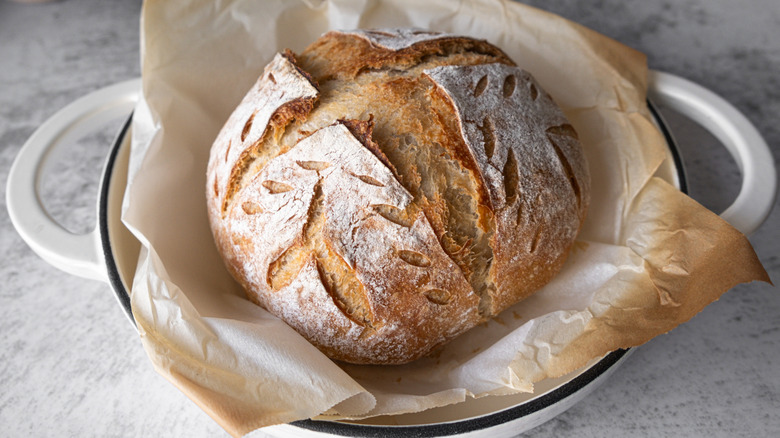
Sourdough bread's origins trace back to ancient Egypt, but in the modern era, California's Gold Rush was the driver behind the bread's popularity in the U.S. It all started in 1849, when a San Francisco miner gave some wild yeast starter to Isidore Boudin, the son of master French bakers. Boudin experimented with it and soon opened San Francisco's first sourdough bakery. The tangy bread quickly won the city's hearts and stomachs. Today, Boudin Bakery has dozens of outlets in Northern California, including a popular spot at San Francisco's Fisherman's Wharf, where diners spoon up clam chowder in Boudin's signature sourdough bread bowl.
Dozens of other San Francisco bakeries nurture their own sourdough starters, also called "mother doughs," which can live for more than a century. The starter, a combination of wild yeast and lactic acid bacteria, gives each loaf its unique, tangy flavor and chewy texture. San Francisco's weather has an impact, too. The city's relentless fog, formed from evaporated ocean water, contains unique microbes that don't exist anywhere else, making its sourdough taste unlike any other.
Carb lovers can argue for days about which San Francisco bakery makes the best sourdough. Out of dozens of top-notch contenders, my favorite spots are Noe Valley Bakery (order the sour batard) and Josey Baker Bread (get the whole-grain levain).
3. Fish tacos
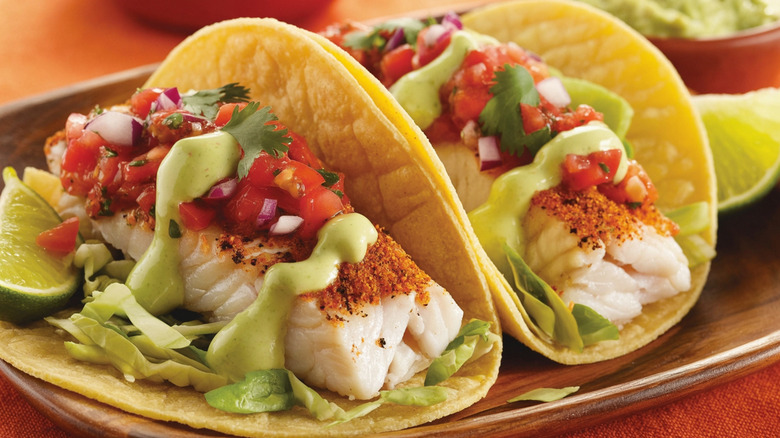
The fish taco is a Baja California import that's a staple throughout the Golden State, showing up on menus at surf shacks, chain restaurants, and high-end bistros. The Pacific Ocean is a key player in the dish. A proper fish taco requires the services of a firm, mild, white-fleshed fish that's recently been swimming in local waters. That fish is often mahi-mahi, but varies based on location and season. In Santa Barbara, tacos might be filled with locally caught lingcod or halibut. In San Diego, chefs may use pollock. Farther north in the San Francisco Bay Area, rockfish is a popular choice.
Purists insist that a true Baja-style fish taco must always be battered and fried, but Californians like freedom of choice, so at most eateries, grilled fish tacos are available, too. However it's cooked, the fish will be accompanied by shredded cabbage, pico de gallo, and a crema made of sour cream, mayonnaise, lime juice, and perhaps chipotle. A soft, folded corn tortilla (never flour) holds it all together. It's perfect just as it's served, but the pro move is to request extra lime wedges for squeezing and a couple of slices of avocado.
California has thousands of eateries serving fish tacos. Ask a local surfer, delivery driver, or investment banker — or anyone at all — and they will tell you which place in their town has the best fish tacos.
4. Cobb salad
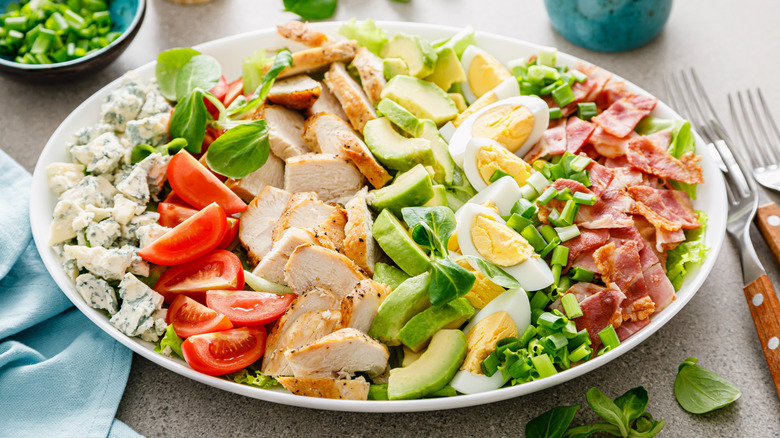
In the 1930s, The Brown Derby was a Hollywood hotspot where A-listers would hang out and movie producers would take meetings. It's also where the Cobb salad was invented, a momentous event that forever changed how Americans viewed salads. The origin story goes like this: One night after the restaurant had emptied, Brown Derby owner Robert Cobb decided to make himself a meal out of leftovers in the restaurant fridge. He pulled out hard-boiled eggs, blue cheese, bacon, roasted chicken, and avocado, and piled them on top of romaine lettuce. The result was a rich, satisfying meal that was nothing like a lightweight leafy-greens salad.
Cobb shared the dish with his friend Sid Grauman, owner of the famous Grauman's Chinese Theatre. Legend has it that Grauman had just had dental work done, so he was happy that the ingredients were chopped into small pieces. After declaring the recipe a winner, Grauman dubbed it "Cobb salad."
The salad became an instant hit at The Brown Derby. Movie stars like Joan Crawford, Bette Davis, and Marilyn Monroe were photographed eating it. Film companies used "the stars' favorite salad" as a promotional tool, passing out Cobb salad recipes to popular magazines. Cobb salad is now a common menu item across the U.S., but not every place makes it like Robert Cobb did. For authenticity, the ingredients should be arranged in rows, not tossed together.
5. Date shake
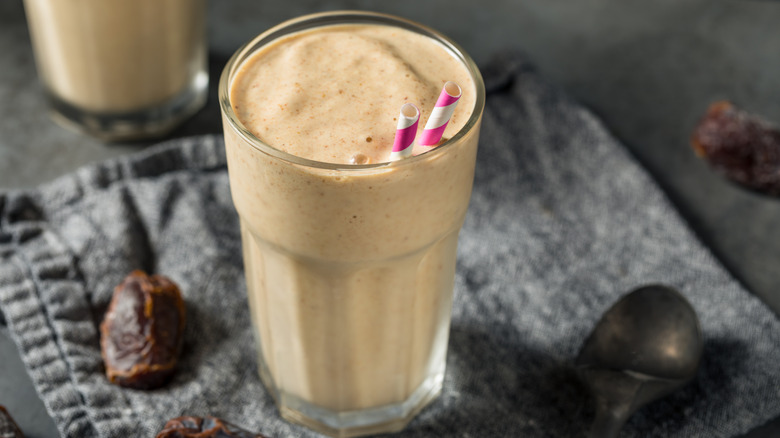
Go on a desert getaway to Palm Springs or any surrounding Coachella Valley town, and you'll discover the region's signature cool-down treat, a shake blended with dates, milk, and ice cream. The first creamy date shake was concocted in 1930 at Valerie Jean Date Shop in Thermal, and nearly a century later, the sweet drink is served and savored at dozens of desert locations.
Date farms have become a major tourism draw, with the desert region producing about 35,000 tons of dates, or more than 90% of all dates grown in the U.S. each year. At Shields Date Garden in Indio, visitors sip date shakes and eat bacon-wrapped dates, pancakes with dates, and date-topped burgers. Shields grows more than 100 varieties of dates, but its date shakes are made with the prized Medjool dates, coveted for their large size and sweet caramel taste, and the golden Deglet Noor, a firmer fruit with a nutty finish. Shields' side attractions include a strollable desert garden and a movie theater playing "The Romance and Sex Life of the Date" every 30 minutes.
Desert dwellers serve dates with just about everything, and they'll happily offer their opinion on where to get the best date shake. My top picks are Hadley Fruit Orchards in Cabazon and Great Shakes in downtown Palm Springs.
6. Tri-tip
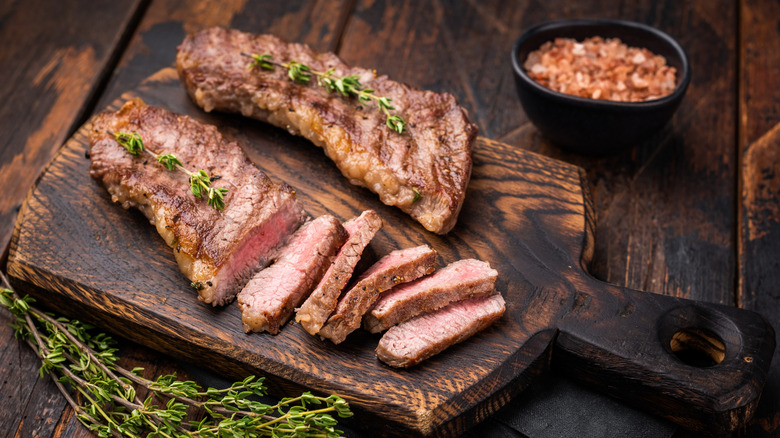
Santa Maria is both a place and a lifestyle, located midway between San Diego and San Francisco on California's Central Coast. The city is bounded by miles of vineyards and dozens of tasting rooms, but it doesn't turn cartwheels to please wine-sipping tourists. Instead, Santa Maria sticks close to its ranching roots: Cattle graze, cowboys wear Stetsons, and people take barbecue very seriously. Here, "barbecue" means tri-tip seared over flaming California red oak.
The tri-tip revolution didn't occur until 1953, even though Santa Maria ranchers had been grilling beef for more than a century. Local butcher Bob Schultz is credited with inventing a new method for preparing tri-tip, a triangular, bottom-cut sirloin steak. Butchers had always ground it up, but Schultz decided to keep it whole to take advantage of its fatty marbling. He seasoned it with salt, pepper, and garlic and grilled it over an open flame. The result? A meaty masterpiece.
This affordable cut became so popular that by the late 1950s, Santa Maria-style barbecue joints had popped up all over the Central Coast. Some of these old-school spots still exist, like Shaw's Steakhouse and Tavern, where you can watch the pit master grill your tri-tip over the sizzling oak pit. You can be sure it will be cooked precisely the way you like it. Another legendary tri-tip spot is The Hitching Post II, made famous by the 2004 movie "Sideways".
7. Cioppino
For nearly two centuries, San Francisco has been a melting pot of cultures and countries. That's one reason for its wealth of amazing food, from pork buns in Chinatown to fresh ravioli in North Beach to burritos in the Mission District.
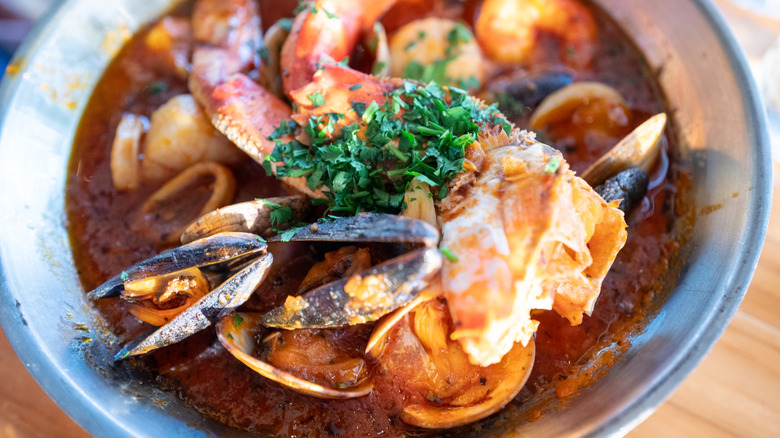
Sometime in the 1800s, Italian immigrants gave the city a fabulous tomato-based seafood stew named cioppino. Linguists might argue that the name "cioppino" is derived from the Northern Italian word "cuippin," which means "fish stew," but I prefer the more colorful origin story: If a fisherman returned with empty nets, he would walk along the pier with an empty bucket and ask his compatriots to "chip in" some of their day's catch to make a communal stew.
The key to a great cioppino is a good mixture of locally caught shellfish and fish, typically mussels, clams, Dungeness crab, scallops, squid, and rockfish. Garlic, tomatoes, and red wine also play starring roles. Cioppino is served all over the city, but it always feels right to eat it beside the bay at Scoma's, one of the Wharf's oldest restaurants (in anything but a white shirt). If the line is too long, other shoutout-worthy spots are nearby, like Cioppino's and Crab House at Pier 39. In the nontraditional category, Sotto Mare in North Beach adds rigatoni pasta to their seafood stew, and the results are drool-worthy.
8. Mission burrito
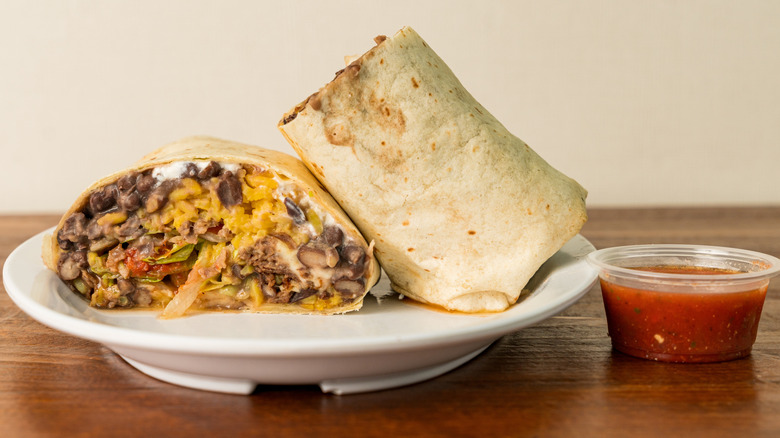
When I was 21, I rented my first apartment in San Francisco, a small studio five floors above Market Street. The rent devoured my paycheck, so every other day I would walk to the Mission District and order a colossal burrito that fed me not just for dinner but also for the next day's lunch. Thirty years later, you can still order a delicious, big-bang-for-your-buck burrito at spots like El Faro and La Taqueria, where owner Miguel Jara won a James Beard Award in 2017.
Mission-style burritos require a 12-inch-wide flour tortilla, which is steamed so it'll stretch even larger to accommodate being stuffed to the gills. Your meat might be pollo, al pastor, carne asada, or carnitas, and that's nearly irrelevant because the grill's sear delivers a je-ne-sais-quoi to all meats that no modern chain can duplicate. You'll probably add rice and beans, and you might request salsa, shredded cheese, crema, or guacamole.
An assembly line of chefs will put your burrito together, and the last one wraps it tightly in aluminum foil to ensure structural stability. Even so, if you feel compelled to eat your burrito while riding a jerking MUNI bus, you're headed for disaster. Ideally, you order your burrito "for here" and eat it like a civilized person, straight from the restaurant's red plastic basket.
9. French dip
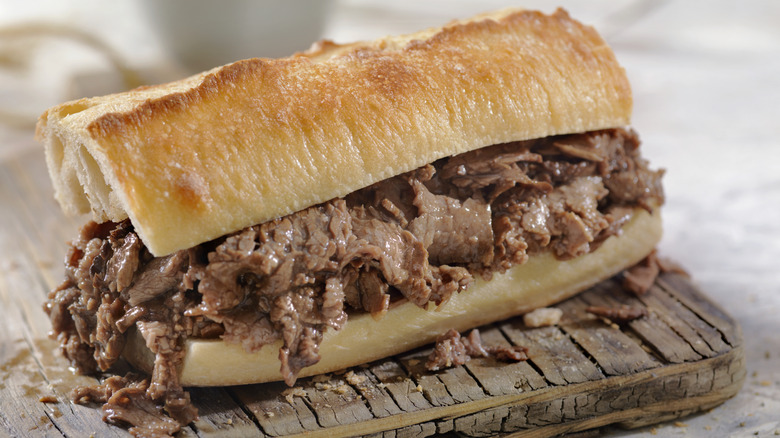
Much like French fries, the French dip sandwich has no direct connection to France. This old-school beef sandwich was born in Los Angeles, most likely in 1918 at a restaurant called Philippe The Original, which is still open today. The story goes that owner Philippe Mathieu was making a roast beef sandwich for a customer when he accidentally dropped the French roll into a pan filled with meat drippings. The customer ate it anyway, then returned the next day and asked for the same sandwich.
The French dip quickly became an LA gastronomic institution, so it's not surprising that another local restaurant, Cole's, also claims to have invented it. It's a killer sandwich either way, and Philippe The Original is worth visiting just for the time warp. In its current location since 1951, the diner looks like it's frozen in the Eisenhower era. Take a minute to check out the memorabilia adorning the walls, then order at the counter. Your French dip can be made from turkey, ham, lamb, pork, pastrami, or beef, and you must select "single, double, or wet," which describes how much of the roll will be dipped. Pro tip? Order a side of juice and dip it yourself. Another pro tip? This is LA Dodgers territory, so take off that San Francisco Giants hat.
Is the French dip the best sandwich in Los Angeles? No. But like cheesesteak sandwiches in Philadelphia, it's an essential piece of LA's culinary soul.
10. California roll
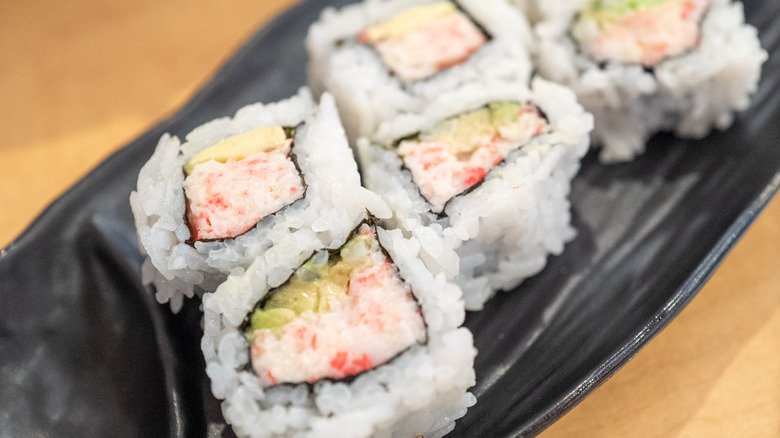
Sushi is ubiquitous now, but back in the early 1960s, most Americans weren't keen on eating raw fish. That reluctance lies at the heart of this might-be-true tale about the California roll's invention: In Los Angeles' Little Tokyo neighborhood, chef Ichiro Mashita served traditional Japanese sushi, but his customer base was limited mostly to Japanese businessmen. Mashita wanted more customers, so he came up with a workaround to appeal to less adventurous palates: He created an inside-out roll — rice on the outside — filled with cucumber, avocado, and cooked crab, and called it a California roll.
The dish became an immediate hit in Los Angeles and started America's sushi revolution. Later, other chefs would claim that they, not Mashita, had invented the California roll, but no one knows for sure. Mashita can certainly be credited with popularizing them as celebrities like Audrey Hepburn and Rock Hudson became his loyal customers.
Today, you may know of self-proclaimed sushi connoisseurs who refuse to order California rolls because "they're inauthentic". The bad rap stems from mass-produced California rolls — typically sold at warehouse-style grocery stores and gas stations — made with imitation crab (surimi) instead of the real thing. No self-respecting sushi chef would ever pull a stunt like that. The crab in a true California roll is California-caught Dungeness crab or snow crab.
11. Avocado toast
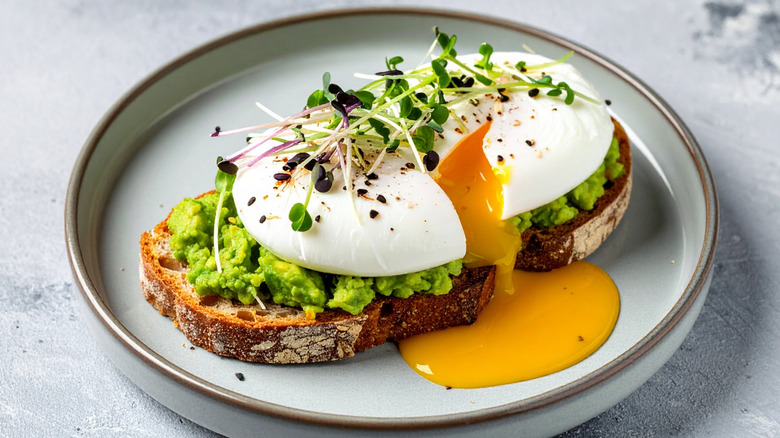
Although some people see avocado toast as an internet-fueled fad invented by millennials, Californians see it as a mealtime mainstay. Along with Australians, Golden Staters have been eating the stuff since the 1920s, nearly a century before the social media era. That may be because we have thousands of avocado trees growing in our state, and we can only eat so much guacamole.
California-grown avocados make up about 90% of the nation's crop. Of the seven varieties that are grown commercially, the Hass is the undisputed king. The black, nubby avocado has a creamy texture that's ideal for mashing, so it's often used for avocado toast. The first Hass avocado tree was planted in the 1920s by Rudolph Hass, a postman and amateur horticulturist from La Habra Heights, California. Hass planted the tree by accident — its seed was mixed in with the seeds of Fuerte avocados — but Hass found its fruit to be especially tasty, so he patented it. Now every commercial Hass avocado tree is a descendant of that La Habra Heights tree.
In California, chefs level up avocado toast by piling on the extras: a poached egg, prosciutto, or even cherry tomatoes. Some restaurants go way beyond basic pairings. San Francisco's Avotoasty serves a bourgeois version decked out with jet-black pearls of Hackleback caviar and 24-karat edible gold leaf. Too pretentious? Maybe. Maybe not.
12. Pacific oysters
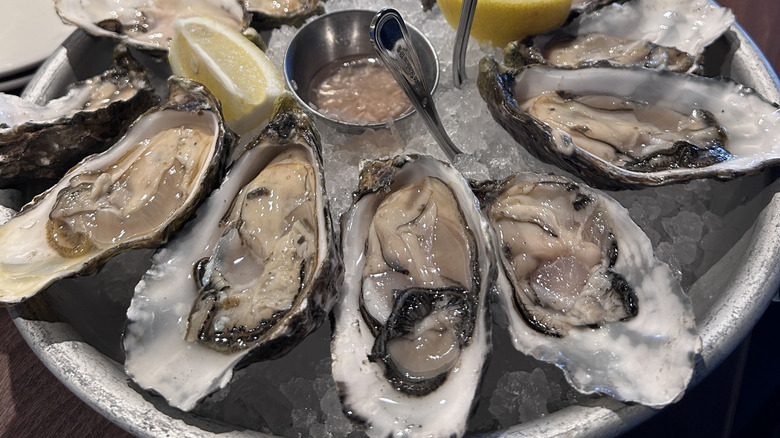
My favorite day-trip from San Francisco lies about 50 miles north in Tomales Bay, one of the West's best oyster-growing regions. These are Pacific oysters, an entirely different bivalve than East Coast or Gulf Coast oysters. Their shells are deep, round, and have ruffled edges. Their meat is delicate with a buttery texture and smooth mouthfeel. They taste mild and crisp when eaten raw with a squeeze of lemon, or dipped in mignonette.
Several oyster farms are clustered near the tiny hamlet of Marshall on Tomales Bay. Tomales Bay Oyster Company is California's oldest continuously run shellfish farm, established in 1909. You can buy fresh oysters here, but you must shuck them yourself. For oyster-slurping without the work, drive a few miles along the bay's shoreline to Hog Island Oyster Company or The Marshall Store. At either spot, the staff will bring you oysters that were pulled out of the bay only an hour or two earlier.
If you're not wild about raw oysters, you can order them grilled in garlic butter or a chipotle-bourbon barbecue sauce, or broiled in decadent Rockefeller-style with spinach, two types of cheese, and breadcrumbs. Any way you eat them, these oysters — and their beautiful Tomales Bay home — will linger in your mind for a long time.