

10 Spam Flavors, Ranked Worst To Best
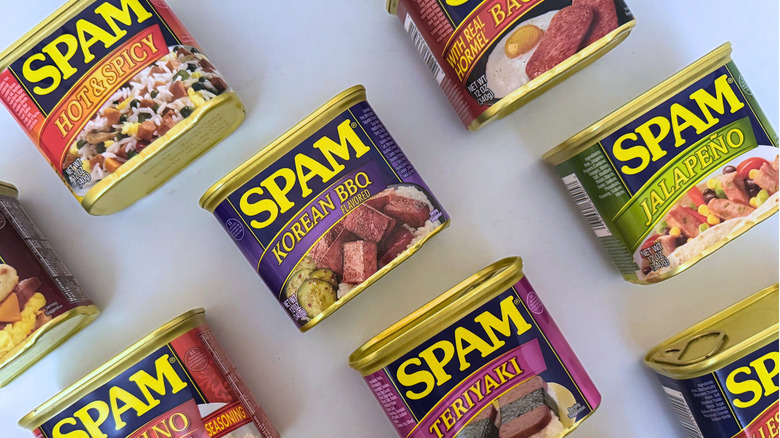
Spam hasn't always had the best reputation, with some people wary of eating it for various reasons. But, at the end of the day, this polarizing food is an affordable and satiating canned good that's easy to whip up at any time. It's also pretty darn delicious depending on the flavor you choose.
Being a long-time defender of Spam (and a Filipino one at that, meaning my motherland is a country where the brand is particularly popular), I'm here to show you all that it can be enjoyable so long as you know which varieties are worth trying out and how to use them in the right recipes. To do this, I purchased and sampled 10 different flavors from my local grocery store and ordered them from worst to best. In doing so, I learned both which ones will keep people hating and which ones are sure to create some fans.
10. Korean BBQ
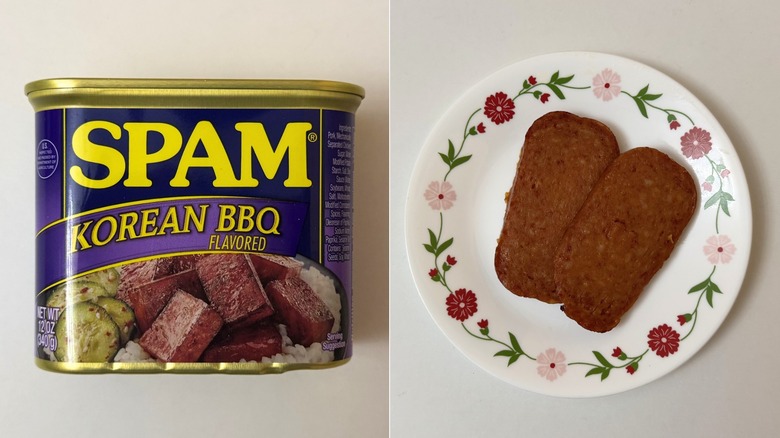
I've been to my fair share of Korean BBQ joints over the years to celebrate special occasions, and not once at the handful of spots I've frequented have I tried something that tastes like Spam's take on it. The brand's flavor is hard to pin down, but the closest word that came to mind as I sampled it would be "funky."
It had a very smoky essence, which feels right since the Korean BBQ experience is all about grilling various meats. There was also a slight spice to it from ingredients like paprika and gochujang paste — again, not totally uncommon depending on the protein and marinades you choose at a Korean BBQ restaurant. But, what I wasn't expecting was how otherwise indiscernible everything else would be, making this the first time I've understood why some people tease Spam for being a "mystery meat."
The packaging clears its contents up, though, listing pork, mechanically separated chicken, soy sauce, garlic, and ginger as some of the main ingredients. I wouldn't have been able to pick out any of these elements without reading the label; all I'd know is that they come together to create something that should be left behind on the grocery store shelf.
9. Oven Roasted Turkey
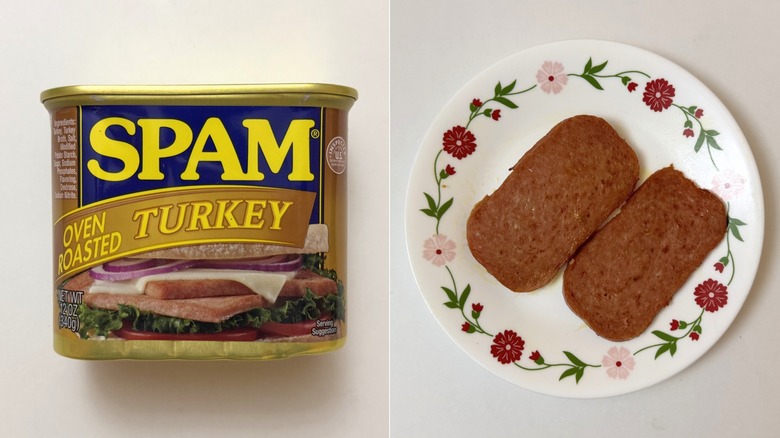
Second to chicken, turkey is my protein of choice in most scenarios. As such, I was expecting that Spam's Oven Roasted Turkey would join the ranks of my favorite flavors from the brand, but that was not the outcome. While it actually does use 100% white, lean turkey, it in no way tastes like any turkey I've had, whether it be the cold cuts I've put in my sandwiches or the birds that have sat on my table during Thanksgiving dinners. The only semblance is an overall, subtle, tame flavor (compared to a majority of the other products on this list, at least).
This mostly just tastes like salt and nothing else, so I wouldn't advise eating it on its own or making it the shining star of a meal. Luckily, there are plenty of ways to take Spam to the next level by incorporating it into recipes. It just so happens to be an expert-approved ingredient that upgrades fried rice, with the accompanying veggies and eggs helping to add flavor while also detracting from some of the canned meat's saltiness. Or, you could opt for any of the better-ranking Spam varieties to follow, all of which can stand on their own more.
8. With Real Hormel Bacon
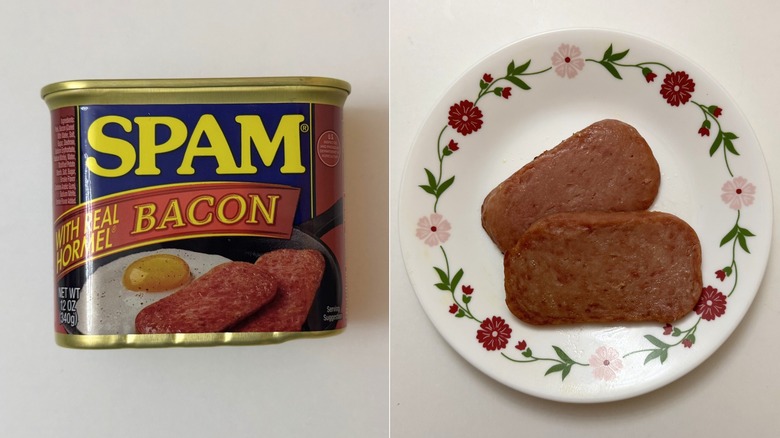
Spam is a good alternative to expensive breakfast meats, but in the case of the one with Real Hormel Bacon, the two are fused into one canned product. As you can guess by the name, this variety takes Spam's Classic flavor and incorporates extra bits of meat sold by the popular food processing company. Seeing as Hormel didn't place particularly well in our ranking of store-bought bacon brands, though, it's not surprising that it didn't do much to elevate the Spam.
When you tear back the pull-tab lid, you're met with a pale pink-beige hunk of meat that looks like the ham cold cuts you'd find in the grocery store fridge aisle. And, well, what do you know? It tastes a whole lot like it, too. There's nothing bad about that flavor, especially for those who love ham. In fact, I'd recommend this to be eaten in between two slices of bread with a slice of cheese as a sandwich. However, I'd imagine people picking this product off the shelf are understandably expecting it to taste more like the smoky, savory bacon typically enjoyed alongside some eggs and pancakes for breakfast. You won't get that here, which is why Spam with Real Hormel Bacon lands in the bottom three.
7. Hickory Smoke
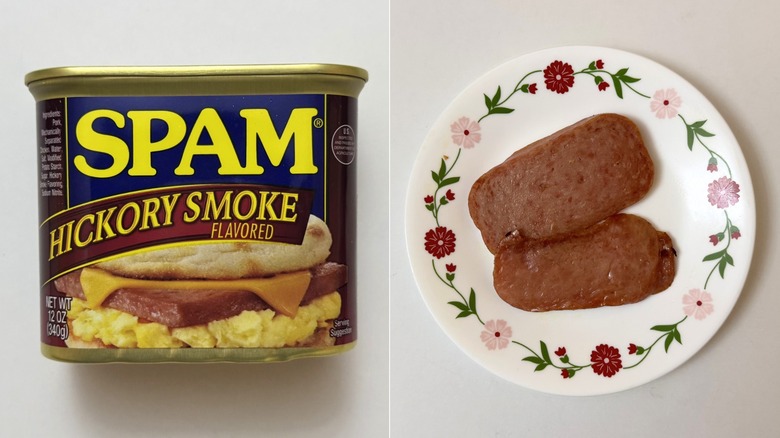
Straight out of the package, Hickory Smoke Spam looks very similar to Spam with Real Hormel Bacon, having a pale pink body with white spots dotting it throughout. More notable than its appearance, however, is its scent. It lives up to its name, emitting a smoky smell (albeit a somewhat fake one) when you open the tin and give it a whiff.
Taste-wise, I can see this being a safe go-to for many, as it's not too far off from the Classic Spam. It's just a slightly more intense version of it on account of its charred, barbecue-esque quality and earthiness. As inoffensive as this generally is, this also means that, to some degree, it's on the plainer side. That's not necessarily a critique, but nothing really stands out about it either, with the flavors discussed next simply being more interesting, which is why this Spam variety lands where it does on this ranking.
6. Jalapeño
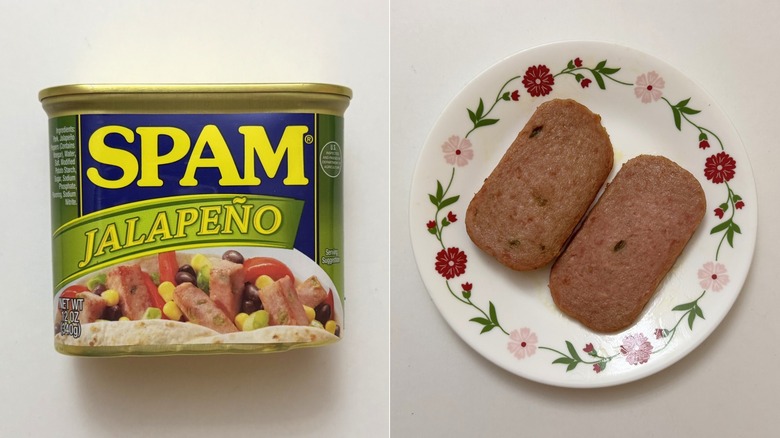
Spam's Jalapeño is one of the most aptly named items on this list. You can actually see green specks of it against the Spam's dark brown body once it's out of the air fryer. You'll also notice that these pepper chunks are not generously used throughout; there are about two to three pieces that you can visibly see, and it's when your taste buds make direct contact with them that you feel how particularly spicy the Jalapeño Spam flavor is.
And, even if your bite doesn't contain one of those extra spicy flecks, each and every other mouthful still overtakes your palate with a strong peppery essence. In other words, the intensity of spice largely varies depending on your bite, but there's always some level of heat going on, whether mild or potent. Jalapeño lovers are sure to love it either way. As Spam itself recommends, you can add it to tacos or quesadillas for a little kick.
5. Classic
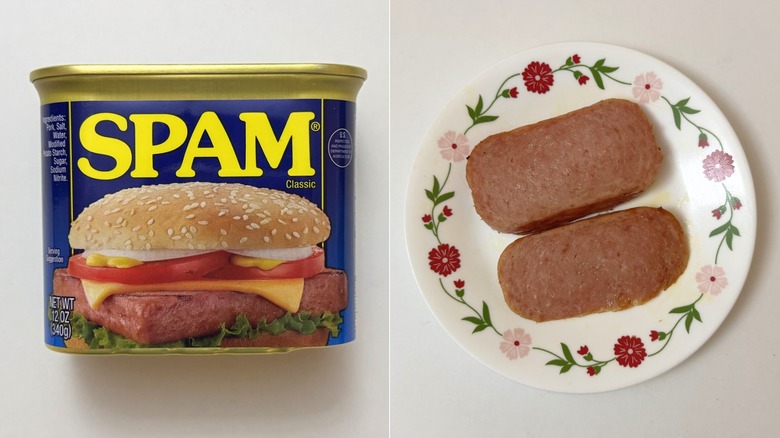
Prior to this tasting, I've only tried one or two of Spam's non-original flavors, and that was not a repeat occurrence. But, when it comes to Classic Spam, that's something I've grown up eating time and time again. It's a savory taste I'm more than familiar with, so I was pretty confident (and maybe a little biased) in assuming it'd land high up in the ranking. When trying it after about six or so other varieties, though, it was knocked off the pedestal I had kept it on for so long.
Classic Spam has no niche flavor or ingredient it's trying to give off, such as Korean BBQ or Jalapeño. It's simply what it is: Pork shoulder and pork ham (hence "Spam") accompanied by sugar and whopping amounts of salt — 790 milligrams per two-ounce serving, to be exact. So, without any special element to help mask that sodium, all you're left to focus on is the overwhelmingly salty taste. It's a bit too much to take when eaten on its own, but it's nothing a condiment couldn't fix. Alternately, you could use it with some rice and seaweed in the popular Hawaiian snack, musubi.
4. 25% Less Sodium
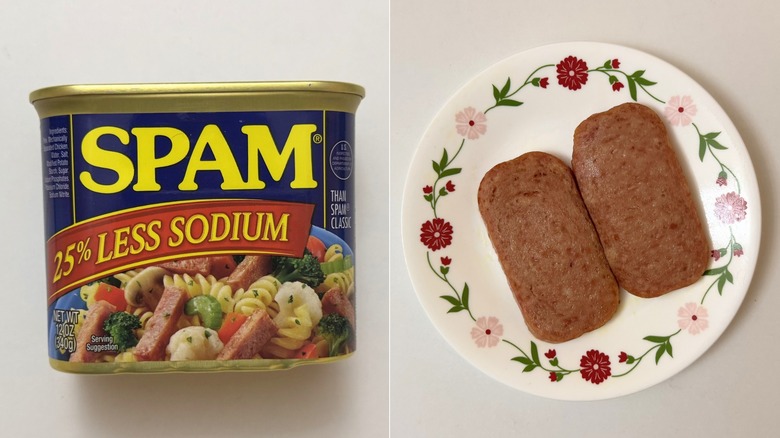
Now that I've tried Spam's 25% Less Sodium alternative, I'll be recommending it to my family as our new pantry staple to keep stocked up on. It comes in a darker shade of pink than its Classic counterpart, but takes on the same savory, deep flavor.
This time, however, it contains only 580 milligrams of sodium per two-ounce serving instead of 790. That's still a quarter of the recommended daily salt intake; nonetheless, it's a world of difference both in nutritional content and taste. The jarringly salty quality that was present in the Classic is significantly dialed back here, and it's much less of a slap in the face when sampling it. That also leaves more room to actually notice and enjoy the slightly sweet notes Spam has, too, that people likely wouldn't pick up on otherwise when eating the original flavor. Buying the lower-sodium version will unfortunately set you back an extra dollar (more or less, depending on location) compared to the Classic, but those extra pennies are well worth the improvement.
3. Hot & Spicy
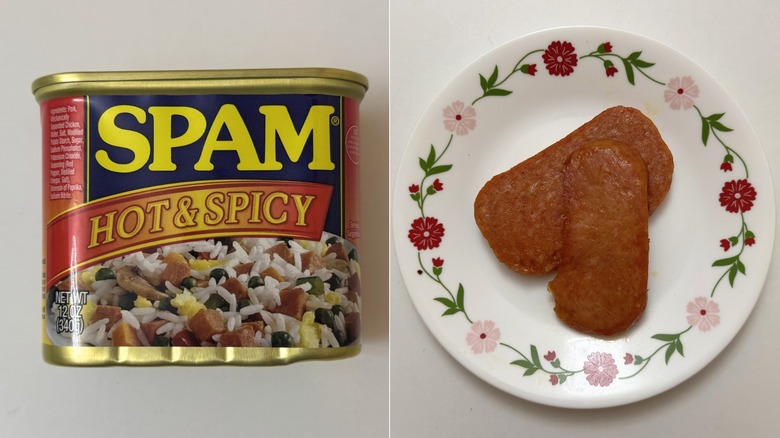
Hot & Spicy Spam looks a smidge radioactive, with a brighter orange hue than most others on this list due to its blend of red peppers and paprika. I'll gladly take it, though, as this is one of the best flavors there are, and I can't believe I haven't tried it sooner.
Upon taking a bite, I mistakenly thought that it wasn't going to live up to its name. The spice doesn't immediately hit your tongue, but after just a few moments, the fiery heat starts building up extremely quickly and spreads out over every part of your mouth, even extending into your throat. This, along with a slight tanginess from the distilled vinegar, lingers far after you've swallowed, making an accompanying glass of milk or some other relieving beverage a necessity. I wouldn't have it any other way as an avid spice lover. I'd imagine it would hit even better dunked into some cheese sauce or chopped up in a bowl of ramen.
2. Teriyaki
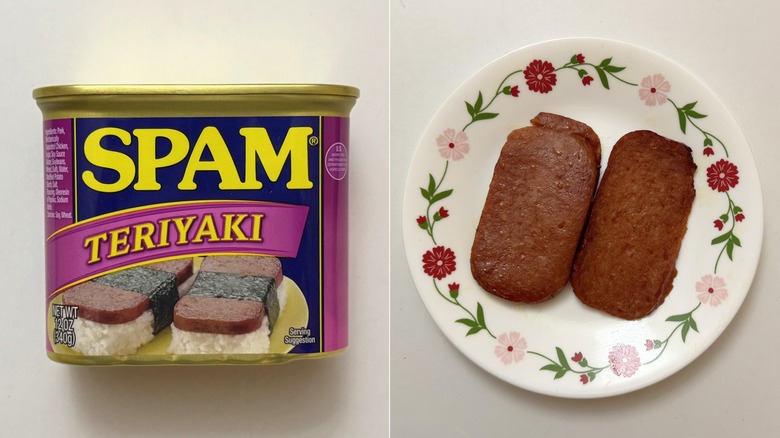
You can't go wrong with Teriyaki Spam. There's a reason foods flavored using the condiment do so well, and it's no different here, with this tasting like a popular menu item you'd find at Panda Express or another Asian-inspired eatery.
Though Teriyaki is often associated with Japan, where the cooking method has its earliest roots, it was in Hawaii that soy sauce was combined with local ingredients, such as pineapple juice, to create the thick, syrupy glaze that those in the United States have come to know it as. This is the version that Spam based its product on, resulting in a sweet meat. And, though it leans sweet, it's not cloying and instead nicely balances its sugariness with Spam's usual savory, salty touches (ensuring the sodium also didn't taste overwhelming as it did with some others). This would be a solid alternative to your usual Teriyaki chicken if you ever wanted to switch up the typical protein.
1. With Tocino
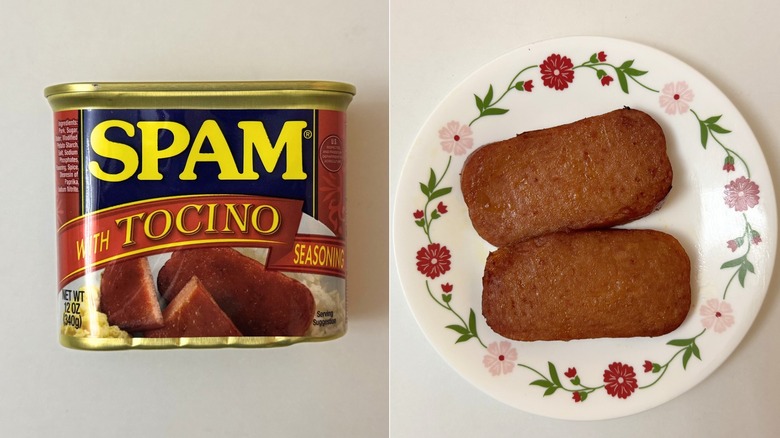
Tocino is one of the traditional Filipino foods everyone needs to try at least once. But, if you can't get your hands on the real thing, Tocino Spam is a good place to start. It cost me $6.99, which is about a dollar more than most of the other flavors on this list, and I'd spend it again.
Similar to the Hot and Spicy, it falls toward the orange side in hue. That's not as eyebrow-raising when it comes to this flavor, though, as traditional tocino — your meat of choice (usually pork) in a marinade of brown sugar, soy sauce, garlic, annatto, and more — has a reddish-orange hue. So, the deep shade is spot on. Even more importantly, it's pretty accurate in flavor. It offers the same sweet, caramelized, and faintly garlicky taste. And, of course, the brand ensures it's pleasantly meaty as always.
It's a top contender for making a Spam fried rice comfort meal. Better yet, try Tosilog, a hearty Filipino breakfast dish consisting of garlic fried rice, fried eggs, and Tocino — or in this case, Tocino Spam. Then, top it off with some of the sugary, yet tangy, banana ketchup that's so loved in the Philippines.
Methodology
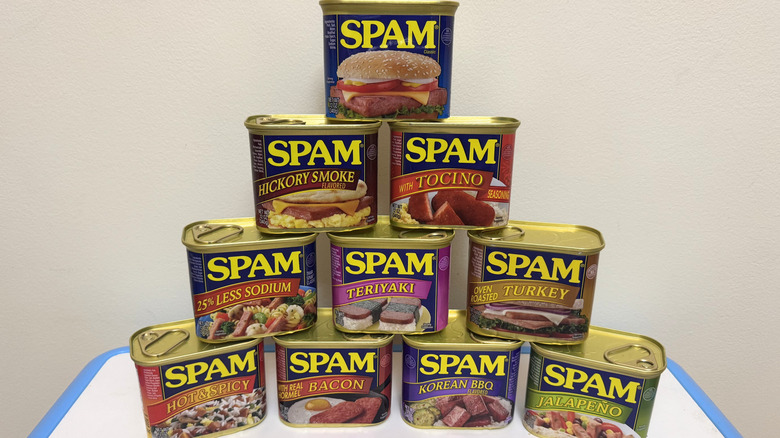
In preparing the Spam I taste-tested for this ranking, I cut off at least two slices for each variety and popped them into the air fryer for a few minutes until the edges crusted up to a nice crisp. Since they all largely had the same texture — a toasted, browned exterior with a spongier, juicier middle — flavor was the main consideration when ordering these from worst to best. I noted whether it achieved its advertised flavor, such as if I could clearly identify jalapeño or teriyaki, and also how salty it tasted. Those with indescribable or "inaccurate" notes or too much salt were placed lower in the ranking.
In a few cases, I also factored in the product's price, since some were more expensive by over a dollar. I decided whether I thought the extra money was worth it, depending on the Spam's flavor and ability to be incorporated into other dishes, like fried rice or a sandwich.