

9 Ways McDonald's Was Different In The '60s Vs Today
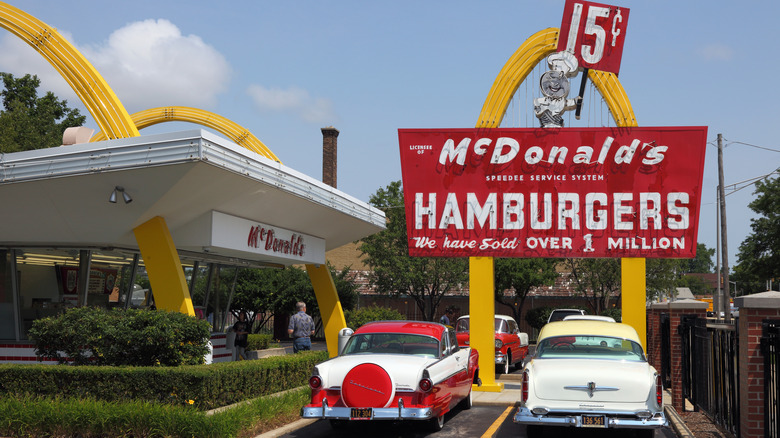
If you walked into a McDonald's in the 1960s, you'd notice plenty of differences right away. For one, the restaurants looked quite different, with bold architecture inspired by the Space Age. In addition, the menu was much smaller, and many of the chain's most iconic items didn't exist yet. And although the brand was growing rapidly, it wasn't anything like the global behemoth it is today, with locations numbering in the tens of thousands.
The first McDonald's opened in San Bernardino, California, in 1940 as a barbecue joint. However, it really took off after founders Richard and Maurice McDonald pivoted to burgers and fries and introduced their streamlined Speedee Service System. The brothers started franchising in 1952, and when Ray Kroc got involved a few years later, he kicked the expansion into high gear. The timing couldn't have been better. As more Americans bought cars and embraced convenience foods during the 1960s, McDonald's fast, drive-in model was more appealing than ever.
To say that the 1960s were a pivotal time for McDonald's would be an understatement. As the company grew throughout the decade, it introduced standardized restaurant designs, expanded its menu beyond the basics, and rolled out new marketing ideas. Many of those changes helped shape the McDonald's we know today, while a few fell by the wayside. If you're curious about what McDonald's looked like more than 60 years ago, here are nine ways the chain was different.
1. McDonald's restaurants featured futuristic Red and White architecture
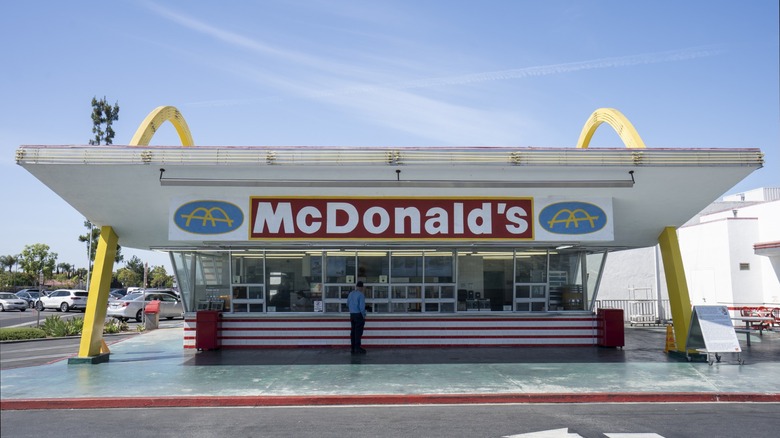
In the 1960s, McDonald's restaurants were designed to grab your attention before you even parked. Most restaurants featured futuristic Googie architecture with swooping golden arches, bright red-and-white tiles, large windows, and neon lights. In addition, there was almost always a bright red sign in front anchored by a golden arch and topped with Speedee, McDonald's original mascot who was a chef with a burger for a head.
McDonald's unique "Red and White" architecture was the brainchild of architect Stanley Meson. Richard and Maurice McDonald hired him in the early 1950s to create a restaurant design that would highlight their new Speedee Service System, which replaced carhops with self-service windows and included an assembly line system for employees. Meson decided to go bold, and the brothers loved it, although Richard (aka Dick) asked him to add golden arches for extra emphasis. The first Meson-designed building went up in 1953.
Throughout the 1960s, most McDonald's restaurants sported the bold "Red and White" design. It only started to fade away after the company introduced a more traditional design in 1969 that featured brick walls and a sloped mansard roof. Some "Mansard Roof" McDonald's are still around today, along with numerous modern restaurants, but the "Red and White" restaurants are few and far between. One notable example is in Downey, California. Opened in 1953, it's the oldest operating McDonald's in the world, and a serious blast from the past.
2. The Hamburger University was a brand new concept
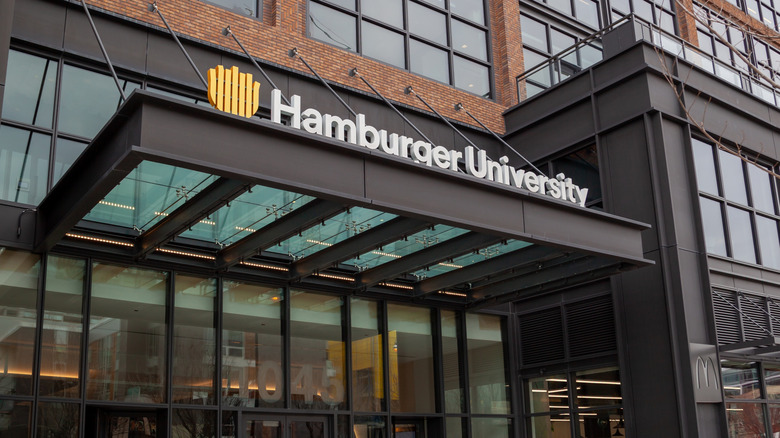
Running a handful of restaurants is one thing. Running hundreds of them is another. As the McDonald's franchise network grew throughout the 1950s and into the 1960s, the company needed a way to train operators and managers to follow the same standards across the board. In 1961, McDonald's president Ray Kroc and future CEO Fred Turner invested $100,000 to create the Hamburger University, a revolutionary fast food training center.
The first Hamburger University opened in Oak Grove, Illinois, in the basement of a McDonald's restaurant. Students attended lectures about everything from how to make french fries to customer service and cleanliness. That year, 14 students graduated from the program. The concept was a success, and McDonald's would go on to open a much larger facility in Oak Brook, Illinois, with dedicated classrooms, kitchens for hands-on training, a museum with historical McDonald's artifacts, and even a hotel to house students.
Today, there are numerous Hamburger University campuses around the globe where students can earn a "Hamburgerology" diploma. The curriculum now includes lectures, simulated service situations, and hands-on training, and it covers additional topics like inventory management, marketing, and quality control. The training ensures managers and owners are well-versed in what it takes to run a successful franchise. Graduates can also use the diploma for further career advancement by applying the credits toward degrees at other universities and colleges.
3. Ronald McDonald made his television debut in 1963
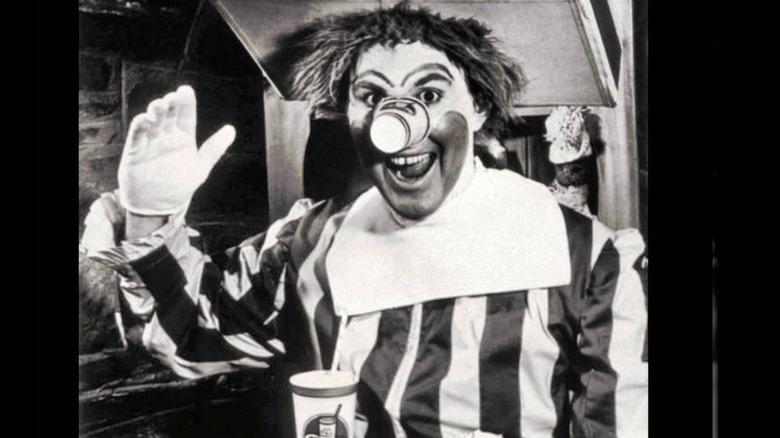
Today, Ronald McDonald is one of the most recognizable fast-food mascots in history, but in the early 1960s, he was a brand-new character. He was created by Willard Scott, a radio and television personality who was also famous for playing Bozo the Clown in the Washington, D.C. area. A local McDonald's hired him as Bozo to drum up business, and he was a huge hit. When his Bozo the Clown contract ended, he created a new clown character just for McDonald's.
Ronald McDonald made his debut in a 1963 television commercial that introduced him as "the world's newest, silliest, and hamburger-eating-ist clown." Played by Scott, he wore a jumpsuit with vertical red and yellow stripes, a soda cup for a nose, and garish face paint that featured a massive mouth and double eyebrows. He also wore a McDonald's tray as a hat and a belt with a tray holding a McDonald's hamburger, french fries, and a milkshake.
In 1966, circus performer Michael Polakovs took over as McDonald's clown mascot, and that's when Ronald McDonald evolved into the character we know today. Polakovs spiffed up Ronald's look with a curly red wig, yellow jumpsuit, red and white striped shirt, big red shoes, and more defined face makeup. Numerous actors have taken on the role of Ronald McDonald over the years, but the mascot's signature look has stayed largely the same since the mid-1960s.
4. McDonaldland characters like Grimace and the Hamburgler weren't around yet
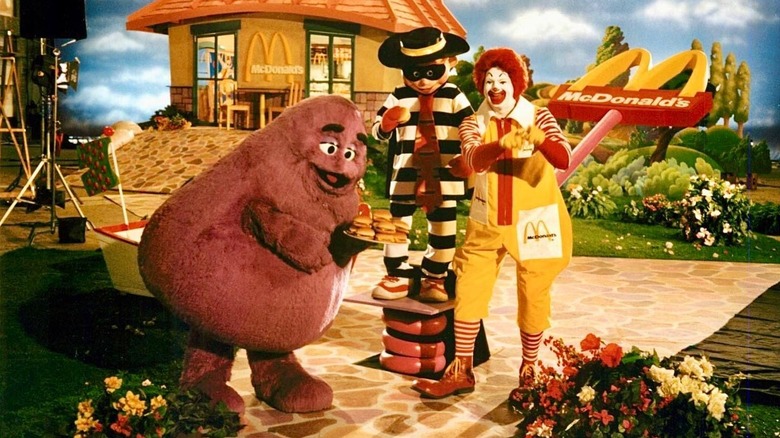
When Ronald McDonald first appeared in the 1960s, he had the spotlight all to himself. That's because sidekicks like Grimace and the Hamburglar had yet to arrive on the scene, and they wouldn't do so for almost a full decade. They debuted as part of McDonaldland, a fictional world introduced in the early 1970s that helped McDonald's appeal to children through a series of whimsical television commercials.
The first McDonaldland television ad aired in 1971, featuring Ronald McDonald leading children through a magical land with apple pie trees, milkshake volcanoes, and hamburger patches. It also introduced the hamburger-headed characters Big Mac and Big Cheese (later renamed Officer Big Mac and Mayor McCheese). Subsequent ads introduced characters like Grimace, the Hamburglar, Captain Crook, and the Gobblins (later renamed the Fry Guys, Fry Girls, and Fry Kids).
While kids in the 1960s never got to experience the antics of the Hamburglar or puzzle over exactly what Grimace is supposed to be, the McDonaldland cast continued to evolve throughout the following decades. Some characters fell off the map, like Mayor McCheese, who had to be retired because a court ruled he was an obvious copy of a character from a kid's show called "H. R. Pufnstuf." Others took on new looks, like the many incarnations of the Hamburglar, and more characters joined the crew, including Birdie the Early Bird and the McNugget Buddies.
5. There were no playgrounds at the restaurants
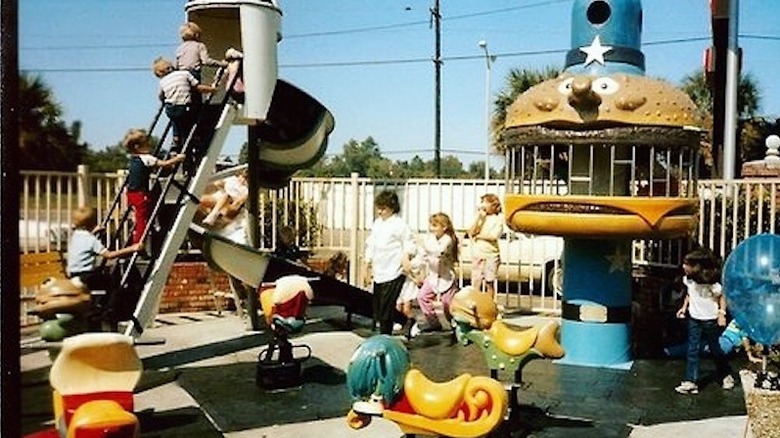
For many people who grew up from the 1970s through the early '90s, a trip to McDonald's wasn't complete without climbing into a caged-in hamburger head or racing down a giant slide. But in the 1960s, kids had to entertain themselves. Remember that this was pre-McDonaldland times, and the company was only just starting to market to families and children. But that would all change in the 1970s when playgrounds began popping up at McDonald's restaurants.
In 1971, McDonald's employed Setmakers Inc., a company that had previously worked on McDonaldland television commercials, to design the first McDonaldland Playland at a restaurant in Chula Vista, California. The playground featured characters from McDonaldland, such as the Hamburglar Swing, the Captain Crook Spiral Slide, and the infamous Big Mac Climber. The playground was a massive hit, and pretty soon, other restaurants were clamoring for their own equipment.
Although McDonald's Playlands (later renamed PlayPlaces) remained popular for decades, they became less common beginning in the 1990s. Safety concerns played a major role. In 1999, McDonald's was ordered to pay $4 million in damages for failing to report playground injuries to the U.S. Consumer Product Safety Commission. More than 400 of those injuries happened on the Big Mac Climber alone, and included broken bones, concussions, and skull fractures. While some McDonald's locations still have PlayPlaces today, many restaurants have shifted their focus to drive-thrus, delivery, and more dining space.
6. Drive-thrus wouldn't arrive until the following decade
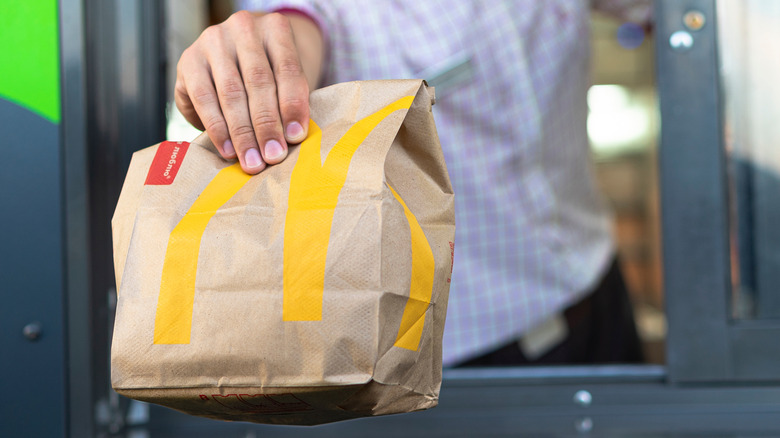
From the beginning, McDonald's was designed with motorists in mind. The first restaurant was modeled after the drive-in restaurants that were all the rage at the time. Around the same time that the Speedee Service System came out, another revolutionary concept was taking off in restaurant chains: the drive-thru. You would think that McDonald's would be quick to jump on that trend, but throughout the 1960s and into the early 1970s, customers still had to park and walk up to the counter to place their orders.
The first drive-thru restaurant was a spot called Red's Giant Hamburg in Springfield, Missouri. Just a year later, In-N-Out Burger implemented drive-thrus and improved the system by adding two-way intercoms. For some reason, though, McDonald's held out until the 1970s, when regional managers began requesting drive-thrus at increasing rates. The company finally relented, and in 1975, the first McDonald's drive-thru opened in Sierra Vista, Arizona.
Interestingly, McDonald's first drive-thru was inspired by the U.S. Army. In the mid-1970s, Sierra Vista franchise owner David Rich realized he was losing money because U.S. Army soldiers at the nearby Fort Huachuca Army Base weren't allowed to be in public in their uniforms. Rich decided to install a sliding glass window at his store so that the soldiers could drive up and order without breaking the rules. That innovation was game-changing for McDonald's, as 70% of all sales in the U.S. now come from drive-thrus.
7. The Filet-o-Fish was a revolutionary new menu item in 1965
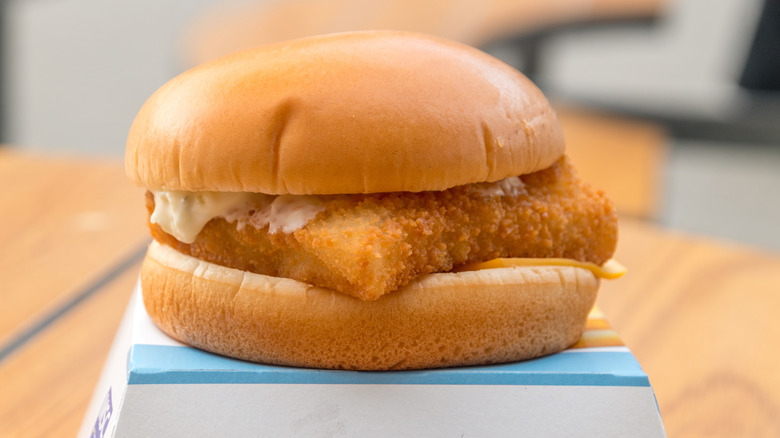
These days, McDonald's launches new menu items every few months, so it's easy to try something new every time you visit. However, customers in the 1960s only had a few items to choose from. Options included hamburgers, cheeseburgers, and french fries, as well as beverages like milkshakes, soda, orange drink, milk, and coffee. The streamlined menu was in keeping with the Speedee Service System, which promised ultra-fast service. That made the arrival of the Filet-O-Fish in 1965 especially noteworthy
The origin of the Filet-O-Fish can be traced to Lou Groen, who owned a McDonald's franchise in Cincinnati, Ohio. In the early 1960s, Groen noticed he was losing money on Fridays, when many of his Roman Catholic customers refrained from eating meat. He suggested adding a breaded fish sandwich to the menu as an alternative to hamburgers. At first, McDonald's was wary, but decided to give it a try, albeit with one stipulation from Ray Kroc.
Kroc had already been thinking about adding a non-beef item to the menu, and his grand idea was the Hula Burger. It featured grilled pineapple and cheese sandwiched between buns. Kroc suggested trialing the Hula Burger and fish sandwich together, and the sandwich that sold the most would make it on the national menu. It may come as no surprise that the pineapple-and-cheese creation was a flop. Only a measly six Hula Burgers were sold, compared to 350 Filet-O-Fish sandwiches, and the latter became a permanent fixture.
8. Breakfast dishes weren't on offer until the 1970s
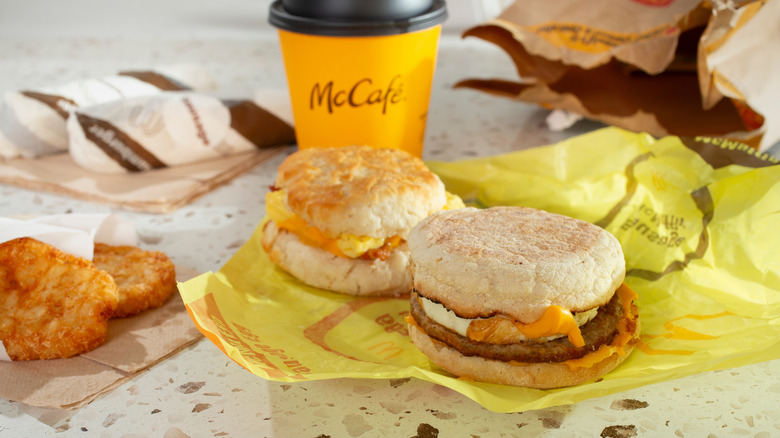
The success of the Filet-O-Fish in the mid-1960s encouraged McDonald's to expand its offerings. In 1968, the company added the Big Mac to the national menu, and the double-decker burger went on to become one of McDonald's most iconic menu items. But if you had a hankering for some McDonald's early in the morning in the 1960s, you were out of luck because breakfast dishes weren't a thing yet. They were, however, just around the corner.
By the time 1970 rolled around, several franchise owners were toying with the idea of offering breakfast items at their restaurants. One Santa Barbara franchisee, Herb Peterson, came up with a breakfast sandwich inspired by Eggs Benedict. It included eggs poached in special Teflon rings, Canadian bacon, and cheese (instead of Hollandaise sauce) in an English Muffin. McDonald's tested it in select markets, and in 1975, the Egg McMuffin officially launched nationwide.
The Egg McMuffin was such a hit that McDonald's quickly realized breakfast could become a major part of its business. In 1977, the company rolled out its first full breakfast menu. Of course, the Egg McMuffin was the star, but customers could also order classic breakfast dishes like scrambled eggs, sausages, hash browns, danishes, hot cakes, and English muffins. Over the years, McDonald's has added a slew of new breakfast items to the menu, including biscuits, breakfast burritos, and its famous McGriddles.
9. Happy Meals were also a thing of the future
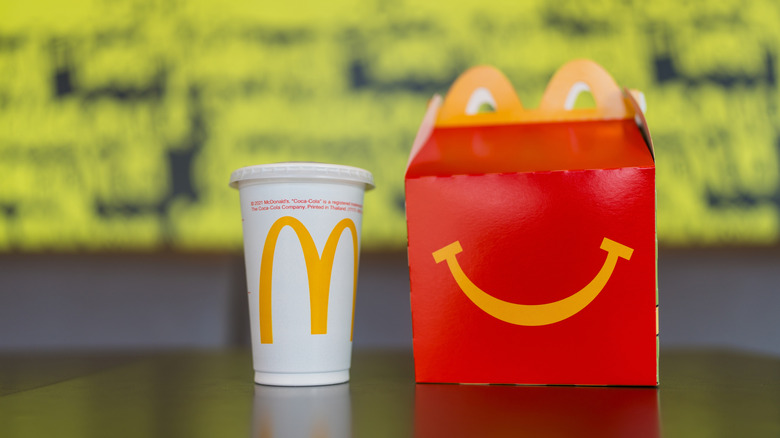
While McDonald's was beginning to market to children in the 1960s, kids still had to order off the main menu just like their parents. There were no special meals that came in brightly colored boxes, no boxes of cookies shaped like McDonaldland characters, and no collectible toys. It would be nearly a decade before McDonald's created the Happy Meal and sparked what would become a national (and later global) obsession.
The origins of the Happy Meal are a little bit hazy because multiple people have laid claim to its creation. One story states that a McDonald's owner in Guatemala named Yolanda Fernández de Cofiño created the meal in 1977. Another story states that Dick Brams, an advertising manager from St. Louis, came up with the concept, and yet another states that an advertising executive named Bob Bernstein was the inventor. Whatever story you believe, what's not disputed is that the Happy Meal hit the national market in 1979.
The first Happy Meals featured a hamburger or cheeseburger, fries, a soft drink, cookies, and a toy in a box featuring Ronald McDonald and friends in a circus wagon. The toys included a spinning top, a McDoodler stencil, and a McDonaldland character-shaped eraser. The toys became the main draw, especially when McDonald's began collaborating with other brands like Star Trek, Disney, and Beanie Babies. Today, the Happy Meals and their toys are still wildly popular with kids and adults alike.