

7 Cream Cheese Brands, Ranked Worst To Best
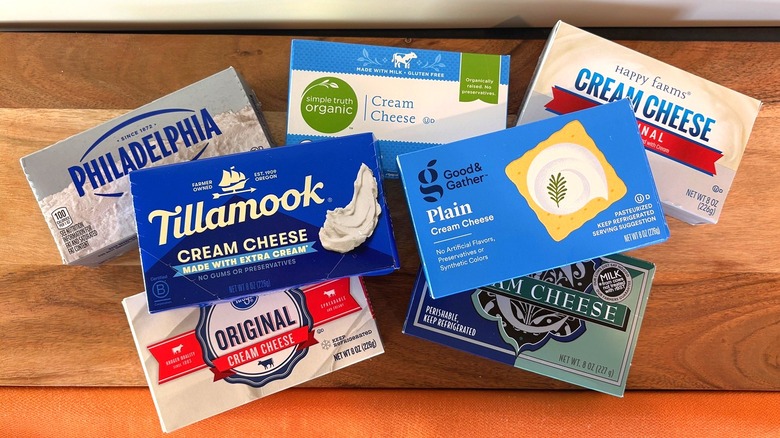
Cream cheese is a refrigerator staple that's right up there with butter, milk, and eggs for me. I can't remember the last time I didn't have some on hand, and I excel at coming up with creative ways to use a leftover block. As a catering cook and frequent happy hour host who prefers appetizers and cupcakes to real dinner, I have softened, spread, whipped, thinned, blended, and melted more than my fair share of cream cheese. Versatile and relatively neutral in profile, cream cheese is ground zero for so many recipes. Sweeten it up, and you've got a dessert. Fold in some onions and it's a dip.
With so many brands on the market (I counted more than a dozen while researching), and with price points between supermarket and name brands being more than double in some cases, the process of selecting a cream cheese for a particular culinary need can be daunting. Because they all look similar in brick form, it's easy to assume there's not much difference between brands, but we at Chowhound believe there are nuances worth noting and a clear winner to choose.
To rank these seven cream cheese brands from worst to best, I conducted a blind taste test using plain, original cream cheese bricks. Prioritizing flavor, I began with a simple smear on a toasted plain bagel. Next, I whipped up mini batches of cream cheese frosting and onion dip (see methodology for more details) to formulate this list.
7. Simple Truth Organic Cream Cheese
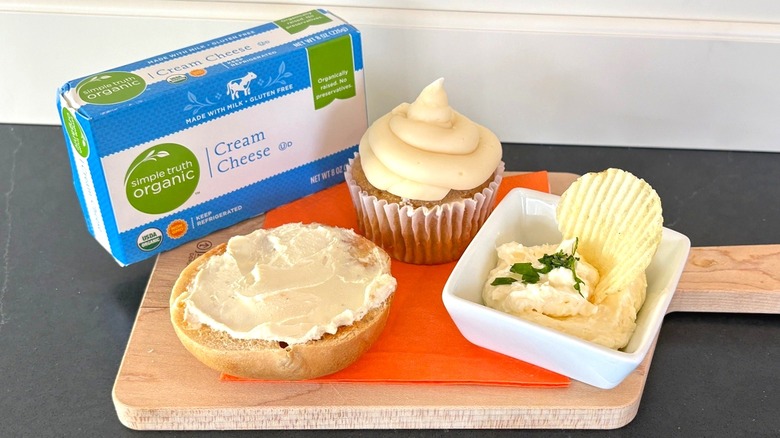
This brick and I got off to a bad start when I tried to slice through the foil wrap with a sharp knife. One of my favorite cream cheese package features is the little hash marks indicating where to score for each ounce. This usually saves a step and spares me a messy measuring cup, but not in this case. Out of the fridge, Simple Truth Organic Cream Cheese was one of the softer bricks I tried, and it decidedly failed my knife test. The foil ripped willy-nilly, and the cream cheese stuck to the inside, so I had to scrape it out and measure it separately. Not a tragedy, but a factor in my ranking, along with its $3.49 price tag.
When I tried a plain smear on a plain bagel – a breakfast staple in my house — I found the flavor lacking tang and the texture gritty. As the only USDA-certified organic cream cheese in my trial, I wanted to like Simple Truth, but I just didn't. When I used two ounces to make frosting, it took some aggressive creaming to incorporate the powdered sugar, and the mixture never really got smooth. Thinking it might be better on a potato chip, I then whipped some into a mini batch of onion dip, but the texture was cottage cheesy, and the dip got watery after sitting out. Lack of taste, odd texture, inflexibility, and price point earned Simple Truth the lowest spot on my list.
6. Good & Gather Plain Cream Cheese
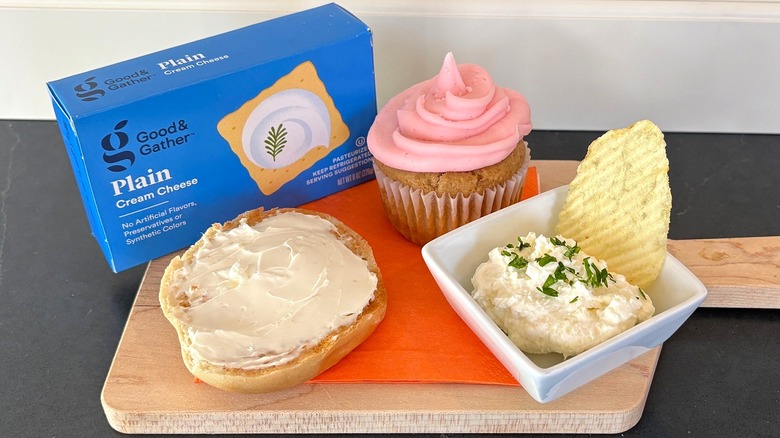
While the foil wrapping on my Good & Gather brick was also flimsy, it was appearance and taste that earned this Target brand cream cheese its second to last rating. Wet on the surface and densely packed, it was filmy on the tongue during my bagel test. It was also more sour and less salty than several of the other brands I tried.
Like most cream cheese products, Good & Gather employs gum polymers to stabilize and gelatinize its components. Created by a process involving bacteria, sugar, and alcohol fermented into a solid form that's then ground into a powder, gum is a non-toxic, natural alternative to the polymer additives formerly used in food processing. Restaurants use it to achieve perfectly thickened sauces, and food manufacturers rely on it for preservation and emulsification. With different gums serving different purposes, they're often combined to achieve the desired effect. And I think that's where Good & Gather's cream cheese recipe misses the mark.
It did not play well with milk or butter during my incorporation tests, forming large curds that were difficult to eliminate both by hand and machine mixing. It also was reduced to a thin, flat consistency when I melted some in the microwave, whereas most of the other brands retained a sturdy, creamy texture.
5. Kroger Original Cream Cheese
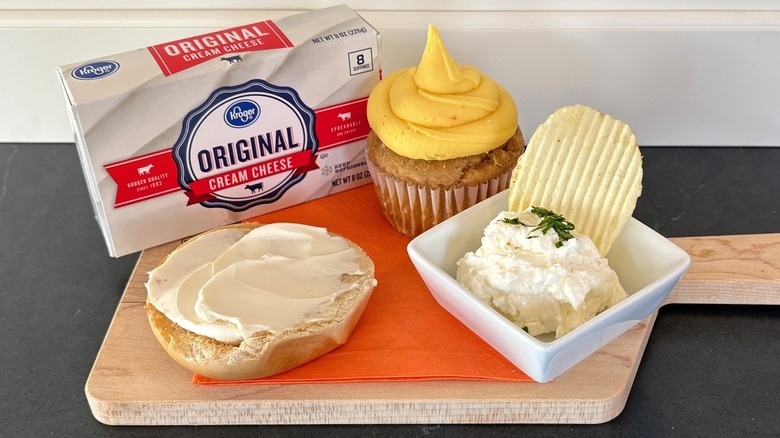
On a bagel, Kroger brand cream cheese had a perfectly neutral flavor, which is a plus at its low price point of $1.50. Neither tangy nor salty, I'd consider it a blank canvas that could go savory or sweet without conflict, and there are plenty of ways to take plain cream cheese to the next level. However, my Kroger brick was the softest right out of the fridge and very sticky. I could not cut through the package with a knife, and it clung to my spoon (and hands, and countertop) rather aggressively.
When mixing up a batch of frosting, the cream cheese and butter repelled each other in a way that I found frustrating. Normally, this is due to the common mistake of using cream cheese that's too cold, but I'd allowed all the cream cheeses an hour and a half on the counter to achieve room temperature safely, and still had trouble getting these two dairy products to combine. With a little elbow grease, I did get them to smooth out and incorporate eventually, but adding the powdered sugar was another challenge, and the frosting didn't pipe cleanly. All things considered, I ranked Kroger cream cheese middle of the pack. As long as you're not making anything fancy or looking for strong flavor, it's fine.
4. Happy Farms Original Cream Cheese
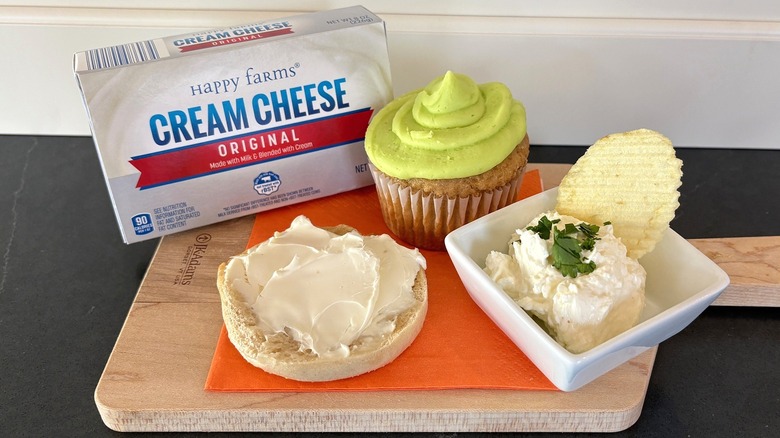
The firmest, squarest brick out of the fridge, Happy Farms was easy to cut and work with, which I appreciated. But it was a little oily on the surface and lacking in creaminess, which turned me off during my blind taste test. Like other Aldi products that are dupes for name-brand versions, Happy Farms cream cheese is an unabashed knock-off for Philadelphia Cream Cheese, but the similarities don't extend much further than the packaging.
With all of the cream cheese brands in my trial containing the 33% milkfat required by the Code of Federal Regulations to be called cream cheese, the nuances between many of these brands are the result of processing and preservation variations. Without getting too nerdy, xanthan gum, guar gum, and carob bean gum additives, as well as cheese whey and clotting enzymes give these bricks their subtle differences. This explains why Happy Farms was a little chunkier than the others and separated slightly during melting and blending.
Another middle-of-the-pack brand that'll work just fine for upgrading a grilled cheese sandwich or adding a creamy, tangy touch to mashed potatoes, Happy Farms has a great price point at $1.65 in my region and makes a fine utility cream cheese.
3. Trader Joe's Cream Cheese
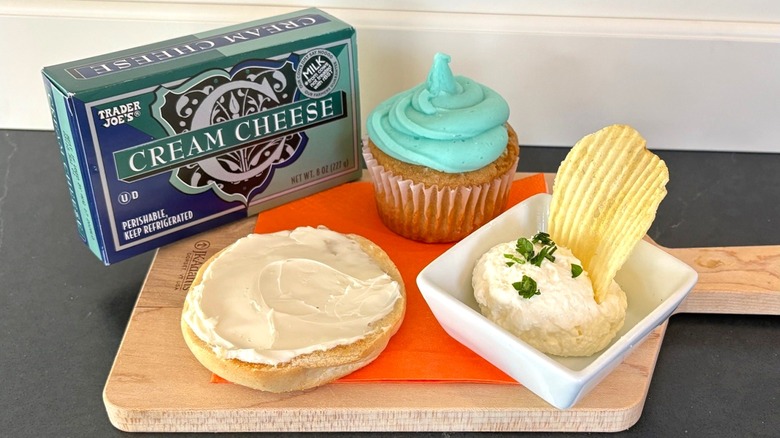
Although I found the texture a little chalky and didn't love it smeared on a bagel, Trader Joe's cream cheese did have a mild, creamy flavor and a little tang. A firm, perfect rectangle in a quality foil wrap, it sliced like a champ and was easy to work with. The package also closed up neatly after opening, instilling confidence that the brick would stay fresh and non-crusty for a full two weeks per USDA guidelines.
Because it melted evenly and held firm under heat, I'd consider this brand a good choice for Alfredo sauce and creamy soups (just make sure to turn the heat down before adding so your soup doesn't become grainy). It also combined with the butter effortlessly during my frosting experiment and whipped up well with a hand mixer, producing a mid-weight texture that piped smoothly from a pastry bag. The hand blended onion dip was hard on my wrist and forearm, requiring a little umph and persistence, and a bit more milk than usual, but it eventually got to an acceptable texture for chip dipping. Despite a few flaws, I think Trader Joe's cream cheese earns a solid spot in the top three.
2. Philadelphia Original Cream Cheese
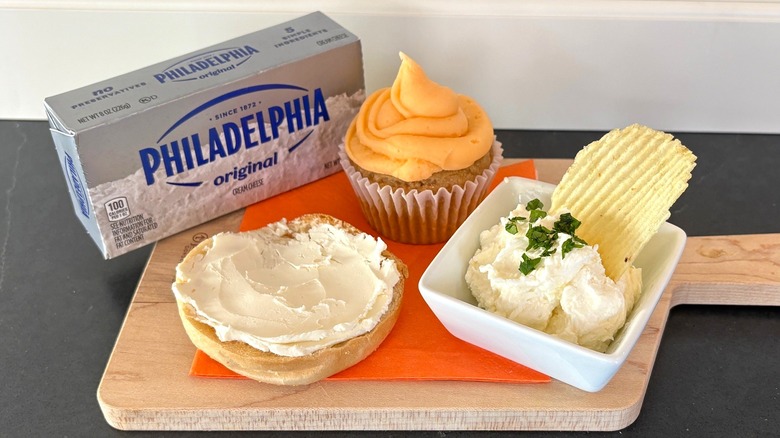
To be honest, I was kind of surprised that my ranking did not produce Philadelphia cream cheese as the clear winner, as it's long been my go-to for no-bake cheesecake, appetizers, and recipes where flavor and texture are important. I always select it to accompany bagels purchased at the supermarket bakery because it's reliably good in its purest form, but a couple of factors landed Philadelphia at number two, rather than number one.
With my top two cream cheeses being by far the creamiest of all the brands sampled and pretty similar all around (including both brands shorting me by about a half-ounce at one end of a less-than-perfect rectangle block), I found Philadelphia to be a little saltier and maybe a little tangier when I tried it plain on a bagel. It was also a little harder to spread when cold and a little higher in price than my number one.
With a cross-section that looked a little like a feta block, it was airier than some of the lower-ranked, claylike bricks and blended seamlessly into both my frosting and dip recipes. It also absorbed powdered sugar quickly and melted into a creamy swirl without separating one bit. The onion dip was ideal, and the frosting piped beautifully onto the cupcake, but my top brand beat Philly by a hair.
1. Tillamook Cream Cheese
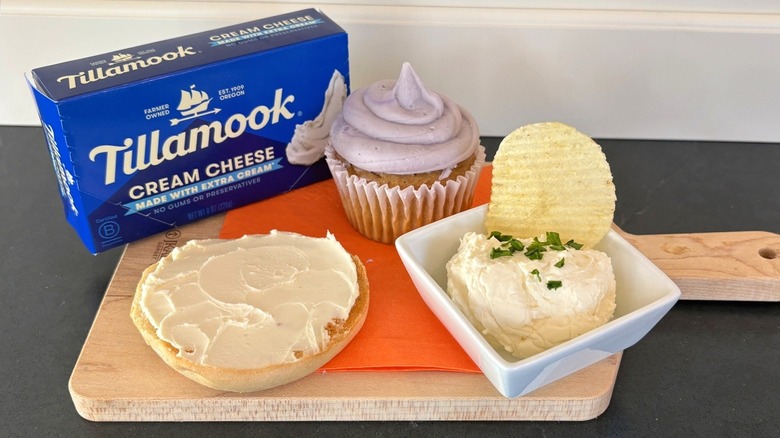
As an Oregon-based, farmer-owned dairy collective that's been producing butter and cream since the 1900s, Tillamook currently manufactures cheese, yogurt, sour cream, and nearly 50 flavors of ice cream, along with spread and block cream cheese. Offering the perfect ratio of tang to sweetness, Tillamook took top honors in my blind taste test and eked out Philadelphia in a few other areas. I like that it spread easily on my bagel and had an airy, almost whipped consistency in brick form. It was also a little sweeter and a little less salty than the runner-up.
A comparison of the ingredients on all the brands I ranked revealed that both Philadelphia and Tillamook have one more gram of sugar and one more gram of fat per serving than the others, which explains why they were both creamier and slightly sweeter. As for key differences, Philadelphia has 10 more milligrams of sodium than Tillamook and 15 more than any of the other brands. Philadelphia also uses carob bean gum, while Tillamook has no stabilizers in its recipe, which might explain why I found its texture and spreadability slightly superior. Tillamook combined effortlessly with other ingredients and melted like a dream into a smooth, creamy swirl, earning it top honors on my list.
Methodology
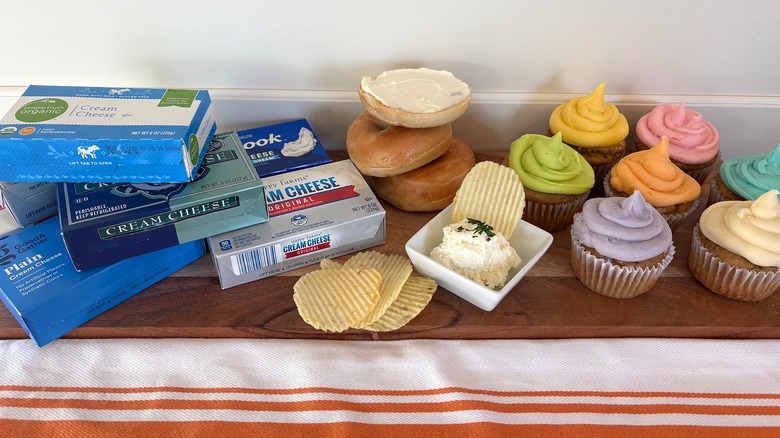
I conducted this ranking by purchasing seven brick-form, plain, original cream cheese products from four different grocery stores. After removing each brick from its outer carton and cutting each brick in half through the foil wrapper, I took detailed notes about each brand's packaging, texture, and appearance. After sectioning off two ounces of each brand for melting, two ounces for making onion dip, and two more for making frosting, I had a colleague smear each cream cheese on a plain toasted mini bagel and record the name of each brand on the underside of individual paper plates. I then tasted each sample and arranged the plates in the order of taste preference, grouping together those that were hard to differentiate by taste alone.
After allowing the samples an hour and a half to reach room temperature, I then used each two-ounce chunk in my go-to recipes for onion dip and cream cheese frosting — creaming by hand at first to judge the manual incorporation and then finishing with an electric hand mixer — taking notes about each brand throughout the process. Price point and nutritional content were also considered.