

10 Irish Foods And Drinks To Seek Out To Get You In The St. Patrick's Day Spirit
As far back as the ninth century, Irish people have paid homage to Saint Patrick, the patron saint of Ireland, on the anniversary of his death — March 17th. The tradition began as a feast day where the rule against eating meat during Lent was lifted, and it evolved into a full-scale celebration with drinking, dancing, and food. When Irish people began immigrating to America, the tradition spread there too and took on a life of its own.
Celebrate St. Patrick's Day in any country other than Ireland, and you'll likely come across lively parades, special dishes like corned beef and cabbage, and green everything, right down to shamrock-hued beer. However, things look a little bit different in Ireland. Sure, you still have parades and parties, but you're not likely to see anyone quaffing green beer. And corned beef is one of those dishes that tourists think is traditional, but locals will tell you otherwise.
To find out what Irish people really eat and drink on St. Patrick's Day, we reached out to several Irish chefs and spirits experts. They shared some of the traditional foods and drinks they enjoy on St. Paddy's Day, many of which are hearty, homey, and deeply tied to the land and long-standing culinary traditions. If you're looking for some authentic Irish dishes to get you into the holiday spirit (or "craic" as it's called in Ireland), these are some foods and drinks the experts say are a must.
1. Full Irish breakfast
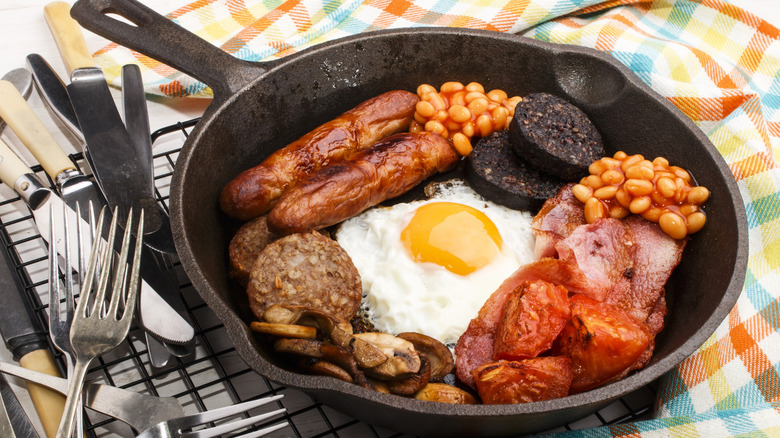
So, it's the morning of St. Paddy's Day, and you know you have a busy day of celebrating ahead. You'll need something hearty to get you started, and nothing fits the bill like a full Irish breakfast (aka a full fry-up). As Scott Hynes, a Dublin-native and chef of O'Toole's Way in New York City, told us, "Its roots stretch back centuries and reflect Ireland's rural heritage, farming culture, and emphasis on hearty, sustaining meals. Originally, it was not a luxury dish but a practical one, designed to fuel workers for long days in the fields."
As Hynes explained, this multi-component meal reflects items that Irish families would have been able to produce themselves and preserve for long winters. Key elements include bacon rashers, plump sausages, black pudding made with pork blood, white pudding (no blood), eggs, and potatoes in some form. Additional sides can include mushrooms, tomatoes, and baked beans. Brown bread or soda bread is also often on hand to mop up the runny yolks and juices.
You'll also need something to help wash everything down, and for that, Hynes told us tea is the way to go. He said, "A full Irish is almost always accompanied by strong black tea. The hot tea helped cut through the meal's richness and offered comfort on cold mornings." Look for Irish tea, as it's renowned for being robust thanks to the inclusion of Assam black tea leaves from the Assam Valley in India.
2. Irish coffee
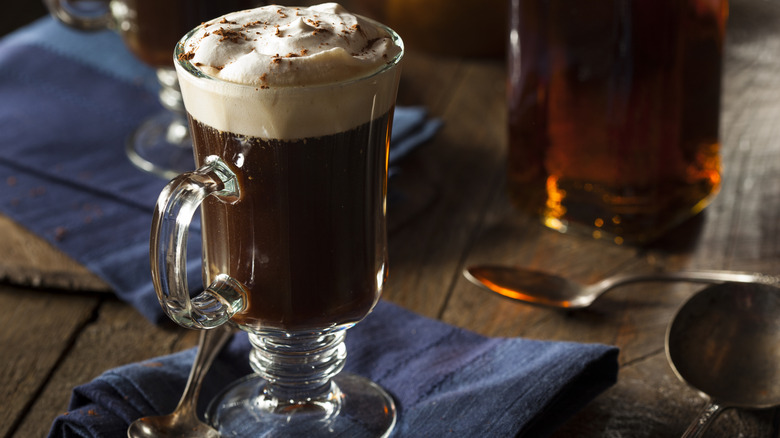
Kevin Pigott, global ambassador for Tullamore D.E.W. Irish Whiskey, is also a huge proponent of the full Irish breakfast, which he calls "one of our strongest cultural food rituals." And if you want to take your full fry-up to the next level, he recommends adding an Irish coffee. He said, "The pairing of an Irish breakfast with an Irish Coffee sets you up for a good day, well-fed and ready to have the craic (Irish for fun) with all your best friends."
Legend has it that the first Irish whiskey was created at Foynes Airport in Limerick in 1943. After bad weather grounded a flight, the airport restaurant's chef, Joe Sheridan, decided to create a round of drinks for the stranded passengers to warm them up. He brewed hot coffee and added Irish whiskey, brown sugar, and a dollop of cream on top. The drink was a huge hit and would go on to earn international fame.
Though the ingredients are pretty simple for an Irish coffee, there is an art to making a great one. A key step that many people skip when making Irish coffee is preheating the glass. Ideally, you want a tall glass mug. Just add hot water, then pour it out when your coffee is ready. Pour the coffee in, add a spoonful of sugar, and stir to dissolve the sugar. Then, add the whiskey and give it another stir. Finally, gently add the whipped cream so that it floats on top.
3. Soda bread
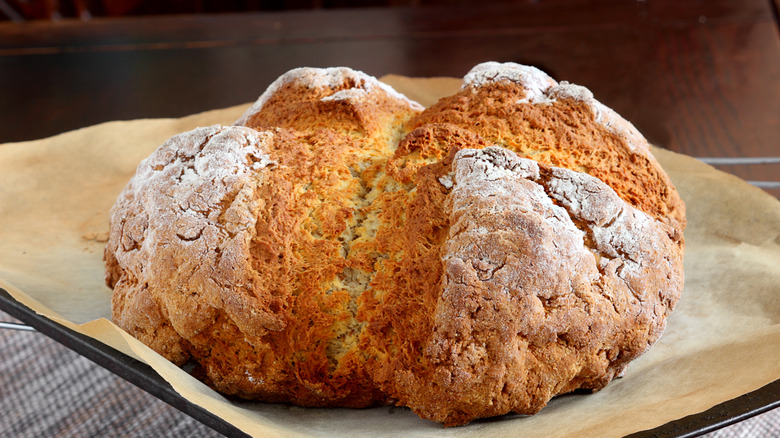
If there's one dish that's pure nostalgia for numerous Irish people, it's soda bread. Many of the chefs we spoke to have fond memories of eating it from the time they were young. Soda bread is a quick bread, which means it doesn't contain yeast. It's made by mixing flour and salt with baking soda and buttermilk, which act as rising agents. It's a simple dish, and that's exactly what makes it so comforting.
In the United States, "Irish" soda bread often includes sugar and raisins. However, Teague Smith, chef of Nine Fine Irishmen at New York-New York Hotel & Casino and a driving force behind the St. Patrick's Day Festival in Las Vegas, told us that's not exactly Irish. He said, "I think people are always surprised to learn that true Irish soda bread isn't the sweet, raisin‑studded loaf they see around St. Patrick's Day. In Ireland, it's usually a hearty brown bread made with whole meal flour and buttermilk, so it's tender, nutty, and not overly sweet."
Smith also told us that soda bread isn't just a St. Patrick's Day treat. "It's the kind of bread you eat daily, not just once a year," he said. The crusty exterior and nice crumb make soda bread the perfect vessel for sopping up sauces, so it's a great accompaniment to the full Irish breakfast, as well as saucy stews and soups. It's also great on its own, slathered in creamy butter and paired with a cup of tea.
4. Lamb stew
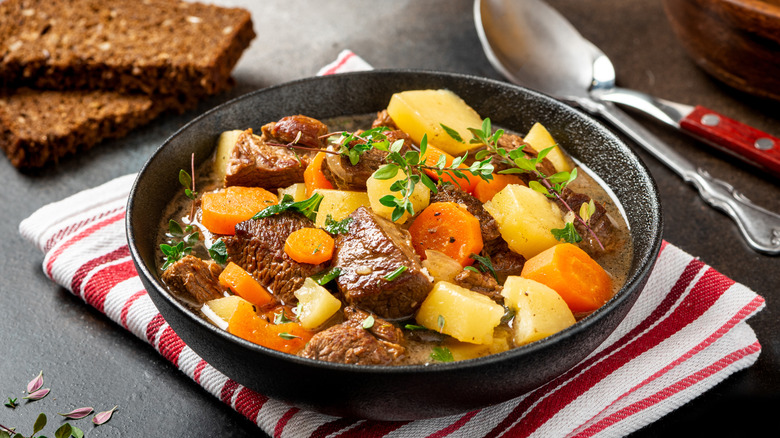
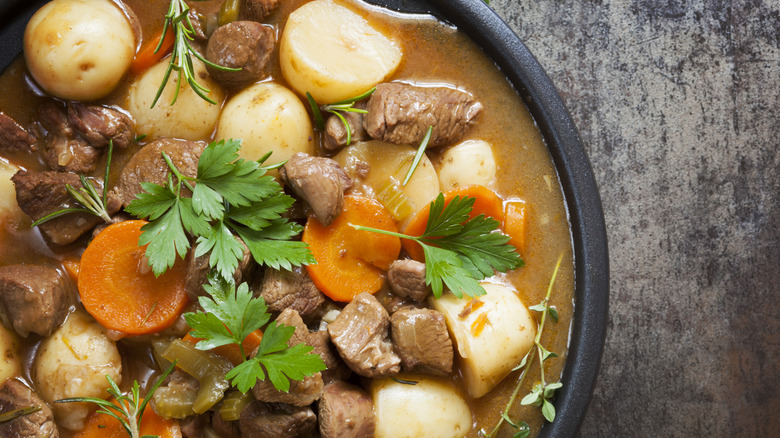
Looking for a hearty and traditional main to make for dinner on St. Patrick's Day? Mark Trimble, a native of Lucan and executive chef at Omaha Steaks, highly recommends a classic Irish lamb stew. "This one-pot meal is the epitome of Irish comfort food," he said, adding that it's a staple in pubs and homes across Ireland. It's a dish with a long history, as people in Ireland have been farming sheep for meat, milk, and wool for centuries.
A good lamb stew isn't overly complicated to make, but it does take some patience. The payoff is well worth it, though, according to Trimble. He said, "The lamb or mutton is slow-simmered until it is fork-tender, adding a blend of carrots, onions, thyme, and potatoes, creating a deeply rich base that is simply unforgettable." Add some soda bread or brown bread for dunking, and you have a filling and flavorful meal.
Traditionally, lamb stew was made with mutton, which is the meat from an older sheep. That's because the younger sheep were saved for their milk and wool. However, now it's common to see lamb used, particularly the neck or shoulder cuts, which have a decent amount of fat that cooks down nicely in the stew. If you can't find lamb, you can always substitute beef. In fact, that's what Irish immigrants in America did, as beef was more plentiful in their new home. As for adding Guinness to create a Guinness beef stew, that's also a modern adaptation.
5. Colcannon
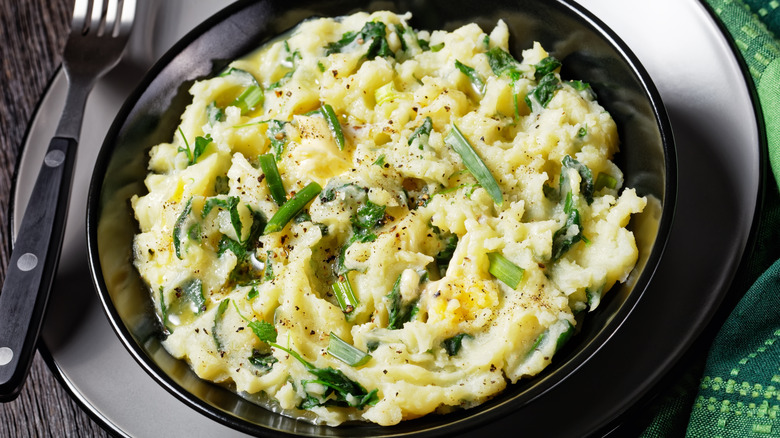
When it comes to side dishes for a St. Patrick's Day feast, potatoes are a natural choice. After all, as Scott Hynes told us, "The potato has been the cornerstone of Irish cuisine since the 16th century." Although it's not entirely clear how the potato arrived in Ireland, some historians believe it may have happened after a Spanish ship became grounded on Ireland's shores in the late 1500s. From there, the starchy tuber became ingrained in Irish cuisine, and one potato dish that's still wildly popular to this day is colcannon.
Colcannon is a mashed potato dish that some say tastes like sour cream and onion chips. It consists of boiled and mashed potatoes mixed with butter, sautéed kale, cabbage, and scallions. Chef James Gabriel Martin of Leviathan Food told us, "The key is to use potatoes that won't be wet or claggy and make sure they are mashed to perfection so that they are soft and velvety. Add a lot of butter, a shocking amount, and then of course the vibrant sautéed cabbage, kale, and scallions bring the whole thing to another dimension."
Interestingly, colcannon also used to be associated with Halloween in Ireland, which may not be so surprising considering Halloween comes from the Celtic festival of Samhain. One tradition involved adding items like coins, buttons, or rings inside the colcannon to predict the future. Each item had a different meaning, and whatever item you received in your portion would tell you what you could expect for the coming year.
6. Irish boilermaker

The tradition of drinking green beer on St. Patrick's Day is entirely an American creation. It can be traced back to a doctor named Thomas Curtin, who served it at a St. Patrick's Day celebration in the Bronx in 1914. It took off like wildfire in the States, but it's not something you'll likely ever see in Ireland. In the motherland, you'll find pub-goers sipping unadulterated pints of brews like Guinness, Smithwick's, and Kilkenny. And if you want to do like the locals do, make it a boilermaker.
A boilermaker is simply a beer served with a shot of whiskey on the side. And according to Kevin Pigott, it's a match made in heaven. "This is one of the oldest drinking traditions in Ireland, having a beer alongside your whiskey," he said. "It acts as a way to prepare the palate for a whiskey by first introducing some delicious beer flavors into the mix." He noted how the maltiness of the beer can accentuate the fruit flavors of the whiskey, especially when sipped slowly in tandem.
Of course, Irish whiskey is a must for an Irish boilermaker. Irish whiskey is typically made with unmalted barley that's triple distilled. You can opt for a classic blended whiskey like Tullamore D.E.W. or a single malt like Bushmills. James Gabriel Martin also recommends trying a single pot still Irish whiskey from Boann Distillery. Single pot still whiskies are unique to Ireland, and they include malted and unmalted green barley, which gives them an extra kick of spice.
7. Boiled bacon and cabbage
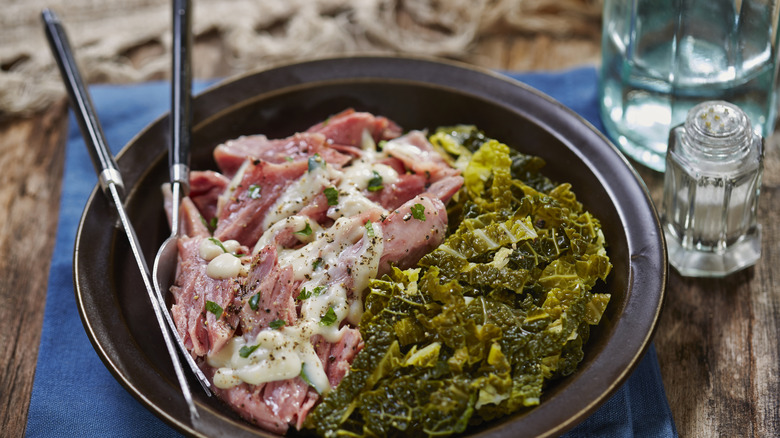
Corned beef and cabbage is another St. Patrick's Day tradition that's more tied to the United States than Ireland. Traditionally, cattle in Ireland were kept for their milk and to do work on farms. And although Ireland did have a tradition of exporting corned beef to countries in Europe and the Americas during the 17th century, the average person couldn't afford to eat beef, salted or otherwise. Pork was the go-to meat in many homes, and boiled bacon and cabbage was a popular combo.
To this day, boiled bacon and cabbage is a staple in many Irish homes, and it may have been that way in the States, too, had it not been for scarcity. Scott Hynes explained, "The Irish immigrants couldn't find it here when they arrived on boats over a century ago, and had to settle for the closest thing possible, which is how corned beef was added to the cuisine." In New York City, where many Irish newcomers settled, salted beef was abundant at Jewish shops and delis, and that's how it came to be an Irish-American tradition.
If you want to try your hand at making Irish boiled bacon and cabbage at home, look for back bacon. It's leaner than regular streaky bacon and typically comes in thick slices. Simmer the bacon first until just about done, then add shredded cabbage to the mix and cook until both are done. The dish is often served with a creamy parsley sauce.
8. Boxty
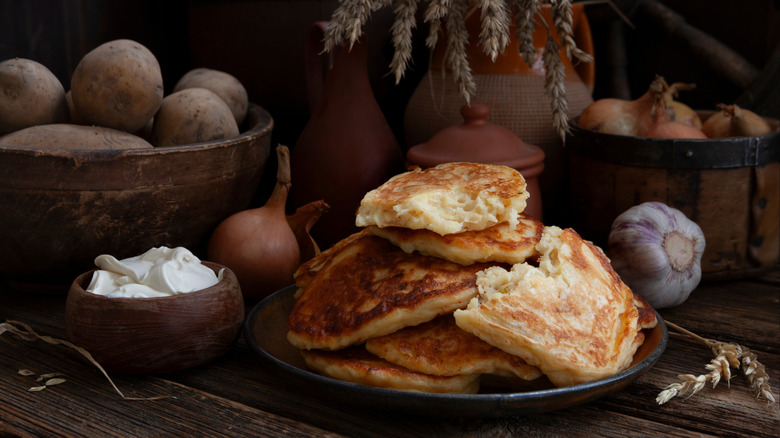
There are many preparations for potatoes in Ireland, and one of the most traditional is boxty. As James Gabriel Martin explained, "Once an integral part of Irish life at one time, an old turn of phrase warns, 'Boxty on the griddle; boxty on the pan. If you can't make boxty, you'll never get a man!'" The dish likely originated in Northern Ireland in the 1700s, and it's best described as an Irish potato pancake. However, there are several things that set it apart from other versions, like latkes and rosti.
Mark Trimble told us, "What makes it special is that the batter combines both finely grated raw potato and cooked mashed potato." He went on to explain that the potatoes are then mixed with buttermilk and flour and pan-fried until golden brown. "The result is a pancake that's crispy and slightly textured on the outside but soft and fluffy on the inside, showcasing the versatility of the potato in a single dish," he said.
Boxty is a great choice for St. Patrick's Day because it's always been somewhat of a celebratory dish. For example, Martin explained that it was traditionally served during the Celtic pagan festival of Imbolc (now rebranded to celebrate Ireland's matron Saint Brigid) to pay homage to the coming of spring, rebirth, and fertility. But you really don't need a special occasion to enjoy boxty, as it's pretty easy to make and works well with a wide variety of dishes any time of day.
9. Dublin coddle
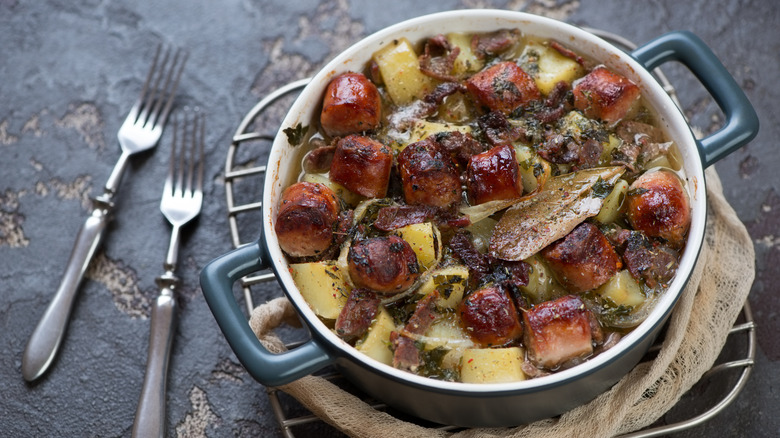
While many Irish dishes have become island-wide classics, there are also some regional creations that are worth considering for a St. Patrick's Day feast. One that Scott Hynes grew up with is traditional Dublin coddle. At its essence, it's a working-class dish that consists of whatever is on hand, simmered low and slow in a pot or slow cooker.
Recipes for coddle vary depending on family traditions or whatever ingredients happen to be in the fridge and pantry at the time of cooking. However, there are a few ingredients that often make it into the pot. These include onions, bacon rashers, sausage, and potatoes. Other additions might include carrots, leeks, and fresh herbs like parsley. Basically, the ingredients go into a pot with water, and everything is slow-cooked until tender and flavorful.
Coddle is the perfect meal around St. Patrick's Day because it's hearty and warming, so it's a great way to ward off late winter chills. It's also a great hangover helper because it's meaty and starchy. Plus, you don't have to put in too much effort to make it, which is key on those post-party days. And if you want to add a little hair of the dog, you might consider throwing some beer into the mix as it simmers away.
10. Bread and butter pudding
When we asked Teague Smith if there were any sweet treats that should make it into a celebratory Irish spread, he told us, "In Ireland, St. Patrick's Day isn't really a dessert‑driven holiday, but you'll see the same traditional treats people enjoy year‑round. A slice of apple tart with custard or a cozy bread and butter pudding is much more common than the themed green desserts you notice in America. It's all about comforting, familiar flavors."
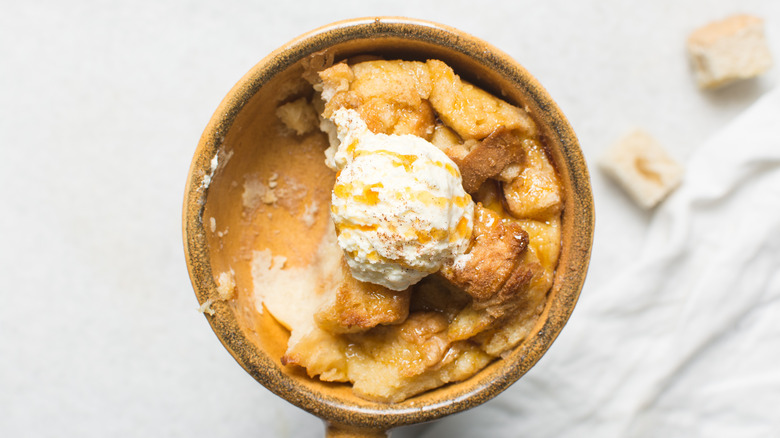
Several other chefs also mentioned bread and butter pudding as a favorite after-dinner treat because it's easy to make with just a few ingredients and ultra-homey. A basic recipe calls for sliced bread (several varieties of bread work well for bread pudding) spread with butter and placed in an ovenproof dish. Then, you heat up some milk on the stove and whisk in eggs, sugar, and vanilla. Pour the milk mixture over the bread and bake until the top is golden and the center is just set, but still custardy.
Another appealing aspect of bread and butter pudding is how versatile it is. You can add raisins or nuts for textural variation and sprinkle the bread with cinnamon and brown sugar. You can serve it with a scoop of ice cream for a beautiful contrast between warm, bready pudding and cool, creaminess. You can also top it with whipped cream, sticky toffee sauce, or fresh berries.