

10 Types Of Burritos You Can Find In Mexico And The US
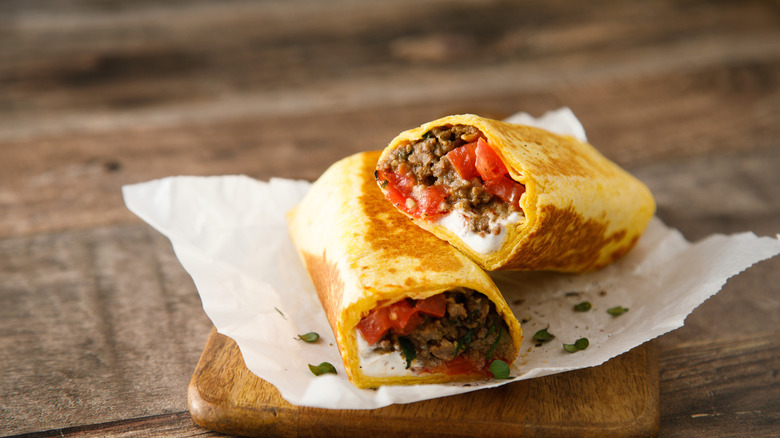
It's hard to think of a more perfect handheld meal than the burrito. You get a thin flour tortilla topped with various ingredients, then rolled into a neat package that you can easily eat on the go. Plus, the burrito is incredibly versatile. Like its cousin, the taco, a burrito can include pretty much anything you want in it, provided it's all wrapped up in a flour tortilla. And that's exactly why the dish has taken on so many forms.
Most sources point to Northern Mexico as the birthplace of the burrito, specifically the states of Sonora and Chihuahua where wheat is a staple crop and flour tortillas are common. The name translates to "little donkey," which may refer to the way the meal was transported back in the day. Those early burritos likely contained just a few basic ingredients like beans and meat or cheese, and you can still find this style in Mexico today. But as the dish spread, it began adapting to new ingredients, regional tastes, and expectations around portion size.
When I first moved to Mexico, my basic understanding about burritos came from what I had experienced in Canada and the U.S. That is to say, a flour tortilla wrapped around meat, cheese, beans, veggies, and rice. Perhaps some guacamole, sour cream, and salsa too. If you've eaten at Chipotle or Qdoba, you know the drill. But I've come to realize that burritos vary vastly in different regions. If you're looking to expand beyond the version you're used to, these are several styles of burritos you'll find in Mexico and the U.S.
Burro percherón
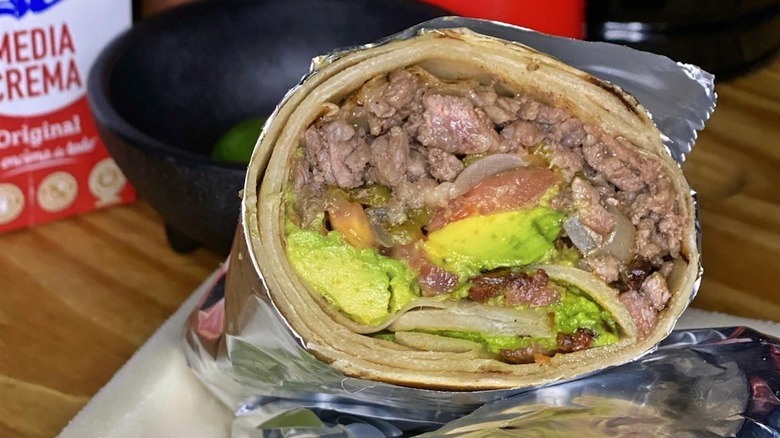
While burritos can be found throughout Mexico, they're more common in the Northwestern states, where they're often much smaller and thinner than what you find in the U.S. However, one exception is the burro percherón, a mighty-meat-filled creation that can reach lengths of 20 inches and weigh up to two pounds. Inside the expansive flour tortilla, you'll find a mix of seasoned and grilled carne asada, diced tomatoes, avocado, and mild cheese like queso Chihuahua.
This monstrous burrito became popular in the state of Sonora in the 1980s and 1990s, and now you can find it in many other places, including neighboring Chihuahua and even some spots in the United States. It's named after the Percheron horse, which is known for its hefty size. As for the burro part, that's the term many Norteños (Northerners) use for burritos, which is fitting considering it refers to a full-sized donkey as opposed to a little donkey.
To construct a burro percherón, the first thing you need is a sobaquera, a huge flour tortilla that's stretched thin by hand. Carne asada is the most common meat used in the filling, but there's nothing to say you can't use other proteins like chicken or carnitas (slow-cooked pork). In addition to avocado and tomatoes, some people add onions and chiles, and many top the burrito with salsa and crema. You can also find versions wrapped in bacon or drowned in sauce.
Mission burrito
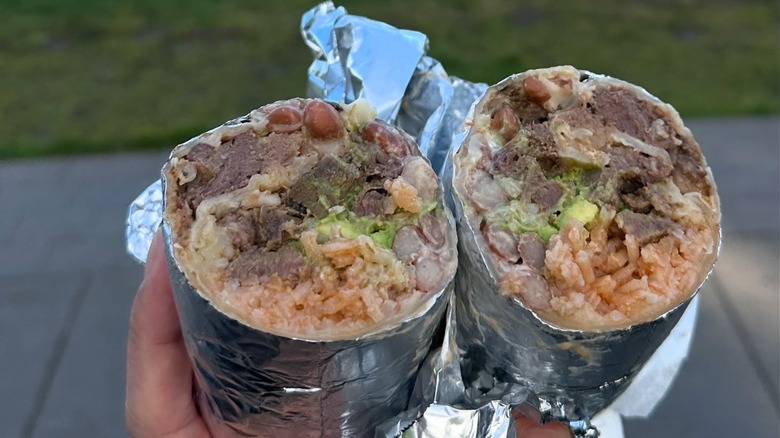
If you're from the United States, you're probably familiar with the Mission burrito. Like the burro percherón, this burrito is ultra-bulky and packed with meat and cheese, along with rice, beans, guacamole, pico de gallo, and sour cream. The meat can include anything from carne asada to carnitas, and you can also leave the meat out altogether for a vegetarian version. Everything gets rolled up in a flour tortilla, then the burrito is wrapped in foil to keep everything in place.
By most accounts, the origin of the Mission-style burrito is a spot called El Faro in San Francisco's Mission District. The story goes that back in 1962, owner Febronio Ontiveros was tasked with creating extra-large burritos to feed local firefighters, so he doubled up on the flour tortillas for each burrito. The ultra-filling meal was a hit and others soon began to follow suit. Now, you can find multiple variations, including "dorado-style" burritos that are griddled to make the outside crispy and golden.
Interestingly, the Mission burrito was the inspiration for Chipotle Mexican Grill. Chipotle founder Steve Ells spent some time in San Francisco after graduating from the Culinary Institute of America, and that's where he became enamored with the city's iconic, customizable burritos. He took the concept to Denver, Colorado, and in 1993, Chipotle was born. Thanks to the chain's colossal success, this style of burrito is now what many people picture when they hear the word "burrito."
Burrita de mariscos
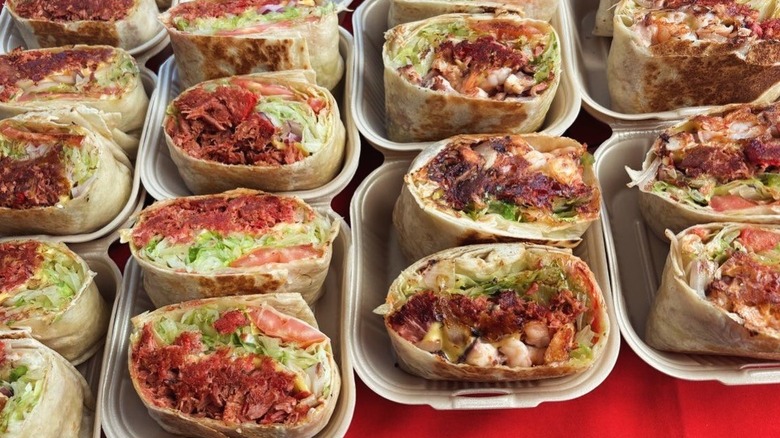
You can't visit Puerto Vallarta without trying burritas de mariscos. Located on Mexico's Pacific Coast, the resort town is famous for its fresh seafood, and one of the most popular ways to enjoy it is in a burrita (essentially a burrito that's folded instead of rolled). But don't expect your typical seafood burrito with rice and beans. These coastal creations are cheesy and creamy, packed with succulent seafood and fresh veggies, and griddled until crispy and golden on the outside.
The restaurant Tacón de Marlin popularized burritas de mariscos in Puerto Vallarta over 25 years ago, and now they're among Mexico's most iconic seafood dishes. The small chain has locations in Puerto Vallarta and Guadalajara, plus there are plenty of other places that emulate the style all along the coast. The smoked marlin burrita is the star of the menu, but you can also opt for shrimp, crab, octopus, sea bass, or mixto burritas that include a mix of various types of seafood.
The secret to these ultra-craveable burritas is all in the preparation. The seafood goes onto a griddle with sliced red onions and sliced American cheese. Once everything is cooked and the cheese is melted, it's all piled onto a flour tortilla and topped with lettuce, tomatoes, house-made ketchup, and mayo. Then, the tortilla is folded into a square and slapped on the griddle to crisp up. The final step is to slice the burrita in half and griddle the cut edges for extra char and caramelization.
California burrito
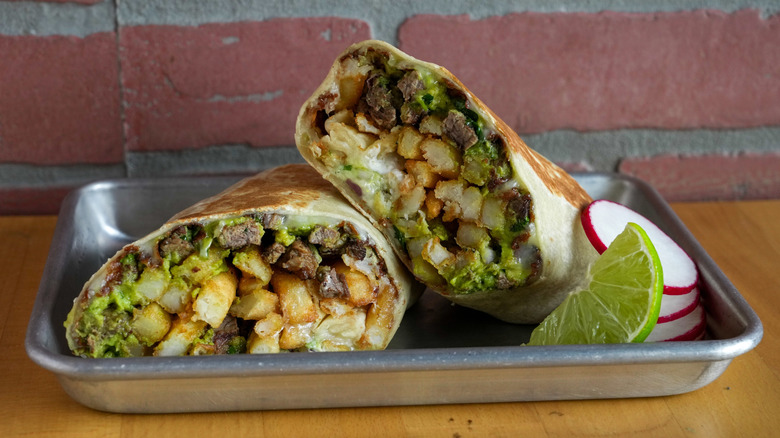
Like the name suggests, the California burrito hails from the Golden State and it's the perfect mash-up of Mexican and American flavors. It starts with a large flour tortilla that's piled with carne asada, Monterey Jack or cheddar cheese, guacamole, pico de gallo, sour cream, and french fries. The addition of fries might seem somewhat odd, but folks from Southern California will tell you they're great for soaking up moisture and adding extra texture and flavor.
Although there is some dispute over exactly who created the first California burrito, we do know that it was born in San Diego sometime in the 1980s. Some say it came about at Lolita's Mexican Food thanks to a customer who would often order a carne asada burrito and stuff fries into it. Others say it was created at a restaurant called Santana's. When popular chain Roberto's Taco Shop added it to the menu, the dish really took off.
Today, you can find countless spots in San Diego that serve this carb-tastic creation. The ingredients are pretty much the same, although there are slight variations, like versions without pico de gallo and guacamole. You can also find California breakfast burritos with eggs, breakfast meats like sausage and bacon, and fries or diced potatoes. Venture outside of San Diego, though, and the California burrito isn't nearly as ubiquitous. In many parts of the country, some might confuse it with the Mission-style burrito thanks to the Chipotle effect.
Burrito de guisado
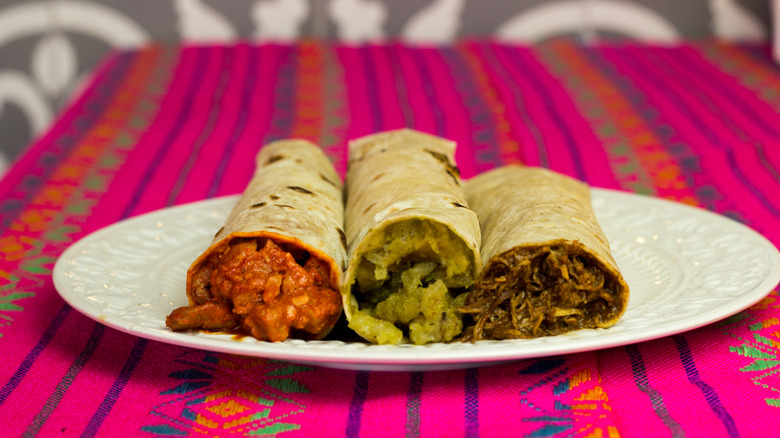
Bunyanesque burritos may be the norm in the many parts of the U.S. and a few small pockets of Mexico, but the majority of burritos south of the border are much simpler affairs. Often, they simply consist of a flour tortilla filled with some sort of guisado, which is a stew-like dish featuring meat, vegetables, or both slow-cooked and simmered in a sauce. Burritos de guisados are usually rolled thin so that they're easy to eat and carry.
The beauty of guisados is that there are so many styles to choose from. Depending on the restaurant or food stand you visit, you might find chicharron in a vibrant salsa roja, shredded chicken in tomatillo-infused chile verde, or rajas con crema featuring roasted poblanos cooked in a cream sauce, sometimes with chunks of potatoes. Chile colorado (a stew featuring beef in red chile sauce) can be considered a type of guisado, as can chicken tinga.
Beyond the variety of fillings, burritos de guisado are also popular for practical reasons. Tacos de guisado are one of the most popular taco styles across Mexico, but their saucy fillings can make them messy to eat and tricky to transport. Wrapping that same stew inside a flour tortilla turns it into a compact, portable meal that holds up on the walk to work, during a school break, or anywhere you need something filling that won't spill down your arm.
Breakfast burrito
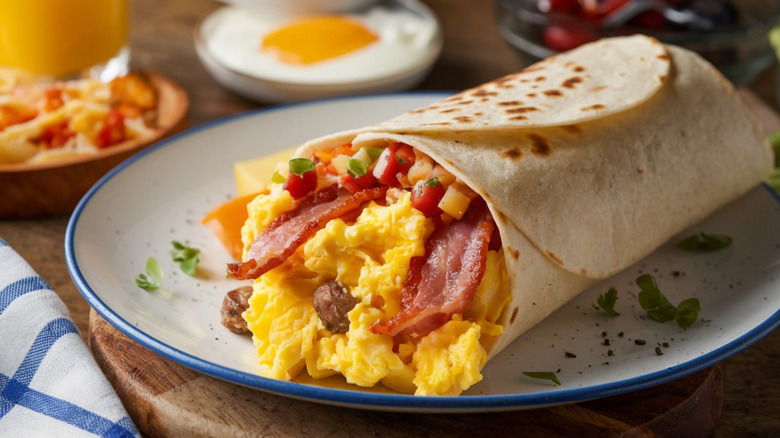
Unlike some burrito styles tied to a single city, the breakfast burrito is everywhere. It's a staple at diners, brunch spots, mom and pop shops, and even fast food chains throughout Mexico and the U.S. You might think it was one of the earlier burrito styles to emerge, thanks to its simple ingredients (at its most basic, it can simply include scrambled eggs wrapped in a flour tortilla). However, it's actually a relatively modern creation with roots that can be traced to New Mexico.
Legend has it that the breakfast burrito first made its appearance at a restaurant in Santa Fe, New Mexico, called Tia Sophia's in 1975. To be fair, the Santa Fe New Mexican noted that the idea of wrapping breakfast foods in tortillas was nothing new in the state, but that Tia Sophia's co-founder, James Maryol, was the first to name it a breakfast burrito and serve it in a restaurant setting. The dish was a hit and would go on to become beloved around the world.
It's easy to see why the breakfast burrito is so popular. For one, it can be as simple or super-stuffed as you want, with fillings like eggs, cheese, potatoes or hash browns, bacon, chorizo, peppers, onions, and more. You can also slather it with salsa or give it a healthy dollop of guacamole or sour cream. Plus, as long as it's not covered in saucy toppings, it's easy to hold in one hand, whether you're sitting down with coffee or heading out the door.
Burrito de chile relleno
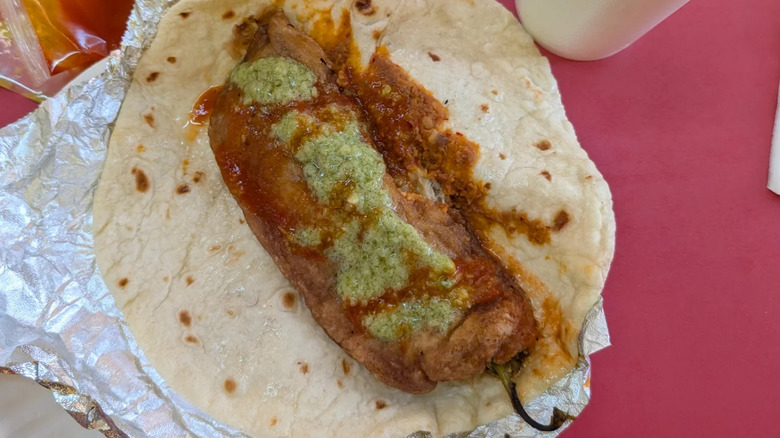
In the Mexican state of Chihuahua, burritos are a big deal. In fact, some say they were created in the city of Juárez, although it's hard to say for sure. The town of Villa Ahumada is famous for its burrito restaurants and stands, and one of the most popular styles you'll find there is the burrito de chile relleno. Simple, but packed with satisfying textures and flavors, it features a roasted chile that's stuffed with cheese, battered, fried, and rolled in a flour tortilla.
The burrito de chile relleno is a great representation of Chihuahua-style cuisine because it combines local and foreign influences. Chiles are native to Mexico, and the flour tortilla was created in the north. Then you have the queso Chihuahua, also called Mennonite cheese because it comes from the community that settled in the region over a century ago. The cheese is mild and creamy, and it melts easily, making it the perfect filling for a chile relleno.
Also sometimes called a burrito Norteño, the burrito de chile relleno starts with a large green chile, usually an Anaheim or chile güero. The chile is roasted, and the blackened skin is scraped off, then it's slit open and filled with queso Chihuahua. The stuffed chile gets dunked into a simple batter of eggs and flour, then it's fried until crispy and browned. Finally, it's rolled up in a flour tortilla, sometimes with refried beans and salsa.
Chimichanga
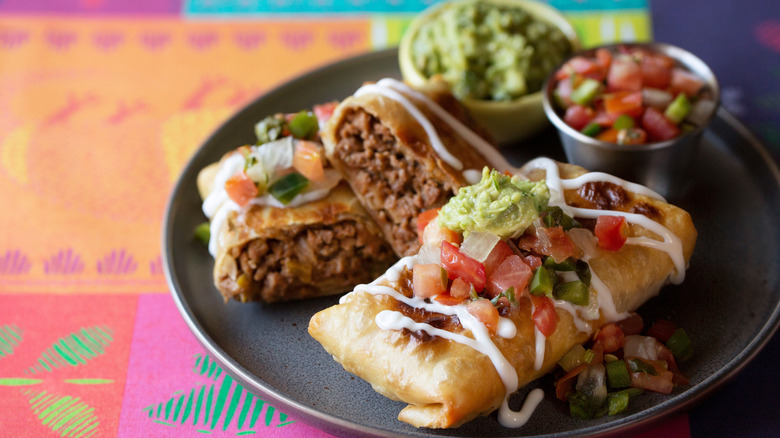
Crispy and golden on the outside and filled with all manner of tasty ingredients, the chimichanga is a Southwestern favorite. It may look slightly different than your average burrito and sport a different name, but don't let that fool you — the chimichanga is really just a burrito that's deep-fried. Think of it like a dorado-style burrito, but instead of a light griddling, it gets a full-on fry for a crunchy outer shell.
The chimichanga has a much-debated origin story. One theory states that Monica Flin of El Charro restaurant in Tucson, Arizona, created it in the 1920s after accidentally dropping a burrito into the deep-fryer. Apparently, she was about to curse in Spanish, but then changed course and shouted out the nonsense word "chimichanga" instead. Others say restaurant owner Woody Johnson created it at Woody's El Nido in Phoenix, Arizona, a few decades later. Some also believe it may have been invented in Mexico.
Regardless of where or when it originated, the chimichanga has endured as a delicious and highly adaptable dish. Typical fillings include meat, beans, rice, and cheese, although you can experiment with pretty much anything you like. You can stuff the flour tortilla to the max and top it with pico de gallo, sour cream, and guacamole, or make smaller versions to serve as party snacks. The only real rule is that the chimichangas should be made with tightly wrapped flour tortillas so the insides don't fall out while frying.
Burrito de machaca
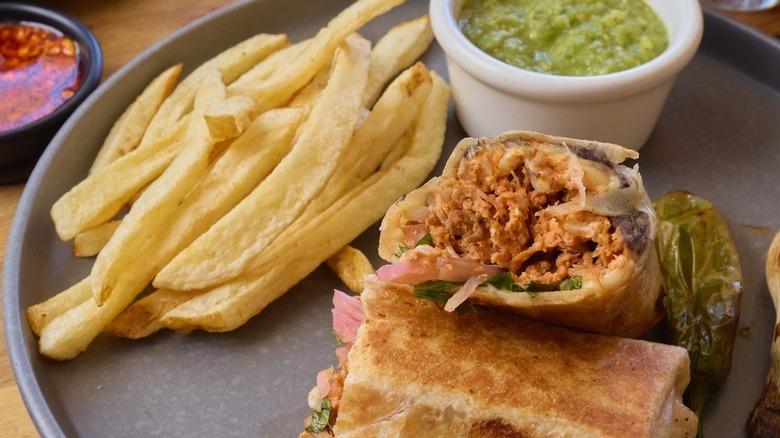
One of the reasons that burritos really took off in northern Mexico was their portability. This was particularly appealing to vaqueros (cowboys) as they could carry these handheld meals in their saddlebags as they were out on the land tending to cattle. Ingredients that could withstand long days in the heat were especially valuable, which helps explain the popularity of machaca. Made from beef that's salted, marinated, and dried to preserve it, machaca can be stored for extended periods before being pounded into fine shreds
Machaca is very popular in Northern Mexico, but harder to find outside the country and even in some other Mexican states. However, it's pretty easy to make at home. All you need to do is marinate beef (any cut will do) in salt, pepper, and garlic. You can also add other flavor enhancers such as dried chilis, spices, or herbs. Traditionally, machaca is dried in the sun, but you can dry it on low heat in the oven or in a dehydrator. When it reaches a jerky-like consistency, cool it, then pound it until it's soft and fluffy.
There are numerous ways you can use machaca in burritos. You can go basic with just a layer of machaca and refried beans. Some people also like to rehydrate it by sautéing it with ingredients like onions, tomatoes, and potatoes, or mixing it into a stew like chile colorado for an extra-beefy guisado-style filling. I also like it in breakfast burritos, as the salty beef works nicely with creamy scrambled eggs.
Smothered/wet burrito
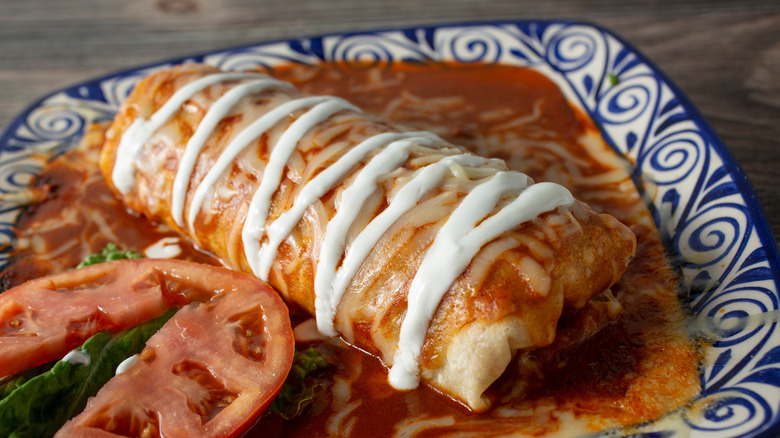
As the name suggests, a wet or smothered burrito is doused in sauce, making it more of a knife and fork meal than a handheld bite. It's often filled with ground or shredded meat, cheese, beans, and rice, then slathered in sauce (usually red or green salsa or enchilada sauce) and sometimes melted cheese. The only real difference between smothered burritos and enchiladas is that the latter are traditionally made with corn tortillas.
Some say the wet burrito was created in Grand Rapids, Michigan, in the 1960s. This theory makes sense, as there was a large Mexican population living there during that time. However, the truth is this style likely developed in different pockets of the U.S. independently. For example, people in New Mexico have been smothering breakfast burritos with sauces for decades. Then there is the Mexican hamburger from Denver, Colorado, which features a ground beef patty and beans wrapped in a flour tortilla and topped with green chile sauce and melted cheese.
Like many of the burritos on this list, smothered burritos don't have to conform to a strict set of ingredients. You can tweak them to your liking with different fillings and sauces, and experiment with unconventional flavors. For example, mole is typically used for meats or enchiladas (aka enmoladas), but it can work beautifully on a wet burrito. Sriracha can amp up the heat, while tzatziki can cool things down a notch.