

How To Keep Your Pickled Vegetables From Losing Their Crunch
We may receive a commission on purchases made from links.
Nobody wants mushy pickles. In addition to flavorful brine, the crunch factor plays a significant role in what makes these salty snacks a delicious addition to a wide variety of dishes. Though there's an abundance of store-bought pickles, a number of which we have ranked from worst to best, there's something special about making your own pickles, especially when you understand the science behind how pickling works. All pickles run the risk of losing their satisfying crunch over time, but there's a specific technique you can employ to ensure that your homemade pickles remain nice and crisp for a long time. It's called low-temperature pasteurization, and while it may sound like you need a dedicated science lab or manufacturing facility for this, it's easy to do at home using most routine pickling equipment.
Low and slow is the name of the game: jarred pickles are placed in water baths maintained at 180 to 185 degrees Fahrenheit for about 30 minutes. The prolonged heat exposure helps kill any unwanted microorganisms that might contaminate the mix. Higher temperatures run the risk of softening the pickles, which defeats the entire purpose of this approach, so it could be worth investing in a reliable cooking thermometer. For best results, make sure to pick out a recipe that specifically calls for this exact method or explicitly states that it's suitable for low-temperature pasteurization.
More tips for crunchy pickles
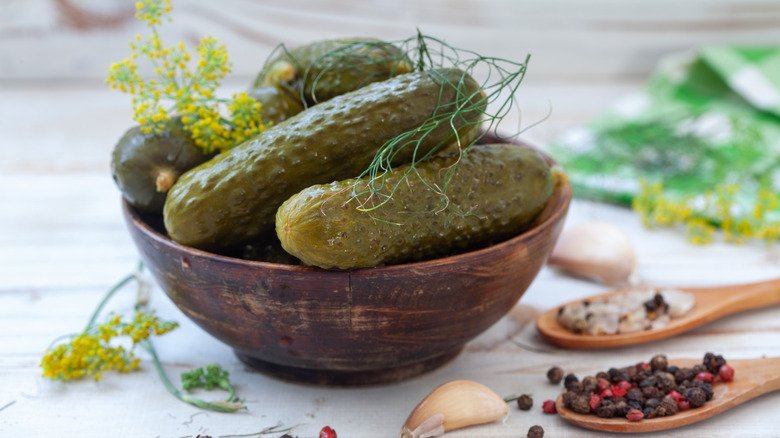
There are a number of additional hacks that help achieve the perfectly crunchy pickle. For those who prefer the convenience of store-bought pickles, look for ones labeled "fresh-packed," which tend to be crisper than fermented pickles. If you're going the DIY route with pickled cucumbers, the type of cucumber you use also makes a significant difference in how crunchy your pickles turn out.
The way you prepare your vegetables prior to pickling also plays a role. A savvy trick, which requires an additional step for the extra crunch factor, is soaking the vegetables in a salted ice bath. The salt helps draw out moisture from the cells, contributing to a crisper texture, while the ice helps keep them firm. If you're tight on time, we've got an expert-approved pulverization technique for super-crunchy homemade pickles that also helps release some pent-up energy. And you may be surprised to learn that another secret to making deliciously crispy pickles is to add loose-leaf tea to the brine. Thanks to the tannins in tea, the cell walls of the vegetables are better preserved, resulting in a crunchier pickle.