

10 Old-School Steak Dishes That Everyone Used To Love
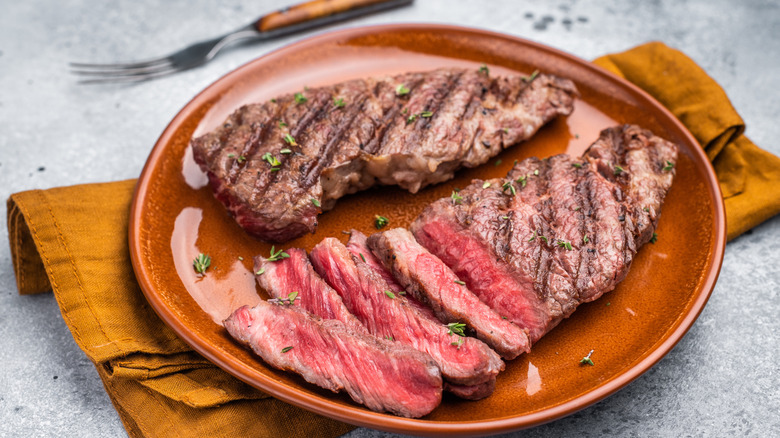
We don't think twice about seeing steak in the grocery store. It's beloved for so many different reasons, including its flavor, the number of different cuts you can prepare, and its high protein content. It's interesting to think that steak (and red meat as a whole), which is now a staple on menus at both high-end restaurants and fast-casual spots, was once seen as a very niche, haute protein reserved for the wealthy.
Not only have the symbolism and accessibility of this protein evolved, but so have the ways we consume it. Like any dish, be it seafood, desserts, or, yes, steak dishes, it has evolved to fit changing palates, budgets, and international influences. Yet, some of the steak dishes and preparations we consider to be "old-school" are still the ones that we love the most and think back on fondly.
If you are feeling reminiscent of some of the steak-centric dishes your Boomer parents used to make or want to try your hand at retro recipes, you've come to the right place. While these steak dishes have been around a long time, they are still just as good (if not better) as the first time they were made.
1. Steak Diane
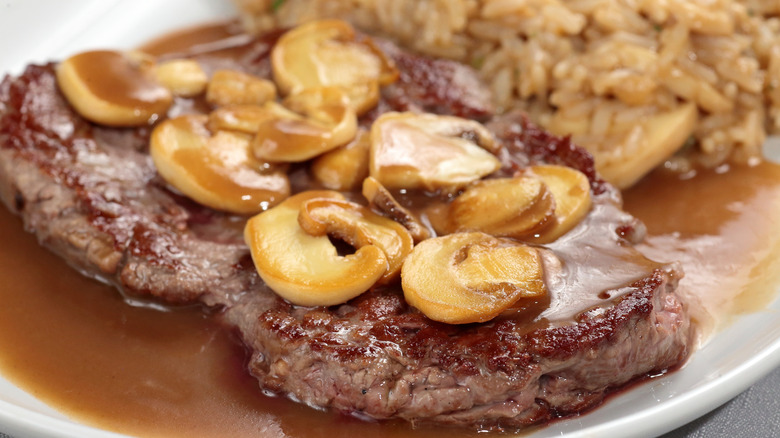
Steak Diane is definitely not a popular menu item now, but in the mid-20th century, it certainly was. The exact origin of this dish is hazy, though it's often thought to be a nod to the goddess of the hunt that bears the same name.
Australian Women's Weekly credited chef Tony Clerici of The Colony Club with creating this dish in its October 1954 publication, noting that housewives were eagerly trying to imitate it at home. Clerici's secret? Tons of sweet butter, Worcestershire sauce, and peppercorns. The recipe for this steak was even printed in a Weight Watchers recipe card from 1974, showcasing a mushroom-topped filet mignon with a side of greens and radish slices — though it was made with "imitation margarine" (a sign of the times). Steak Diane and mushrooms are a common pairing, and it's easy to see how the fungi's umami flavor played off the savoriness of the beef.
Regardless of who's preparing steak Diane, it features a similar approach: sautéing the cut of choice in butter before flambéing and adorning it with a rich cognac sauce. Steak wasn't the only cut to be prepared à la Diane; English restaurants similarly served other game cuts during the 20th century.
2. Salisbury steak
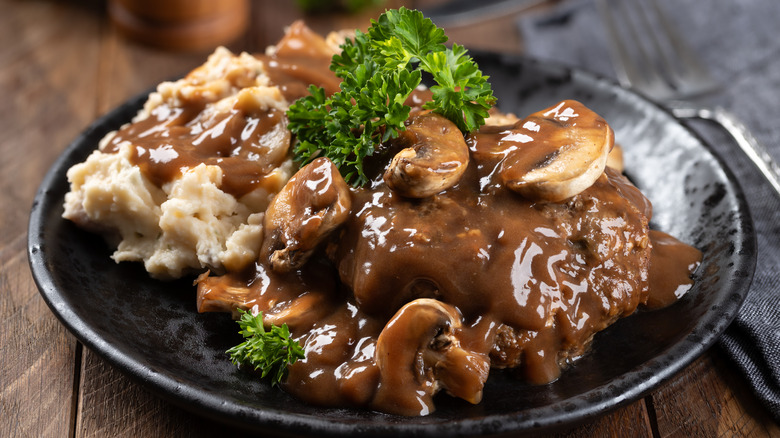
Fans of Hungry-Man dinners will know Salisbury steak quite well, though members of a younger generation may not recognize it. The dish was often associated with other mid-20th-century TV dinners, though it got its start far, far before that. Dr. John Salisbury, the dish's namesake, was a staunch advocate of germ theory and studied the relationship between diet and health. He observed how soldiers during the Civil War were being fed paltry and low-quality rations, but found that when the service members were fed diets higher in meat, they reported better vigor. He recommended a "muscle pulp of lean beef" in "The Relation of Alimentation and Disease," and thus, the Salisbury steak was born.
The United States Department of Agriculture (USDA) requires that Salisbury steak contain 65% meat and no more than 30% fat. The rest can include fillers and extenders, as well as pork. Of course, you also have to leave room for flavorings; many classic Salisbury steak preparations utilize ingredients like Worcestershire sauce, Dijon mustard, beef broth, and mushrooms to make the protein a little more palatable. It's meaty, savory, and — as Dr. Salisbury would probably argue — good for you.
3. London broil
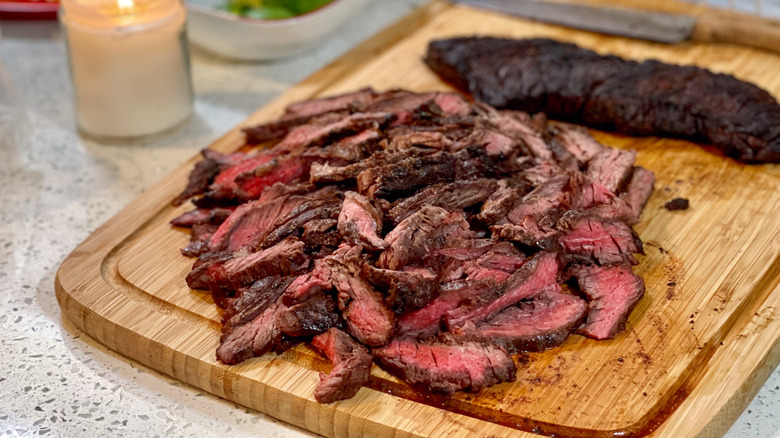
London broil was definitely not our favorite cut of steak growing up, and if you, too, had an ill-prepared version of it, you may feel the same. But when you get a piece of London broil prepared well, it can be nothing short of heavenly.
One of the common misconceptions is that London broil is a cut of meat or a dish when it's actually just a certain way of cooking it. London broil is typically made with top round or flank steak, which are quite tough. The steaks range in thickness from 1 to 4 inches and are usually cut against the grain to ensure that the meat stays juicy and flavorful. Cooks also employ marinades to soften London broil before cooking. Neglect to sear it at high heat or rest it properly, and you will have a dry, chewy steak that's more like tire rubber than beef.
Although its name might suggest English origins, this steak is actually distinctly American. It started to pop up in cookbooks in the 1930s and was likely given its name to make it sound fancier than it actually is. James Beard himself hypothesized that London broil got its start in Philadelphia, but this has not been confirmed.
4. Surf and turf
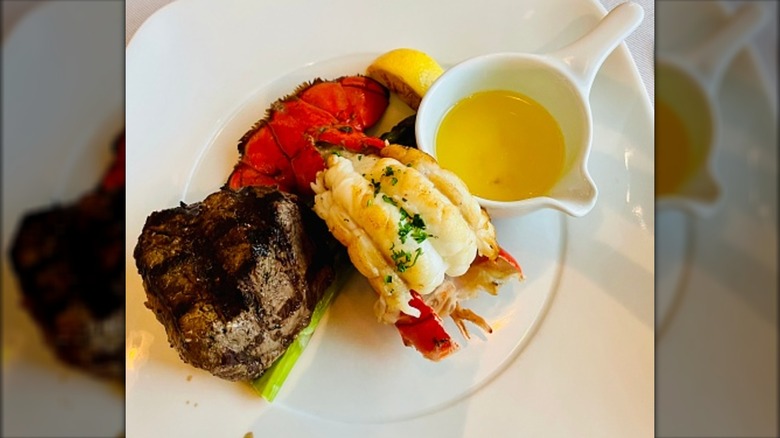
Fans of the restaurant chain Sizzler will likely be able to recognize surf and turf as a popular dish from the buffet chain. A 1972 Sizzler menu and its $3.75 steak-and-lobster deal tell you everything you need to know about this dish: luxury, but on a budget. Surf-and-turf, which plainly means a piece of meat and seafood (often filet mignon and lobster) served on the same plate, grew in popularity as more people were dining out, yet were still conservative with their spending.
There are two potential origin stories for this once-beloved steakhouse dish. Some sources point to it being served in 1962 at SkyCity located in the Seattle Space Needle during the World's Fair, while others point to a print advertisement in 1966 being surf and turf's first recorded occurrence. The latter, served at the Continental Restaurant, came with an illustrious seven courses, including filet mignon, Alaskan crab legs, and halibut in Newburg sauce. Later variations of surf and turf included giant prawns, baked scallops, and more. We don't entirely know if it was beloved because of its ostentatious presentation and flavors, or because people associate it with birthdays and family celebrations at budget-friendly steakhouses — but it deserves a spot on this list nonetheless.
5. Chicken-fried steak
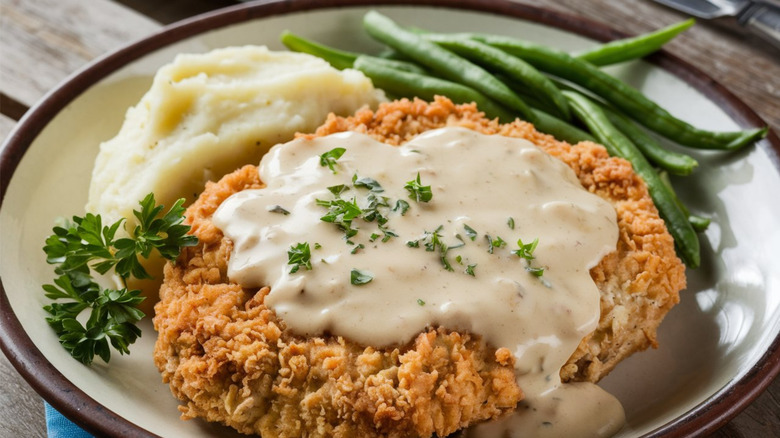
Pay a visit to any local Cracker Barrel, and you're likely to see chicken-fried steak listed. It comes topped with an ample serving of sawmill gravy, sides, and biscuits or corn muffins. Some other diners may also serve it, but chicken-fried steak has otherwise been relegated to the confines of history.
Many sources point to this thinly sliced, breaded-and-fried beef dish as originating in Texas, where it's often served with mashed potatoes and gravy. Recipes can be traced as far back as the 1920s; however, batter-fried steaks have likely been around much longer than that. Food historians draw parallels between chicken-fried steak and German Wiener schnitzel (made with veal) and suggest that the idea for the dish was brought to Texas by immigrants. However, this has not stopped other historians from bringing up the "by accident" theory, claiming that a short-order cook in Lamesa, Texas, messed up two orders for chicken and fried steak, in turn creating the chicken-fried steak.
Texans have different variations on this dish, including ones made with egg and flour, breadcrumbs, and an eggless dredge. Regardless of how it's made, it's clear that chicken-fried steak drums up feelings of family and Southern comfort for many — whether they call the Lone Star State home or not.
6. Steak and eggs
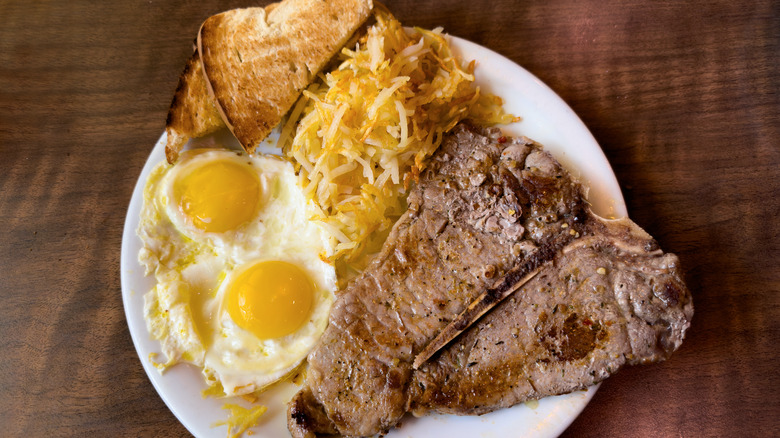
We can think of few breakfasts that are as strongly "American" as steak and eggs. A plate of steak served with eggs and sides — all before 10 a.m.? That's about as quintessentially protein-hungry-American as it gets. But you may be surprised to learn that steak and eggs didn't actually get its start in America.
Steak and eggs first became an iconic dish in Australia when settlers were promised that they could eat meat three times a day — something that wasn't entirely possible for a laborer living in England (Australia's colonial overseer) in the 1800s. And as Australia's meat industry started to grow, so did the prevalence of steak and meat in the diets of its inhabitants. When American service members traveled to Australia during World War II, they developed a taste for this protein-heavy dish. Several astronauts have even eaten steak and eggs before their journeys because of its high-protein and low-fiber content, which reduced the number of trips to the bathroom astronauts would need to take.
With low-fat diets becoming all the rage in the 1970s, steak and eggs took a decidedly heavy hit. You can still find this dish at some restaurants, though, and enjoy this classic American-ish breakfast.
7. Steak tartare
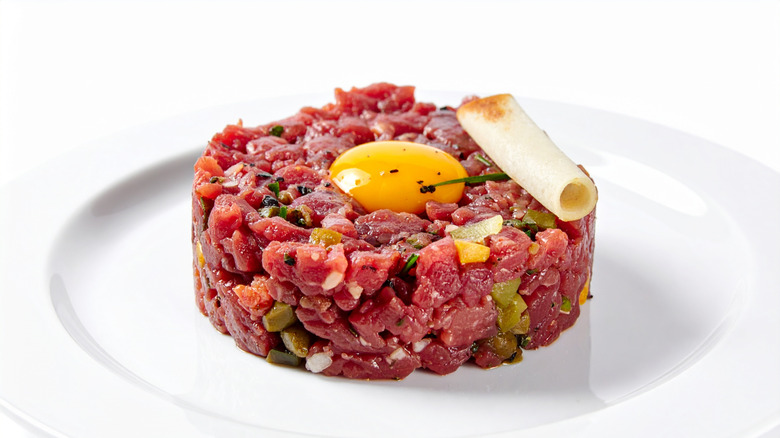
If the thought of eating raw meat (and raw egg) makes you squeamish, now would be the time to turn away. Steak tartare is certainly an old-school dish and not something you often see on fast-casual menus. In fact, it may be about as vintage as it gets, considering its roots trace back to the Tartar warriors of Central Asia. According to (likely untrue) legend, Mongol warriors would not only use their horses as a mode of transit, but also as a method of food preparation (and sometimes the food itself). They would place raw meat underneath their saddles so that when they rode, it softened and could be more easily eaten. Eventually, through the movement of the Mongols into different areas of the world, it became more widely popular, and by the 17th and 18th centuries, it had taken hold in Europe, where beef was the primary protein used.
It was the French who gave the dish a facelift and added a raw egg yolk while also enhancing its flavor with ingredients like capers, herbs, and sauces. Once Americans had found out about it, it started popping up on fine dining menus, especially at French restaurants. There is no concrete reason why steak tartare eventually fell out of fashion, though its appearance in popular culture (including in the 1987 film "Wall Street") and as a sign of wealth and opulence has surely cemented it into food history.
8. Steak au poivre
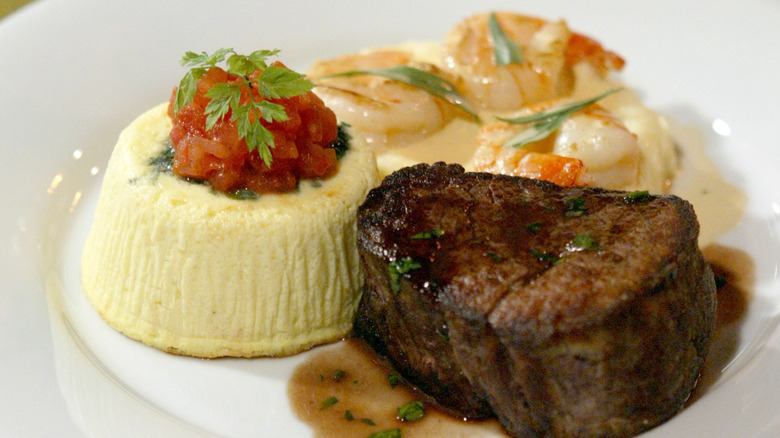
If you are a big fan of peppercorns and the flavor that they offer, you may be partial to steak au poivre. It became popular in the 1960s, though the idea of crusting a cut of meat in peppercorns dates back much farther than that. "Martha Washington's Booke of Cookery and Booke of Sweetmeats," for example, contains a recipe for peppercorn-crusted venison that instructs the reader to season the cut with lemon juice, pepper, and salt, "then paste it with gross pepper layd on ye top." The peppercorns add flavor and alleviate some of the dryness of the venison, and it does about the same thing for beef. Eventually, chefs, including Auguste Escoffier, played with pepper as an ingredient (including in the aforementioned steak Diane).
However, steak au poivre wasn't really brought into focus until Julia Child published her recipe for steak au poivre in her 1961 cookbook, "Mastering the Art of French Cooking," where she recommended that folks stray away from a brandy-based sauce, instead coating the cuts in peppercorns before cooking them in a sauce made with Cognac. While it might sound a lot like steak Diane, the primary difference between these two recipes is the peppercorn coating and the fact that steak au poivre doesn't usually come with mushrooms, nor does it employ a super flavorful sauce with ingredients like Worcestershire sauce and Dijon mustard like steak Diane does.
9. Chateaubriand
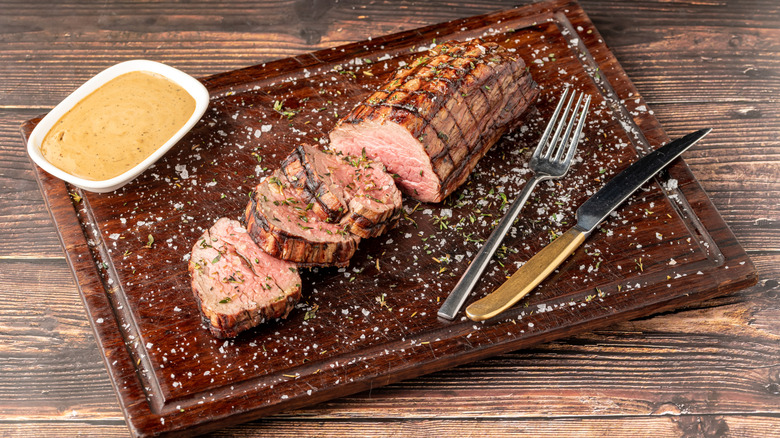
The name Chateaubriand may conjure up the feeling of a grandiose dish, and yes, it is nothing short of a showstopper. Like filet mignon, it's sourced from the center of a beef tenderloin, giving it a high price tag, juicy flavor, and incredible tenderness. Since the meat is so high-end, this steak dish is usually served with compound butter or demi-glace, which allows the cut's natural flavor to shine.
Many have connected the name of this steak to the author and French diplomat François-René de Chateaubriand. The term used to refer to a method of preparing steak, which was served with a béarnaise sauce, but eventually was used to refer to "filet de boeuf" — a cut rather than a preparation. Regardless, this dish was beloved in France, the country where it was initially created, and once Americans discovered French cuisine in the 1950s and 1960s, they were hooked. We can thank culinary figures like Julia Child and Jacques Pépin for this; the duo featured it on an episode of "Julia & Jacques Cooking at Home," which aired in 1999. When plating the cut, Child described it as "a moment of beauty" — and we're inclined to agree.
10. New England steak tips
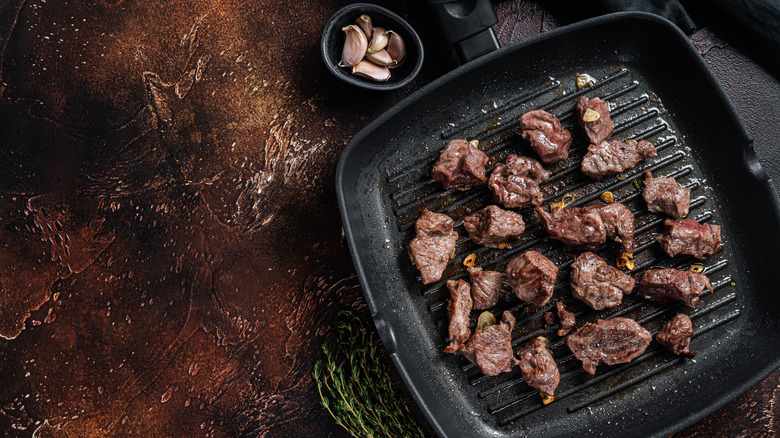
If you grew up in New England, you know what steak tips are — we'd even venture to say that they're an East Coast delicacy that everyone should try at least once. If you visit a sports bar or a casual dining restaurant like Ninety Nine in the Boston area, chances are you'll see them on the menu. This steak dish, which is often made with sirloin flap meat, hanger steak, or some other tough cut, is slathered in a simple marinade – often just made of Italian dressing — before being cooked quickly and served solo or on top of a salad.
The origins of these steak tips are murky, though their creation likely coincides with the amount of undesirable cuts — like sirloin — being rendered from the cow in the '70s. Call it Yankee frugality, but home cooks started taking these inexpensive cuts home and trying to do something with them. At the same time, more and more Greek immigrants were coming to the area and bringing their own regional steak dishes, including kebabs, which bear some likeness to the steak tips. There's also the Ninety Nine origin story: Allegedly, a cook accidentally knocked beef into a bowl of Italian dressing. Not wanting to let perfectly good beef go to waste, he tossed it on the grill, and before the fast-casual chain knew it, it had a winner on its hands.
Regardless of how they were created, the sure thing is that steak tips are a New England staple and one that has not come completely off the menu. While it might not be as popular with visitors of the region as other seafood-based dishes, these tasty morsels are definitely worth trying.