

9 Facts About Budweiser Every Beer Lover Should Know
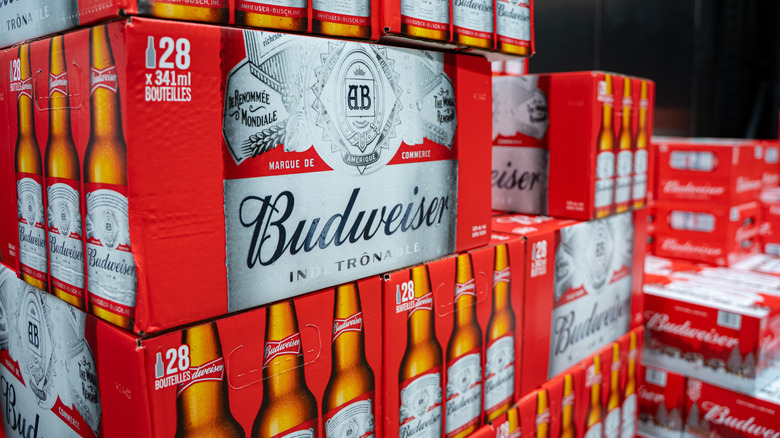
Budweiser is one of the more recognizable brands out there, with its iconic red and white label and always-extravagant Super Bowl ads (and sometimes super adorable ones, like 2024's must-watch "Old-School Delivery" commercial). But even if you crack open a cold bottle of Bud on the regular, you might not be aware of just how much company lore exists beyond what we see in ads. There's actually over a century of little-known facts and historical anecdotes about Budweiser that range from sweet to downright bizarre — and sometimes, even super petty. Then again, maybe this isn't so surprising, given that the company named itself "King of Beers." (One thing they're not, however, is the king of BBQ sauce flavors — sorry, Budweiser).
From lawsuits to mascots having their own mascots, Budweiser (and its parent company, Anheuser-Busch) has made some interesting choices over the years. That said, it's also transformed the beer industry in ways that changed it forever, often for the better. Whether you're just a fan of beer or you're a beverage history buff, these lesser-known Budweiser facts might make you see the brand through a different lens. Without further ado, here are nine facts about Budweiser every beer lover should know.
1. The Clydesdales were a gift
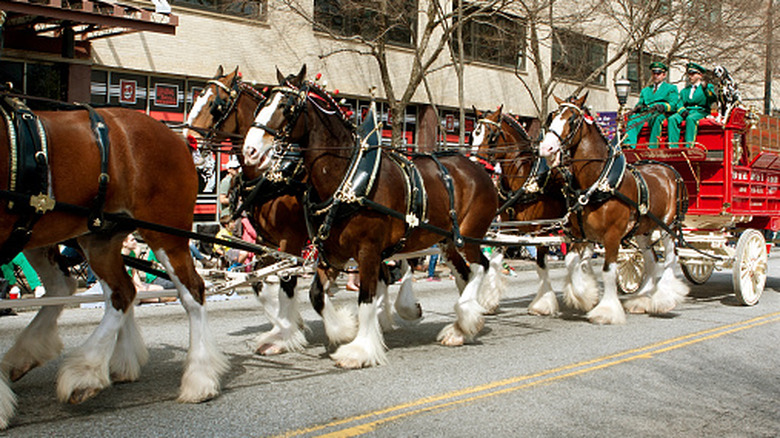
The famous Clydesdale horses weren't intended to be a cultural phenomenon — they began as a symbol to commemorate the end of Prohibition. It was 1933, and a time of celebration for the brewing company (and the rest of the country, as it was now legal to drink alcohol other than medicinal whiskey, which was the only legal spirit during Prohibition). This is why August Busch, Jr. and Adolphus Busch III purchased 12 Clydesdales as a gift to their father, Anheuser-Busch president August Busch Sr., and the brand itself. The team of horses was used in a triumphant procession down Pennsylvania Avenue to the White House, bringing the first post-ban case of Budweiser to the U.S. president, Franklin D. Roosevelt. The horse-drawn carriage carrying beer had now become a marketing plan, and it was the beginning of the Clydesdales being synonymous with Budweiser. They became a permanent part of ad campaigns and Budweiser events.
Not just any horse could be a Budweiser Clydesdale, however. There are specific requirements (beyond being all bred on the same ranch). As you may have noticed when watching the Budweiser ads, the Clydesdales are identical. This is by design — only horses with black hair, brown bodies, and white feet can be on the team. They also have to be a certain height — six feet tall, shoulders to ground. And they all have to wait until their fourth birthday to be considered, even if they do meet all of the other requirements.
2. It was the first company to ship beer by refrigerated train cars

Transporting beer used to be a big issue before refrigerated trucks and trains were common. Certain types of beer could spoil if they got too warm, and this made it so that most beer-makers kept distribution pretty local. Not Anheuser-Busch, though — it was popular enough in the 1870s that, not only was it transporting its beer via refrigerated train cars, but it had created its own company to do so.
St. Louis Refrigerator Car Company was the brewery's very own fleet of refrigerated train cars, used to distribute its beers far and wide. In fact, Anheuser-Busch is often credited as being the first brand to truly pioneer this system of transport, as no other brewery had done this before. There's only one of these train cars left, a model from 1904, and it lives at the National Museum of Transportation in St. Louis. This carbrought over 6 million gallons of beer to Texas from St. Louis during its operating days.
3. Budweiser's origins involve a love story (and a failing brewery)
The creation of Budweiser and the Anheuser-Busch partnership was shaped as much by romance as it was by the love of beer — at first, anyway. Adolphus Busch owned a brewery supply company and met Lilly Anheuser while he was selling brewing equipment to her father, Eberhard Anheuser, whose own brewery wasn't exactly doing well at the time. Eberhard was terrible at brewing beer, and everyone hated it. Lucky for him, the guy who just fell in love with his daughter and married her was awesome at it.
Busch partnered with his new bride's dad, first as a salesman for the brand, and later as a full-on partner. His brewing expertise made all the difference, and before Anheuser's death in 1880, the company was renamed to Anheuser-Busch. Budweiser became a total hit — Busch transformed the recipe into something that tasted much better. His innovations for the brewery went further than this, however — he was the first person to introduce pasteurization into the beer-making process and actively spoke out against Prohibition (including to the president himself).
4. Its mascots have their own mascot
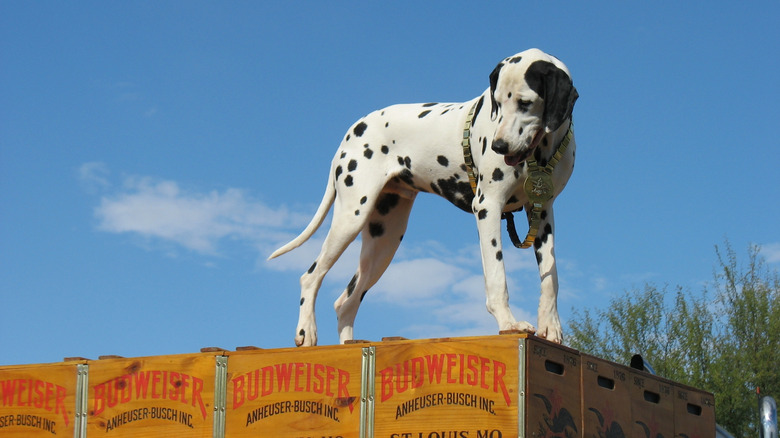
On television, the Budweiser Clydesdales are the mascots and stars of the company's advertising. But, as it turns out, the mascots also have their own mascot. For decades, the horse teams have traveled with a Dalmatian riding along with them on that iconic red beer wagon. This tradition dates back to when beer used to be delivered by carriage (the Dalmatians would protect the cargo while the delivery drivers unloaded beer orders).
Beer may not be delivered by carriage anymore, but the bond between Clydesdale and Dalmatian (and trainers) is still strong. Today, the dogs, trainers, and horses all work together as one team and family, even living together on the same farm. The Dalmatians participate in parades and major public events, even appearing in commercials with the Clydesdales (including Super Bowl ads). This partnership has reinforced a nostalgic, old-fashioned image that has long defined Budweiser as a brand.
5. The brand got petty when Samuel Adams became successful
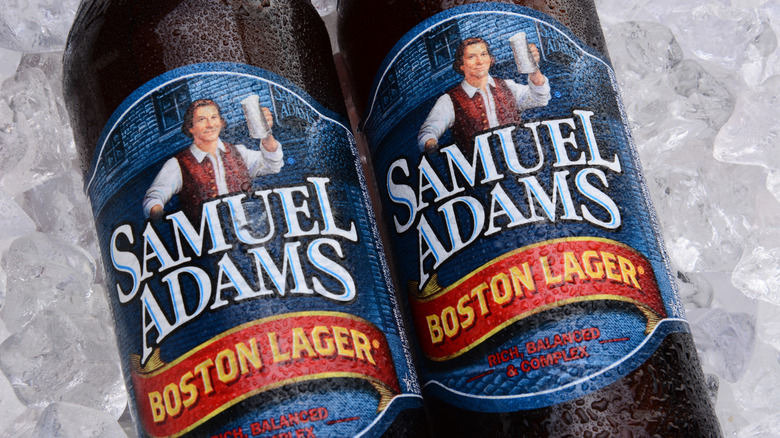
By the 1990s, Budweiser was not just competing against major national lagers, but smaller-scale and up-and-coming breweries as well. Samuel Adams was becoming successful at this time, and in 1996, Anheuser-Busch got pretty annoyed by this. The company attacked Samuel Adams via a series of ads questioning if it was actually authentically connected to Boston and insinuating that much of the beer was brewed outside of the city.
This aggressive attack was mostly unsuccessful — mostly. Samuel Adams' sales did take a dive, but only for a few years. And eventually, the company got Budweiser back: In 2021, during a Super Bowl ad, a character in a Samuel Adams commercial set the Budweiser Clydesdales free. That'll show 'em, Samuel Adams (which, by the way, has become extremely unaffordable). Anheuser-Busch still comes off looking worse, let's be honest — but joke's on both of them as neither is the most popular beer in America today.
6. Budweiser sued a florist (and lost)

Budweiser aggressively protects its slogans, and one time, in 1983, this involved suing a local Ohio group of florists. For only one week in 1982, the Florists Association of Greater Cleveland used the slogan "THIS BUD'S FOR YOU — And 11 More Rosebuds" for a special promo to sell flowers on a local scale. And we're talking super local. This was just advertising that included banners in the windows of local florists, local television commercials, and ads in the local newspaper.
Anheuser-Busch accused the florist group of trademark infringement, false advertising, and unfair competition, amongst other things. Sure, the Anheuser-Busch company had been using "THIS BUD'S FOR YOU" as a slogan since around 1979 (a time when six-packs were much cheaper), so, technically, the florists didn't have the rights to use the slogan. However, a judge saw the lawsuit for what it was (ridiculous) and the florists won — because, obviously, nobody was confusing beer with flowers from Cleveland. "No consumer called any florist asking to be delivered a six-pack; nor did any consumer call A-B seeking to purchase two dozen roses," decided Judge Ann Aldrich in 1984 (via Metropolitan News Online).
7. The company once owned a bunch of theme parks
Anheuser-Busch has been involved in way more than just beer over the decades. The company also owned a pretty major collection of theme parks around the United States. At one point, it owned 10 parks, all through its Busch Entertainment division. And, at the time, Busch Entertainment was the second-biggest entertainment park business in the U.S. These theme parks, of course, also doubled as marketing lands for Budweiser products (samples of Anheuser-Busch products were even given out from time to time).
It was a pretty successful side gig for Anheuser-Busch for many years. Theme parks owned by the company included well-known destinations like SeaWorld, Busch Gardens, and Sesame Place (a Sesame Street-themed park). The company kept the parks until 2009, when it merged with another wildly successful beer company called InBev. The Blackstone Group gladly took Busch Entertainment off Anheuser-Busch's hands for 2.3 billion dollars that year.
8. There was a Budweiser video game
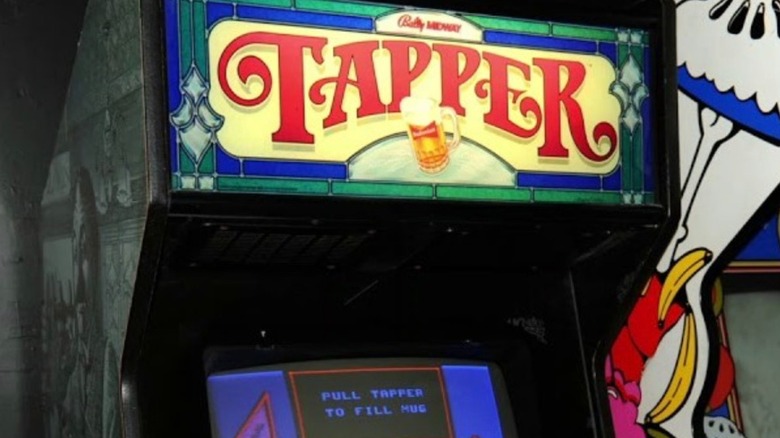
Long before there were branded mobile games, Budweiser had its very own arcade video game called "Tapper." Released by Bally Midway in 1983, the game was incredibly simple — which is why people loved it. You played a bartender serving beers to customers. All you had to do was give them beer, keep the bar clean, and make sure nothing broke or got spilled — that's all.
Tapper had a fun design and tons of Budweiser mentions. This included logos on the walls, Budweiser mugs, and even an appearance by a Budweiser-branded blimp. And while those over 21 years old could find Tapper in plenty of bars (including those in Las Vegas casinos like Circus Circus), it would eventually be replaced by Root Beer Tapper, released in 1984. This was a kid-friendly version of the arcade game suitable for places like Chuck E. Cheese (which, on top of arcade games, also used to have a full Chuck E. Cheese animatronic band). It's still around today in various forms.
9. Anheuser conquered the soap industry then set his sights on beer

We're all well aware at this point that Eberhard Anheuser was awful at making beer before he joined forces with Adolphus Busch back in the early days of Anheuser-Busch. He was, however, extremely good at something entirely different. Long before Anheuser-Busch, and Budweiser right along with it, became one of the most famous beer companies in the world, Anheuser was a manufacturer of soaps and candles (essential household goods in 1800s-era St. Louis). And he was really, really good at it — his company was the largest one at the time.
It may sound like a confusing career jump from soap to beer, but Anheuser was a true businessman. He was educated as a chemist in Germany before immigrating to the U.S. in 1843, where he went on to have a hand in many business ventures and partnerships. His success in the soap industry clearly encouraged him to take on the beer world in 1852, although with far less outstanding results. Lucky for him, it wouldn't be long until Adolphus Busch (and his brewing supply business) came along to help him out.