

How To Make Restaurant-Quality Stir Fry, According To An Expert
We may receive a commission on purchases made from links.
If you forego the fried chicken and egg rolls in favor of light, fresh dishes when you visit your favorite local Chinese takeout spot, chances are that you are no stranger to stir-fry. This versatile dish, which can include an array of proteins, vegetables, aromatics, and starches, is usually very simple, but it is packed with a ton of flavor. As such, if you order a particularly great stir-fry at a restaurant, you may be inspired to try your hand at your own homemade variation.
While stir-fry is an easy dish to make at home, it's an incredibly difficult dish to make well. From choosing the right pan to perfecting your flipping technique, there are numerous mistakes that home cooks can make along the way that can ruin the texture of stir-fry and make you wonder why you didn't just order takeout in the first place. But no need to fear; we called in the big guns. Timothy Paroulek, executive chef at the Grand Hyatt Grand Cayman Resort & Spa, shared his top tips for crafting tasty, well-textured, restaurant-worthy stir-fry at home with us.
1. Use a wok instead of a skillet
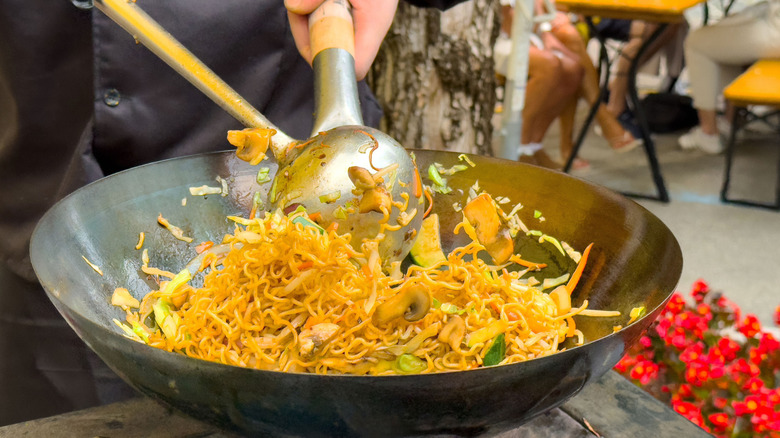
Any home chef knows that having the right tools is the key to setting yourself up for success for making anything, whether that's a juicy steak, a batch of muffins, or stir-fry. One of the best investments you can make, especially if you cook stir-fry, is a wok. Timothy Paroulek, executive chef at the Grand Hyatt Grand Cayman Resort & Spa, recommends using one over what he calls a "conventional-style pan."
"Generally, woks are larger and their unique shape increases the surface area of the metal," he says. "This enables cooks to transfer more heat into the food at a faster rate and achieve more browning and caramelization." The wok has a deep shape with tall sides, which is also helpful in keeping ingredients and oil contained, rather than splattered on your stovetop.
Woks generally aren't that expensive; you can find lower-end wok, like this one, for sale on Amazon for around $40, or invest in a higher-end carbon steel one for upwards of $100. But Paroulek also offers an alternative. "If you are looking to [stir-fry] vegetables, but do not own a wok, a large [cast-iron] pan is able to heat up properly and achieve a similar result." Most home cooks likely already have a cast-iron skillet lying around, making it a more versatile option, but if not, this one from Lodge is a solid choice. However, if you prefer something lighter and plan to cook up stir-fry often, buying a decent wok might be a good idea.
2. Opt for gas, charcoal, or wood when possible
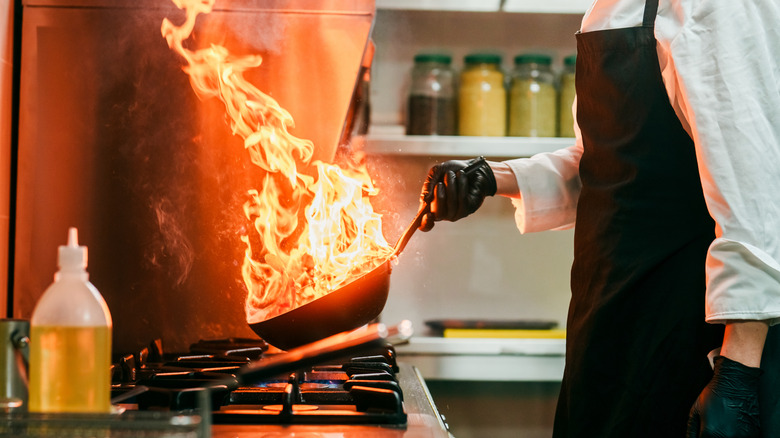
If you've ever peered into your favorite Chinese takeout joint's kitchen, you've likely noticed an absence of electric burners and a whole lot of woks and gas burners. Timothy Paroulek is partial to gas when making stir-fry, as it is incredibly effective at giving food wok hei, which he explains is a Cantonese term meaning "breath of the wok." "When ingredients are [stir-fried] in a wok over a strong fire, the wok instills a unique smokey roasted flavor to the food, or 'wok hei,'" he says. Gas burners are also easy to situate a wok on top of and heat up faster than other cooktop surfaces. The smokiness is very difficult to replicate using an electric or induction burner.
However, not all of us are blessed with a commercial-grade gas stove in our home kitchens. Luckily, Paroulek offers a couple of alternatives, including an outdoor gas grill. "This allows me to get a higher temperature and the signature flavor that is achieved from a high-powered open flame in a commercial kitchen," he says. If you're going gas-free, you can also take his suggestion and try a wood-fired, propane, or charcoal fuel source instead.
3. Avoid overcrowding your pan
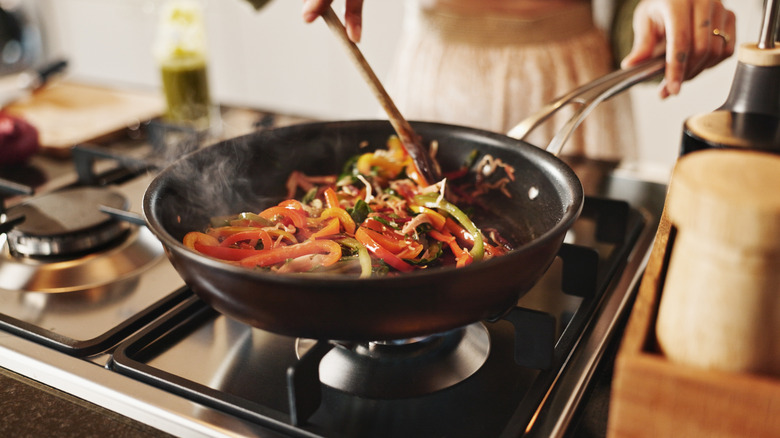
Have you ever tried making stir-fry by throwing all of your ingredients haphazardly into a pan, turning up the heat, and hoping for the best? While this method may be good at creating copious amounts of leftovers, you could be doing so at the expense of the flavor and consistency of your stir-fry. "When the wok is ready, make sure you do not overfill the pan. Even a smoking hot wok can be overcrowded," says Timothy Paroulek. When you add too many ingredients to the pan, especially ones that have a high water content or are pre-frozen, you could be causing those ingredients to steam, rather than develop the signature wok hei. "Adding too much food into the wok at one time reduces the temperature of the wok and will negatively affect the final product," he says. Plus, a stuffed wok may be difficult to maneuver, toss, and turn, leading to a poor cook.
The rule for exactly how much food to add to the wok (or your pan of choice) varies and is something that Paroulek believes comes with time. "Through practice it is easy to determine the correct volume of ingredients for the size of your wok and power of your burner," he says. In general, experts recommend adding equal parts meat, veggies, and starch (like noodles or rice) to your stir-fry and paying attention to not only how much is in the pan, but also how long each element needs to cook.
4. Preheat and pre-season your wok before cooking with it
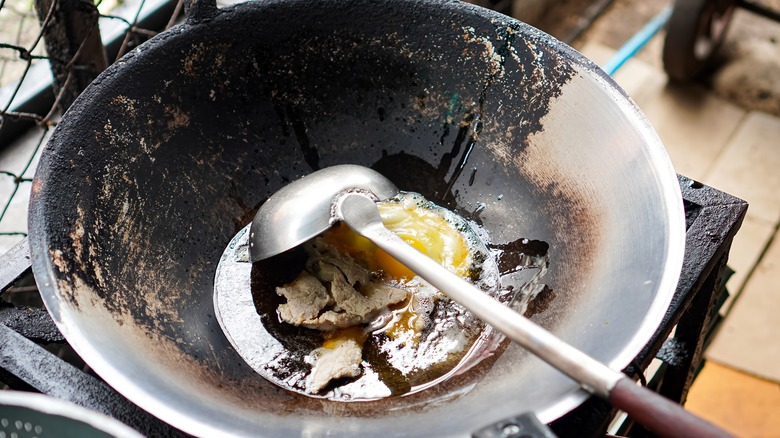
Preheating is not a cooking step that you should skip, and it's especially important when working with a wok. Timothy Paroulek explains that the wok needs to be heated until the oil smokes before you start to add your ingredients. "Cooking in a wok requires a high heat to attain the flavor associated with [stir-fried] food," he says. It's worth mentioning that others have recommended that you preheat the skillet, then add in cold oil. Regardless, you'll want to crank up the heat to medium-high before you start cooking. That way, when you add your first ingredients to the wok — meaning the ones that need to cook the longest — you'll get the perfect amount of wok hei and smokiness, rather than slowly cooking and steaming them.
Another important pre-cooking step that you won't want to skip is seasoning your wok. Just like a cast-iron skillet has a coat of oil that needs to be replenished over time, a wok develops a patina of sorts, which prevents the food from sticking to it. When you cook in the pan, as is the case with cooking something in a cast iron skillet, the oils will season the wok and help it stay nonstick. That being said, regularly adding oil to the pan, reheating it, and letting it cool with the oil will ensure it's ready for use when it's time to stir-fry.
5. Always use neutral oils for cooking
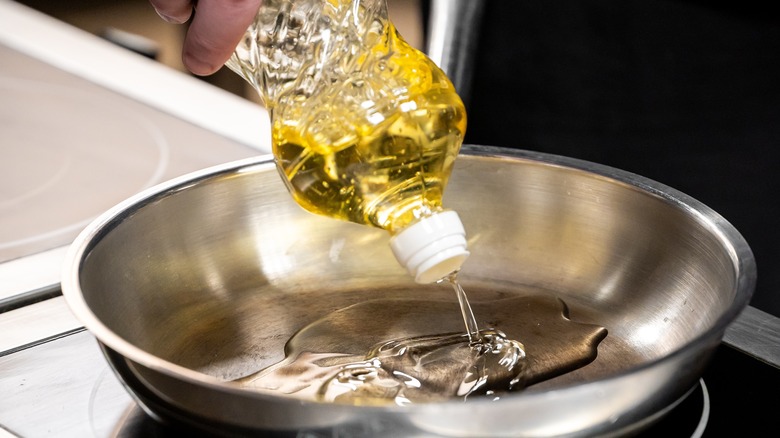
There are many different types of cooking oils out there, each with its own properties, flavors, and uses. The important thing to remember when selecting which one to use in your wok is that you're cooking over high heat for short amounts of time. So while butter makes things more delicious, it's not a good candidate for stir-fry because it starts to smoke and tastes acrid when heated past 350 degrees Fahrenheit. Extra-virgin olive oil is quite grassy in flavor (non-neutral) and has a pretty low smoke point, too.
The best type of oil to use for your wok and stir-fry is one that can tolerate high heat and doesn't negatively alter the taste of the food you're cooking in it. "Peanut oil, safflower oil, and sunflower oil are all good choices for high heat stir-frying," says Timothy Paroulek. He likes using soybean oil, in particular, but notes that there are some regional variations depending on the type of stir-fry you're making, like ghee or coconut oil. "I might also consider tallow, lard, or rendered chicken fat if I have them available to add more flavor to the dish; these can be a secret weapon to take your dish over the top," he says. If you're working with flavorful or low-smoke point oils, like sesame, be sure to add these at the end of the cooking process so that you don't have to worry about any acrid flavors in your final dish.
6. Add ingredients to your pan based on the amount of time it takes to cook them
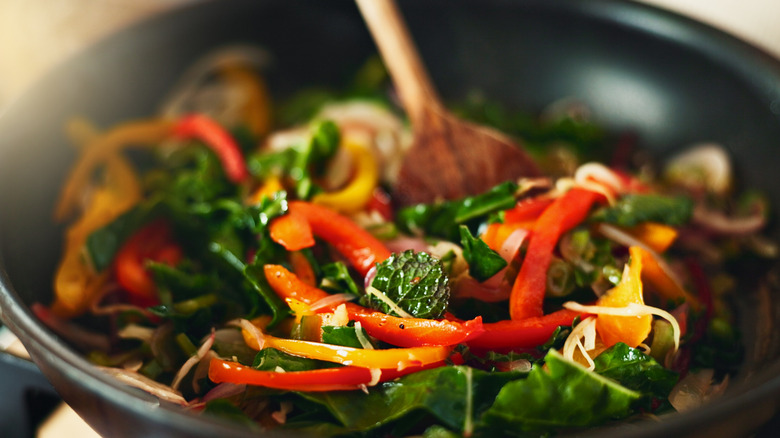
One of the most important things to master when making stir-fry is when to add your components. It would be great if your veggies, meat, and aromatics all cooked at the same rate, but the reality is that not taking into account their differences in moisture and texture may leave you with some components that are undercooked or soggy. "For instance, mushrooms generally take longer to cook than bell peppers, and chicken may take longer to cook than onions, based on how your chicken and onions are cut or processed," says Timothy Paroulek, noting that aromatics generally take the least amount of time to cook.
He recommends, before you even turn on the heat, that you organize your components based on how long they take to cook. "This way, you are prepared to add the ingredients that take the longest first and have the ingredients that cook very quickly on hand, ready to add near the end of the cooking process." It's one of the best techniques for stir-frying veggies because it allows all of the components to cook at the rate that they need to in order to still maintain their toothsome texture. This method will also minimize the amount of running back and forth you'll need to do between your wok and chopping block.
If you're working with frozen ingredients, you'll want to add them after your protein and aromatics. To stave off sogginess, avoid thawing these veggies before cooking them.
7. Minimize the amount of liquids you add to your stir-fry
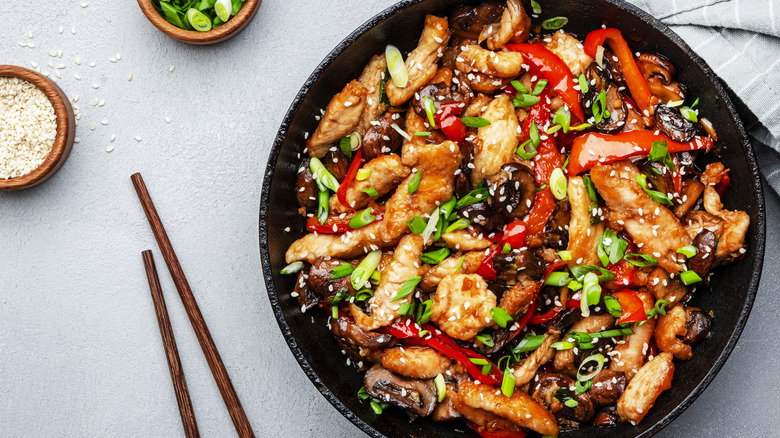
Controlling moisture is one of the most important things that anyone cooking stir-fry needs to do. When you add too much moisture to your pan, it causes the ingredients to become too saucy and wet, which prevents them from becoming super crisp and well-textured. However, you shouldn't let your fear of moisture limit your sauce options, as your seasonings are what will give depth and complexity to your stir-fry.
One tip that Timothy Paroulek offers is to add your liquid seasoning to the edges of the wok, rather than to the center. He explains that this will not only minimize the risk of over-saucing, but it will also help the sauce mix evenly with your dish. Generally, since stir-fry sauces often contain sweeteners, it's recommended that they only be added at the end of the cooking process. Otherwise, the sweeteners can over-caramelize or burn, imparting acrid notes to your dish. Moreover, adding sauces too early can cause your stir-fry to be too wet, as your meat and veggie components will braise in the sauce and soften.
8. Avoid using overly watery ingredients
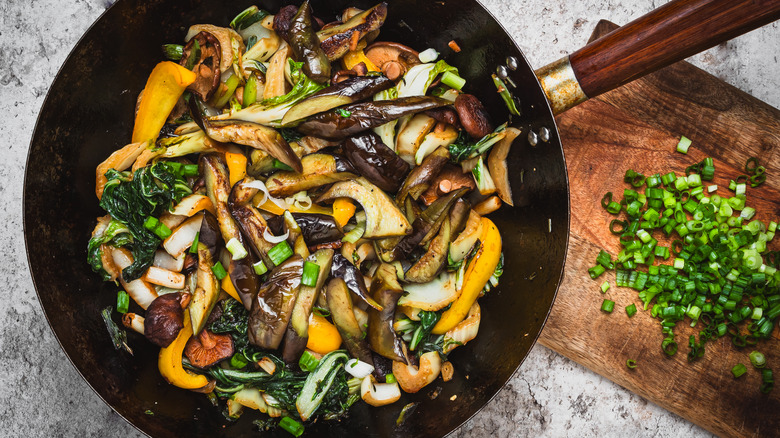
One of the biggest contributors to moisture in your stir-fry may not be what you think it is. Sure, sauces can add a little too much moisture to an otherwise perfectly cooked dish, but you'll also want to pay attention to the water content of your individual components when deciding on what to add to your recipe. "Vegetables that have a high-water content and hard root vegetables are generally avoided for stir-fries as they tend to become mushy and watery or burn before cooking," says Timothy Paroulek. He cautions that while these vegetables, which include zucchini, tomatoes, and squash, can be cooked ahead of time or chopped into smaller pieces, they generally require more advanced cooking techniques to prevent them from turning the entire dish into a soupy mess. Beginners are better off sticking to the simple and foolproof options: "Onions, garlic, leeks, mushrooms, bell peppers, and broccoli are good examples of vegetables that work well in [stir-fries]," he says.
Another unlikely moisture culprit that you may not have considered? Tofu. One of the common mistakes that people make with this protein before stir-frying it is not removing all of that excess moisture. When it hits the pan, it turns wobbly and gelatinous, which not only ruins its texture, but also the consistency of anything else in the wok. Not only should you use extra-firm tofu, but you should also squeeze out any moisture with a clean, dry kitchen towel before cooking it to reduce its water content.
9. Pay attention to how finely you cut your ingredients
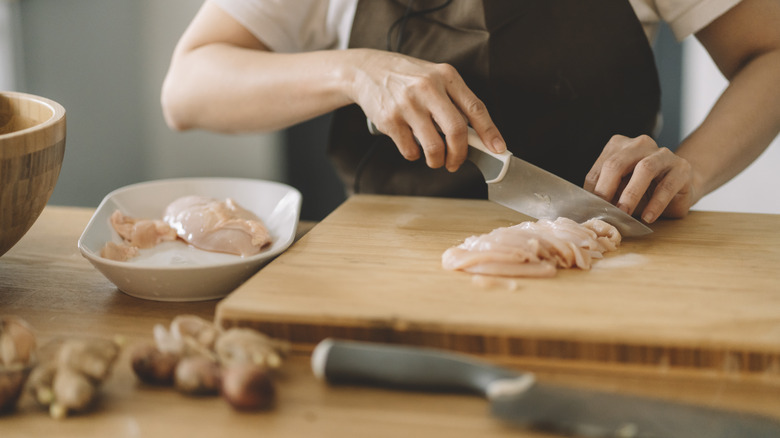
Have you ordered stir-fry from a restaurant, only to discover one, almost full-sized floret of broccoli and some aromatic and onion scraps strewn about? Not only can this ruin the entire experience of eating the stir-fry — and prompt you to awkwardly pick up the floret with your chopsticks and eat it over the course of four bites — but it can also mean that its texture is not optimal. When you cut your ingredients to a similar size, they generally cook more evenly and are easier to eat. "Overall, it is best to cut your ingredients small enough that they cook fully before burning in the high heat of the wok," says Timothy Paroulek. He explains that the size you cut your veggies is dependent on the type of dish that you're making. If you're making a fried rice dish in your wok, smaller, bite-sized pieces may be ideal. But if you're cooking up a stringy noodle stir-fry, you'll want to cut ingredients like peppers and carrots into long, thin strips so that you can eat them along with the noodles.
The type of dish isn't the only important consideration to make. "Also, we need to consider that often we eat stir-fried dishes with chopsticks or a spoon, so we want to serve our guests a dish that can be easily picked up with these utensils and eaten comfortably," Paroulek says.
10. Don't skimp on the MSG
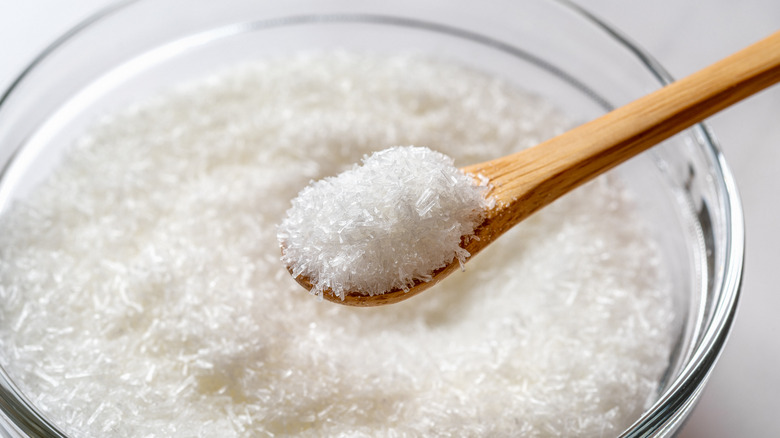
We would be remiss not to talk about MSG on this list of tips for improving stir-fry. It's an ingredient that has been unfairly demonized over the years, as people have falsely tied it to negative health claims. However, eating MSG has since been recognized as safe, according to research published in the Comprehensive Reviews in Food Science and Food Safety. There are many, many foods that can benefit from MSG, and stir-fry is one of them.
"MSG is the most underrated ingredient that home cooks tend to avoid," says Timothy Paroulek, citing the disproven health effects. He goes on to explain that glutamate is naturally found in many foods, like tomatoes and cheese, and adding MSG to your dish is like giving it a chemically similar dose of the flavor compound. "Adding a small amount of MSG to your stir-fry makes a big difference and is recommended," he says. You may need to only add between ⅛- and ¼-teaspoon of it, and in some cases, it may allow you to reduce the amount of salt (or salty ingredients) that you add to your recipe.
If you're still wary about adding crystalline MSG to your dish, you can opt for another ingredient that Paroulek describes as underrated: oyster sauce. This condiment is a popular addition to many stir-fries because it offers saltiness, richness, and sweetness, along with an attractive caramel color. "Some dishes just cannot be replicated without oyster sauce," he says.