

7 Instant Espresso Brands, Ranked
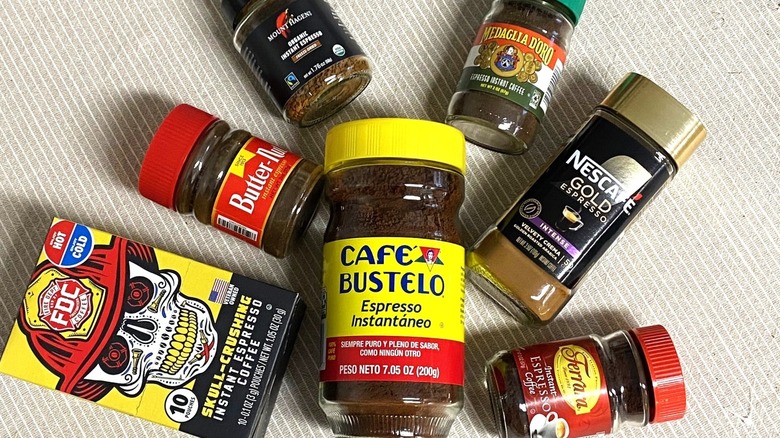
Instant coffee occupies a unique position in the world of grocery store coffee products. It's not what coffee snobs reach for, those connoisseurs who grind their own beans and whip out the French press or pour-over setup. Instant espresso is even more niche. It charms consumers hungry for caffeine and an especially intense coffee flavor — but who are low on the time or patience required to wait for fresh coffee to brew: busy people. Or someone like myself, who owns one of the best drip coffee makers per reviews (a Ninja) yet lacks the counter space for an espresso maker. (Instant coffee products are also big among campers and backpackers for these very reasons.)
Instant espresso (and coffee) is made by either freeze drying or spray drying, two very different processes that result in the same just-add-hot-water beverage. Freeze drying yields superior flavors over spray drying, but neither can hold a torch to the bold, rich, complex taste of real espresso — or its silky mouthfeel. You also won't find crema atop a cup of the instant stuff like you would a freshly pulled shot. With full awareness of these differences, I chose seven of the most popular instant espressos available today in grocery stores or online and put them to the test. I aimed to discover which, if any, would win me over with their flavor and texture. I swapped filtered water for regular to upgrade the flavor of my instant espressos, giving them every chance to excel. With that little boost, here's how the seven contenders performed.
7. Fire Dept. Coffee
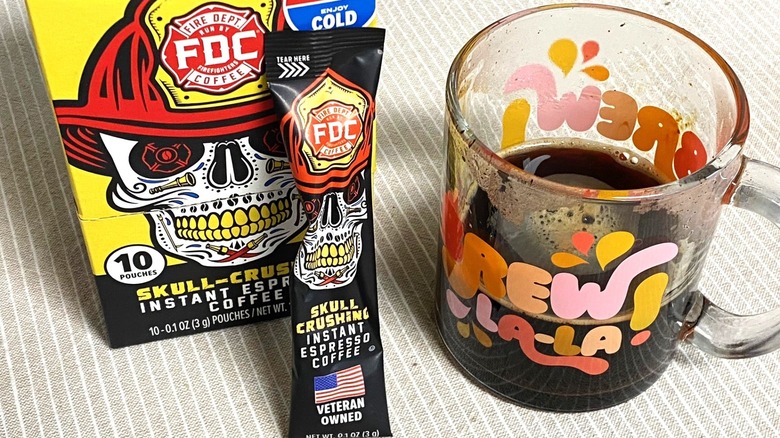
The bright, skull-emblazoned packaging for Fire Department Coffee's Skull-Crushing Instant Espresso promises an amazing fast-caff experience. I also appreciate that this is the only instant espresso I reviewed that comes not in a jar, but in 10 individual packets. If you're a camper (or firefighter, like the brand's founder), this one might be for you. It wasn't for me, though. Something you'll notice off the bat is that this instant espresso calls for 8 ounces of water per individual packet. When made to that order, the resulting drink was unsurprisingly thin; this is coffee, not proper espresso. I was willing to be convinced if the flavor held up its end of the bargain, but the aroma was distressingly off: acrid and sour.
Flavor-wise, my first cup was very watery in mouthfeel. It tasted as sour as it smelled and as muted as it looked. Round two, made with less than half the called-for water, gave me an espresso that was just plain bad: burnt-tasting and bitter. You might be able to make it palatable with a sweetener, though I wasn't interested in this experiment. The company does sell regular ground and whole bean coffee for brewing, too, so I might give it another shot sometime just to support a good cause.
6. Ferrara
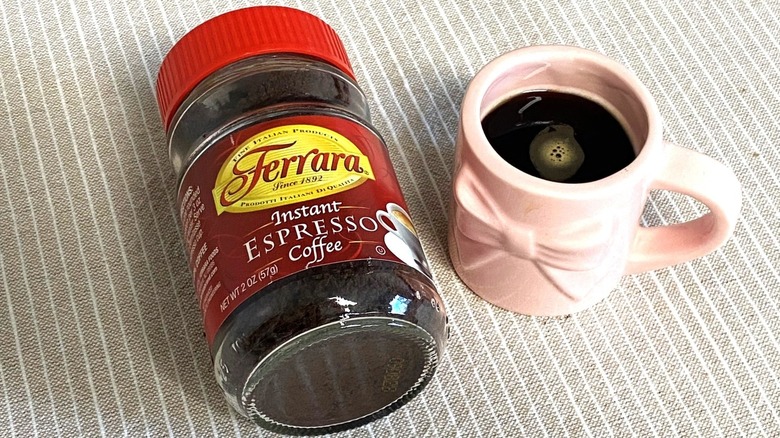
Ferrara instant espresso is one of the cheaper options on this list ($4.49 at Harris Teeter). It's made via spray drying (the powdery granules are the giveaway) and consists of both Arabica beans (the type of beans Starbucks uses) and Robusta beans, a typically cheaper coffee bean type with an earthier flavor. There's nothing necessarily wrong with that, but this instant espresso's aroma in the jar immediately worried me — it smelled like it would have a sour bitterness once prepared.
My fears were proven true: this one just didn't do it for me. After preparing the espresso according to instructions, all I picked up on my palate was bitterness without any complex espresso-like flavors, making it feel like the drink was simultaneously too weak and too strong. It had a sour, unpleasant aftertaste as well. That said, this is one of those instant espressos that's likely perfect for baking or preparing a creamy hazelnut tiramisu. With sugar added into the equation, Ferrara's instant espresso could find its place. Its fans also mention that it's great for iced coffee drinks as well as hot, so this just may be the thing for a three-ingredient fluffy Dalgona coffee.
5. Café Bustelo
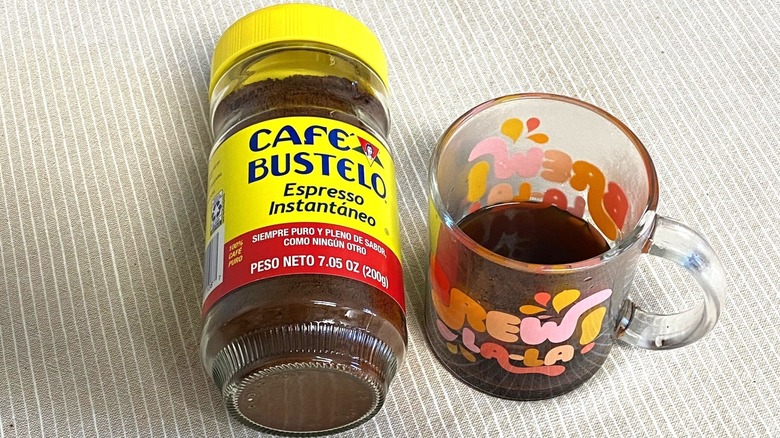
You get a lot of product for just under $8 with Café Bustelo's 7.05-ounce jar of instant espresso. If you follow the directions on the label for making a serving (1 teaspoon to 6 ounces of hot water), that jar should last you quite a while. I made my initial cup according to the recommended ratio, but this produced a watery coffee with a thin mouthfeel — nothing like espresso. I tried it again, this time using an extra half teaspoon of grounds. The flavor was less muted, but the mouthfeel was still not what I was hoping for.
Café Bustelo was one of our best bargain picks when we ranked the best instant coffee brands. The instant espresso should deliver on that promise if you can tweak your ratios to get the flavor to where you like it. It's not an espresso with complex notes by any means, but it's certainly not bad. It's a little bitter, but not overwhelmingly so, and its nutty undertones could make it a great option as a base for drinks. For plain old instant espresso, though, I probably wouldn't buy this one — but I wouldn't turn down a cup if someone offered it to me.
4. Butter-Nut
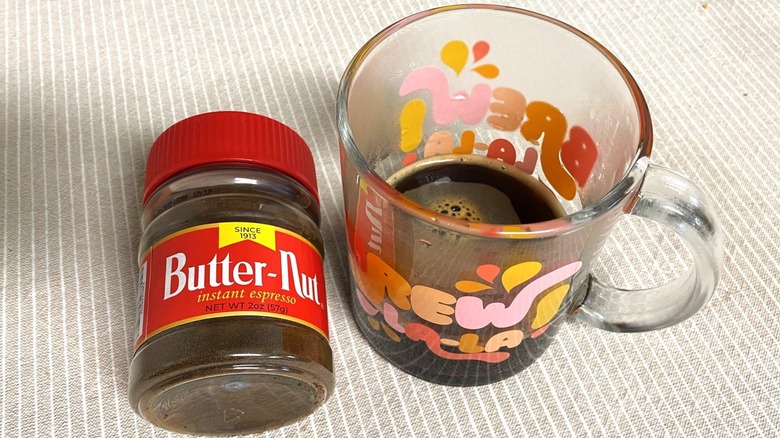
Even just the toothsome name "Butter-Nut" had me excited to try the instant espresso from this Midwestern coffee brand. Per the company's website, Butter-Nut instant espresso is designed to feature tasting notes of chocolate, toasted caramel, and (one would hope) rich espresso. I did detect those first two notes in the aroma when I opened the lid; in fact, the sweetness was promising.
When I added my rounded teaspoon of granules to 6 ounces of water as directed, I was met with an espresso that was extremely muted in flavor and mouthfeel. When I added another teaspoon of granules, the beverage's sweetness did make itself known, but the aftertaste was the dealbreaker: bitter and tart. Knowing what was coming made each relatively pleasant sip something of a drag. I wonder if adding salt to it could help cut the bitterness, but again, it's not the experience on the palate that's a bitter bummer; it's the aftertaste. It definitely has more oomph to it than Café Bustelo, though.
3. Medaglia D'Oro
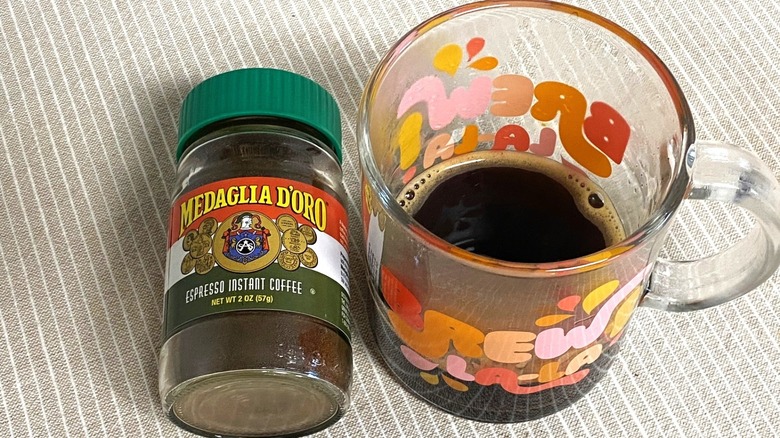
Medaglia d'Oro's instant espresso appears to be a little harder to come by than the other products in this ranking — a bit pricier, too. I found my 2-ounce jar on Walmart's site for $9.73, but if you buy from Medaglia d'Oro's website, the link takes you to the J.M. Smucker Co. Shop, where the instant espresso is listed for $6.99. And unlike some of the other instant espressos I ranked, you won't find it on Amazon. The relative scarcity of Medaglia d'Oro piqued my curiosity about this Italian-style espresso.
I first prepared it as instructed, using 1 teaspoon of granules per 6 ounces of water. This gave me a thin, watery drink with what I noted as a "basic instant coffee flavor." I tried again with half the amount of water and was much more impressed. It was a deep, smoky espresso with nutty notes, similar to the aroma of the granules in the jar. It wasn't particularly smooth as a standalone beverage, but sometimes that's what I want. It reminded me of Starbucks' decaf House Blend from when I ranked eight popular ground decaf coffees: a drink for when you crave in-your-face levels of flavor.
2. Mount Hagen
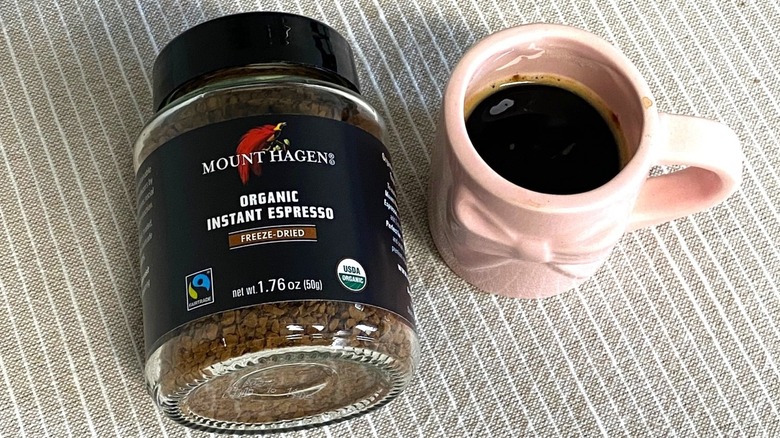
Where Medaglia d'Oro seemed like a semi-rare find, Mount Hagen's instant espresso was the epitome of "niche." It's organic fair trade, for one thing, the only such option I reviewed. In addition, all of Mount Hagen's coffees are not only instant (so surely the company knows what it's doing in this regard), but also freeze dried, the superior method for a flavorful instant coffee. All of this must be why the 1.76-ounce jar is $11.99 on both the brand's website and Amazon – the priciest product I reviewed.
Compared to the more powdery, spray-dried instant espressos, these freeze-dried granules took a little more stirring to fully dissolve; this wasn't a dealbreaker, though. I also didn't need to modify my ratios with Mount Hagen; a teaspoon of the granules in 2 ounces of hot water made a beverage that was surprisingly smooth and drinkable. It didn't have the mouthfeel or complexity of real espresso, and it was less intense in flavor than the instant espresso that I ended up ranking first, but that was fine by me. I could see myself drinking a cup of this every now and then. The only issue is the price: I'm not convinced it's worth almost $12 for that little jar — not with the first-place contender as an option.
1. Nescafé
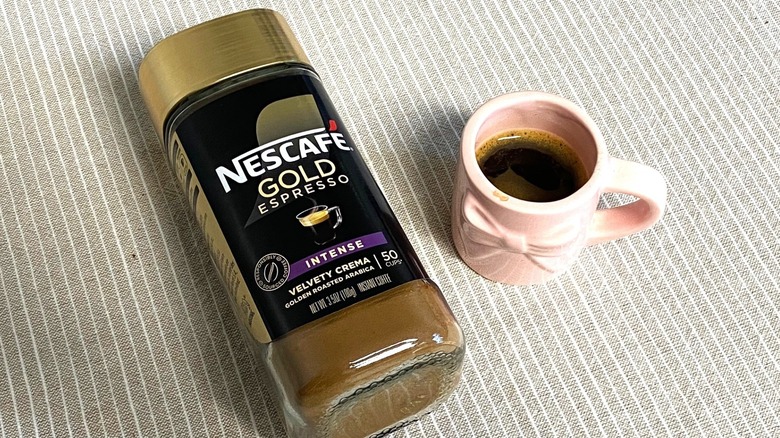
Prior to this review, Nescafé's jars of instant espresso always drew my eye in the coffee aisle, but I never thought to try them. The brand's instant coffee offerings have a global presence (its sweet latte packets were super popular in China when I lived there), and Nescafé is represented in the United States with its line of Gold Espressos. I picked up this 3.5-ounce jar for $9.24 at Walmart; that's one of the best prices among all the instant espressos I ranked.
When prepared as instructed with 2 ounces of water for espresso (6 ounces for Americano), the resulting beverage actually looked a little like a fresh espresso shot. As advertised on the jar, there was crema; it dissolved before I was able to even take a sip, but it was fun to see it. (A subsequent cup produced no crema at all.) Per the name of the product, the flavor was definitely intense, which was a tad surprising from a spray-dried coffee. It offered up a pleasantly sweet taste with caramel notes, though the mouthfeel was not as thick as a true espresso. In all, this is very drinkable, and the price is right. If instant espresso is what I'm craving, this budget-friendly variety hits the spot.
Methodology
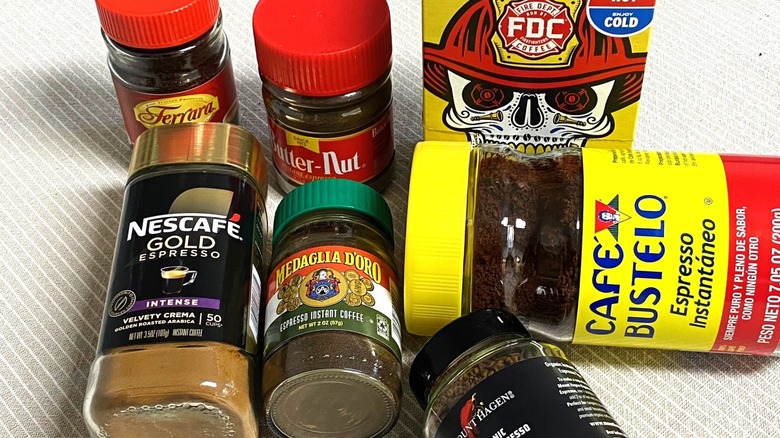
For this ranking, I selected instant espresso brands that are readily available in grocery stores or through shipping online via Walmart and Amazon. A high-ranking brand will have a strong, espresso-like flavor and a full-bodied, rich mouthfeel — not watery. Price will only impact ranking if two espressos are tied, in which case, better value for money will determine the higher ranking.
I used boiled, filtered water to prepare each cup and followed package instructions. That said, in some cases, the manufacturers' instructions yielded a beverage that was far too weak and watery to be considered espresso, so I added more instant espresso until the beverage came closer to its intended goal and stood a fair chance against the others. The product was then ranked with these changes taken into account, though all photographs are of the instant espressos before any additions were made to the cup.