

10 Popular Steak Cuts, Ranked Worst To Best
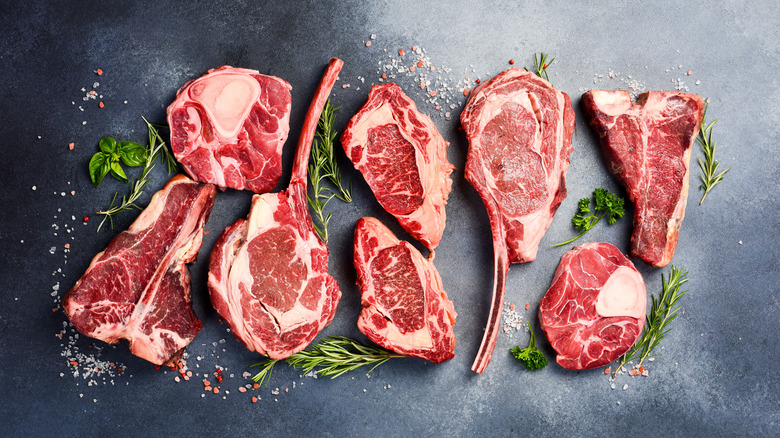
When many of us think of a celebratory meal, the menu often involves a perfectly cooked steak. Few things are as satiating to a carnivore as a cut of beef that has been prepared flawlessly. While there are plenty of techniques you can use to obtain restaurant-worthy results from virtually any cut of beef, such as butter basting or popping the meat into an immersion circulator, some steaks are just better than others, especially for novice cooks.
In my nearly two decades as the chef and owner of a restaurant, I have prepared thousands of steaks of all kinds. While there are plenty of factors to consider when sourcing the finest meat possible, such as obtaining USDA Choice or Prime beef and buying from a local purveyor versus a traditional grocery store, I still have my favorites when it comes to cost, flavor, texture, and ease of preparation.
No matter how much experience you may have in the kitchen, some cuts are simply harder to cook to succulent perfection, while others may lack the intense beefy flavor that makes a quality steak so satiating. If you are wondering which cuts a professional chef prefers to work with, you have come to the right place. Read on to discover my ultimate ranking of popular cuts of steak and how best to prepare them.
10. Round steak
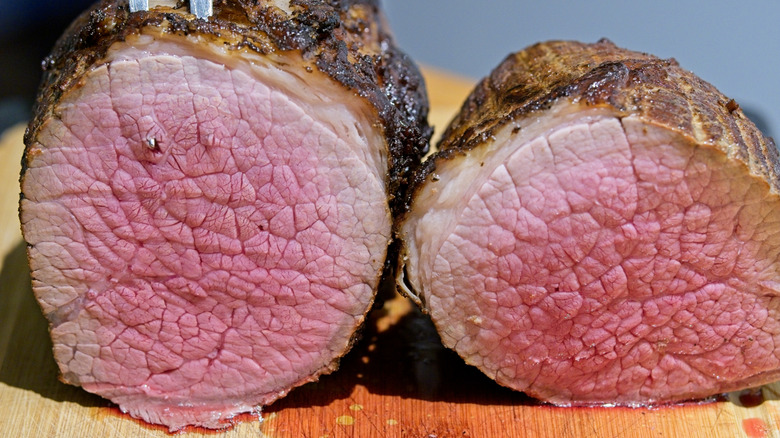
Though they are incredibly affordable, round steaks are perhaps the worst cut on the market. Round steaks hail from the rear legs of a cow. Because this part of the animal is well-utilized, the meat is abundant in connective tissue and has little to no intramuscular fat, meaning the meat can become incredibly tough when improperly cooked. Round steaks come in two primary varieties, the top and bottom round. The top round is sourced from the inside of the hind leg, while the bottom round comes from the outside. You may also spot the eye of round, which is a segment of the bottom round that is even more fibrous.
Round steaks are less well-suited for high-heat cooking methods, such as pan searing or grilling. They generally benefit from low-and-slow cooking methods, which break down those connective tissues and tenderize the meat. Because of this, round steaks require quite a bit of finesse and patience to properly prepare, which may make them less desirable for those seeking to get dinner on the table in a flash.
That said, there are a couple of tasty ways to prepare a round steak that may be worth investigating. One such technique is to prepare Swiss steak. This recipe involves tenderizing a round steak with a meat mallet until it is about ¼- to ½-inch thick. The flattened steak is subsequently braised in a tomato and onion sauce, which further allows the meat to soften and infuses it with flavor.
9. Flat iron steak
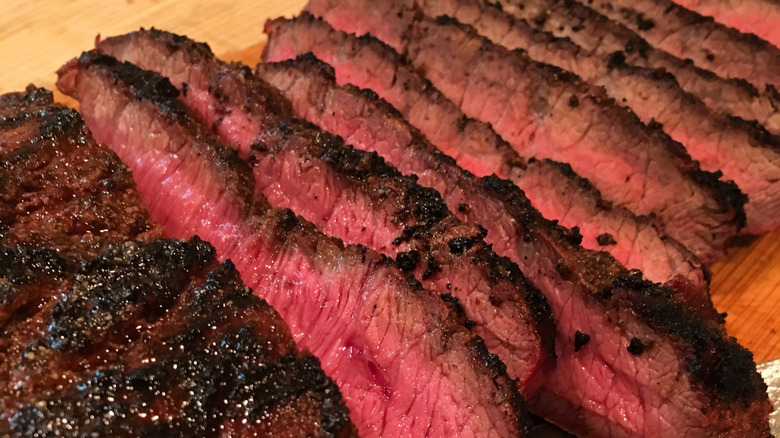
Second to last on this ranking of popular steak cuts is the flat iron steak. This cut, which also goes by "butler's steak" or "oyster blade steak," hails from the neck and shoulder region of the cow, more precisely the shoulder blade. The muscles here are frequently used by a cow, making the meat abundant in connective tissue that spans the center of the cut in the form of a silver skin. The flat iron steak, however, is an oddity in that the meat itself is quite well-marbled, and when expertly removed by an experienced butcher, any sinew and residual connective tissue is trimmed away, yielding a cut that can be wonderful to work with.
Perhaps the main reason this cut ranks so low is that it can be notoriously challenging to find. This cut emerged in 2001 out of a collaboration between the University of Nebraska and the University of Florida, which were tasked by the National Cattlemen's Beef Association to discover a new cut of steak. Since there are only two flat iron steaks per cow and they require a skilled hand to remove, most retail grocery stores do not keep this cut in stock. It is typically reserved for specialty butchers or restaurants, with conventional grocery stores opting to stock the more accessible top blade steak, which is nowhere near as tender or flavorful. Because of its marbling, the flat iron steak lends itself to conventional high-heat cooking methods, such as pan searing or grilling.
8. Hanger steak
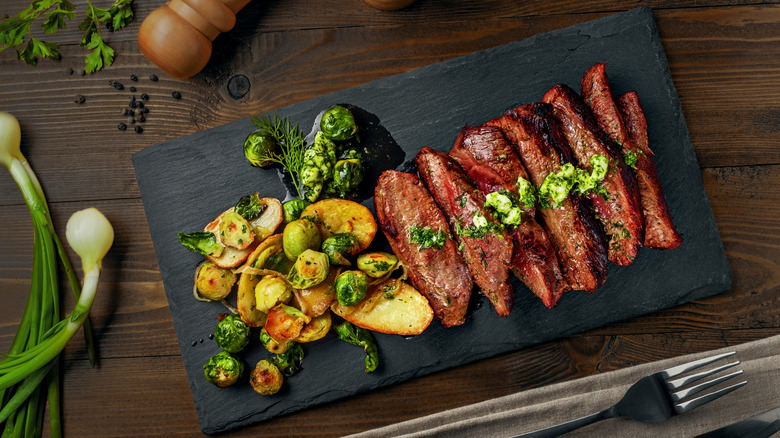
As its moniker suggests, hanger steak is a tapered cut of meat that is sourced from the belly of the cow, where it hangs underneath the animal's diaphragm. Historically, in the United States this steak cut was also known as the "butcher's steak" because hanger steak was prized by butchers. Internationally, however, it has long been considered a delicacy, especially in France, where it is known as an "onglet," as it is frequently served with a red wine reduction.
Though hanger steak can be delicious when prepared properly, it can be hard to source owing to the fact that there is only one per cow. If you do find one, hanger steak has another potential downfall in that it is challenging to cook well. While it has ample marbling, since this is a part of the cow that doesn't get much exercise, there is also a distinct membrane that bisects the cut, which can become tough if it isn't excised by a skilled butcher.
To properly prepare a hanger steak, it is important to use high-heat cooking methods and to always cook this cut to a medium-rare doneness. Anything beyond that will render a hanger steak dry and chewy. Ways of improving the texture and flavor of hanger steak include submerging it in an acidic marinade and allowing ample time for the meat to rest before slicing it against the grain.
7. Flank steak
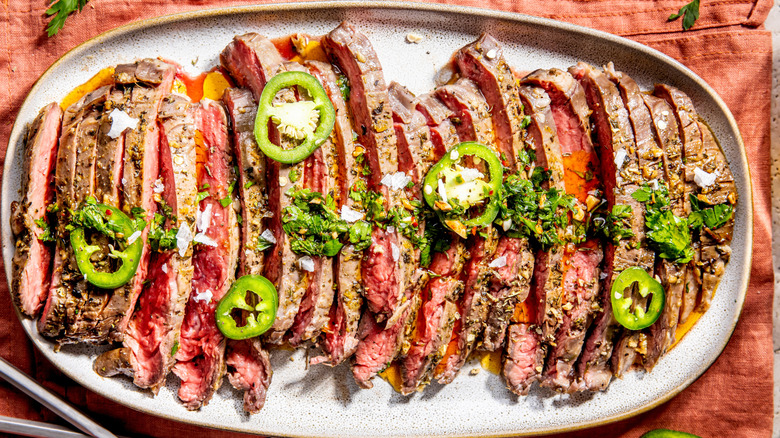
When it comes to flavorful, budget-friendly cuts, a flank steak is always a good option. This cut hails from the flank primal of the cow, which spans across the bottom of the animal behind the belly and in front of the legs. The flank steak is the muscle on the interior of this primal cut. When removed and cleaned of excess connective tissues and fat, this thin cut of steak can be fantastic, despite its lower fat content.
The key to flavorful flank steak is using care when preparing and slicing it, both of which require a bit of finesse. This is one of the reasons it ranks where it does. If overcooked, flank steak can quickly become an exercise in monotonous mastication rather than a delicious meal. Flank steak should always be marinated and cooked quickly over high heat until it reaches a medium-rare doneness.
Though grilling is perhaps the easiest method for cooking flank steak, it can also be prepared in the oven using the broiler. The broiler allows for the exterior of the flank steak to develop a crisp crust that yields to the tender interior of the steak. Just be sure to monitor doneness closely using a meat thermometer. Serve flank steak with a classic chimichurri sauce or pesto for a delicious and quick meal.
6. Skirt steak
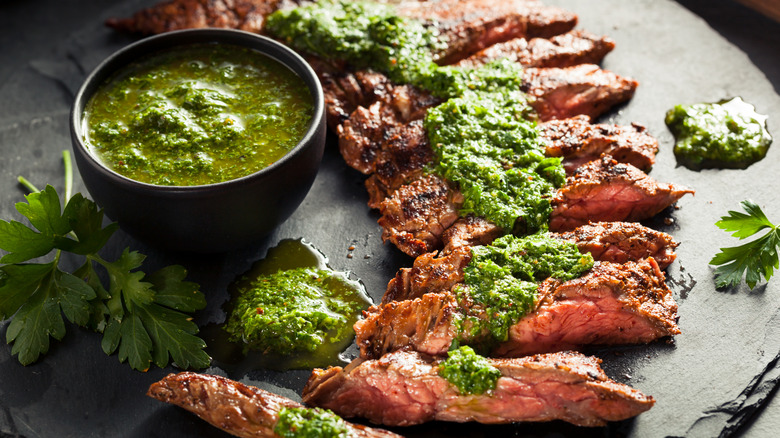
One of the beefiest, most delectable cuts of steak out there is the skirt steak. This cut is sourced from the belly or short plate of the cow. It typically comes in two forms, the inside and outside cut. The outside cut is generally preferred because it tends to be thicker and has a more even shape, making it easier to cook. This steak gets its name from its morphology, which resembles a pleated skirt.
These long, loose muscle fibers make this cut of meat especially well-suited to marinades, which can help to tenderize the thin cut, despite the fact that it has a decent amount of marbling. That said, it is prudent to be careful when marinating a skirt steak. Because these muscle fibers are so porous, they can quickly absorb too much marinade, rendering the meat mealy. This is one of the pitfalls of cooking a skirt steak that makes it challenging to prepare, which is one of the reasons it doesn't rank higher.
Though slicing any steak against the grain is important, this is even more crucial with skirt steak. Failure to do so will render this meat impossible to chew. The grain of a skirt steak is relatively easy to identify, but it can be challenging to slice due to its length. For this reason it can be helpful to divide the meat into smaller segments that are easier to cut.
5. T-bone
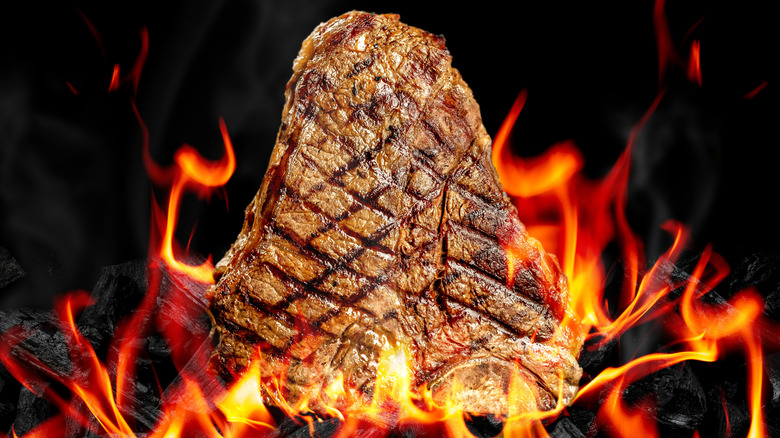
The T-bone hails from the short loin primal of the cow, an area that is prized for the most tender cuts of beef. Within the short loin are two subprimals, which are divided by a T-shaped bone, the beef short loin or New York strip and the tenderloin or filet mignon. When you purchase a T-bone, you are getting both steaks. Despite the somewhat hefty cost of a T-bone, this is a cut that is a home run for those wanting the best of both worlds, meat that is both supple and robust in beefy flavor.
The primary reason a T-bone doesn't fare better on this ranking is because it only contains a portion of the filet mignon and because it can be somewhat challenging to cook well. Though the bone acts as a buffer for the meat, keeping it moist and tender as it cooks, it can be hard to cook evenly, making this a cut of beef that is best suited for more experienced cooks, especially since they aren't cheap.
Unlike most other steaks, the best way to cook a T-bone is not to pan sear it. Its irregular shape makes it quite challenging to achieve the correct medium-rare doneness on the meat located on either side of the bone. Grilling, roasting, and even an immersion circulator are the best ways to achieve the perfect medium-rare doneness throughout the steak. At an average of 12-20 ounces of meat per T-bone steak, this cut can easily serve two people.
4. Porterhouse
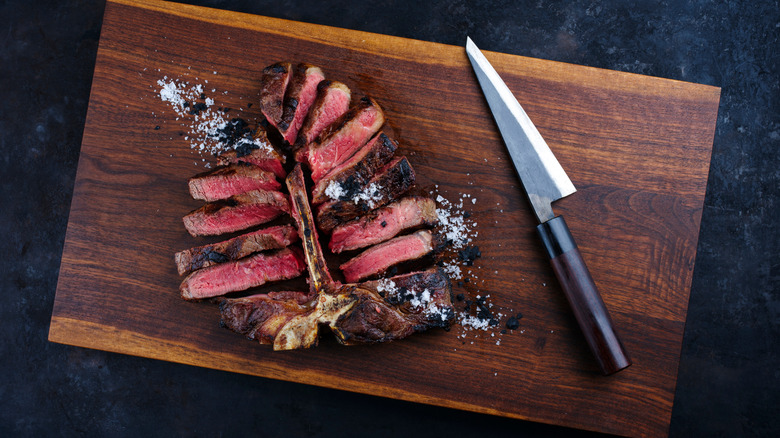
It follows that the next cut of steak to appear on this ranking would be the porterhouse. Like the T-bone, this is a composite steak taken from the short loin primal of the cow. It consists of both a New York strip and a filet mignon that are divided by a T-shaped bone, making it a great buy for those wanting bold, beefy flavor and a tender cut of meat.
The primary difference between the T-bone and the porterhouse is that the former is sourced from the front of the short loin primal, while the latter is taken from the back end. As a result, the porterhouse is both larger and more expensive to buy. As dictated by the USDA, the average porterhouse should have a tenderloin with a maximum width of 1.25 inches versus a T-bone, which is usually roughly ½ inch in diameter. A porterhouse typically weighs in at about 24 ounces, making it an ideal portion for up to four people.
Like the T-bone, a porterhouse can be similarly challenging to cook due to the presence of the bone. Again, high-heat cooking methods, like grilling or roasting tend to be the best ways to achieve a consistent medium-rare doneness throughout both halves of this cut. For best results, keep seasonings to a minimum and rely on the Maillard reaction to coax the most flavor out of this cut of beef.
3. New York strip
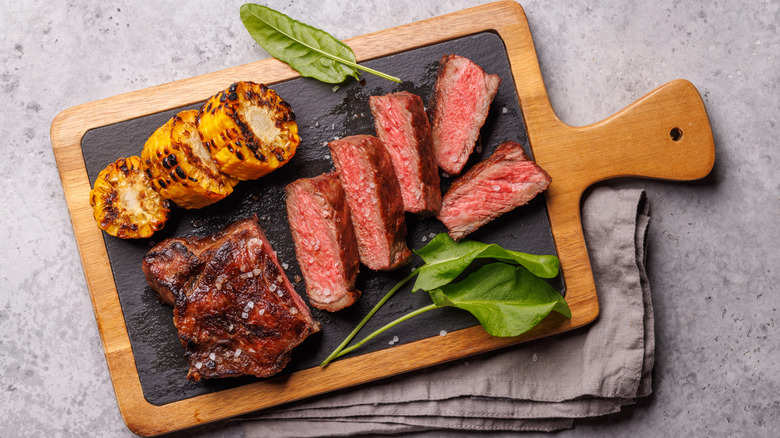
If a T-bone or porterhouse seems like too much meat or feels too daunting to cook properly, I highly recommend opting for a boneless New York strip steak. Also known as an ambassador steak, strip loin steak, Kansas City strip, club steak, or an Omaha Strip, this cut is abundant in intramuscular fat yet has a firmer texture that gives it a satisfactory mouthfeel.
The advantage to a New York strip steak is that it is quite forgiving to cook. It is frequently referred to as the ultimate griller's steak, but it can also benefit from any other high-heat cooking method, including roasting, butter basting, or a reverse sear. That said, there are some mistakes to avoid when preparing New York strip steaks that you should be aware of. Perhaps the most important of these is not preheating the cooking surface adequately to get a good sear on the meat, which will amplify the beefy flavor of this cut of meat.
The only reason this cut of steak doesn't rank higher on this list is because the top two tend to be fan favorites. However, for my money and personal tastes, a New York strip is hard to beat for flavor and texture.
2. Filet mignon
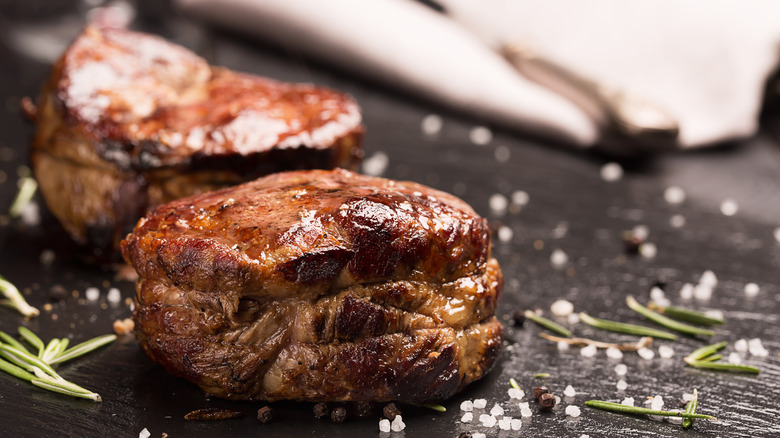
On the other side of the T-bone and porterhouse spectrum is the coveted filet mignon. The filet is what many of us go to when we are looking to splurge. It is considered by many to be the most premium cut of beef owing to its buttery texture and mild flavor. What makes this cut from the short loin primal so special is that it represents a relatively small percentage of the overall weight of a cow, roughly 2%-3%. This means it can be quite expensive and isn't something you will likely throw on a grill for an average weeknight dinner.
Though relatively low in intramuscular fat, the filet can be a cut that is relatively easy to prepare well as long as you treat the meat with reverence, which is why it ranks so highly on this list. Perhaps the biggest pitfall you can encounter when preparing a filet is overcooking it. A filet should never be cooked beyond a medium-rare doneness. Doing so can easily render the meat dry and chewy.
Because of its mild flavor, a filet lends itself to bolder sauces and garnishes. Compound butters made with garlic and fresh herbs, red wine reductions, and creamy sauces can all elevate a filet into a gourmet dining experience befitting of a fine dining restaurant from the comfort of your own home.
1. Ribeye
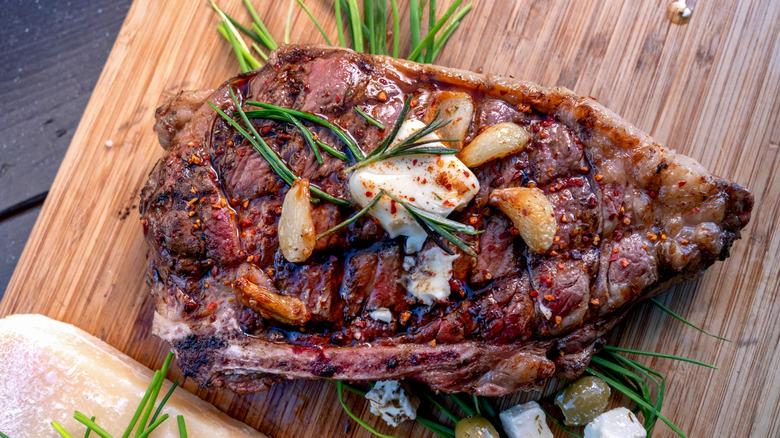
Also known as a Delmonico, Spencer, Scotch fillet, or beauty steak, the ribeye is arguably the king of all cuts. Its unique combination of rich intramuscular fat and robust, beefy flavor make it a home run in almost any preparation. The ribeye hails from the rib primal of the cow, an area between the shoulder and the loin. Ribeye steaks are cut from ribs 6 through 12 and can range in thickness from a half inch to 2 inches in diameter. Each steak is composed of three segments, the center or longissimus dorsi, the cap or spinalis, and the complexus, which is sometimes removed depending on the butcher.
Ribeyes are sold in boneless and bone-in varieties. The tomahawk is an especially well-regarded cut owing to its hefty size and meticulously trimmed bone. Another especially flavorful cut that is harder to come by is the ribeye cap steak or the rib crown. This cut is sourced from the exterior of the eye of the ribeye. It is often removed, rolled up, and fastened with butcher's twine for easy preparation. This portion of the ribeye is even more flavorful and tender because of the high ratio of marbling within it.
When it comes to cooking a ribeye, high heat is always preferred. Though grilling can be a great way to infuse a ribeye with that intense smoky, charred flavor, a butter-basted ribeye is nothing short of spectacular. The meat remains intensely succulent while fresh garlic, herbs, and butter infuse it with aromatics and flavor.