

What Are Donut Peaches And What Makes Them Different From The Rest?
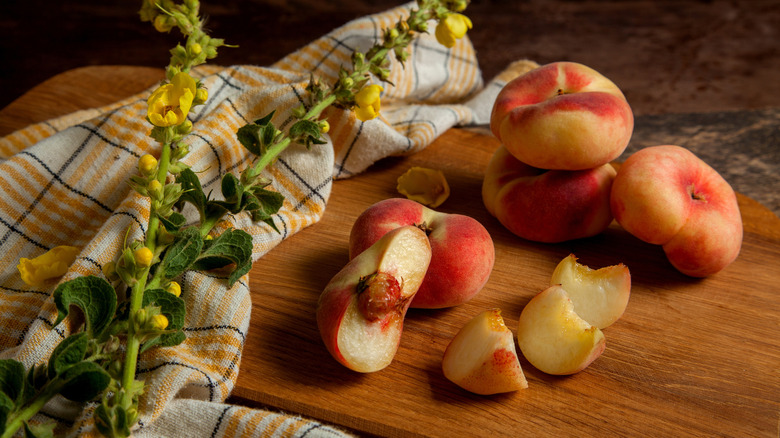
Stone fruits, botanically termed as "drupes," come in all sorts of shapes and sizes. While you may have come across varied sizes of globular peaches, plums, nectarines, and some overlooked summer hybrids like pluots, have you ever spotted peaches that look like they've been pressed on from the top and are laterally elongated? These are called donut peaches, a nod to their unique shape, similar to a donut without the hole in the middle (unless you remove the pit, of course). At times, you may notice that they are also referred to as Saturn peaches, flat peaches, or saucer peaches. If you're wondering what makes these peaches so special or different from the usual yellow and white peaches you are accustomed to, we're about to spill the beans. Beyond the evident difference in shape, there are quite a few traits that set donut peaches apart from the likes of the more familiar yellow peach. Donut peaches are a type of white peach, meaning they are typically less acidic and tart than yellow peaches.
Once ripened, they are a delight to the taste buds, bursting with sweet flavors with a subtle hint of their drupe cousin, the almond. Their skins also don't have any fuzz, so if you're averse to the fuzzy texture of the skin of a conventional peach, there's no need to peel — simply dive right in! Furthermore, the pits are much easier to remove, requiring just a little finger poke and slight pull; you won't need a detailed guide on how to efficiently pit your peaches. So, if you ever come across these delicacies at your local farmers' markets or grocery store, better believe that you're in for quite a peachy treat.
How donut peaches came to be and ways to use them
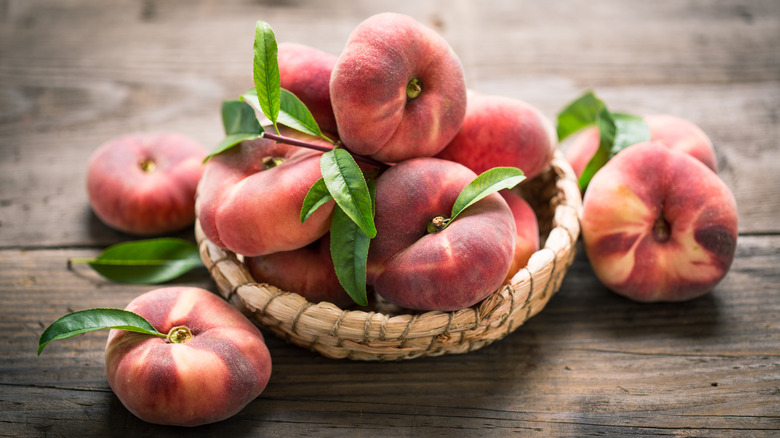
Where on earth did these extraterrestrial-looking peaches even come from? Contrary to the misconception that donut peaches are genetically modified, the origins of this succulent peach variety can be traced back millennia, where they were naturally grown on donut peach trees in China. For years, China was the only country where donut peaches could grow and thrive. At the time, the challenge with successfully growing donut peaches outside of China came down to their early blooming, which made them vulnerable to frosts. Thankfully, this was a challenge that the botanical geniuses at Rutgers University in New Jersey could tackle. In the 1980s, the university's plant-breeding experts developed a frost-resistant strain of donut peaches and named it "Saturn," given its shape that resembles the rings of Saturn. Now, these donut peaches thrive in the United States, particularly in the South.
When it comes to savoring this saccharine fruit during its prime, there are very few that come close to enjoying a fresh, juicy bite. That said, you can pretty much use donut peaches in place of yellow peaches in almost any recipe and in a variety of creative ways. This swap is particularly perfect if you prefer more sweetness from the peach than the tart notes. Be it a three-ingredient peach dump cake, homemade canned peaches, or a decadent peach sauce that you will want to drizzle over almost any sweet treat, donut peaches are here to transform the staples into something special.