

5 Grocery Store Chains With The Worst Seafood Departments
There's nothing quite like a crawfish boil with the family, or hosting a fish fry for your friends and neighbors. However, it's definitely food that comes with pretty careful instructions. If not handled properly, you just might end up in a whole world of hurt. The FDA advises that customers only buy seafood that is refrigerated or displayed on a bed of ice. Not to mention, fresh seafood is the best way to guarantee your seafood boil is delicious.
While it's a common belief that the best places to purchase seafood are fish markets or fish houses — mainly because you're getting the freshest fish possible and it helps support local economies — not everyone lives near one. For many, the only option for seafood is the nearby grocery store, for everything from shrimp to sushi, which is actually safe to eat from a grocery store. In a world where consumers are concerned about where grocery stores are getting their seafood and arguing farmed versus wild, there is a lot to consider before putting that pound of shrimp at Costco or Kroger in your shopping cart.
That's why we've put in the research to create this list of grocery stores that have the worst seafood departments, according to reports, news articles, and customer reviews. We looked at each store's reviews and reports on the quality of their seafood and where they source it, as well as whether they've had recalls or other scandals. Read on to find out which grocery stores you should avoid the next time you want some seafood.
1. Walmart
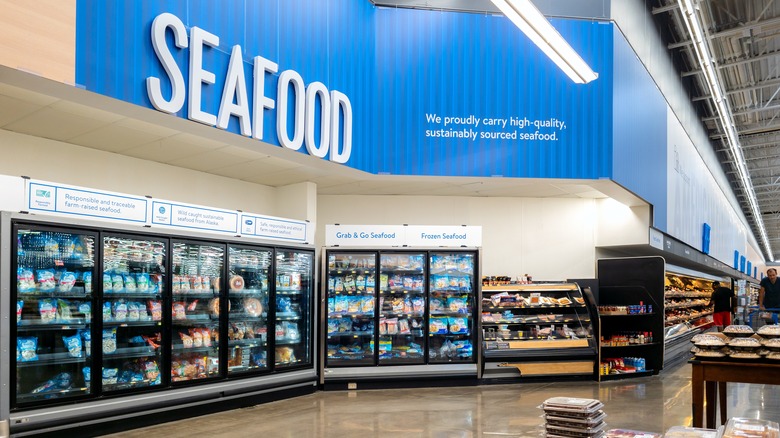
This first entry is probably not much of a surprise for many, especially since the first news item we found is very recent. The FDA announced on August 19, 2025 that consumers should avoid frozen shrimp sold at Walmart processed by an Indonesian company that may have been contaminated by Cesium-137. The shrimp were sold at stores in 13 states. But that's not the only negative against the chain.
Walmart has also faced mislabeling allegations, contending that the brand was attempting to push imported shrimp as domestic shrimp. An investigation in 2024 into the biggest shrimp producers linked Walmart and other retailers to the exploitation of shrimp farmers in Asia. While Walmart's sustainability policies may not have been up to snuff in the past, at least it's working to improve. In 2023, Walmart announced it would ask its tuna suppliers to "source exclusively from vessels that have 100% observer monitoring (electronic or human) by 2027." It also said it would source from fisheries using zero high seas transshipment unless it is covered by "100% observer monitoring" by 2027.
In terms of quality, even our own Chowhound writer found Walmart's Great Value brand was lacking in the canned fish department, though there are plenty of complaints on the Walmart website. It's Marketside Skin-on Salmon Fillet has low rankings, with customers claiming it was spoiled, tasteless, and made them sick. Others alleged that the Louisiana Crawfish also weren't fresh and smelled horrible. Still more complained about the ratio in the Seafood Festival, as well as complaining about the quality and smell.
2. Aldi

Aldi certainly has the most interesting model out of all the stores on this list, prioritizing fewer workers, products, and SKUs to keep costs and prices low. As such, the brand doesn't have a dedicated seafood department in the traditional sense. Its seafood is displayed in the boxes it was shipped in, rather than on ice or in displays. However, it's not the low prices that make Aldi not the greatest place to shop for seafood.
The store has faced a number of recalls and negative news regarding its seafood over the last year. In May 2025, stuffed salmon sold at Aldi's was recalled because it didn't include a potentially life-threatening allergen in the labeling. In 2024, it was one of several grocery stores to face lawsuits over sustainability claims and eco-labels. While the lawsuits were eventually dropped, the store agreed to change its farmed salmon marketing. Later on that same year, an investigative report was released, alleging that Walmart and Aldi purchased contaminated shrimp from an Indian supplier, which also mistreated its employees. We also can't forget the decade-old scandal involving North Korean workers at Chinese seafood suppliers that Aldi purchased from.
And then there are the complaints about the seafood. One customer posted a photo on Reddit of a worm in the salmon they just purchased. Another thread on Reddit had several complaints about Aldi's frozen fish, saying it wasn't very good. This was echoed on a different social media posts, where more chimed in that Aldi's frozen salmon wasn't great. There were complaints about the lobster shrimp ravioli, with some saying it was too fishy and didn't impress.
3. Costco

Costco is one of those places that at first glance appears to be hit or miss, though from our research, it tends to lean more on the miss side of things with seafood. It offers a mix of fresh and frozen seafood — mostly in bulk sizes, as is the store's model. In the last year, it's had two seafood recalls. Kirkland Signature Smoked Salmon products were recalled in October 2024 over listeria risk, reaching the FDA's highest risk level of a Class 1 Recall. The store was also hit by the canned tuna recall in February 2025 over botulism concerns.
Costco received a failing grade on Greenpeace's latest Tuna Scorecard, released in 2024 (the 2025 report isn't out as of publishing). The report looked at 16 major retailers, each receiving an overall environmental score and an overall human rights score. Costco failed at both, earning a 35% in environment and 25% in human rights. On the plus side, as of January 2025, Costco announced it would be working more closely with the Aquaculture Stewardship Council (ASC) by carrying more ASC-certified products. At that time, about 72.9% of Costco's farmed seafood was ASC-certified.
That's not even getting into the complaints online. On our own ranking, we put Costco's Morey's Fine Fish and Seafood Marinated Wild Pink Salmon at the bottom, citing a weird, mushy texture. Some customers warn about overpricing on some fresh items, and several said they returned the Aquastar crab legs for smelling fishy and low quality. Others said the frozen lobster wasn't worth it, as well as disappointing and disgusting.
4. Winn-Dixie
While Winn-Dixie may have one of the best meat departments among grocery store chains, but it doesn't measure up when it comes to seafood. It, too, recalled canned tuna in February 2025 over contamination concerns. Winn-Dixie also had a location in South Florida shut down around the same time, in part because shrimp, mahi fillets, and tilapia were stored at unsafe temperatures, per Local10, and it failed to meet essential requirements for food safety compliance. Roaches were also found in the bakery.
True, this was only one location. However, reviews of crabs bought from a different location complained about a weird smell from the frozen crabs that they bought. Another commenter on the thread commented that they had frozen shrimp from the store that smelled strange, as well. There are also several reports of food poisoning. Out of 29 suspected food poisoning cases from Winn-Dixie over the last year on iwaspoisoned.com that posts "vetted consumer food-safety reports," four were on seafood products. They include both fresh and frozen fish and shellfish.
5. Kroger
Sometimes, having a decent sustainability and sourcing policy isn't quite enough to ensure that you have a good seafood policy. Kroger has been a World Wildlife Fund partner since 2009 and launched a more comprehensive sustainability policy in 2021. But the brand was caught up in the large-scale canned tuna recall in February 2025 over botulism concerns. Not long before that, in December 2024, Kroger's sushi was voluntarily recalled after being linked to a salmonella outbreak.
Kroger's seafood appears to get consistently negative reviews online. In this post on social media, a customer laments getting salmon and tilapia with a "bad taste" three times in a row. Others commented with their experiences of food poisoning and also getting fresh seafood from Kroger that tasted off. Remember, a good way to tell if the fish you're hoping to purchase is fresh is to make sure that it's firm — not mushy — and doesn't have any discoloration.
Another post showed a worm/bug found in a bag of fresh shrimp. There were also many negative reviews on products like the Mercado Seafood Medley, Crunchy Butterfly Shrimp Frozen, frozen wild-caught Pacific Whiting fillets, wild-caught large peeled and deveined shrimp, Pacific Cod fillets, and pink salmon fillets. Common complaints were about the taste (fishy, too salty), the size, the quality, and more. There have also been complaints that the fish weren't packaged properly. From the number of them, it's probably a good idea to show for seafood pretty much anywhere else.
Methodology
How did we determine what constitutes "bad"? Well, it definitely involved a whole lot of research and diving into internet rabbit holes. We wanted to set strong parameters and go off more than simply customer complaints. And while things such as ethically sourced seafood and farmed vs. wild-caught often come down to personal preferences, the general consensus is that grocery stores are, at the very least, appearing to move toward incorporating this more into their standard practices.
There were three main areas that we researched to determine if a grocery store had a bad seafood department. First, we looked to see if it had any recent scandals over the last year. This can include anything from the handling and storage of seafood to recalls, selling potentially contaminated food, and so on. We then also looked into their sourcing and sustainability programs to ensure that they had them and that they were sufficient. According to The University of Washington, knowing the country of origin, certification labels, and having a seafood sourcing policy are the best ways to know if that tilapia or salmon is sustainable.
Lastly, we turned to customer reviews. These were sourced from the grocery store websites, Yelp, Reddit, and social media accounts. We looked at reviews for specific products and what customers didn't like about them, as well as overall comments on stores and their seafood departments.