

15 Kitchen Island Trends That Are Taking Over
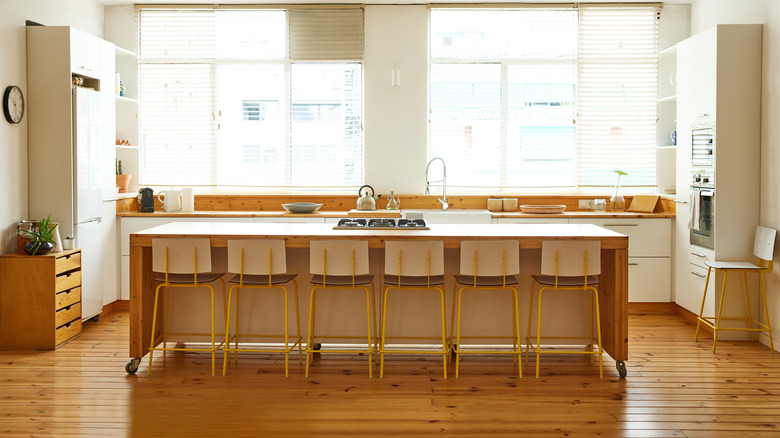
Depending on the layout and size of your kitchen, an island can be a great addition to the space. Plus, while adding an island can sometimes require construction work, it doesn't have to. Although many islands are built-in workstations designed to match the rest of the kitchen, this isn't always the case. They can just as easily be added to the room as freestanding pieces.
In fact, there aren't many rules for what constitutes an island in the first place. It's different from a table because it's the same height as your countertops, and it needs to be accessible from all sides — otherwise, if it's joined to one wall, it's technically a peninsula.
Beyond that, your island can be anything you want it to be in terms of functionality. This has led to a fun rise in kitchen island trends, allowing homeowners to get wildly creative with how they use, decorate, and fit out their islands, from top to bottom, and on every accessible side.
1. Multi-purpose islands
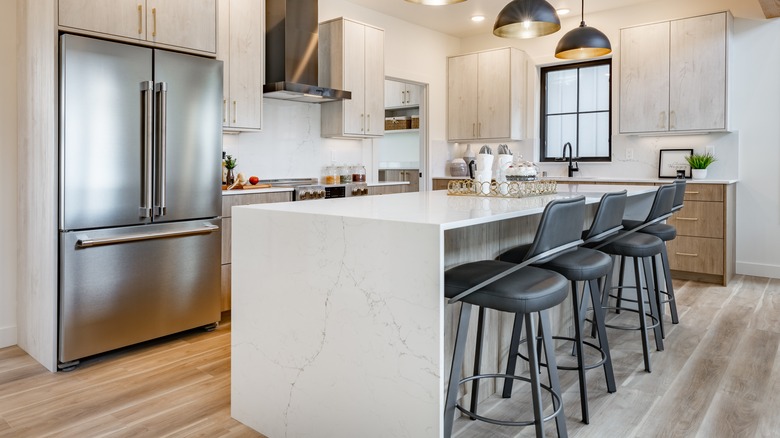
Most people will agree that an island's main function is to serve as an additional workspace. This is handy enough, but homeowners have realized they can further elevate this piece so that it serves multiple purposes — and this trend has only gotten more popular.
Along with providing more counter space, islands can also be fitted out to function as an additional eating area, a place for extra storage, or even just a decorative feature. Many people treat it as a sort of breakfast bar, where families can gather to have their quicker, more relaxed meals that don't require as much space as a dinner table.
But your kitchen island is also a great place to extend your kitchen decor. From beautiful light fixtures to wooden bowls filled with seasonal fruit, the island is often the central focus of the kitchen. Letting it serve multiple purposes, both functional and aesthetic, just makes sense.
2. In-island sinks
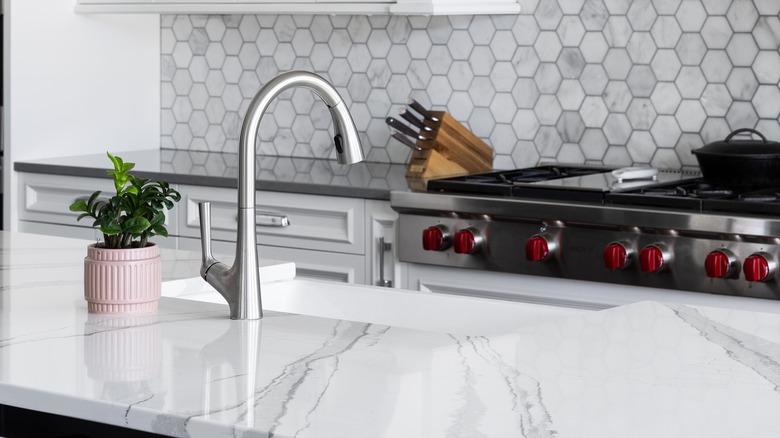
One great way to make your kitchen island more functional is to install a sink. If your kitchen is large enough, this can serve as a secondary alternative to your primary spot, or it can be the location for your main sink. It all comes down to how you plan to use your kitchen and whether or not you share the space with other home chefs.
Having a second sink, however, allows for one to be home to your more niche requirements, such as a boiler tap or a garbage disposal. This can be a handy safety precaution if you have small children at home, as well as a helpful way to streamline your kitchen tasks.
An in-island sink also allows for some critical design decisions in terms of which sink material you prefer. While your main sink might be stainless steel, you can have some fun with your island alternative. Think farmhouse sinks or natural stone, rolling straight in from the rest of your island's material.
3. Hidden microwaves
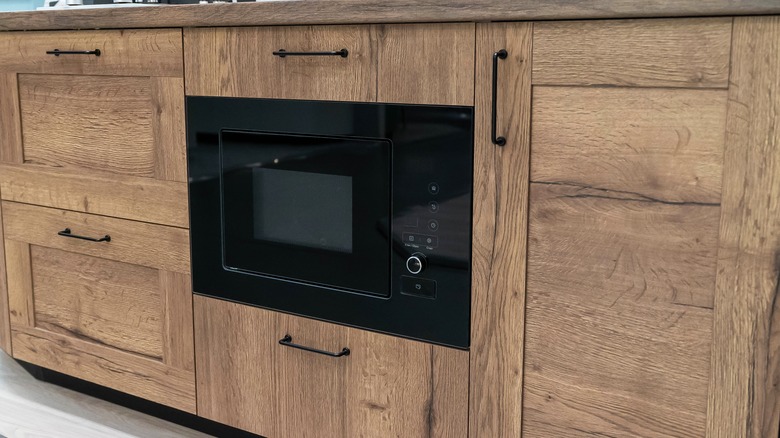
For decades, microwaves have held a prominent place in our kitchens, often placed on the counter or hung above it. But lately, people are looking for creative ways to free up space. This has led to a rise in appliance garages for many, but if you have an island, you can also consider placing your microwave here.
At first, this might take some getting used to. A hidden microwave in your island means it'll be at waist height, so it might not feel quite as accessible as having it on the counter or hanging up higher — at first. In practice, however, you might find that it's actually more helpful. With your microwave positioned directly adjacent to your largest workspace in the kitchen, you can easily multitask parts of your process, such as softening butter while baking.
Plus, the aesthetic perks are obvious. Namely, with your microwave installed out of sight, it's one less unsightly appliance crowding up your counters.
4. Two dishwashers
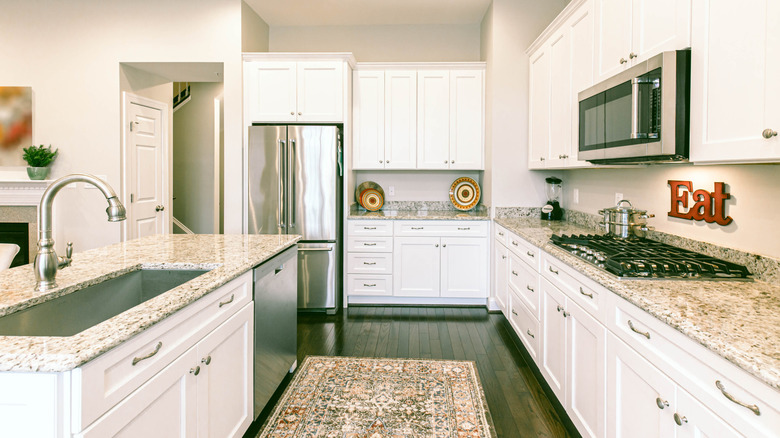
If you're trying to figure out how to elevate your kitchen island, adding appliances is a safe bet. One great option is to install a second dishwasher, which can be a game-changer for anyone with a large family or who hosts often. It also works well in conjunction with a second sink, if you decide to go that route, too.
It's worth noting that having a backup dishwasher on your island doesn't necessarily mean you have to run two dishwashers regularly. It's simply there for those times when this would be helpful. As an added bonus, having two dishwashers allows you to run different cycles simultaneously. This can help with cleaning up after more intricate meals, where you might want to wash pots and pans in one machine and your used dishware in another.
5. Combination worktops
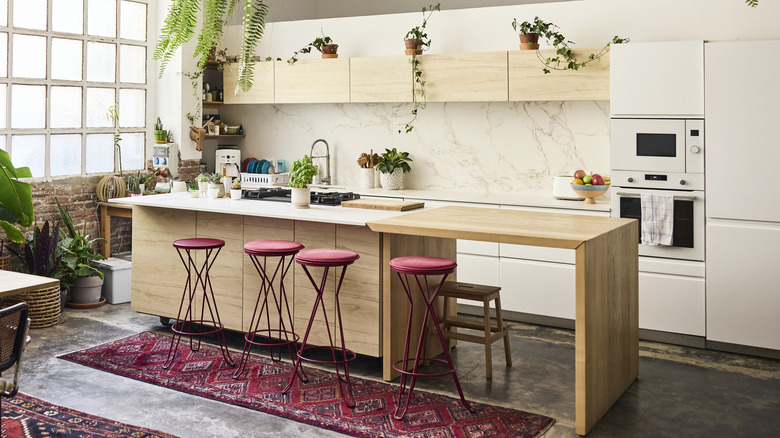
For many people, the kitchen island features the same worktop as the rest of their counters. This creates a beautiful, streamlined look that can tie the whole room together — but it could also be a missed opportunity for something that's both more visually interesting and more functional.
One alternative is to create a combination worktop that features two prominent materials, each useful in its own way, such as one half natural stone and one half butcher block. Doing so allows for a more multidimensional workspace that can help create zones in the kitchen and maximize the flow.
One thing worth considering, however, is that various worktops will require different maintenance. For example, if you clean your butcher block with a vinegar mixture, you would need to be careful not to spray it on the stone surface, as the abrasiveness can be damaging. But in general, the versatility of a combination worktop is definitely worth it.
6. Waterfall countertops
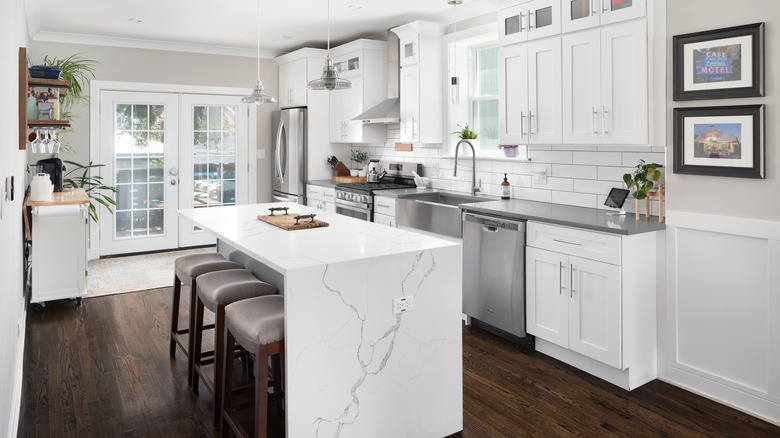
One major benefit of having a kitchen island is that you can make design decisions around this particular piece that differ from your regular kitchen counters. This can involve everything from your cabinetry to your hardware, but one rising trend is the use of a waterfall countertop. This look is also something that can only be executed well on a kitchen island or a peninsula.
Unlike a more traditional countertop design, a waterfall countertop is when the stone used to make the worktop extends—or cascades—down the side of the cabinets, extending fully to the floor. It's not necessarily done for any practical purpose, but it instantly gives it an elevated look.
To execute this island's appearance effectively, you can really use any material you prefer, but you'll need one that can be designed either as one piece or to appear as such. Most opt for a quartz, granite, or marble finish and choose one with stunning veining for a more dramatic design look.
7. Natural wood finishes
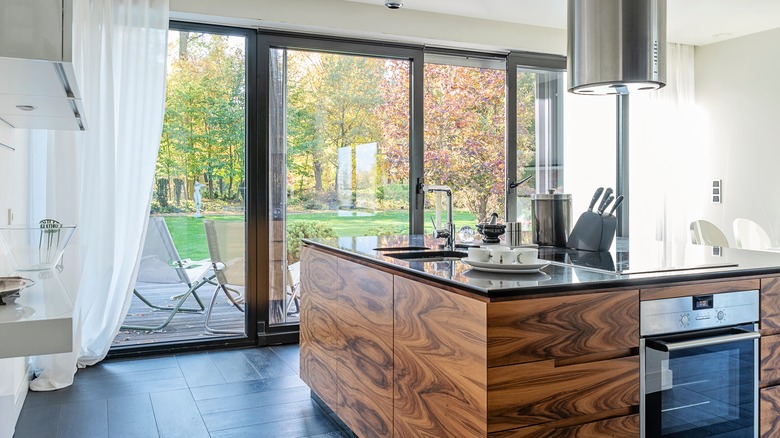
For a more rustic aesthetic, natural wood finishes in the kitchen are on the rise, and this goes beyond a wooden worktop. Instead, wooden cabinetry and trim are making a major comeback, and this trend also applies to kitchen islands.
The key to achieving a fresh and modern look in a wooden kitchen is to consider the hue and finish of your wood carefully. Anything too warm or shiny runs the risk of looking dated, while a more natural finish is very on-trend at the moment. The same goes for the shape and edges of your wooden finish. Avoid overcomplicated engravings or borders for a truly timeless look.
As an added bonus, a natural wood finish on your island can complement a variety of aesthetics. Depending on how it's styled, it can work just as beautifully in a modern farmhouse-style home as in a house with a more rustic, cottagecore-inspired kitchen.
8. Curved edges
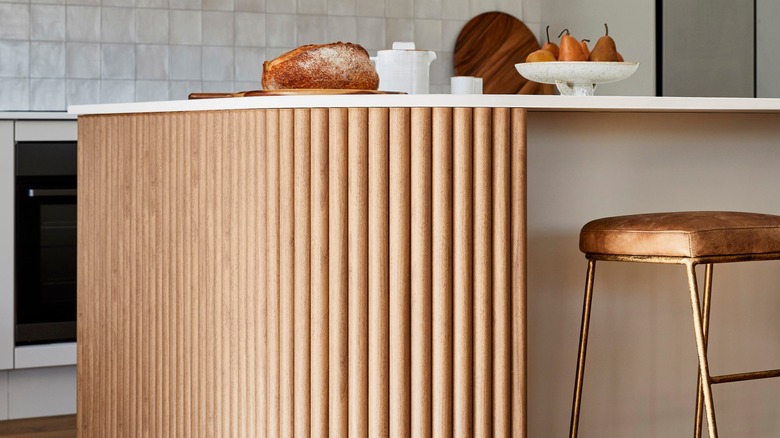
Curved edges have been a rising trend in all areas of design over the past few years, from doorframes to sofas. That's why it's no surprise to see their increasing appearance in kitchens, as well — and especially when it comes to island design. But the beauty here is that a curved island can do so much for the right space, assuming your kitchen is large enough. Much like a curved sofa in the living room, you need a kitchen that can accommodate the floor space required for a curved island.
But without that barrier, a curved island packs a stunning punch and can be surprisingly functional, too. When standing on the inside, using the island as a workstation, everything is closer at hand with a curved island. But on the opposite side, you can likely squeeze in an extra stool or two thanks to the extended width of the outer curve.
9. Mixed metal fixtures
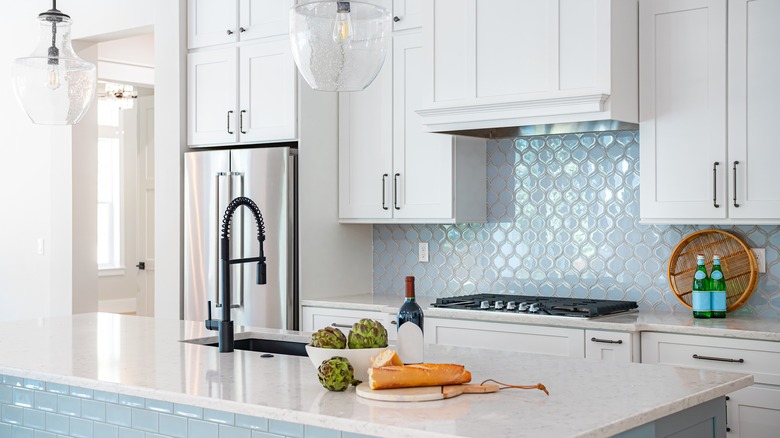
There's a reason interior designers often refer to hardware, such as doorknobs and drawer pulls, as the jewelry of the room. There's a lot of overlap, conceptually. These elements are usually made of metal and add an extra dash of interest to the space. Most people will tell you that the finishes in one room should all match — until recently.
As a rising trend, more and more people are opting to mix metals in their kitchen, and changing up the hardware on your island to differ from your main cabinetry is one great way to do this. The key is to make sure your fixtures still share some commonalities. They can have the same shape, size, and scale but different colors, or they can be the same color but different finishes, with some polished and some matte.
Just remember that the metallic finish of your plumbing fixtures, such as your sink faucet, should be considered and incorporated into the overall design plan as well.
10. Integrated appliances
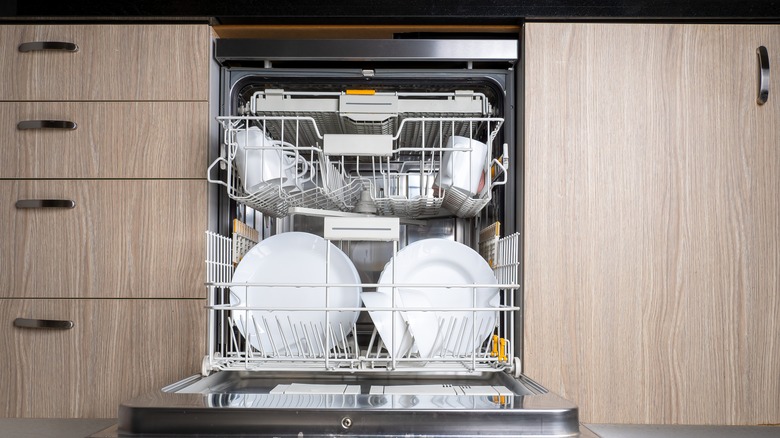
If your goal is to have a sleek, seamless-looking kitchen, then installing integrated appliances is an absolute must. This is when appliances such as the dishwasher, microwave, and refrigerator are 'hidden' with built-in cabinetry to conceal the unsightly exterior. With this growing trend has come the added layer of installing integrated appliances in your kitchen island.
In the past, the island wasn't generally the home for any appliances, but this is changing — and especially in larger kitchens. Whether it's your primary or secondary dishwasher, or your built-in microwave, integrated appliances are the perfect way to blend function into style and keep your kitchen's overall aesthetic both intact and elevated.
This look is most paired with a simple cabinetry, and there's something about an integrated appliance that feels instantly modern and chic. This also, of course, calls for a customized island, which opens the door to a whole host of design options—including the integration of smart appliances into the space.
11. Organic pendant lights
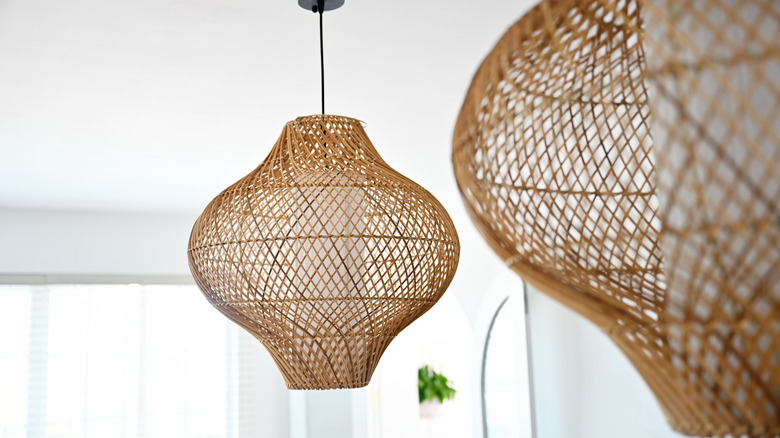
For many years, kitchen islands have been fashionably lit with oversized lantern pendants hung overhead, typically in sets of three. However, with time, designers have begun to take more risks, and new lighting styles are starting to emerge and take over. Most recently, we've noticed a swing toward organic pendant lights.
This particular pick for overhead lighting is less about the fixture itself and more about the shade. Often a simple cable fitting with woven or rattan shade, organic pendant lights are a reflection of our ongoing obsession with biophilic design. This aesthetic effectively brings the outside in, utilizing warm, earthy materials, colors, and textures that are layered together to evoke a sense of calm.
While oversized pendants certainly still have their place, particularly in farmhouse-inspired kitchens, organic lighting is a great way to warm up your kitchen and strike a balance between a refined and relaxed aesthetic.
12. Colors to complement the cabinetry without matching
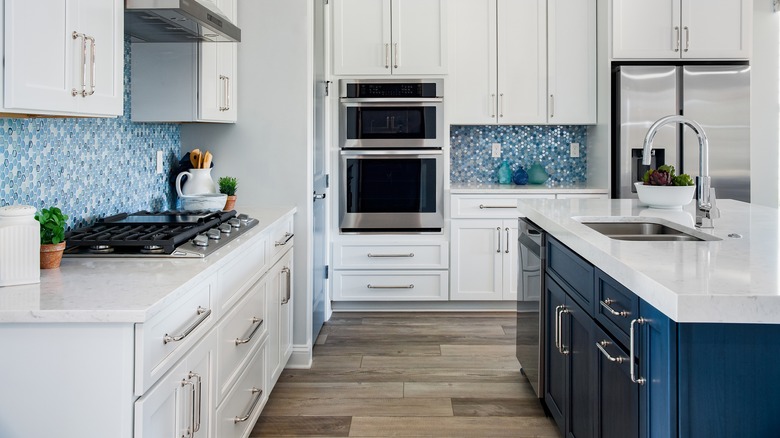
Across the board, most designers will tell you that not only is 'matchy-matchy' out, it's been out for quite some time. While furniture sets and uniform built-in cabinetry were once highly coveted, most people are craving comfortable, lived-in aesthetics that feel both intentional and relaxed. Unfortunately, this means a full set of anything too uniform feels decidedly fussy.
This is often seen with an island that works well in the kitchen's existing cabinetry, but isn't painted in the same color or finish. It might look like complementary colors from a similar pattern, or painted wood when the cabinetry is all natural, or vice versa.
Of course, if you opt for this option, it's essential to ensure that everything still aligns in key ways, such as scale, shape, and overall style. Otherwise, you risk creating visual chaos rather than cohesion.
13. Surface lamps
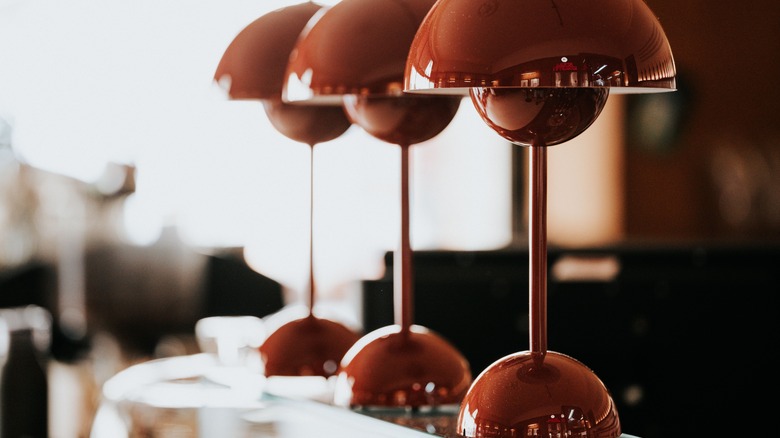
As far as new tech goes, rechargeable lighting arrived on the scene fairly quietly and now seems to be everywhere. Gone are the days of simply accepting that a corner must be dark because there's no place to plug in a lamp. Now, you can pop a small, rechargeable lamp anywhere you'd like, and this includes on top of your kitchen island.
Some islands might already feature built-in outlets, but it's not necessarily somewhere you'd want to keep a lamp all the time. Instead, these sockets usually exist so you can plug in smaller appliances as needed. But if you're using your island as an occasional eating space or breakfast bar, some tabletop lighting might be helpful.
Overhead kitchen lighting can be notoriously harsh, as it is necessary to illuminate the space when cooking. But with rechargeable lamps on hand, you can easily convert your existing island into something new, with a warm, glowing ambiance that's perfect for creating ambiance.
14. Contrasting aesthetics paired together
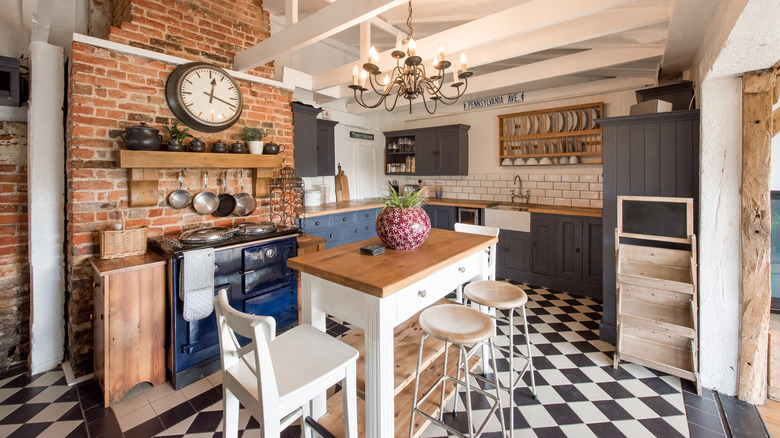
Of all the ways you can mix and match your island to the rest of your kitchen, contrasting aesthetics paired together might be the most surprising... at least at first glance. But when you really think about it, designers have been blending different eras and design schemes together for years now — and to much acclaim.
An all-modern kitchen in a vintage home, for example, can be a beautiful surprise, just as a vintage, rustic island can create a stunning shift in a more contemporary kitchen. The same is true of pairing country and chic, or classic and bohemian, together, and this can be achieved through a variety of kitchen island elements. Opt for more ornate cabinetry finishes, add traditional trim, or use a different worktop finish on your island. Alternatively, if you're looking to add a free-standing piece, consider sourcing a vintage item that's truly one of a kind and can make a powerful statement in your home.
15. Shades of blue
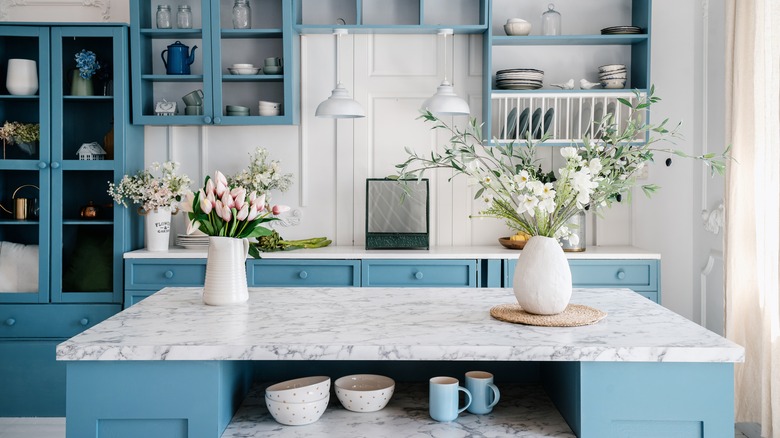
For a few years, green kitchens were all the rage. From sage to emerald, it seemed everyone wanted their cabinets painted in some lush variant of the shade. Now, it seems blue is taking over, and the kitchen island is the perfect place to give it a test run.
Depending on the size and style of your kitchen, opting for a bright, bold paint color might be an intimidating prospect. But dipping your toe in by painting your island is a great first attempt at adding a splash of color, and blue is a fairly easy tone to work with. Whether you go with a dark, moody navy or a softer pastel hue, it pairs beautifully with existing woodwork and cabinetry.
This is especially true if your kitchen is already a neutral base to begin with. Also, known for its calming properties, blue can bring a sense of relaxation to an otherwise busy, bustling hub in your home.