

I Tried 9 Different Tricks For Separating Eggs, And This One Makes My Life 10x Easier
We may receive a commission on purchases made from links.
If you've ever attempted to bake a meringue-based dessert or a custard, like a classic crème brûlée recipe, you have encountered the frustration of one of the most challenging tasks in the kitchen: separating egg yolks from their whites. This unenviable task can be messy at best and downright anxiety inducing at worst. Often the yolks are punctured, dissolving into a pile of goo, before you even have a chance to get the contents evacuated from their shell, resulting in waste, which, considering how expensive eggs are, is not a casual loss.
While there are a number of tips and tricks for successfully separating egg yolks from their whites, such as bringing them to room temperature first and tapping them against a countertop rather than the edge of a bowl for an even break of the shell, the actual process still requires some skill and potentially a kitchen gadget to get the job done effectively. As a professional chef with nearly two decades of experience, I have done my fair share of trial and error with perfecting this task, and even I occasionally run into hiccups.
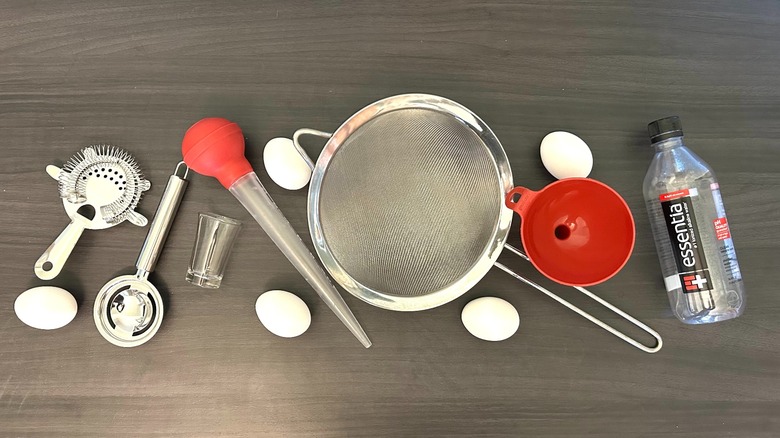
As such, I set out on a mission to test once and for all what trick or gadget would be the most effective at tackling this annoying task. I employed the shells, an ordinary turkey baster, and even ordered a newfangled egg separating device to see if it was the answer to my soufflé fantasies. Read on to discover which of these methods actually made my life 10x easier and which were a total bust.
9. Employ a cocktail strainer
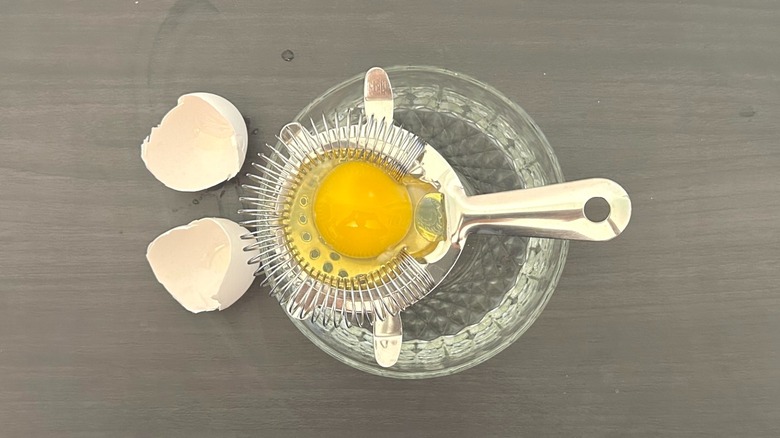
Admittedly, I was a skeptic of this method from the get-go, but I decided it was worth attempting this hack I discovered on the inter webs. My suspicions were well-founded. The theory behind this method is that an egg can be cracked onto a cocktail strainer that has been perched on a bowl or glass and the whites will readily fall through the holes in the utensil.
While this works well for liquids being separated from solids that are shaken together for a bougie cocktail, like a tasty whisky sour, it most certainly doesn't work for separating an egg yolk from its whites. At the core of the issue is the viscosity of the egg whites. They are thick enough that they do not glide handily through the holes of the cocktail strainer, even when gently shaken or nudged. The egg simply sat perched atop the strainer in its entirety, making this trick a complete failure.
8. Using the shell
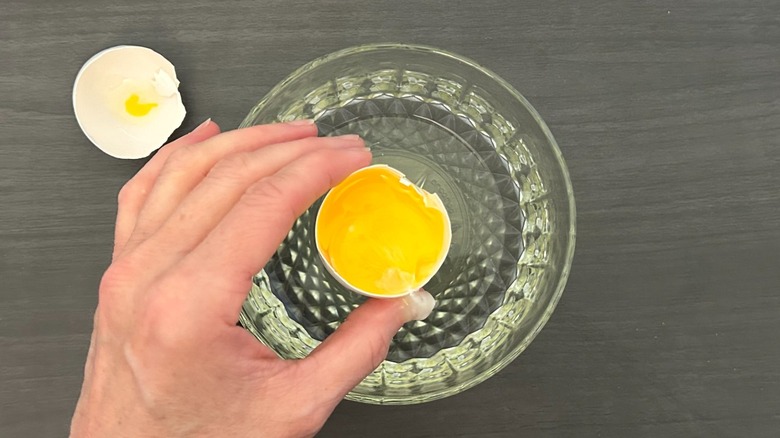
The second to lowest ranking method for separating egg yolks from their whites is to do so using the very shell of the egg once it has been cracked open. The yolk itself can be transferred from one half shell to the other until the whites have completely been emptied into a bowl. While this method does in fact work, it is not without its flaws.
More often than not, you run the risk of piercing the egg yolk with the shell, which results in a mess, and you'll likely end up wasting the egg. Even a professional baker will run this risk, making it that much more of a problem for home cooks. While I cannot completely write this method off, I don't rely on it because it isn't fool proof. You are much better off trying one of the other methods on this list, especially if you are accident prone or have shaky hands.
7. Cracking it into a slotted spoon or fine mesh sieve
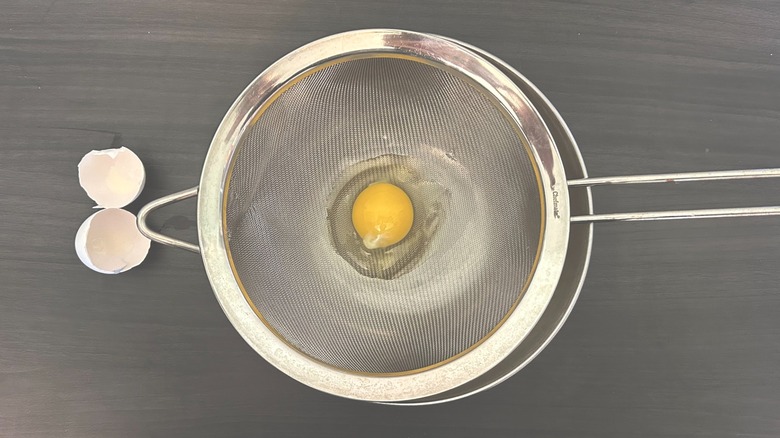
Another method that works, but not especially well, is cracking the egg into a slotted spoon or fine mesh sieve. This one comes with something of a caveat, however, as the efficacy of the method is contingent on the size of the slotted spoon and the weave of the fine mesh sieve.
Slotted spoons with wider holes and fine mesh sieves with looser wires are more likely to allow for the whites of the egg to pass through them. Even so, this requires some coaxing and shaking to jostle the egg whites through the gaps, a process that can inadvertently damage the egg yolk, which is what happened to me as I attempted it.
I even tried tossing an egg into the top portion of a double boiler to see if the larger holes would make the process less messy. It did, somewhat, but it was still hard to get the whites to pass through the holes and the yolk still got damaged. All in all, I'd give this method a D grade overall.
6. Pop it into a funnel
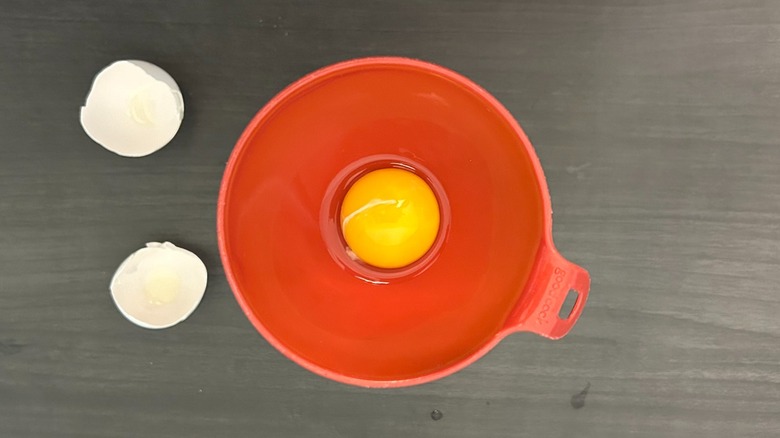
Among the methods that actually does work well to some extent is using a funnel to separate the egg yolk from its whites. When cracked into a medium-sized funnel, the egg whites will slowly fall through the opening in the contraption. The key word here is "slowly," This method takes awhile for the whites to actually make their way through the hole, and even when allowed to sit for a while they may not completely separate from the yolk.
I ended up jiggling the egg in the funnel to coerce the whites through the hole, which sped the process up. That said, the finished product still yielded an egg yolk that was surrounded ever so slightly by a film of egg whites, not one that was cleanly separated. This makes the method passable, but not especially effective. I would give it a C- grade and probably wouldn't bother to use it, especially since I dislike washing funnels.
5. Scooping the yolk up with a shot glass
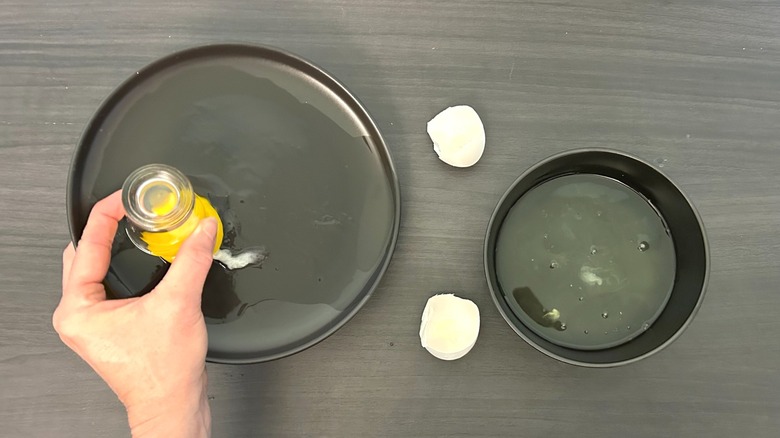
This is another method I discovered while googling this topic that I had not tried before. The theory goes that you crack the egg onto a plate and then use a shot glass to secure the yolk while pouring the whites into a cup or bowl. A standard 1.5-ounce shot glass is typically used for this purpose.
While the hack works, it is potentially tricky to execute. I found the standard–sized shot glass to be barely wide enough to fit around a large egg yolk, making it precarious to secure it to the plate before tilting the whites into the bowl. Though I was able to get the whites separated, I was concerned at every step of the process that I'd puncture the egg yolk.
If you are interested in attempting this method, I'd recommend using a slightly larger-than-average-sized shot glass, perhaps a 2- or 3-ounce one with a wider mouth (these are also known as "squat" or "flared" shot glasses). This will give you a bit of wiggle room for the egg yolk to fit comfortably within the glass, which will eliminate the potential for damaging it. That said, this method is still a little clunky and not especially efficient, even if it works.
4. Invest in a fancy egg separator tool
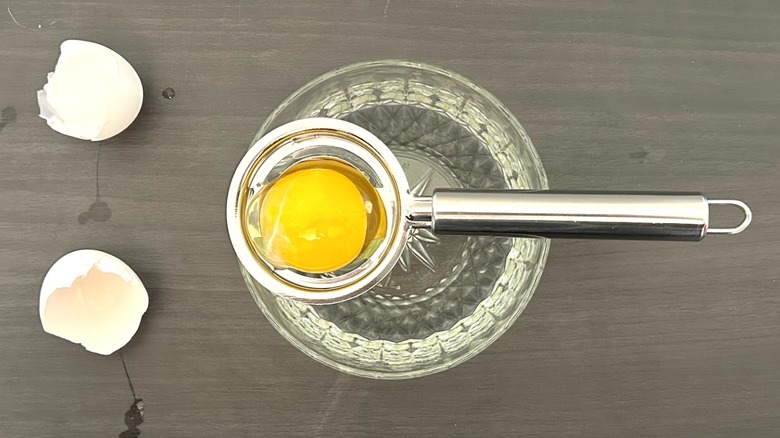
I'm not typically a gadget collector, especially when it comes to tasks in the kitchen. As a general rule, I find a majority of these to be gimmicky and they seldom do what they are advertised to do. However, for the sake of this experiment, I decided it was worth picking up one of the many egg separating gadgets for sale, like this one from the Qiifaiikooii brand.
Unlike a majority of kitchen gadgets, this one actually did what is said it would do, sort of. When I placed the separator onto a bowl and cracked an egg onto it, the whites did indeed begin to fall through the gaps in the device. However, they didn't completely pass through on their own. They required some jiggling and encouragement (maybe even some TLC), to make their way through. The end result was a cleanly separated yolk, but I wouldn't say it was a miracle, nor was it a time-saving gadget. As such, I wouldn't bother spending money on this gadget unless you happen to enjoy collecting kitchen utensils. Save the cash and try one of these other methods instead.
3. Sucking up the yolk with a plastic bottle
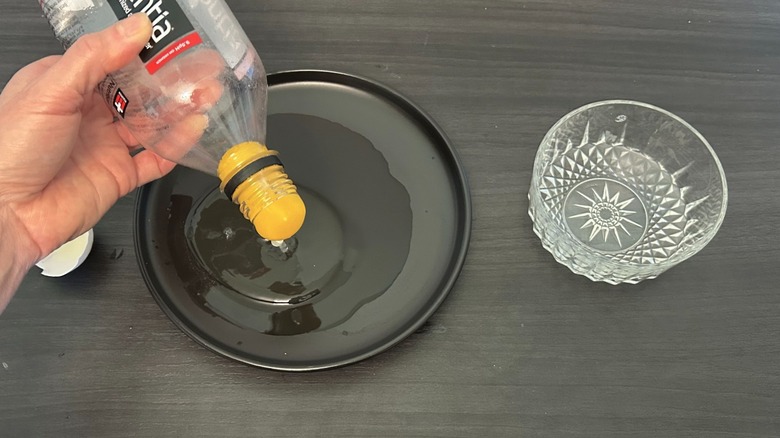
If you have spent any amount of time searching for easy ways to separate an egg yolk from its whites, you will likely have seen this snazzy trick. It involves cracking the egg and dumping the contents onto a plate. The yolk is subsequently sucked up into a clean plastic water bottle before being transferred to a bowl or cup.
The method is sound, and it works ... really well. All it takes is to squeeze some of the air out of the bottle before placing it atop the egg yolk. As the bottle is released, the yolk is drawn up, and voila, it has been parted from its whites.
My only hesitation with this method is the cleanliness part. The water bottle needs to be sanitized before you use it for this purpose, which can be done by first washing and rinsing it with soap and warm water and then soaking it for about 10 minutes in a diluted solution of bleach with water. This takes some forethought, however, and I tend to be a bit of a germaphobe. That said, if you are willing to put in the work to sanitize the bottle, go for it. This hack is highly effective.
2. Draw the yolk up into a turkey baster
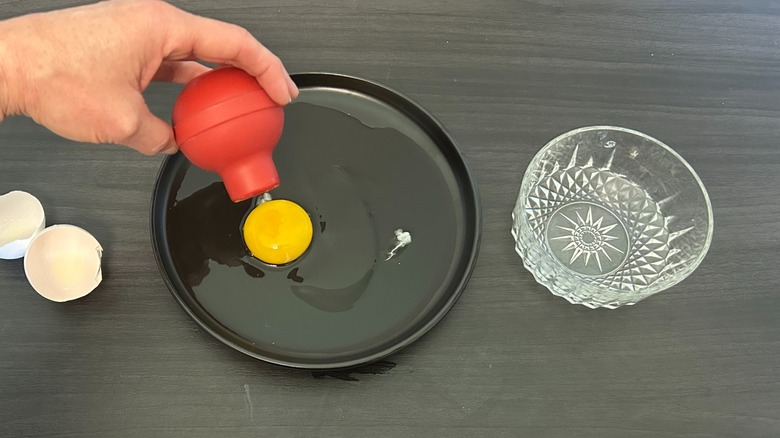
I admit that I hadn't thought of or heard of this hack until I started googling the subject, but boy am I glad I did. The process involves a tool you likely already have on hand for the holidays: a turkey baster.
For this to work, you simply remove the bulb of the turkey baster from the plastic, cylindrical tube. Crack the egg onto a plate and use the bulb much the way you would an empty plastic water bottle to suck it up before transferring it to a bowl or cup. The process was incredibly easy and highly effective.
If you happen to be the kind of person who really hates touching raw eggs because of their gloopy texture, this is the best method you will find for separating the yolks from the whites, and it uses a gadget you don't even have to special order. Just make sure to clean and sanitize the turkey baster before and after use.
1. By hand
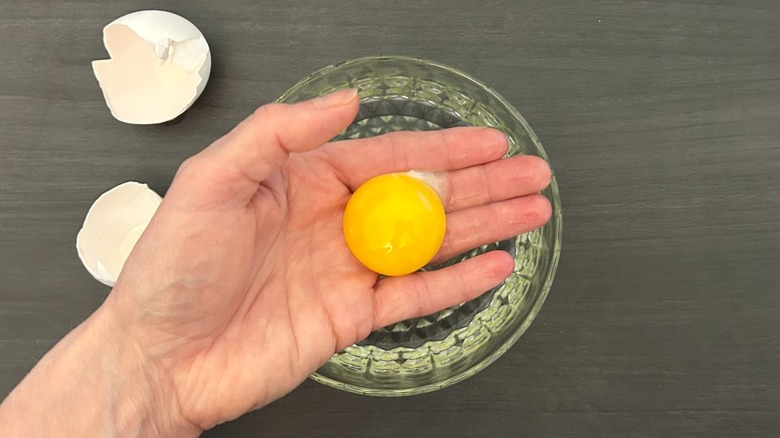
Though perhaps controversial, I still maintain that the single best way to separate an egg yolk from its whites is by hand. Again, this method is only effective if you can get past the yuck factor of handling raw eggs, but if you can there are a couple of reasons to consider doing so.
The process involves cracking an egg over a bowl and emptying the contents into one hand. Slowly transfer the egg yolk back and forth from one hand to another, leaving a slight gap between your fingers to allow the whites to pass through. After just a few passes, the yolk will be white free and ready to whip up into a decadent dessert.
Perhaps the main reason to use this method is that it doesn't involve any extra clean up or dishes. The only thing you have to wash are your hands, which you have to do anyway after handling raw eggs, as it is one of the most common kitchen sanitizing mistakes people often make. Another reason to use this method is that it is one of the only ways to effectively remove the chalazae from the egg yolk. This is the stringy white thing attached to the yolk, which, while perfectly safe to consume, can yield lumpy custards if not properly disposed of.
Methodology
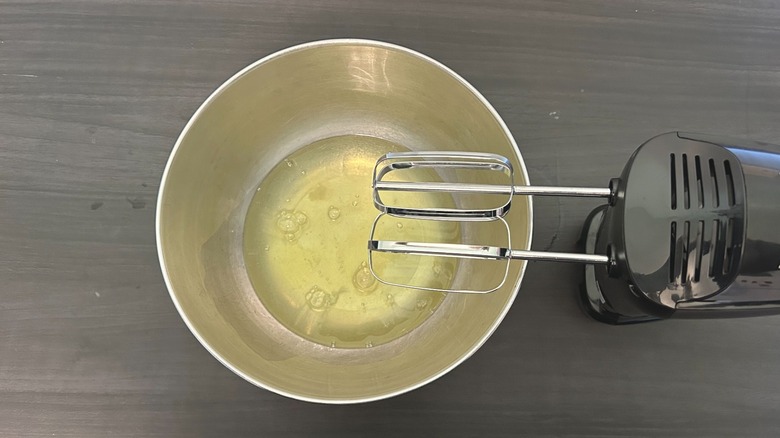
My first order of business in testing different tricks for separating eggs was to obtain fresh eggs. While there are a number of reasons for why the membrane surrounding an egg yolk can be stronger or weaker, including the diet of the chickens and how the eggs are collected, the single biggest deciding factor in how well the yolks hold their shape has to do with the age of the egg. As eggs sit, their structural integrity begins to weaken, making the yolks increasingly difficult to separate from the whites. Bottom line: Fresh eggs are a necessity when you intend to separate them into their constituent parts.
Next I tested each method, evaluating them based on ease, efficacy, and the amount of clean up required. I am more than willing to do some extensive clean up if a culinary process is truly more effective and convenient, particularly if I am planning on working in bulk and processing a number of eggs at once. That said, if the amount of clean up doesn't merit the end result, I see no reason to add to the amount of time I need to spend in the kitchen. It is my hope that my detailed analysis will help you perfect your egg separating game and will make baking your favorite desserts that much easier.