

I Tried 6 Different Methods For Peeling Garlic, And This Is The Only One I'll Ever Use Again
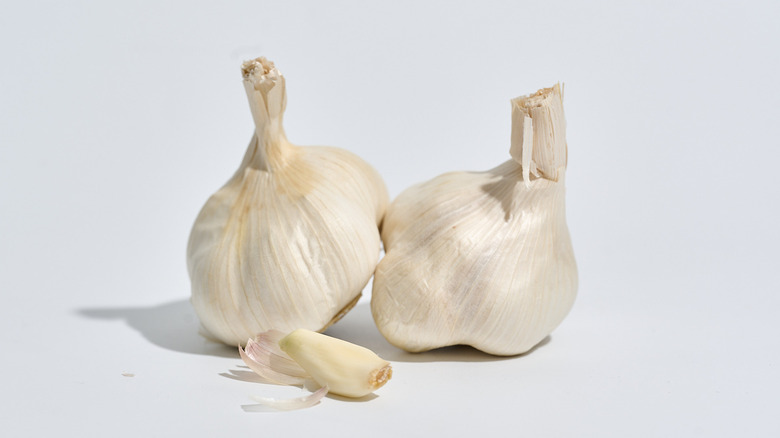
Having worked in many kitchens, I can tell you that every chef has a least-favorite prep task. For many, it's grating cheese; for others, it's peeling carrots, cracking eggs, or squeezing lemons. Still, there's one task that everyone can agree is the worst, and it's one that every chef has to do almost daily: peeling garlic. Between the stubborn paper skins, the small size, and the lingering, potent scent, it's a task that's tedious at best, and frustrating one at worst, especially for recipes that require more than a few cloves.
I hate peeling garlic just as much as anybody else; it's a task I dread anytime I make a meal, but can't avoid, lest my dish be lacking in delicious, garlicky flavor. Surely, though, there's a method that makes the smelly, tedious task a little less painful. To find out, I tested six different ways to peel garlic, using some tried-and-true, some unique, and some I'd never even heard of, hoping to find one that reigns supreme. The result? There's actually a way you should be peeling garlic, and if you haven't tried it yet, it's going to be your kitchen prep game-changer.
6. The microwave method
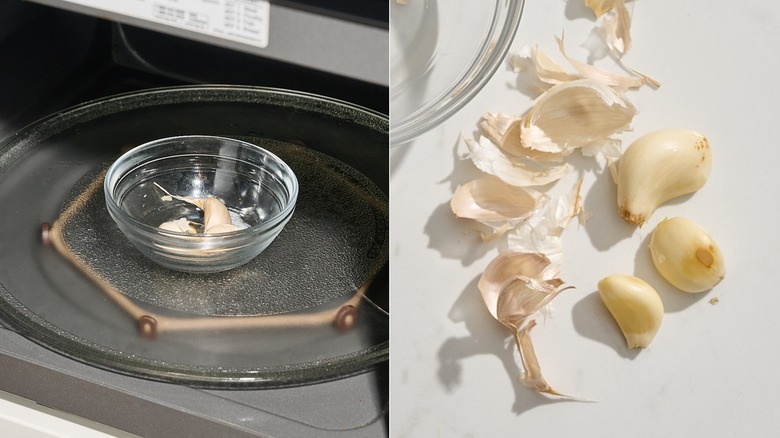
This method feels a little bit like an old wives' tale; a little outlandish, but just clever enough to work. In this method, garlic cloves are placed into a microwave-safe bowl and zapped for 10 to 30 seconds, which softens the skins just enough to peel easily away from the cloves. It's a bit like boiling tomatoes to remove the skins, relying on heat to detach the outer layer until it wipes easily away. The problem, though, is that it doesn't quite work.
Ten seconds doesn't sound very long, and it shouldn't be for most foods — but for garlic, it's more than enough time to turn the cloves into morsels of molten lava. I pride myself on having fingers capable of touching hot pans, pots, and foods, but I had a hard time peeling the garlic without wincing in pain. Beyond that, the skins weren't nearly as easy to remove as I expected, especially considering how many cooks rave about the magical method. Plus, according to food scientist Gavin Sacks, in an interview with NPR, microwaving the garlic can mute the flavor, which is the last thing I want when working with something known for that very quality. For that reason, I'd ditch this method entirely, opting for heatless methods instead.
5. The jar-shaking method
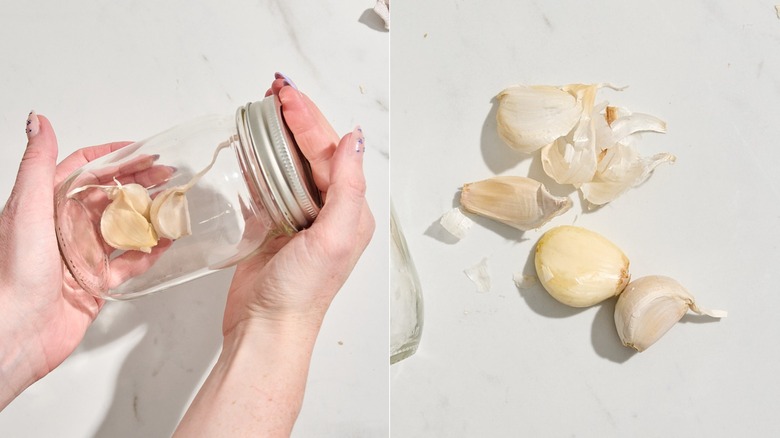
This method requires vigorously shaking the garlic cloves in a sealed jar until they are peeled. In theory, this means that you never have to touch the cloves, leaving your hands free of the lingering scent. The idea is that the friction from shaking the cloves against the walls of the jar breaks and eventually removes the thin paper skin, resulting in fast, peeled garlic. That being said, the more friction the better — meaning it works best with larger amounts of garlic.
This method isn't my favorite for a few reasons. First, the garlic requires almost a minute of vigorous shaking, or longer for older, smaller cloves that have extra-stubborn skins. The other reason? It dirties a jar or container that could otherwise be used for something else. Because this method failed to peel half of my cloves, I decided it was mostly a bust; I'd rather dirty a knife or set of bowls for better, faster results, without looking ridiculous while I do it.
4. The rolling pin method
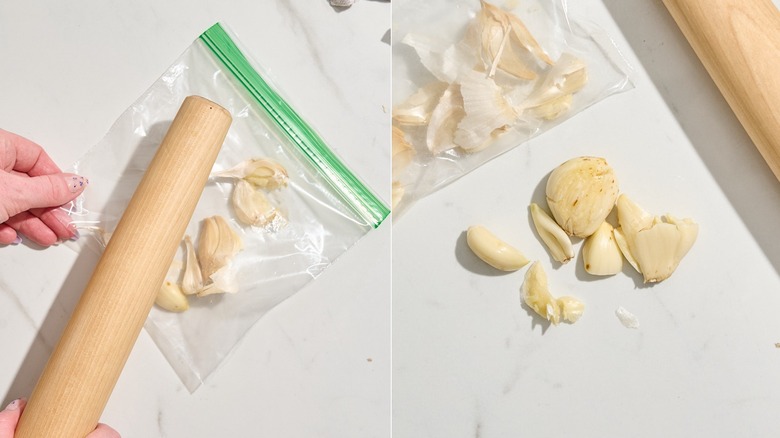
Like the jar method, this method works by creating enough friction between the cloves and the bag to remove the skins; this time, though, the friction is created by the force of a rolling pin. A similar technique to tenderizing chicken or making breadcrumbs, this one requires a little strength and a wide open countertop to avoid smashing other ingredients — or worse, another appliance or tool. Cumbersome as it may be, the method does work, though it comes with a caveat.
Before I owned a garlic mincer, I grated all of my garlic on a microplane in order to achieve the paste-like texture of a fine mince (the only thing I hate more than peeling garlic is chopping it, sorry Bobby Flay). This meant that when peeling garlic, I needed it to remain whole so that I could grip it enough to grate it. If this is something you require, too, then the rolling pin method is not for you. In order to remove the skins successfully, the garlic needs to be smashed hard enough to split and flatten, which for most uses, is still workable; but for anything that uses whole, un-smashed cloves, this method wouldn't work.
3. The dome method
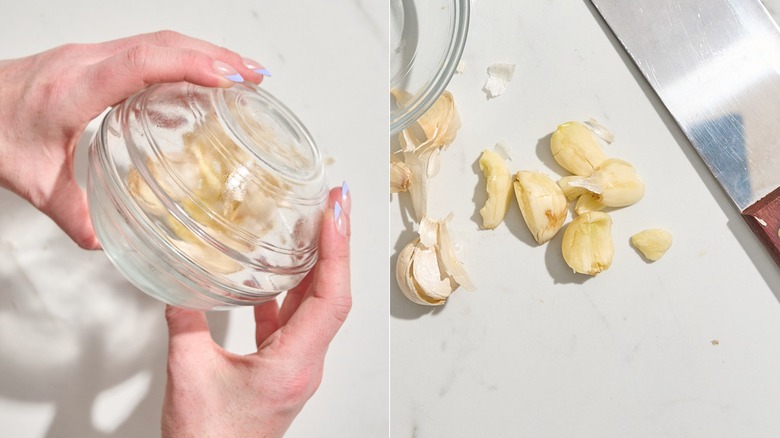
This method isn't too dissimilar from the jar method, as both require shaking the garlic vigorously to remove the skins. This method has one extra step that helps remove the skins a little faster, though: First, the cloves are smashed firmly with a knife, then added to a bowl and shaken with another bowl placed on top, creating a dome. It takes less dexterity than you'd think to hold the two bowls. Once you find the right grip, it's just as comfortable as holding any jar or container would be.
This method works best for high-volume peeling, which is why it's favored by restaurant chefs who always have a few bowls handy. Is it worth it for the home cook? Likely not, since again, it dirties two bowls and takes a lot of effort for a small amount of yield. However, it's a great method for getting your pent-up energy out, and it works well for removing the skins cleanly away from the cloves.
2. The knife-smashing method
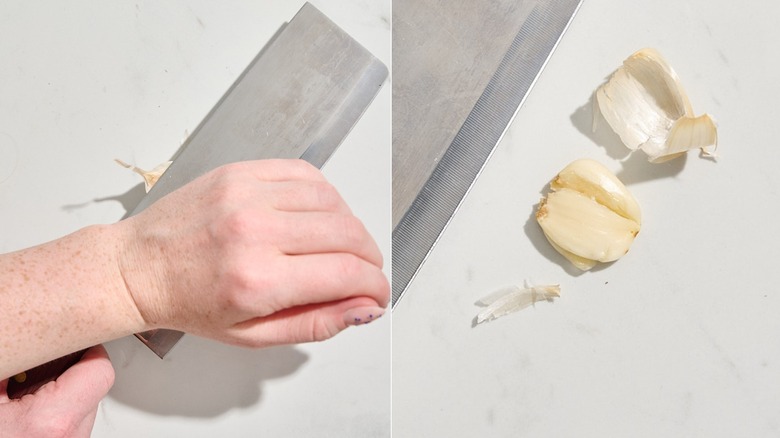
This is by far the most classic method of peeling garlic, beloved by chefs far and wide as being easy, straightforward, and efficient with the flow of the kitchen. It's the method that chefs in restaurants use when they don't have time to soak the cloves in water overnight, and the method you're most likely to use when peeling just one or two cloves at home. Before this article, it was also my favorite method, and one I've used for years, even when cooking in bulk. The method is simple: Take the side of the knife against the clove, drive the heel of your palm into the knife to smash the garlic, then remove the split skin. The smashing is gentle compared to the rolling pin, leaving you with a clove that's just flat enough to chop but not pulverized into tiny pieces.
The only reason why this method isn't my favorite (or at least, not anymore), is that it leaves your hands covered in the pungent garlic juices that never quite seem to wash away. I've gotten more adept at avoiding it and more used to the aroma on my fingers, but stubborn cloves still, now and again, leave me frustrated and reeking. On one hand, I simply have to admit that it comes with the territory — but on the other hand, it's a good case for using an even better method.
1. The knife-piercing method
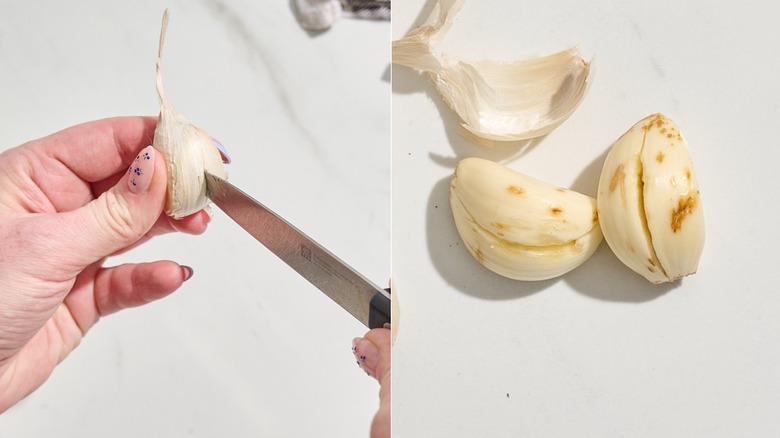
This is a method I hadn't heard of until I started doing research for this article, and a TikTok popped up claiming that this was the ultimate way to peel garlic. I was admittedly in awe — not only because it looked stunningly easy, but because I'd never seen anyone do it before. The method is simple, but it takes a minute to figure out. Peel away the outermost layer of papery skin until you can see the cloves clearly, then peel away a clove to work with. The method on TikTok insisted on keeping the clove attached to the bulb, but I found it easier to work one by one. With the clove detached, pierce the knife directly into the bulbous middle, wiggle it until you feel the skin break, then simply pull it out of the skin. That's it: a 2-second maneuver that requires no smashing, peeling, or shaking.
@victoriasthings Garlic Peeling Hack! Fastest and perhaps the easiest way to peel garlic! 🧄 Hassle free!! Tip 1 🔴: There is a trick to removing garlic cloves using this method. After inserting the knife and beginning to pry, twist the knife anticlockwise slightly and push it away while simultaneously lifting your elbow. This maneuver raises your hand and aids in extracting the clove. The process is quite effortless. (Make a few attempts and you'll get the hang of it) Tip 2 🟢: Butter knife is the safer alternative. #TriedandTested #GarlicHack #PeelingTrick #Garlic #peelgarlic #garlichack
I tried this method with a few sizes of both cloves and knives and found that neither made a difference, as long as you're skilled with larger knives. The key to making this method work seems to be the slight, almost unnoticeable wiggle that breaks the skin from the clove, which takes some practice to get the hang of. When done correctly, the clove should break cleanly away from the skin in one piece. I was successful about nine times out of 10 with this method, walking away with clean hands and a bowl full of perfect, whole garlic cloves — and a new favorite way to peel garlic.
Methodology
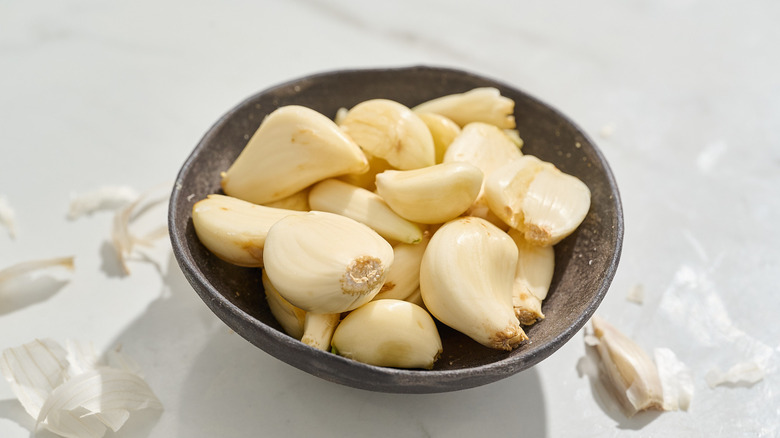
There are a lot of methods out there for peeling garlic. Some, like Ina Garten's boiling technique, feel impractical for home cooks who could otherwise peel garlic in a few minutes or less. While, unlike Alton Brown, I love my garlic press, I do think that the silicone garlic peeler is a one-dimensional tool that barely works well enough to justify buying.
I narrowed my tests down to the fastest, most efficient methods that make sense for home cooks to use for most recipes. From there, I tested each with a mixture of small and large cloves, as well as a few tweaks to each method to find the absolute best version of each without compromising the garlic or the speed.
Each method had pros and cons, but only one method stood out to me as the best combination of efficiency, ease, and cleanliness. That's the method I believe I'm most likely to use again — and again, and again.