

7 Tips For Safely Grilling In The Rain
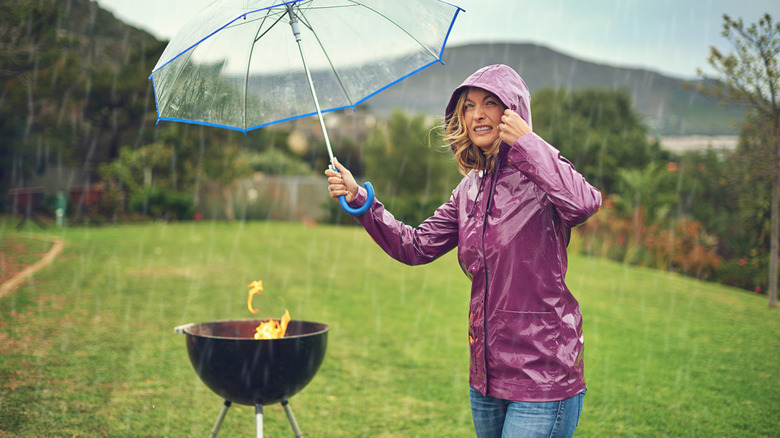
As a former professional barbecue pitmaster in coastal Virginia, I don't believe in "grilling weather." I've seared steaks while getting pelted with pinecones during a hurricane (fun, but not recommended), I've smoked pork loin in a foot of snow, turned tri-tip while a tornado formed above my head, and hauled soggy cardboard cases of country ham down from a truck in many an April shower.
Glorious (or unhinged, depending on your perspective) as all that may sound, it would be irresponsible to encourage anyone to do the same at home. But, you shouldn't necessarily wait for the perfect blue-sky day to get your grill going, either. Cooking is a dance we do, and there are few joys in life greater than dancing in the rain — as long as you're wearing proper footwear. Barbecue season is for amateurs; here's how to grill in the rain like a pro, and live to tell about it.
1. Don't do it in a lightning storm
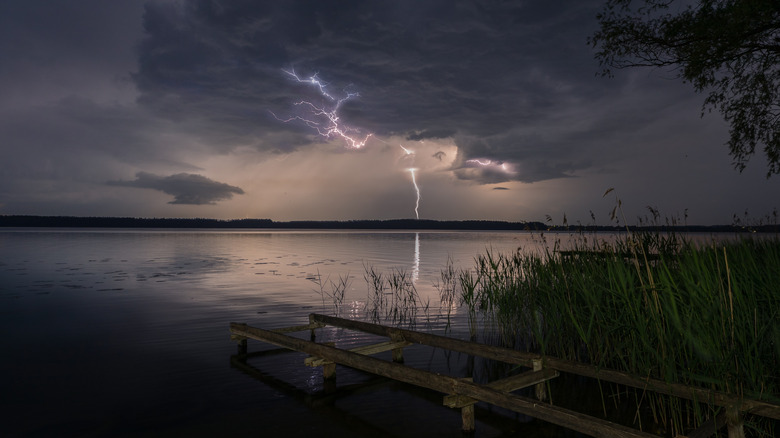
It's one of outdoor cookery's biggest, most unavoidable disappointments; you've been to the butcher, devised recipes, and dry-rubbed or marinated your meat overnight. Bags of charcoal are stacked against the side of your house (or propane tanks are lined up by the grill). Invitations have been extended. Then you awake to dark clouds printed on the horizon like a terrible newspaper headline. And the thunder rolls.
You aren't proving anything — or at least anything positive — by parading around with oversized metal grilling utensils like a mobile lightning rod during an electrical storm. If you can hear thunder, you can be struck. According to the CDC, most lightning deaths occur on Saturdays during the summer, and two out of three occur between noon and 6 p.m. Now, I don't have statistics on the most popular time of day to cook outside, but I'd wager it falls within that window. Coincidence? Maybe. But take the heightened risk seriously. Cook indoors and live to grill again. You can always use a George Foreman... it's technically a kind of grill, right?
2. Wear non-slip shoes
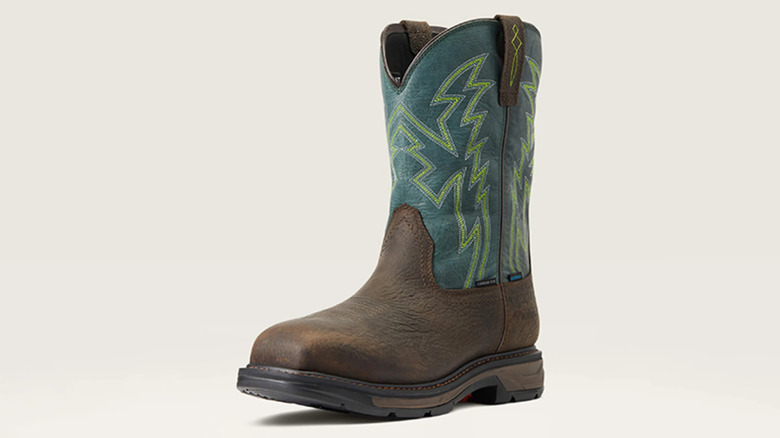
If you've ever worked in a restaurant or medical office, there's a decent chance you've owned a pair of non-slips (which should more accurately be called "slip-less" shoes, since they help you slip... less). Popular varieties either resemble Crocs or thick black clogs, and are designed to maintain traction indoors and outdoors in wet, greasy, or even, to some extent, icy conditions.
Ariat work boots are my go-to: Not only do they have a wonderful grip that keeps me from eating dirt with a pile of raw ribs in my hands, but they also hold my pant cuffs away from pooling water. And also they look cool (if you're into the whole Western aesthetic thing). This is not, however, to say that form should follow function; just because you're decked out in a floral-print button-down with cargo shorts doesn't mean you need to blow out your flip-flop on a stray ember, hot coal, or grease splatter. No matter how grippy your sandals are, opt for closed-toe shoes — especially if you're a charcoal griller — and stay out of the hospital long enough to enjoy your cheeseburger in paradise.
3. Don't use solvents
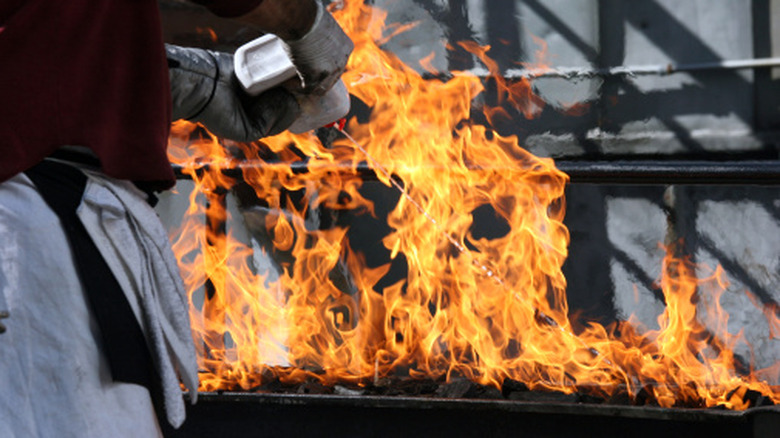
Lighter fluid is not your friend. First of all, its noxious flavor will find its way into everything you cook on a grill you've squirted it on. Consider it a contaminant of good taste; if you're serious enough to be grilling in the rain, you should be serious enough to care about what you're grilling. Secondly, it's a safety hazard; it won't likely catch when wet, but if you've got it going and rain hits it, the stuff can scatter like napalm. Just say no.
Get a charcoal chimney starter instead. It's how Alton Brown lights his grill. It's also the first of our nine ways to start a charcoal grill without lighter fluid. Charcoal chimneys work well in the rain because you can place them in your grill (with the top and bottom vents wide open), get them going, then close the grill and walk away until they're roaring hot. Fatwood (a natural pine resin firestarter) will also work, but I have mixed feelings about the piney flavor that tends to linger in my smoker, and don't generally like to close the lid when starting coals with it. Worth noting here: if you're going to use fatwood, always make sure it's burned off completely before starting your cook. We use hardwoods in barbecue for a reason — softwoods contain unpleasantly bitter resins (and pine definitely deserves its place on the list of barbecue woods to avoid).
4. Take cover (if you can)
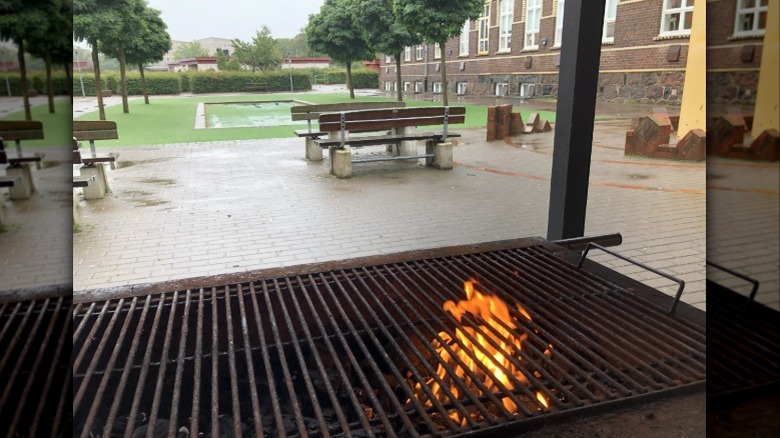
Taking cover from the rain isn't an option for everyone, but if you've got an awning or sufficiently tall patio umbrella, use it (again, just not in a thunderstorm). If you find yourself battling some particularly strong directional winds, set up your grill so that the vents are away from it or blocked by a windbreak. This can be a solid fence, the side of your house, or something you MacGyver together out of a tarp or plywood. Failing that, you could always bribe someone to follow you around with a handheld umbrella. All perfectly acceptable solutions for the perfect rainy-day grilling setup.
Whatever method of weather mitigation you choose, it is enormously important to ensure that any structures are securely anchored and kept at a safe distance from the flame. You don't want to explain to the neighbors (or the insurance company) why a flaming EZ-Up cartwheeled over your fence and landed on their roof.
5. Cover your food
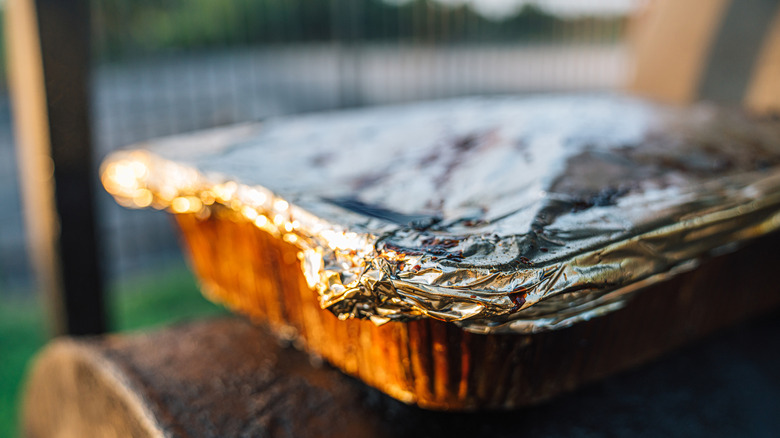
The whole idea behind resting your meat before serving it is that as it cools, the tendons relax and reabsorb moisture. Rushing the process — intentionally or not — is a recipe for disaster, and will likely result in a cold, tough, textural nightmare. When grilling outside, make sure you cover up your food while it rests. Rain rapidly steams off residual heat rather than allowing it to gradually decline, and also washes away spices and makes food soggy. Not exactly the bragging rights we hope for when firing up the grill.
Covering your dishes isn't simply a matter of avoiding a meat bog of a dinner, though — it's a safety concern: once your finished product enters the Danger Zone (40 to 140 degrees Fahrenheit), you've got a limited amount of time before it needs to be refrigerated. Chances are pretty good that if you're out there grilling, the rain is neither boiling nor on the verge of freezing, so the exposure is bound to bring it right into that range.
6. Keep the grill closed and a fire extinguisher nearby
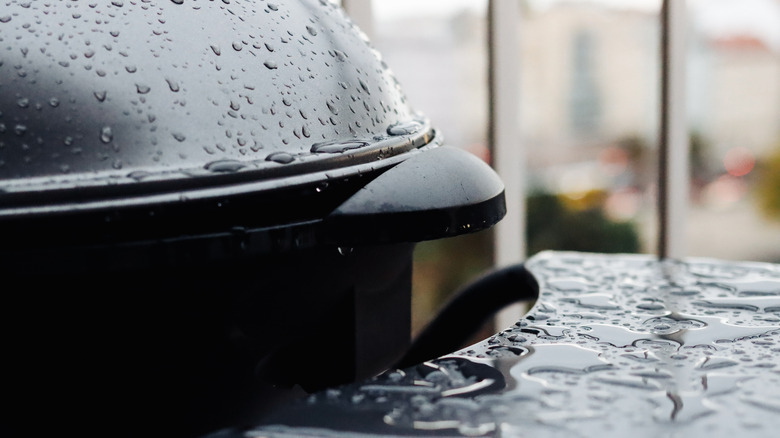
It might seem counterintuitive, but rainy days are among the most important times to keep a fire extinguisher nearby, and your grill closed as much as possible. It's important to keep it closed when it's sunny out, too, but not so much for safety reasons. This is because maintaining consistent heat is essential to achieving perfect results, and opening your grill constantly is the easiest way to disrupt your rack of ribs' journey from raw to religious experience. And that's on a good day.
Rain will put a literal damper on your flame, wash away rubs, and mess up your cook times. But if you've got your grill rolling like the bowels of hell and then open it in the rain, it can also scatter grease and cause burns or even fires. The best method for removing dinner (failing shelter) is to open your grill as little as possible and retrieve your flame-licked vittles with a pair of long tongs through the crack.
As for the fire extinguisher, you should have one whether you grill or not, but it should be easily accessible if you're playing with an open flame. And remember that they can expire, so check before you start grilling; the last thing you want is to arrive at your heroic moment shooting blanks.
7. Never use an electric grill
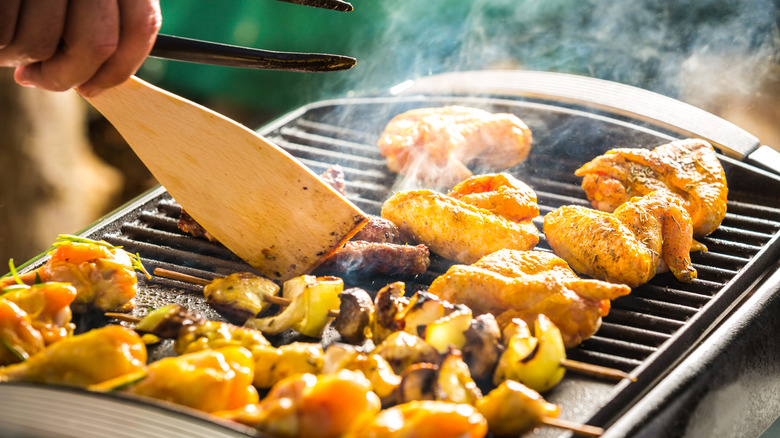
Grills come in all shapes and sizes, such as charcoal, gas, propane, upright and offset, pellet, and tabletop. There are at least 12 types of grills, and only one stands out as an absolute hard no in the rain: the electric grill. If you're imagining a giant George Foreman, you're not too far off; they tend to resemble propane grills with a grooved cook surface where you'd normally find grates. As the only grill safe for indoor use, it is the perfect solution for cooking when it is raining outside.
Electric grills can offer unmatched precision in temperature control, even cooking, and a complete absence of smoke or gaseous fumes. However, while it will give your steak some gorgeous grill marks, it will never have that steamed-in-its-own-juices flavor that results from drippings finding their way down to an open flame. Some of you might be wondering whether using a flameless cooking medium even counts as grilling, and that's a valid debate — one that electric grill proponents should definitely be having indoors if it's raining.