

Fly By Jing Vs Momofuku: Which Instant Noodles Brand Comes Out On Top?
In the nearly 70 years since its invention, instant ramen has become a staple in pantries across the globe, universally known for its easy assembly and stunningly low price. Invented in 1958 by businessman Momofuku Ando, instant ramen came as an answer to the food shortages striking Japan after World War II. Ando, who combined dried chicken soup flavoring with dehydrated noodles, discovered the science behind what makes instant noodles instant, creating what we know today as Nissin Ramen — which you may recognize for the plastic-packaged Top Ramen or the styrofoam Cup Noodles. Since then, instant ramen has become a culinary staple, often filling entire aisles (and dorm pantries) with different flavors and noodle types.
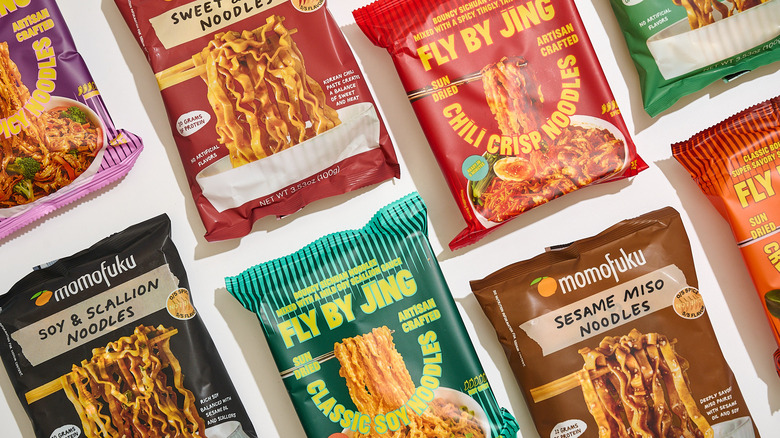
I still love instant ramen now just as much as I did in college – in fact, I might eat it even more now, opting to upgrade the broth with creamy add-ins like peanut butter or add protein-packed toppings like eggs or leftover chicken. Some brands have taken notice of the need for an elevated instant noodle, creating a product that feels artisanal and homemade while still being effortless to prepare. Two of the biggest brands tackling elevated instant noodles are Fly By Jing and Momofuku, both recognizable by their hand-cut noodles, unique flavor pairings, and flashy modern packaging. The question is: While both are bringing instant noodles to a new level, does one do it just a little bit better? To find out, I tested all flavors side by side to determine which brand comes out on top.
Some recommendations are based on first-hand impressions of promotional materials and products provided by the manufacturer/distributor/etc.
Methodology
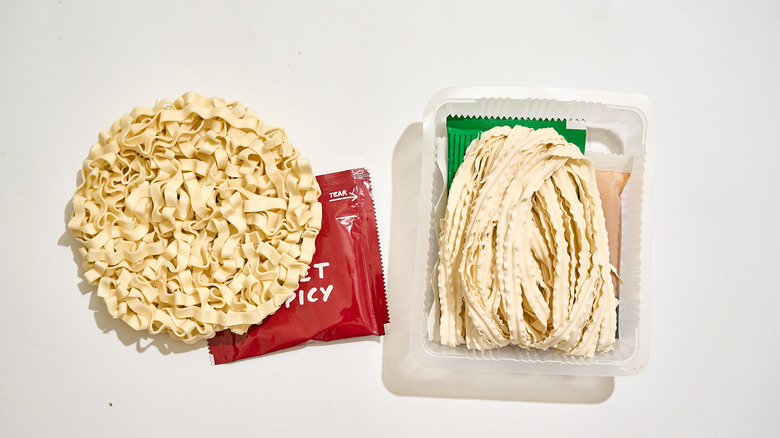
For the most accurate comparison, I paired each brand's flavors with the other's equivalent, matching the flavor profiles as closely as possible for the best results. Once paired, I boiled each packet according to the specified directions, drained the noodles, and mixed them with the flavor packets and ingredient add-ons (where applicable). I tried each flavor side-by-side before moving on to the next, and worked with a secondary tester who prefers mild heat (if any), taking her reviews into consideration for each flavor. I then reviewed each brand's noodle alone, testing for chewiness, silkiness, and how well the sauce clung to the noodles. Each brand had many strengths, so determining a final verdict became a culmination of variables: variety, noodle quality, and flavor.
Creamy Sesame vs Sesame Miso
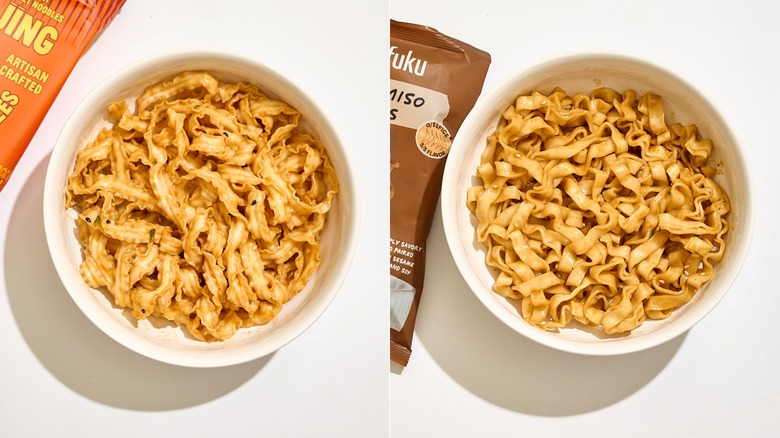
I tried each brand's take on sesame flavor side-by-side, first starting with the Momofuku Sesame Miso Noodles. The noodles are coated in a miso-sesame sauce and topped with sesame seeds for a silky, saucy noodle with the slightest crunch of texture. The sauce is surprisingly soy-forward, tasting less like a sesame-based sauce and more like an umami-packed soy sauce. The miso is a clean, subtle flavor that works well here, but without the emphasis on the sesame flavor, it gets a little lost behind the soy flavoring. Still, the flavor works well as a straightforward, saucy option, especially for those who don't like spice.
The Fly By Jing sesame equivalent is a little different: Labeled as Creamy Sesame Noodles, the noodles come with a sesame paste and a seasoned soy sauce that together create a creamy, flavorful sauce. This version is also more soy-forward than I'd have expected, with a much less creamy consistency than I hoped. It's also a little spicy — but in a tingly way, like a Sichuan peppercorn, which lingers on the front of the palate. While I love the idea of creamy sesame and spicy chili, this one didn't quite deliver on creaminess or sesame flavoring. With neither option a perfect, super-nutty sesame, I'd likely choose Momofuku's version for the hint of miso and toasted, earthy undertones.
Sweet and Spicy Noodles
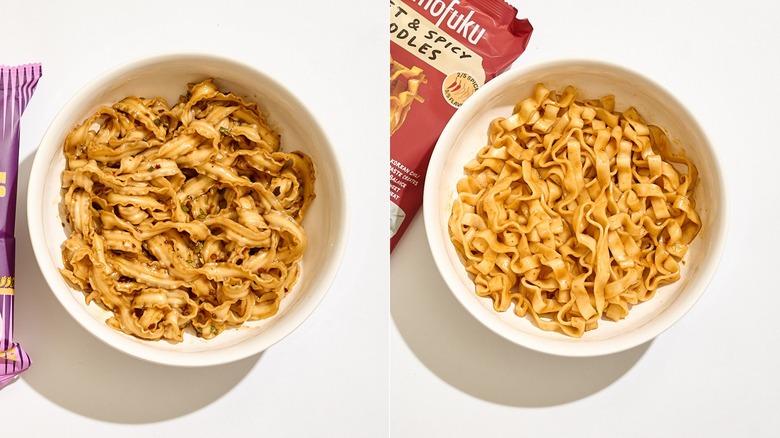
This comparison is a little more straightforward: Both brands offer a flavor referred to as "Sweet and Spicy". Though they each have the same name, the noodles take different approaches to achieve the unique balance of flavors. Momofuku uses Korean chili paste gochujang mixed with molasses and soy sauce to create a deep, savory heat with a soy-forward flavor. Like many Momofuku options, soy sauce is the prominent flavor, leading again to a straightforward and mild noodle. This might be the noodle for you if you don't like spice, like it was for my secondary tester, who found Fly By Jing's noodle a little too spicy. For me, though, I wanted something a little more sweet and a little more spicy.
My first thought when tasting the Fly By Jing Sweet and Spicy Noodle was that it tasted, essentially, like a tangy chili crisp — and as it turns out, that's exactly what it's flavored with. Using Sichuan Chili Sauce, which is flavored with brown sugar, mushrooms, garlic, chili, and spices, the Sweet and Spicy noodles are layered with a tangy, spicy, slightly sweet flavor that tastes bold without being overly spicy. I found it to be sweeter than the Momofuku equivalent, but that assessment turned out to be a matter of spice tolerance — my secondary tester couldn't taste the sweetness of the brown sugar through the hotness of the chili peppers. My vote? If you're seeking a truly sweet and spicy noodle, Fly By Jing's is the one, but if you want something milder, Momofuku may be the better choice.
Classic Soy vs Soy and Scallion
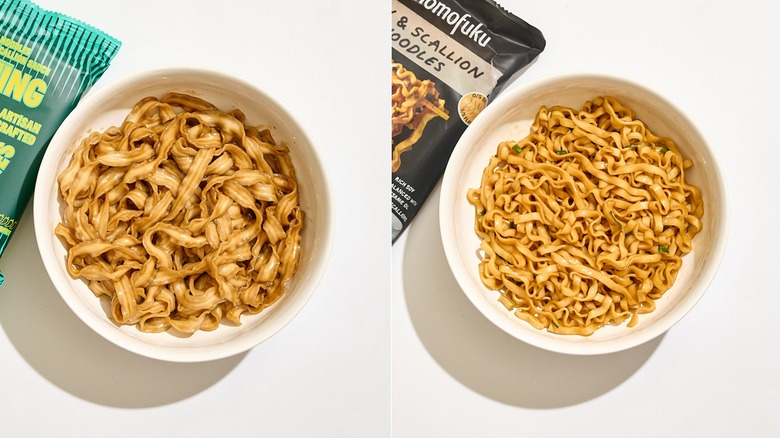
This is a flavor I'm glad to have had a secondary tester for: Without them, I may have wondered if something was wrong with my taste buds. Fly By Jing and Momofuku both offer a version of a classic soy noodle that, in theory, should taste pretty similar, given that the ingredient lists are nearly the same. However, I found that the two noodles couldn't have been more different. The Fly By Jing noodle had an unusual flavor that was neither mild nor spicy, savory nor sweet — it tasted artificial, which was surprising for such a simple flavor, and especially after enjoying the other, chili-laced soy-based sauces. My secondary tester agreed, only managing a few bites before returning to the Momofuku version of the same.
The Momofuku Soy and Scallion, on the other hand, is an excellent balance of flavor — not surprising, since most of the brand's flavors are so soy-forward. This flavor lets the soy sauce shine, complemented by subtle, pleasant scallion flavor. This is by far the best Momofuku flavor, and contrasted with Fly By Jing's weakest, it easily wins this pairing.
Chili Crisp vs Tingly Chili Noodles
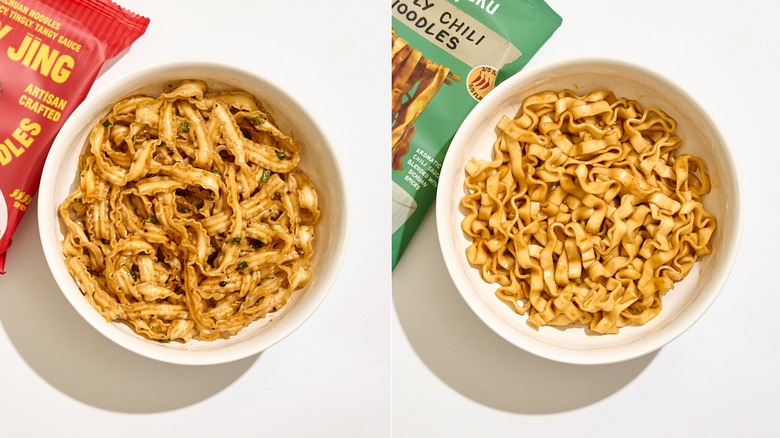
While Momofuku outshines Fly By Jing in soy sauce, Fly By Jing takes the lead with chili crisp. The second and possibly most notable chili crisp noodle offered by the brand, Chili Crisp Noodles uses the brand's Original Sichuan Chili Crisp as the flavor base for the hot and tangy noodle. Unlike the Sweet and Spicy, the Chili Crisp is a more savory heat, with a higher spice level and lingering tingly aftertaste. It's not overbearing, either — unlike Buldak's super-hot noodle, for example, this noodle can easily be eaten for lunch without putting you in tears (or gastric distress). The depth of flavor is obvious in this noodle, especially compared to Momofuku's version of the same.
Momofuku is also well known for selling chili crisp, but instead of using it in the noodle base like Fly By Jing does, the brand opts instead to use a blend of Sichuan spices, chili paste, and sesame oil to flavor the Tingly Chili Noodles. The result is a mild, slightly fruity flavor that again emphasizes the umami-rich soy. While tangy, like the name implies, it isn't spicy like I'd expect a chili noodle to be, and it ranks lower than Fly By Jing's version for me.
Comparing the noodles
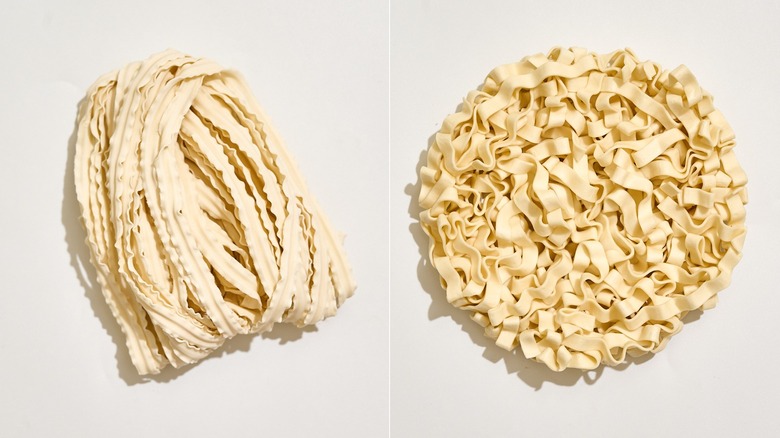
The noodles are likely the reason you'd buy either of these brands — for the higher price point, Momofuku and Fly By Jing both offer artisanal, air-or-sun-dried noodles that are thicker and chewier than what is typically found in traditional instant noodle packets. The Momofuku noodle is a flat noodle about ¼-inch wide, while Fly By Jing's is a wider, ½-inch ribbon-cut noodle inspired by thick Dan Dan noodles. I found that both noodles have a chewy texture and hold sauce well, with Fly By Jing's ribbon edges cradling the sauces while Momofuku's were better at absorbing the sauce directly. For the price, I'd opt for the Fly By Jing noodles, which feel just a little more special: If you gave me a bowl and told me they were homemade, I'd believe you.
The verdict: Which instant noodle brand comes out on top?
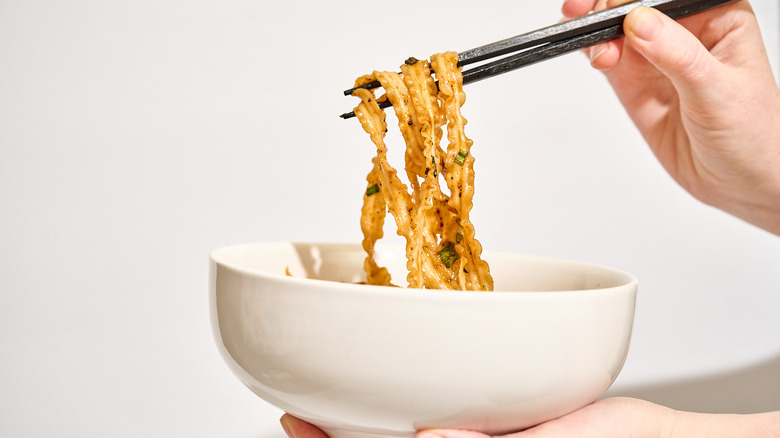
The winner of this pairing is hard to determine — each brand is around the same price point, same protein level, similar ingredients, and each has good flavors to offer. When compared side-by-side, Momofuku has a better classic soy and a chewier, clingier noodle, but Fly By Jing has spicier, more layered chili crisp flavors and a silkier, more artisanal noodle. For a truly elevated instant noodle, I'd choose Fly By Jing, which has the value to match the higher price point.