

15 Mistakes To Avoid When Making Fresh Pasta
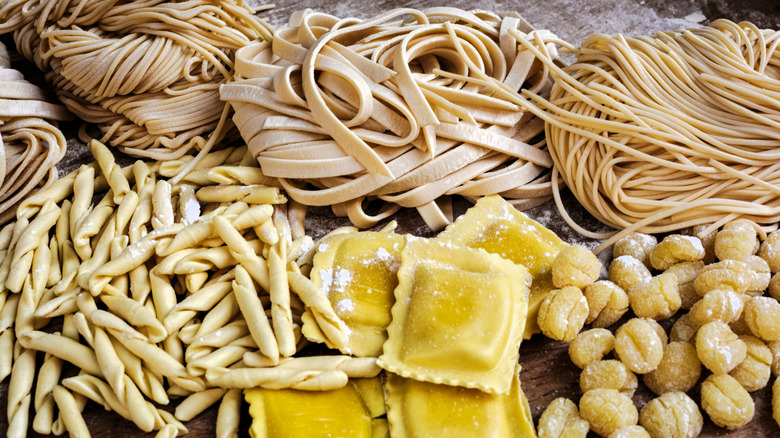
After graduating with a degree in Italian cuisine in Florence, Italy, and spending the last five years working with some of the best kitchens in town, I've learned quite a lot about making fresh pasta. For starters, it's by far one of the most rewarding projects you can tackle in your home kitchen; however, it's also the easiest to mess up without even realizing it. A simple mistake, whether it's forgetting to salt your pasta or using the wrong type of flour to make your dough, can quickly ruin your evening dinner plans.
Over the years, I've made what seems like hundreds of pounds of fresh pasta, and through that, I've become an expert in perfect and imperfect pasta. It's a tricky and tedious thing to make, although once you've mastered it, or at least found your rhythm, you won't be able to stop. Below are 15 mistakes to avoid at the start of your pasta-making journey, so you can begin with a leg up.
1. Mistake: Buying excess pasta tools
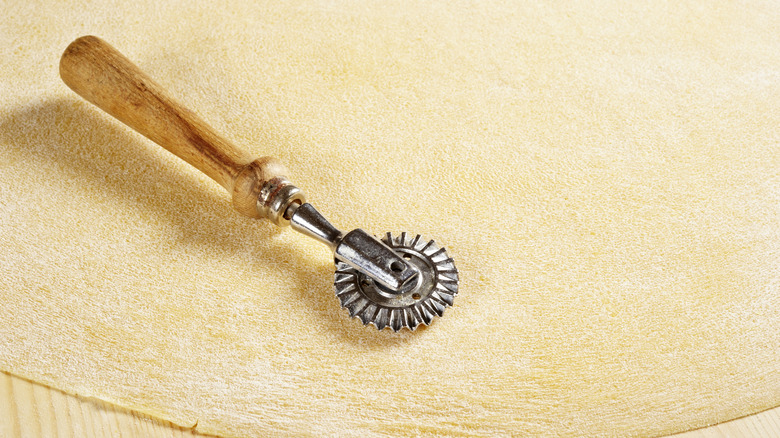
Unless you're planning on publishing a book on pasta making or are simply obsessed with the craft, you don't need to fill up your kitchen with unnecessary equipment that will probably only be used once or twice. If you have to invest in a few pasta tools to improve and elevate your skill, then buy ones that are versatile, durable, and will actually add something to your kitchen space.
Most professional chefs and pasta-making fanatics will recommend getting a hand-cranked pasta machine, so you can roll your dough into thin, flat strips and cut it into noodles. You can find them online or at most kitchenware stores. Along with the pasta machine, you can get a rigagnocchi (also referred to as a gnocchi board): a handheld, ridged board used to create gnocchi, cavatelli, or garganelli. However, if you want to keep your pasta tools to the bare minimum, all you really need is a kitchen scale, a fork, a working surface, and a rolling pin.
2. Mistake: Not measuring your ingredients by weight
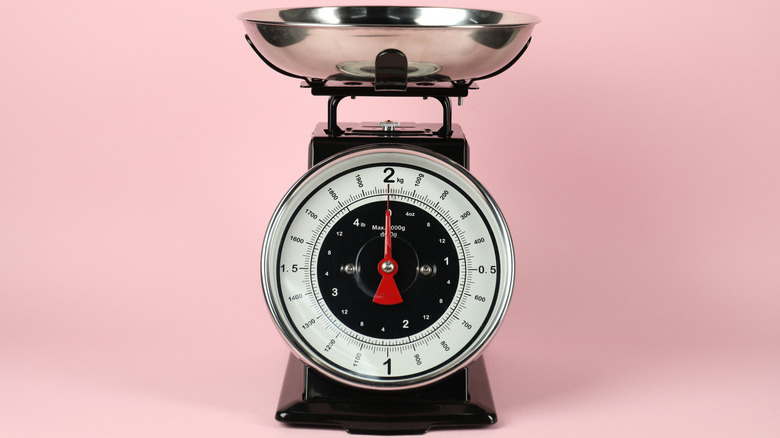
Not only is a measuring scale a must-have for your baking projects, it's also an essential tool for pasta making. While I'm sure nonnas have been measuring with their heart for generations, precision and accuracy make a real difference.
Measuring your pasta ingredients by weight rather than cups is a crucial factor for obtaining the right consistency, ensuring that your flour-to-liquid ratio is the same every time you whip up a batch of pasta dough. When measuring ingredients with cups, it's quite easy to accidentally add too little or too much without realizing it — this will throw off your whole recipe before you've even got your hands dirty.
For example, a cup of flour can vary in weight depending on how you scoop it, and this will ultimately affect the hydration levels in your dough. Measuring your ingredients by weight ensures the exact gram or ounce of flour you're using, so if your dough is too wet or dry, you can easily correct your mistakes and edit your recipe with accuracy. Plus, using a measuring scale allows you to place your mixing bowl directly on the scale and add your ingredients. That means no measuring cups or teaspoons required, which equals less mess and one less scavenger hunt through your kitchen to find that missing tablespoon.
3. Mistake: Using the wrong type of flour
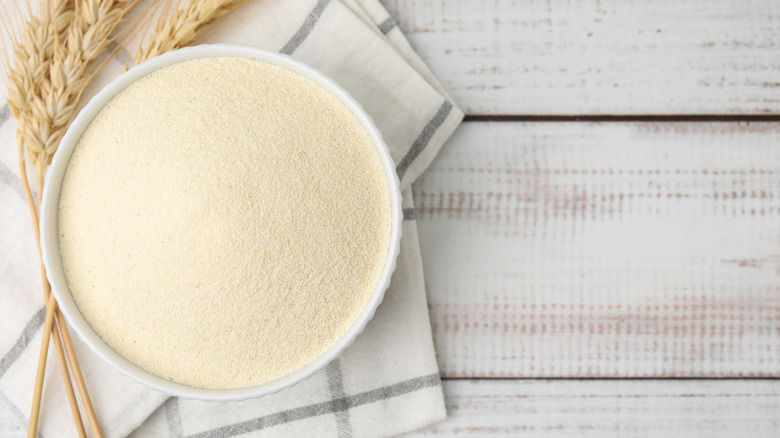
Not all flour is created equal, and pasta dough is one of the recipes where that difference matters. The two flours primarily used in pasta making are 00 flour and semolina flour (also referred to as semola). "00" flour ("doppio zero" in Italian, meaning "double zero") is finely ground wheat flour, often referred to as the "gold standard" of flours for pasta dough. The name "00" refers to the grind size, with 00 being the finest grind. Unlike all-purpose flour's coarsely ground mill, its superfine, powdery consistency helps the dough create a more tender, hydrated crumb, making it easier for the dough to come together. This is the type of flour you'll want to use when making egg-based pasta dough for shapes like tagliatelle and pappardelle.
If you want to make pasta shapes like cavatelli or orecchiette, then you'll need to make semolina-based pasta dough. Semolina flour — specifically, finely milled semolina flour — is better for a water-based pasta dough because it has a high gluten content, creating a strong dough that can replace the binding role of eggs.
Substituting these flours with another type can easily ruin your dough. For example, if you use all-purpose flour in lieu of 00, you'll end up with a tough, chewy pasta dough. If you use 00 flour in place of semolina when making a water-based dough, you'll end up with a dough that lacks the structural strength it needs.
4. Mistake: Getting dry-to-wet ingredient ratios wrong
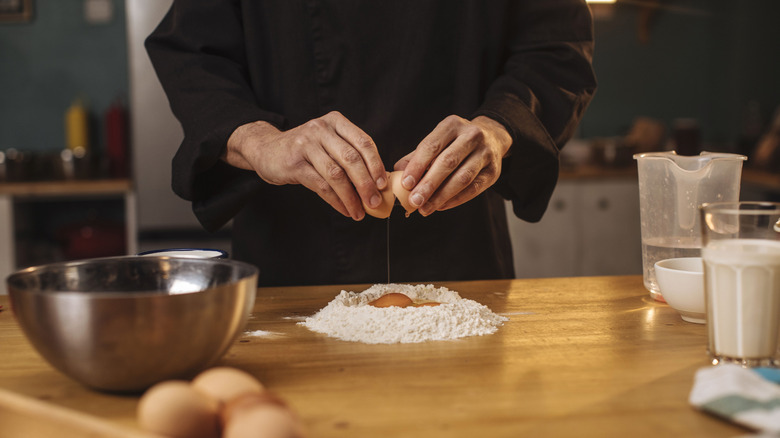
Just like any type of dough you're making, getting the dry-to-wet ingredient ratio wrong is a pretty common mistake for a novice home chef. Pasta dough is quite temperamental; if it has too much water or flour, it can directly affect the dough's consistency, gluten development, ease of handling, and the final texture of the pasta.
If there's too little moisture, the dough will be crumbly, tough to knead, and hard to put through the pasta machine, causing it to get stuck or tear when rolling. To revive it, you can sparingly add a teaspoon of water to the dough while kneading it until it becomes cohesive and pliable. If you're on the opposite end of the spectrum and your dough is too wet and sticky, you can knead in small amounts of flour (1 teaspoon at a time) until it's smooth and no longer clings to your hands.
However, the majority of people doing this add too much flour to their dough at this point because they think any extra stickiness can be resolved with a sprinkle of flour. Some stickiness actually signals that the gluten hasn't fully developed yet. So, if your dough is a bit too sticky, give it a few extra minutes of kneading or cover it in plastic wrap and let it sit at room temperature for about 30 minutes. This will let the dough relax and become more manageable, without any additional flour needed.
5. Mistake: Not using room temperature eggs
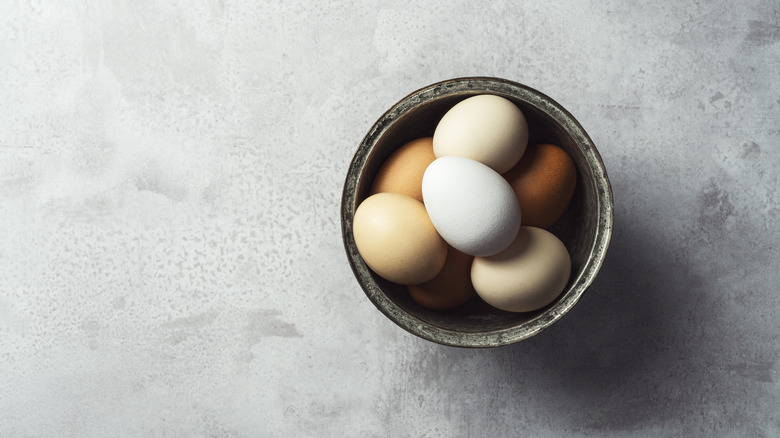
Another common mistake that people make when whipping up pasta dough is not using room-temperature eggs. While it might not seem like such a crucial mistake, it can actually make your dough harder to knead, too dry, or prone to tearing. Eggs at room temperature break down easily with flour, creating a smooth, homogenous dough. Cold eggs have a much thicker consistency, and their fat molecules are tightened when chilled, making it harder to incorporate them into a dough. It can also slightly chill the dough, making it tough to knead.
This is especially important when making egg-based pasta dough, where eggs are the main source of hydration. If your dough is dry, it can be tempting to add a teaspoon of water to rehydrate the dough, but this will ruin the dry-to-wet ratio, resulting in a tough dough with a gummy texture. Ingredients like eggs and flour bind together easily when they are at the same temperature, creating a smooth and cohesive dough that's ideal for rolling and cutting. You can easily prevent this by pulling your eggs from the fridge for at least 30 minutes before you start making your pasta dough to allow them to come to room temperature.
6. Mistake: Adding olive oil to your dough
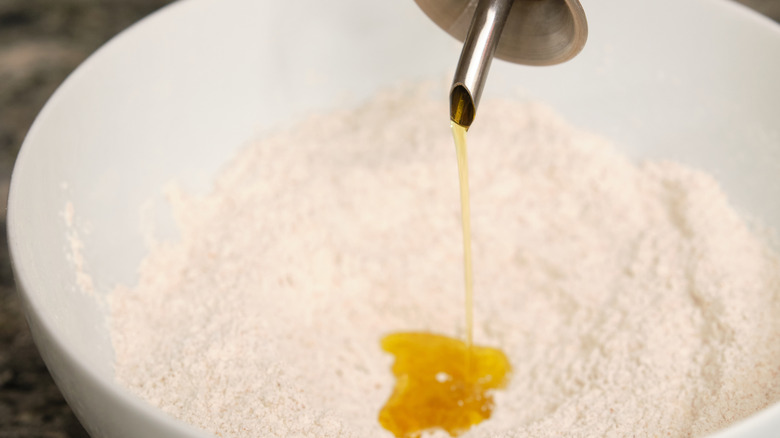
Incorporating olive oil into pasta dough is one of those kitchen myths or "must-dos" passed down by nonnas and recipes written in dusty family cookbooks that actually shouldn't be followed. Adding olive oil to fresh pasta dough is pretty much unnecessary since it doesn't add any additional hydration. Since olive oil is a fat, it doesn't add moisture the same way eggs and water do — it can actually affect the gluten development.
Olive oil acts as a tenderizer, coating the protein molecules in the flour and preventing them from producing the strong gluten development that is crucial in pasta dough. Adding it will make your pasta dough more brittle and much more prone to cracking as it rests. A properly made pasta dough with the correct dry-to-wet ratio doesn't need any olive oil to make it smooth and workable.
7. Mistake: Under-kneading or over-kneading your dough
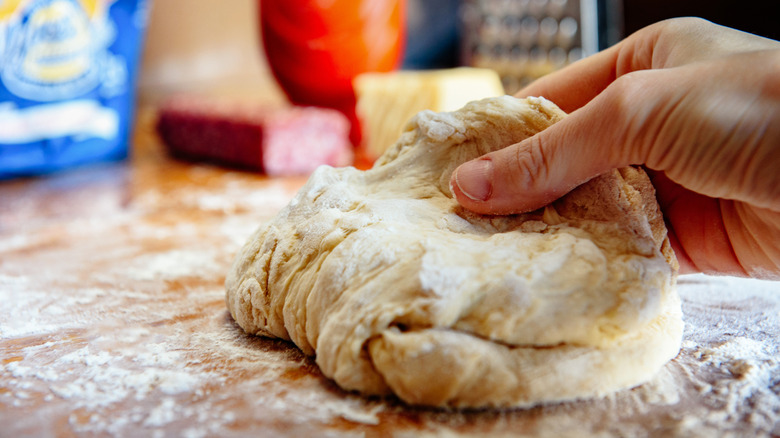
Other than the ingredients themselves, kneading your dough to the correct consistency is an extremely important step when making pasta dough. For those of you who don't know, kneading dough helps to develop a gluten network that binds the proteins in the flour, creating aligned protein chains, which provide the dough with structure and strength. Properly kneading the dough also makes sure it is smooth and stretchy rather than dry and brittle. Furthermore, it takes all those shaggy bits of flour and dough and binds them into a homogenous, elastic dough.
However, there's a fine line between getting it right and over- or under-kneading your dough. If you under-knead your dough, you risk damaging the gluten development, making it hard to roll out or tear within the pasta machine. On the other hand, if you over-knead your dough, it can cause a too-tight and too-strong gluten network, resulting in chewy, tough pasta that's also prone to tearing. Kneading pasta dough shouldn't be a struggle; if you have a well-hydrated, properly made dough, it should feel smooth, slightly firm, and elastic when you're working with it. To ensure that your dough is well-hydrated and that it's ready to roll out and cut, you can poke the dough gently, and if it springs back up, it's ready to use.
8. Mistake: Forgetting to rest your pasta dough
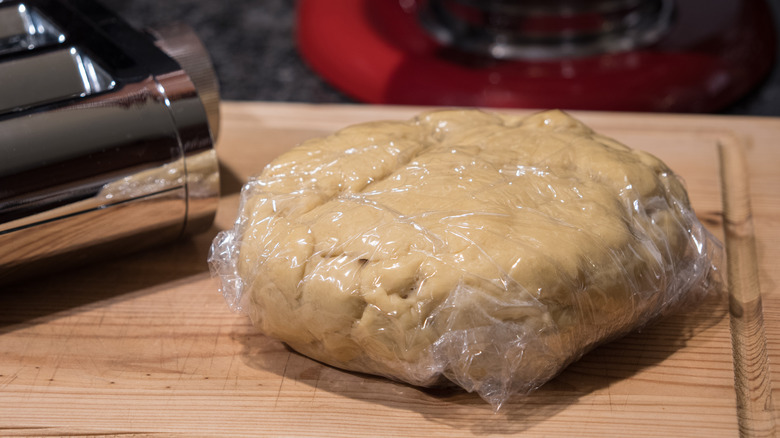
Forgetting to rest your pasta dough after kneading is another common mistake that can dramatically affect the texture and elasticity of the dough. Resting your dough allows the gluten network developed during kneading to loosen and relax, ensuring the flour is fully hydrated and incorporated.
A 30 to 60 minute rest time to allow the dough to relax and become pliable and easy to manage — perfect for making all types of pasta shapes. Make sure to leave your dough at room temperature when resting rather than putting it in the fridge, since this can cause the dough to become a bit stiff, and it might oxidize, giving it a discolored brownish-green appearance. To ensure that it's well rested and ready to roll out and cut, you can poke the dough gently and see if it holds the imprint. If it does, then it's good to go.
9. Mistake: Not wrapping up your dough right after making it
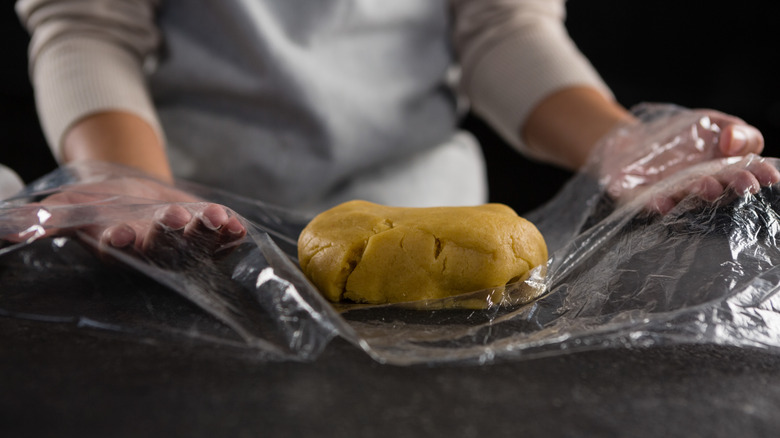
Most people don't know that fresh pasta dough dries out pretty fast when exposed to air, causing it to form a stiff, crusty exterior often referred to as "elephant skin" by professional chefs and pasta-making connoisseurs. This happens when the moisture on the surface evaporates, turning your pliable pasta dough into a tough, dried-out lump that'll most likely crack and shred apart right when it's fed into the pasta machine.
One way to prevent this from happening is by tightly wrapping your pasta dough in plastic wrap immediately after kneading. When you're actively rolling out the dough, only take out a portion of the dough at a time, leaving the rest completely covered while you work on it. If you are working quickly in batches, you can also leave them under a damp kitchen towel so you don't have to fuss around with plastic wrap (pro tip: you can keep plastic wrap in the freezer to keep it from sticking to itself).
10. Mistake: Not flouring your surface and dough
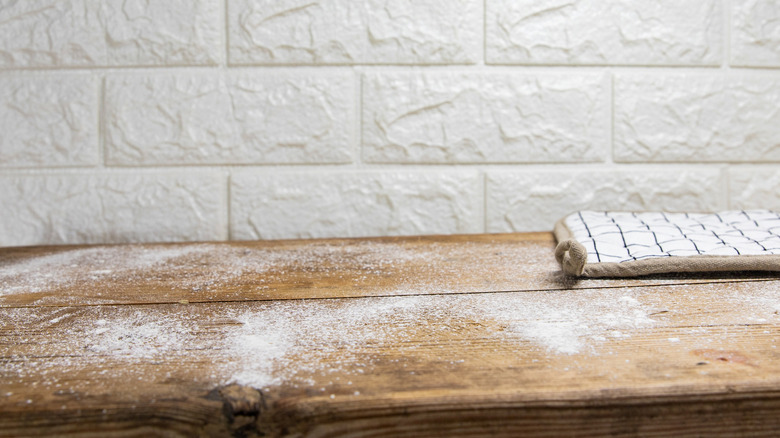
One of the quickest ways to end up with a sticky mess and ripped pasta sheets is by skipping the part where you flour your work surface and dough as you work. Flouring the surface ensures an easier kneading and rolling process, preventing your dough from sticking.
It's also important to flour your dough as you roll it out in the pasta machine to prevent it from sticking. While you might reach for 00 flour to dust your pasta sheets, you should actually be using finely ground semolina. Refined flours like 00 absorb moisture easily, which can quickly get absorbed into delicate sheets of freshly rolled pasta, leading to it becoming sticky. Semolina, however, has a much coarser, gritty texture, which makes it more resistant to moisture absorption. This allows the flour to stay on the dough surface longer and acts as a physical barrier between the pasta sheets and your work surface, tools, and pasta machine.
11. Mistake: Rolling out your dough too thin or thick
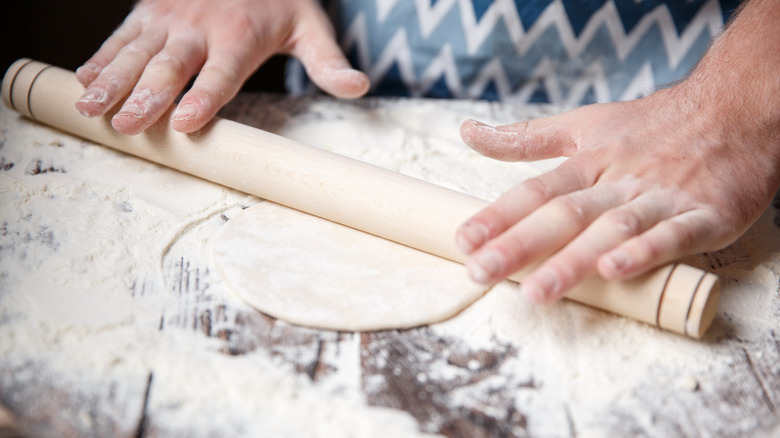
One of the most common mistakes people make when making fresh pasta is rolling out pasta sheets either too thin or leaving them too thick. Rolling it out too thin can cause the pasta sheets to rip, stick, or give the final texture of the cooked pasta a mushy, chewy bite. Rolling it out too thick, on the other hand, causes the pasta to have a dense texture and can lead to uneven cooking.
These two mistakes are easily made, especially if you don't have much experience making fresh pasta dough. One way to tell if your pasta sheet is at the right thickness is by holding the sheet up to the light. If you can see your hand or light shimmering through it, it's most likely ready to be used. However, if you want a more reliable result, roll your pasta dough roughly 1 millimeter or ⅛ inch in thickness — oftentimes this can be achieved on setting six or seven of a standard hand-cranked pasta machine.
12. Mistake: Exposing your homemade noodles to air

Once your pasta is rolled out, it's far more vulnerable to drying out, and leaving it completely uncovered and exposed to the air will quickly result in cracked, brittle pasta sheets that'll cook unevenly or, even worse, crumble into a fine powder. To prevent this from happening, all you have to do is loosely cover your pasta with either a dry kitchen towel or a sheet of plastic wrap. This will keep it moist while you get ready to cut and boil it.
Additionally, you should sprinkle a good amount of finely ground semolina flour on top of each pasta sheet — about 1 tablespoon per sheet — to prevent them from sticking together. If you're dealing with cut pasta like fettuccine or pappardelle, then be sure to completely coat the sheets in the semolina flour to prevent them from sticking — the coarse texture will keep the noodles separated. Afterward, cover it loosely in plastic wrap or a kitchen towel to prevent any further moisture loss.
13. Mistake: Forgetting to salt your pasta water
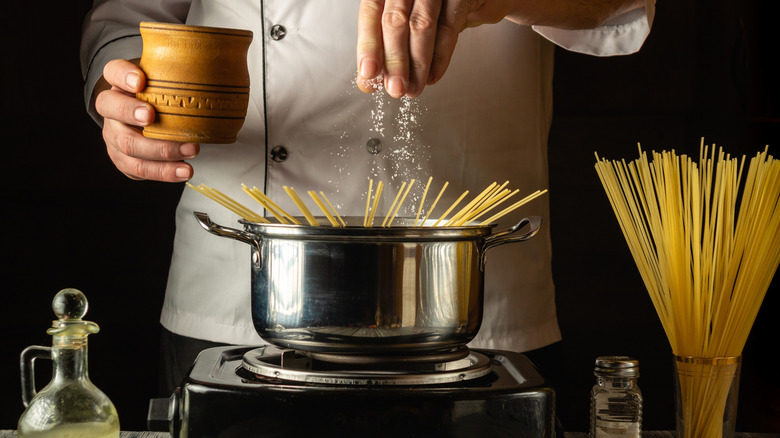
Another common pasta mistake everyone makes when making fresh pasta is simply forgetting to salt the pasta water. Forgetting to add any salt, or even just not putting enough salt in your water, can make your pasta bland and tasteless — no matter how good your sauce is. Beyond flavoring your pasta noodles, salt can also help strengthen the gluten network, helping to create a firm, "al dente" bite.
By the standard of most professional chefs, you should salt your pasta water with about 1 to 2 tablespoons of salt per 3-5 quarts of water for 1 pound of pasta. If you don't want to do all the math, just follow what nonnas have been doing for generations and salt your water so it's as salty as the sea. Be sure to taste your water before adding your pasta, so you can tell if it's overly salty or if it needs an extra handful.
14. Mistake: Overcooking your fresh pasta
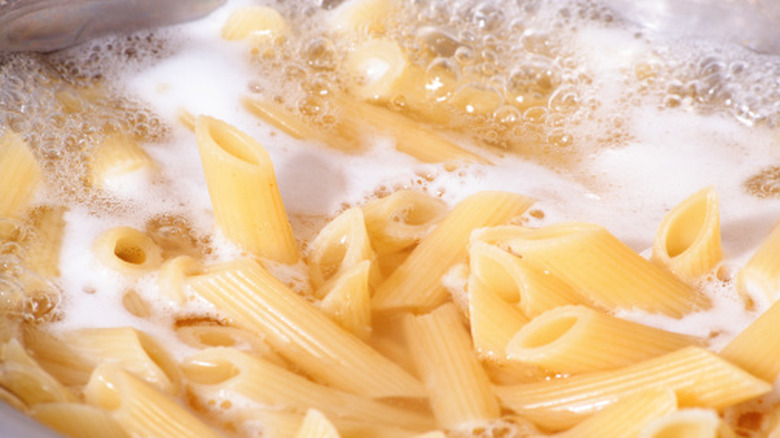
Imagine this: You've been to Trader Joe's to source imported ingredients from Italy, spent all evening making your pasta dough, rolled it out on your brand new pasta machine, and you place the noodles into boiling salted water, then set your timer to 10 minutes, thinking it's going to take as long as dried pasta — five minutes later, your evening dinner plans are ruined. For those unfamiliar, fresh pasta cooks a lot faster than dried, often within one to three minutes, sometimes even 60 to 90 seconds, depending on the thickness of the pasta. This is because it contains higher levels of moisture and lacks the structural density of dried pasta.
Beyond the actual boiling, you also have to be on the lookout for carryover cooking. The pasta should be pulled from the boiling water just before it reaches "al dente", as it will continue to cook in the sauce. If it's fully cooked before it's added to the sauce, then the heat from the sauce and pan will continue to cook it past the point of no return, leaving you with overcooked, soggy noodles.
15. Mistake: Not utilizing pasta water to create a silky sauce
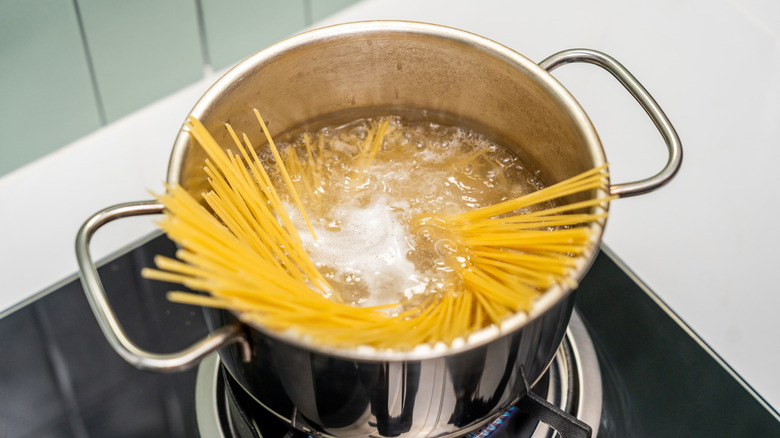
If you haven't already heard it screamed from the rooftops of your local Italian restaurant, you should know that pasta water is practically liquid gold — and tossing it down the drain can easily ruin your pasta before you even know it. Pasta water is starchy, highly seasoned, and basically already an emulsified liquid from cooking the noodles. Adding a few spoonfuls of it to your sauce will create a silky finish that will perfectly coat each noodle and bind everything together.
You might be wondering: "Isn't this just going to make my sauce taste watered down?" — well, no, since the water provides an extra layer of salty flavor directly to the sauce. Besides adding flavor, the starches in the pasta water break down and bind with the oils and fats in the sauce, creating its smooth, luxurious texture.