

15 Types Of Bacon, Explained
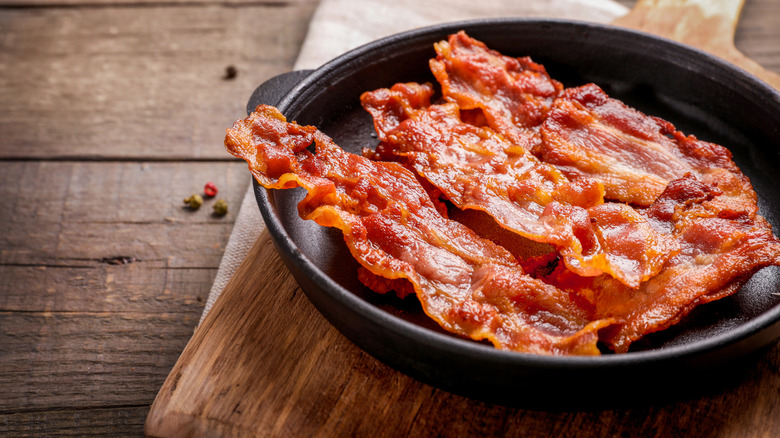
Even the world's biggest bacon fan may be surprised to learn that there are a lot more types out there than the variety we fry or bake (the easiest and best way to cook bacon) at home. For one thing, the particular pork product you grace with the title "bacon" can be surprisingly geography-dependent. Order bacon in Toronto, and your American senses may be shocked by the cornmeal-dusted meat you receive (and no, we're not referring to "Canadian bacon"). Ask for bacon in the United Kingdom, and you may be perplexed by your choice of "streaky" or "back."
Generally, the curing process is integral to meats called "bacon," though you can certainly find a product labeled "uncured bacon" (more on that later). However, some bacon types are processed in different ways, while others are cut from different parts of the pig. The fatty belly is common, but there's also the loin, shoulders, and legs (even the jowls produce a bacon-adjacent product) — all with resulting differences in flavor and texture. Other cured pork meats may not be called "bacon" at all but behave so similarly that you'll often find them interchangeable in recipes. One thing that's almost universal: the bacon family is known for salty, fatty, umami flavors that make it taste good with everything.
We took a three-pronged approach when selecting items for this bacon lineup. First is anything dubbed "bacon" (there will be some overlap). Then there are the cousins — pork products with such bacon-like traits that "ham" is an unsuitable moniker. And third are specific cuts and processing styles that dictate how the meat is bought, prepped, and served.
1. Back bacon
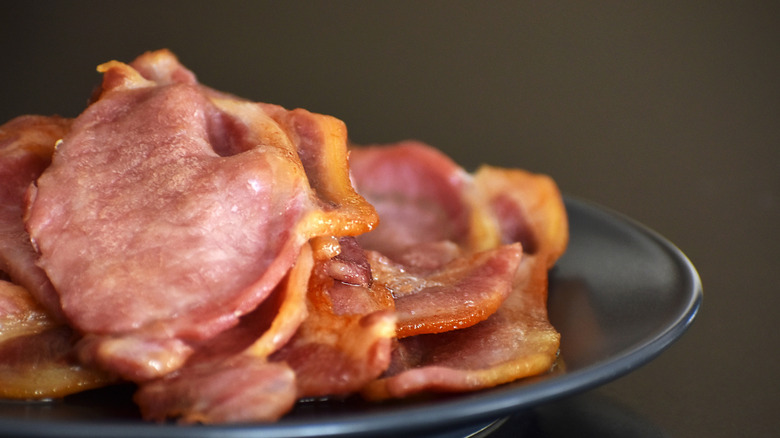
Per the name, back bacon is sourced from the back of the pig rather than the more common belly cuts. To be specific, it's from the loin of the animal — a particularly lean section from where pork chops are cut – but if you also cut a smidge of the pork belly with back bacon, it gives it a little toothsome "streakiness," as they say across the pond. Back bacon is something of an umbrella term, as a number of other bacon types on this list are examples of it. Essentially, if you're American, you're probably not eating much back bacon unless you're a huge fan of traditional eggs Benedict, which comes with Canadian bacon. If you're British or Canadian, it's possibly the only bacon you eat, unless you're fond of streaky American bacon.
The leanness of back bacon gives its appearance and flavor more "ham" than "bacon" vibes. It fries up nicely like regular bacon, with its rendered fat providing plenty of moisture. You could broil it, too; this offers nice char but risks drier slices if the fat drips into your roasting pan.
2. Collar bacon
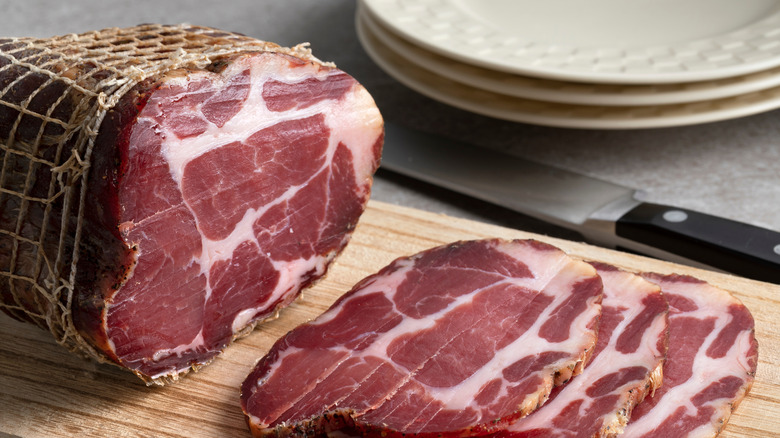
If you've never heard of collar bacon, that's because it's a not-so-common cut these days, not due to any detriment on its part. Cut from the ribeye of the pig's shoulder (or collar), its marbling gives it a more intense, rich flavor than back bacon or belly-cut bacon. A quintessential old Irish and English cut, if you can find collar bacon at the butcher or through online vendors, you'll likely be purchasing a collar joint of about 3 to 5 pounds, and you'll notice its dark pink hue and threads of fat right away. When cooked, its tenderness will win you over, along with its juiciness.
You could cook a collar of bacon the traditional Irish way, with cabbage and potatoes (or turnips). Alternatively, season the joint with rosemary, and do a long simmer with garlic, bay leaves, and other veggies. For a more bacon-esque approach, slice off pieces from your collar joint and fry them up in a nonstick pan with a little water. The fat will render, the slices will brown up and crisp, and you'll have the perfect meat for a bacon sandwich of a different ilk from the usual.
3. Buckboard bacon (cottage bacon)
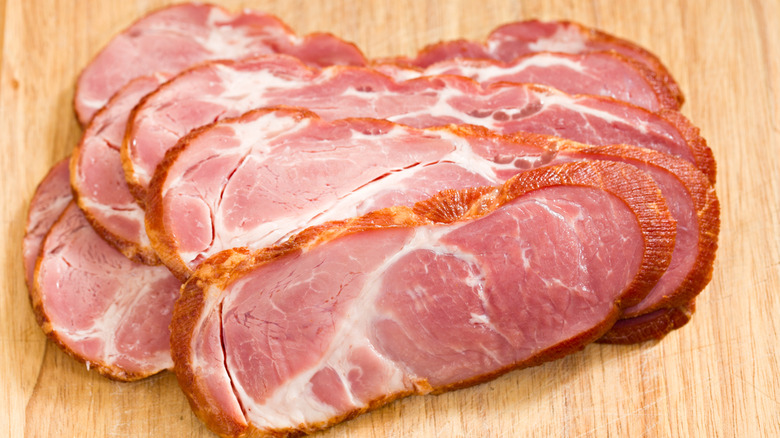
Buckboard bacon, aka cottage bacon, is sliced from the pig's shoulder (the butt) instead of the belly, inspiring some to dub it more of a bacon impersonator than an official bacon. It's leaner than the belly – tougher, too — but features a satisfying, porky flavor that makes it a darling among barbecue and meat curing hobbyists. The relative cheapness of making buckboard bacon yourself rather than purchasing traditional bacon strips is another attractive factor.
You can find buckboard bacon for sale from online vendors for $10 to around $14 per pound. If you prefer to join the ranks of DIYers who cure buckboard bacon themselves, grab a pork shoulder butt from Costco for around $2.60 per pound and slice it until you have slabs of 3 to 4 pounds. Cover them in a brine with salt, sugar, and maple syrup (or whatever else you like to brine in), and chill for about a week. Smoke for three to eight hours, and cut it into bacon-like slices.
4. Streaky bacon (American bacon)
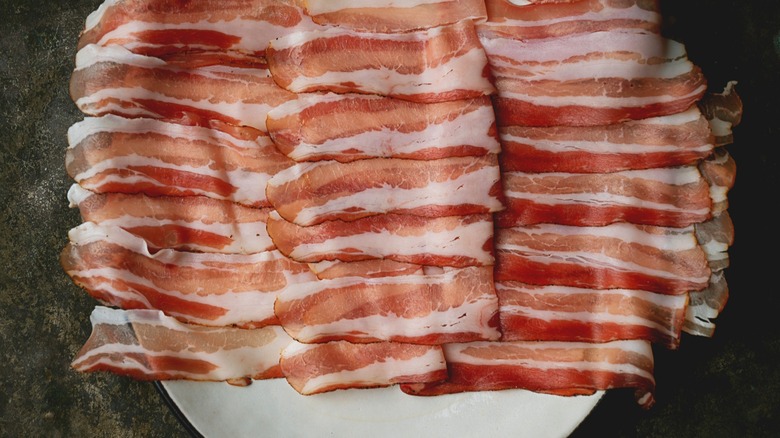
The porky, belly-sourced goodness that the average American fries up and refers to as "bacon," sans modifier, is what the back bacon-focused folks of the U.K. and Ireland call "streaky bacon." Fatty, smokey, and saltier than its back-based cousin, streaky bacon is named, as you may guess, for the clearly delineated streaks of fat running along it; British-style back bacon only contains a small portion of this fat.
That's not to say that the streaky stuff isn't popular across the pond, too. There are certainly proponents of richer, crispier bacon, and for a number of people, the question of one or the other is meal-dependent. Pigs in blankets beg for it, and pancakes seem to be a common food that the U.K. likes to pair with streaky bacon. Burgers, too, as well as American-style club sandwiches are common foods that require those crispy, streaky strips.
5. Canadian bacon
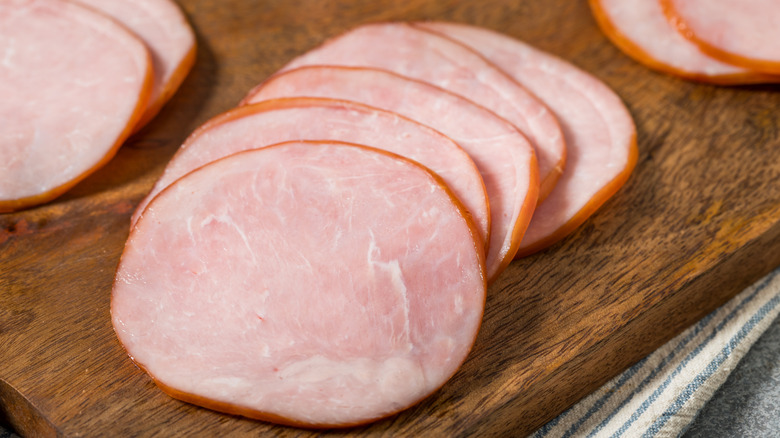
American readers have undoubtedly heard the term "Canadian bacon." It's what you get on a traditional eggs Benedict or an Egg McMuffin, and you can find it in the cold meats section at your local grocery store. In Canada, you won't find these lean, cured (not smoked), round slices referred to as "Canadian bacon," though. In The Great White North, it's more likely just called "bacon," or perhaps "back bacon." It's also the cut that makes up peameal bacon, which is a different type of bacon.
To the untrained eye (or one accustomed to streaky American bacon), Canadian bacon can look suspiciously ham-like, but it's generally leaner and firmer than ham. They're different cuts, after all: ham is typically cut from the pig's rear legs, while Canadian bacon is, again, sourced from the animal's back (aka loin). Canadian bacon is tender, juicy, a little sweet in that ham-like way, and makes many appearances on breakfast and brunch tables; ham is more of a dinnertime protein.
6. Irish bacon (rashers)
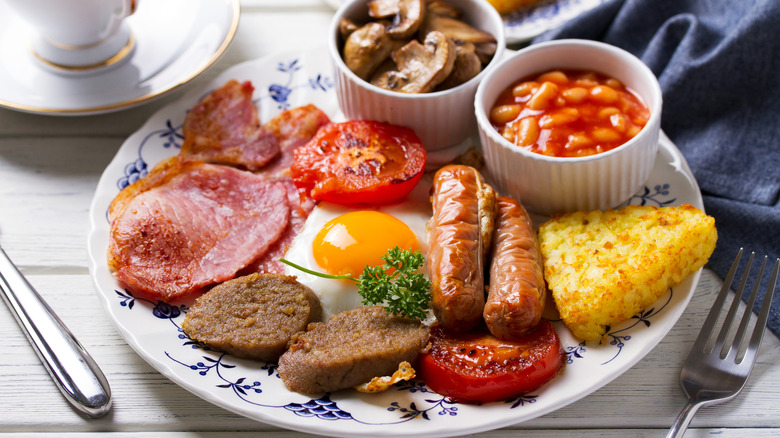
Irish bacon, which comes in thin, oval strips referred to as "rashers," has some overlap with other types of bacon on this list. It's most typically back bacon, sourced from the pig's loin, though you will find some online vendors selling "streaky Irish bacon." Consider Irish bacon and English bacon to be the same thing: back bacon that's most commonly cured, but not smoked, with a strip of fat from the belly offering moisture and flavor (imagine the pork version of a New York strip steak). Still, it's much leaner than actual streaky/American bacon, and when pan-fried, its chewy (rather than crispy) texture and mildly salty flavor will read as more ham-like to a streaky bacon devotee.
Pan-frying is a common cooking method for these bacon rashers, but boiling them up with cabbage yields a traditional Irish dish. If you're familiar with corned beef and cabbage, you've eaten a meal concocted by 19th-century Irish emigrants to the U.S. They were essentially swapping in a cheaper, more readily available meat than Irish bacon.
7. Szalonna (Hungarian bacon)
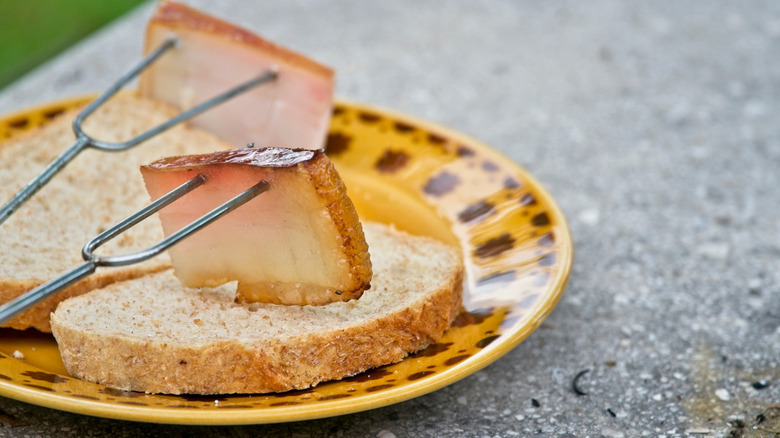
Szalonna falls into the "not quite bacon" category, but it's commonly translated as "Hungarian bacon," so it's good to know where it intersects and diverges from actual bacon. Generally, szalonna is salted and smoked fatty pork cuts, but there are many different types of szalonna in terms of processing method and specific cut. Some types of szalonna are cut from pork belly or jowl, while sózott fehér szalonna (salted white szalonna) is a salt-cured, skin-on slab of pork fatback. It's distinct from other szalonna types in that it's not smoked. There's not much meat on it, if at all, making it similar to csemege szalonna (gourmet szalonna), which is smoked.
Csemege szalonna is what you'll find being cooked over open flame during a traditional szalonnasütés (or bacon fry), where you'd need high-quality, sturdy bread to absorb the szalonna's fatty drippings. Besides communal bacon fries, you'll also find csemege szalonna as the foundation of lebbencs (a noodle) soup, and a key ingredient in túrós csusza (cottage cheese pasta).
If you're in the States, it may not be easy to find szalonna in stores. You could try asking your butcher if they have skin-on fatback. Otherwise, check online vendors selling "Hungarian-style bacon" for a szalonnasütés.
8. Lap yuk (Chinese bacon)
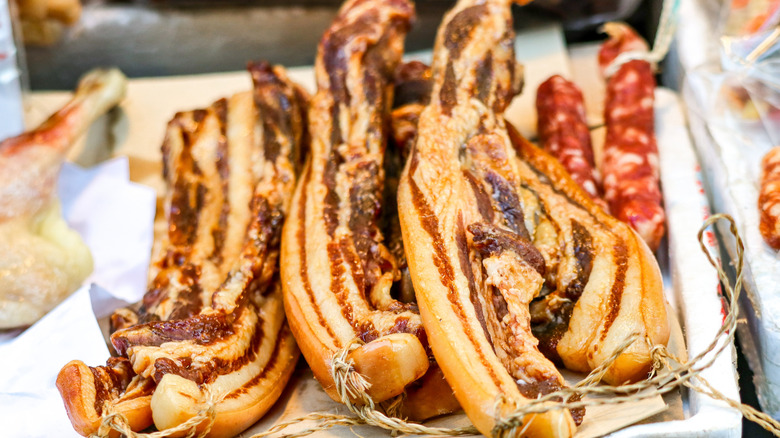
The history of bacon dates back thousands of years, when the Chinese began salt-curing pork belly around 1500 BCE. Lap yuk (or là ròu in Mandarin Chinese) is still a beloved pork meat today, with its distinctive salty-sweet flavor and slightly chewy consistency. Especially associated with the southern regions of China, it's traditionally prepared during the winter months, when the temperature is perfect (50-55 degrees Fahrenheit) for preserving the meat while it's wind-cured. That said, a determined lap yuk enthusiast can prepare this toothsome bacon in a cool basement.
Lap yuk's irresistible flavor results firstly from its sauce, a mixture of aromatic ingredients like star anise, peppercorns, cinnamon, light and dark soy sauce, Shaoxing wine, and sugar. Some recipes also involve Chinese baijiu (or whiskey in a pinch). Strips of pork belly are placed in this divine concoction and left to rest for a few days. Curing then involves hanging the strips with kitchen string and allowing four to six days for them to dry (they will drip). Try lap yuk in clay pot rice, or steam it on top of your grain in a rice cooker so that the fat melts, yielding a decadently oily dish.
9. Peameal bacon
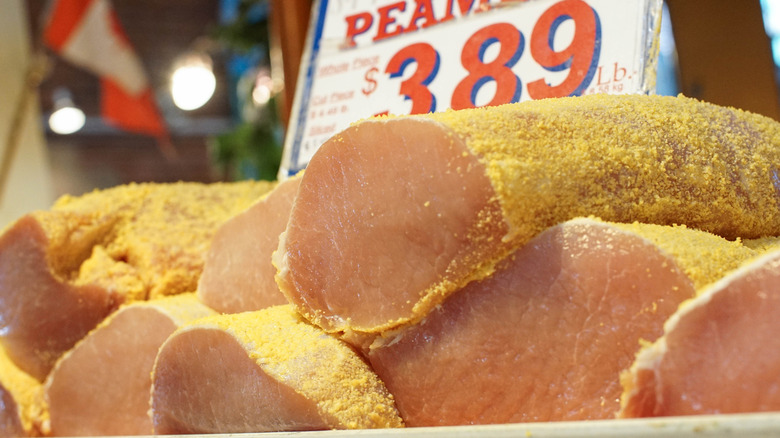
Peameal bacon is one of the bacon types on this list that shares some major overlap with two other items. You'd have the right idea if you consider peameal bacon to be what Americans call "Canadian bacon," except it's wet-cured but not smoked, and rolled in cornmeal (or peameal, if you're preparing it the historical way) before frying or roasting. That means it's a form of back bacon: leaner (especially since it's trimmed of fat) and more "hammy"-looking than "streaky bacon"-looking.
Peameal bacon's true beginnings are contested, like many foods, but a common origin story places its creation in 19-century Toronto, Ontario, with pork product pioneer William Davies. Davies, it is said, rolled the pork loin in crushed, dried yellow peas, forming a crust that would aid in preservation; this gradually gave way to the iconic cornmeal crust of today. If you want to try peameal bacon, you'll likely need to head to Canada. Hit up Toronto itself for a peameal bacon sandwich – the city's signature dish – and Carousel Bakery in St. Lawrence Market for an uber-famous iteration.
10. Guanciale
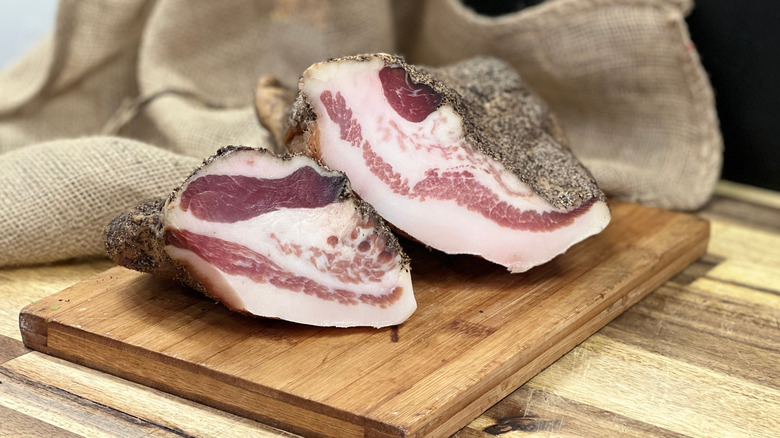
Guanciale is one of the distant bacon "cousins" on this list — a meat that behaves in a similar manner despite being cut from a wildly different spot on the pig than the common back and belly: guanciale comes from the pork cheek (or "jowl"). The cut is salt-cured for a few days; the salt is then rinsed or rubbed away before the meat is aged for around three months. Flavor-wise, you'll detect something a little bacon-like in guanciale — fatty and salty — but without the smokey notes that define many common bacon types. The fat is a major difference: compared to bacon, guanciale's is silkier, not so gristled, and is one of its primary culinary draws. Guanciale is almost all fat, too, with little meat.
You'll find guanciale integral to three pasta dishes of central Italy: amatriciana, carbonara, and the lesser-known (at least to non-Italians) gricia. As that iconic fat renders and the morsels of guanciale crisp up, the dish becomes infused with salty, savory, unctuous umami. Guanciale is also a natural meat for a charcuterie board, and in Italy in the winter, you may find it simply sliced and eaten on bread.
11. Uncured bacon
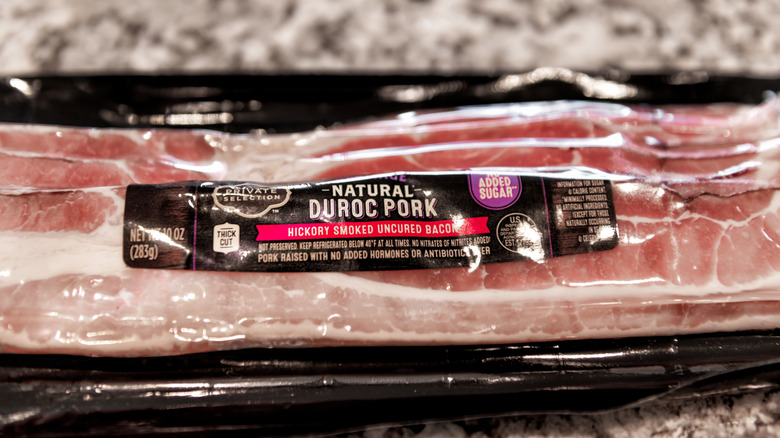
A look at your supermarket's bacon aisle may reveal a package labelled "uncured bacon." Since curing is essential in the production of bacon, this may have raised your eyebrows: is this stuff actually bacon? Rest assured that it is — and that it's also not truly uncured. Bacon is preserved (cured) through either salt or smoke. Bacon producers use dedicated curing salt (plus spices and sugar for flavor) to enhance the antibacterial powers of the curing process. This curing salt is a combination of table salt and sodium nitrates and nitrites, two natural chemicals that can nonetheless form carcinogenic compounds when cooked at high heat.
Uncured bacon is not made with these artificial nitrates. Almost all vegetables contain nitrates, too (and eating them in veggies is not the same as eating them in cured meats!). So, uncured bacon is cured with natural nitrates from celery. Some people believe this can make the bacon "healthier" than standard bacon, but studies have shown that even these natural nitrates end up converting to the carcinogenic compounds when heated. If you like uncured bacon and don't mind spending more for it than regular bacon, go for it; just know that it's not technically "healthy bacon."
12. Pancetta
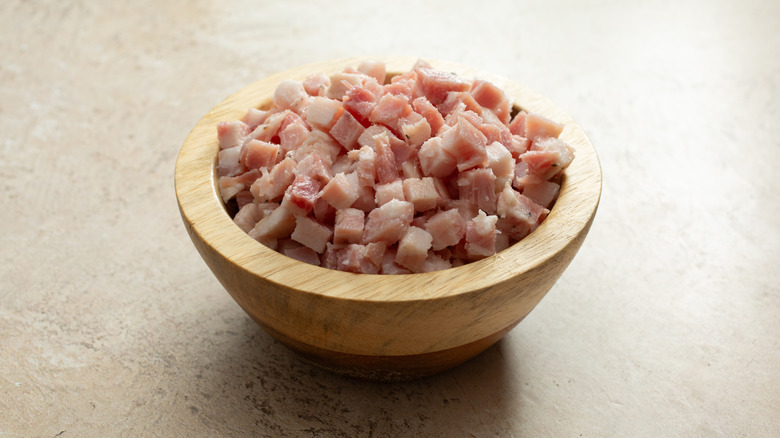
Pancetta is one of bacon's Italian cousins. Like guanciale, it undergoes curing, spicing, and drying, but you might consider pancetta a tad more bacon-like than the former because it's made from pork belly rather than jowl, and you can get it in smoked strips (or unsmoked round slices, if you prefer). It has a strong, porky flavor, especially when unsmoked, and since it's the same cut as streaky bacon, the fat and water content are very similar; they're passable substitutes for each other. In Italian cooking, you'll find pancetta as the base of many savory sauces and soups, as well as on cold cut antipasto plates — especially in Northern Italy.
In the U.S., pancetta is less easy to find in stores than bacon, but more common to see than guanciale. If you're making pasta carbonara or amatriciana, you can swap in pancetta for guanciale — and yes, you can also swap in bacon. The fat will render nicely, and you get that smokey flavor to boot.
13. Slab bacon
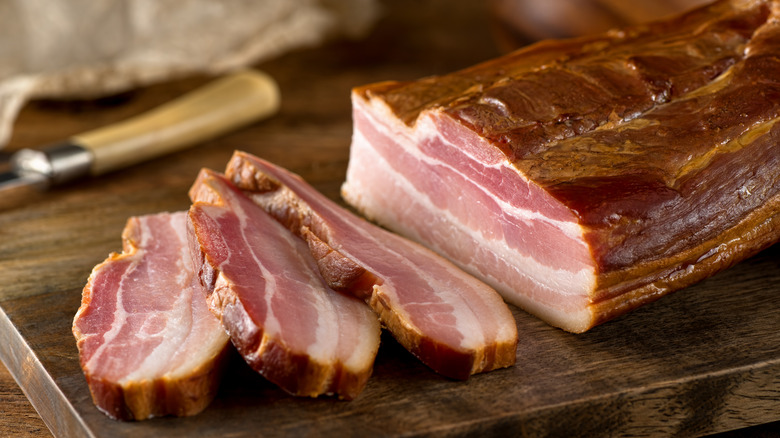
The name alone reveals what this bacon type is: a big ol' slab of smoked pork belly. Consider slab bacon to be the motherlode, a whole bunch of streaky bacon pieces before they're sliced into strips. For a DIYer, the appeal is obvious: you can take that slab and slice it into thin strips for your typical American breakfast meat, or go thicker for recipes that need bacon more resistant to burning, like if you're wrapping scallops or other proteins in it. Thick-sliced slab bacon is also the perfect bacon for a BLT sandwich for its crisp outside and chewy interior. This is a type of bacon you'll likely need a trip to the butcher shop or farmers markets to access, but once you find it, enjoy the jackpot.
Unless you're cooking BLTs or whatnot for dozens of people, you'll probably need to freeze most of your slab. The most convenient way is to slice it all and lay one piece at a time on the edge of wax paper. Fold that over, then do another slice until you have a pile. Freeze in an air-tight bag for one to three months.
14. Bacon lardons
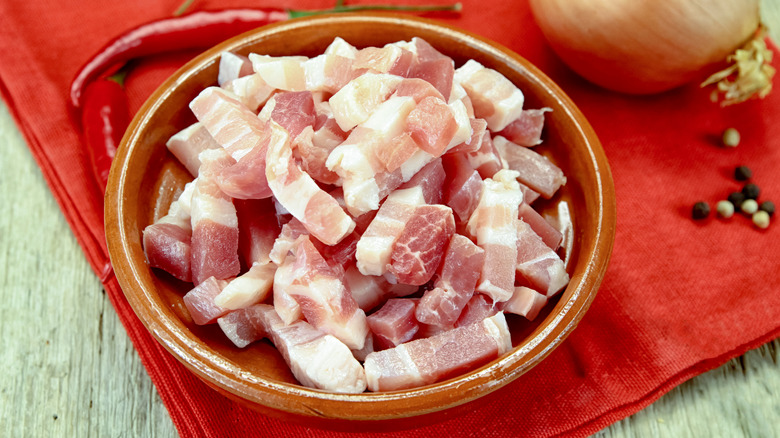
You may have heard or read of bacon lardons, especially in French cuisine; lardons are simply matchstick-shaped pieces cut from slab bacon. Being cured pork belly, their fat lends juicy richness to dishes, along with salty, meaty flavor. In France, lardons are integral to dishes like salade frisée aux lardons and coq au vin, to name a couple. French lardons come from a special unsmoked pork belly cut called ventrèche, but you can certainly make them yourself with regular smoked slab bacon and use them in veggie dishes, omelets, or any other foods that benefit from bacon.
To make lardons, freeze your belly slab for 15 to 30 minutes (it'll cut easier), then slice it into ¼ inch strips. Cook over medium heat, starting with a room-temp pan with a little water. Take it slow to avoid drying them out; you want the fat rendered before the lardons are golden brown and still slightly chewy.
15. Speck
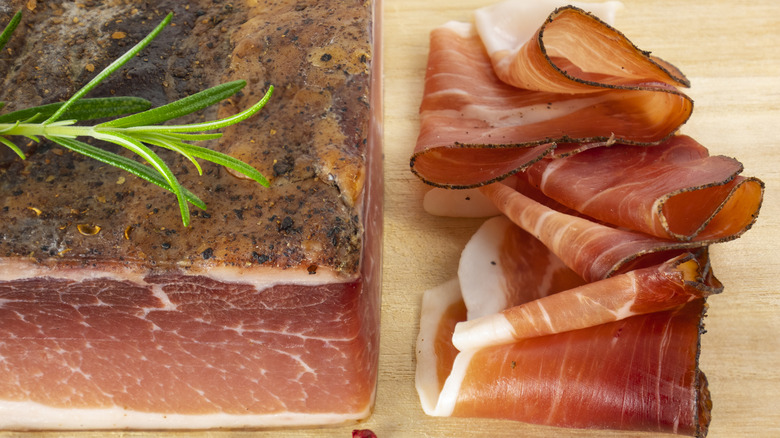
Speck's definition depends on geographic location. In Italy, this pork leg ham/bacon – a charcuterie favorite – is associated with South Tyrol (Alto Adige), where it has Indication of Geographic Protection (IGP) status: high-quality, "true" speck is produced only there. After careful selection, the pork legs are rubbed with and marinated in spices, including juniper, for two to three weeks. They're then smoked outdoors and cellar-cured for 20-32 weeks, during which time a protective mold forms that retains moisture and yields a balanced, savory flavor. It's thinly sliced and eaten cold with bread, or in dumplings.
In Germany, "speck" means "bacon," but there are several styles, cut from different sections of the pig and prepared differently. For instance, Schinkenspeck, from the back hip, is lean and typically used as cold cuts, while Bauchspeck, a belly cut used in cooking, is cold-smoked and air-dried; beechwood smoke provides its distinctive flavor. Buy Bauchspeck online, or swap in pancetta.