

7 Restaurant Chains That Beat Bankruptcy
Bankruptcy can be a beneficial reset for a business that's gotten into too much debt. But social stigma around bankruptcy, plus the near-constant involvement of private equity, have made bankruptcy into something more nerve-wracking for customers who want their favorite chains to survive. Filing for bankruptcy in the restaurant world is actually pretty common, and you'll usually hear about companies filing for Chapter 11 bankruptcy. This is a business-focused filing that allows companies to restructure or revamp their financial organization, while remaining open — although it does often involve closing locations and selling the company to someone else. That someone else can be a private equity group or another company that the bankruptcy court finds qualified.
Sometimes, you'll hear of a company filing for Chapter 7, which is the type of bankruptcy that closes down a company completely, liquidating all assets. Luckily, that tends to be rare, at least for larger chains. While some chains that are struggling financially don't manage to recover and have to file for bankruptcy again, many larger chains come out of bankruptcy with stronger financial support and better business models. Here are seven chains that managed to beat bankruptcy and stay in business.
1. California Pizza Kitchen
California Pizza Kitchen had already been considering a sale before the pandemic hit, but the lockdowns and subsequent drop in business forced it to stop considering and take action. The chain filed for bankruptcy in July 2020 due to an excessive debt load, thanks to a private-equity owner. However, no qualified buyers stepped up to take over, which meant bank lenders took over the bankruptcy plan. But CPK was proactive in slashing costs and managed to negotiate lease concessions (which not every restaurant is successful at), and it dove headfirst into third-party delivery. It also started focusing on how to serve people who were now working from home.
As a result, the company emerged from bankruptcy in November 2020 with its debt slashed and a much stronger business model. A group of investors bought the company, and since then, the chain has gone on to sign international franchise agreements and increased its frozen pizza grocery offerings and brand recognition.
2. Sbarro
Sbarro may be the only chain on this list that did not have to file for bankruptcy in 2020 due to the effects of the pandemic. However, it did go through two filings in the 2010s due to the effects of the Great Recession, and it wasn't exactly left untouched by lockdowns. The first round of bankruptcy occurred in 2011 when the company was dealing with growing debt. The problems continued, however, and Sbarro had to file again in 2014, when it was also dealing with rising costs and shrinking foot traffic. It was a mall food court staple, which meant that any drop in mall traffic meant that its revenue would drop as well.
Luckily, the CEO who took over in 2014 was determined to see the chain survive and thrive. In addition to closing some Sbarro locations, the company tried opening a chain called Pizza Cucinova. Unfortunately, that chain didn't do well and had to eventually close. The company refocused on its basic pizza and pasta dishes and branched out from malls to places like travel centers along highways and tourist locations. It also tried to change its reputation for serving pre-prepared food. This streamlining and effort to diversify helped the company's overall financial health, which protected it from the more severe ravages of pandemic lockdowns in 2020. The company still faced falling revenues from the lockdowns, of course, but it was able to survive as some of its competitors closed down.
3. Fuddruckers
Fuddruckers, home of the build-it-yourself burger bar, first went through Chapter 11 in 2010 when its corporate owner, Magic Brands, filed for bankruptcy. The chain blamed its finances on expensive leases and said it would close several company-owned locations (no franchises were part of the bankruptcy). Magic Brands originally planned to sell everything to Tavistock Group, and in fact, the bankruptcy was meant to ease that transition. However, the owner of Luby's Cafeteria managed to outbid Tavistock and took control of Fuddruckers. The company survived and continued to serve burgers in several states.
However, the pandemic wasn't kind to restaurants that let customers grab their own food. Several Fuddruckers locations had to close, with some cities seeing all their locations disappear. In addition to that, Luby's had already been struggling with dwindling sales for years, and in September 2020, Luby's board decided to liquidate. In June 2021, a Fuddruckers franchisee stepped in and purchased the company from Luby's. Thus began a long attempt to help Fuddruckers improve sales, including opening locations in shopping malls. However, many locations still had trouble staying open.
It also didn't help that in 2024, the company had to quickly respond to social media rumors that all Fuddruckers were going to close. Luckily, the company and its franchisees have kept the chain alive, with some locations re-opening in 2025.
4. Friendly's
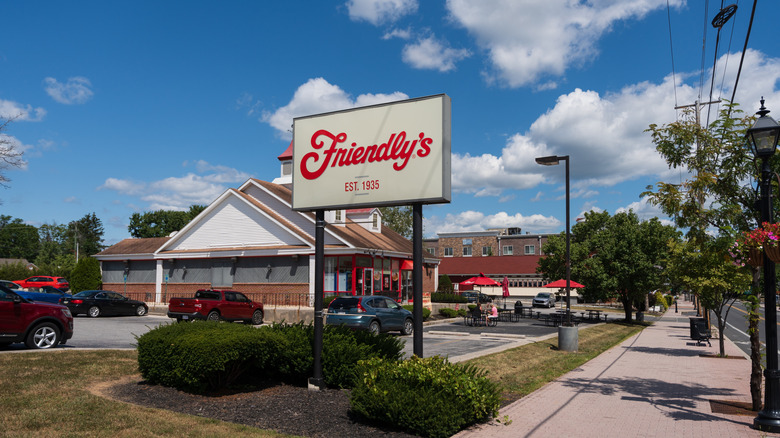
East Coast chain Friendly's has had to deal with two bankruptcies, and it's managed to come back from both rather well. The first filing was in 2011, when the company dealt with low sales and high rents. The company itself wrote on its website that many locations had also become rundown and out of touch. The bankruptcy period was short, but it included a controversial plan to shift its pension burden to the Pension Benefit Guaranty Corporation, which is part of the federal government. The PBGC objected, and the two reached a settlement in December 2011.
In November 2020, Friendly's filed again for Chapter 11. As you can guess, this had to do with the pandemic; the lockdowns had badly affected sales and the company's finances. By 2022, however, the chain was in the midst of a revitalization effort. The chain's fortunes have waxed and waned as it's gone through several acquisitions, but its latest owner still has plans to revamp the chain further, including opening franchises in the Southwest.
5. Sweet Tomatoes
We've included Sweet Tomatoes as a chain that beat bankruptcy, but don't get excited yet. Sweet Tomatoes, a.k.a. Souplantation in California, declared bankruptcy twice. San Diego-based Garden Fresh Restaurant Corp. filed for bankruptcy in 2016 after sales dropped in the mid-2010s. The company's plans were to close locations and find a buyer. Initially, it couldn't, and the company ended up first with a distressed-debt company, and then investment firms. That, however, was an unexpected miracle. Instead of ending up with private equity firms that might have cut service down to the bone, Garden Fresh ended up with Perpetual Capital Partners. That company instead invested in revitalizing the chain. Garden Fresh, Souplantation, and Sweet Tomatoes started doing rather well.
Then the pandemic hit and forced Garden Fresh to declare Chapter 7 bankruptcy in 2020, closing the company completely. It did not beat that bankruptcy, but the chain was so beloved that people tried to reopen it. The first was a failed attempt to turn a La Mesa, California, Souplantation into an independent restaurant. But in 2024, a company called ST Three got the rights to Sweet Tomatoes and opened a location in Tucson, Arizona, which received rave reviews.
Fans of the chain got a shock in December 2025 when Sweet Tomatoes' Instagram account posted a cryptic message about returning to ocean waves and sand. It looks like the restaurant may be exploring a remodel of an old location in Fort Meyers, Florida.
6. Golden Corral
Sometimes the main company behind a restaurant chain isn't the one having problems. Franchisees can find their restaurants going under, as well. And, in 2020 and 2021, Golden Corral's two largest franchisees declared bankruptcy one after the other, affecting 12% of the company's overall locations. The first was Operator 1069 Restaurant Group, which filed in October 2020 after pandemic restrictions had decimated its business. The franchisee emerged from bankruptcy in March 2021, and by April, it announced that its sales were reaching pre-pandemic levels. However, in April 2021, the second-largest franchisee declared bankruptcy. Platinum Corral LLC also blamed the pandemic for a drastic drop in business after its locations all closed at the start of the lockdowns.
Despite the two bankruptcies, the company rebounded nicely. Not only did Operator 1069 Restaurant Group announce good sales numbers, but the company overall was doing a lot better by 2022. Golden Corral's CEO, Lance Trenary, chalked the success up to careful pricing and attention to quality in an interview with FSR Magazine. The chain still makes a lot of food from scratch in its onsite kitchens, and Trenary said that from-scratch often produces a better product than buying it pre-made. By 2023, the chain saw record setting sales. However, in June 2025, franchisee South Texas Corral LLC filed for Chapter 11 for unspecified reasons.
7. Sizzler
Sizzler seemed to be everywhere in the 1970s and 1980s, and for good reason. The chain had expanded rapidly in the previous decades, introducing a salad bar and adapting the menu to follow shifts in diner preferences. In the early 1990s, the chain tried to transform itself into a buffet restaurant. However, that didn't work, and the chain began laying off corporate staff and closing restaurants in 1994 and 1995.
That wasn't enough to help the chain, however, and the company ended up filing for bankruptcy in 1996. Sizzler itself was doing OK financially, and franchisees themselves weren't part of the filing. But Sizzler wanted to close company-owned locations that weren't making a profit, and bankruptcy was the most efficient way to quickly get out of the leases.
Sizzler managed to hang on until 2020, when it was part of the wave of restaurants that had to declare bankruptcy due to the pandemic. This filing was for the main company only and was meant to allow it to end leases when it couldn't get rent abatements. Since then, the chain has cautiously bounced back. In 2023, it announced plans to remodel and include new features like kiosks. However, the chain said its aims were mainly to stick to the formula that made it great during its heyday, including bringing back old mascots. The formula may be working as the updated-yet-nostalgic locations have seen substantial increases in business.