

6 Big Changes Coming To Walmart In 2026
We may receive a commission on purchases made from links.
As 2026 barrels toward us, we're making resolutions to improve ourselves, and Walmart is no different. The company is starting off the year with a change in leadership at the very top. Doug McMillon, CEO and President of Walmart Inc., is retiring on January 31, 2026, after nearly 12 years in the job and more than 40 years with the company, although he's staying on in an advisory capacity for another 12 months. McMillon is being replaced by John Furner, who, like McMillon, started with Walmart as an hourly employee. Furner worked his way up to become President and CEO of Walmart U.S. in 2019, so it's safe to say he knows what he's getting into.
This leadership move marks a new era for Walmart, one in which it's doubling down on the use of technology and AI, from the warehouse all the way to the checkout counter. It's not throwing down the gauntlet to Amazon just yet, but the company is signaling its commitment to leveling up its tech with another major move. In December 2025, it transitioned its shares from the New York Stock Exchange to Nasdaq, the largest company ever to do so. The Nasdaq is the more tech-focused exchange, so Walmart's shift is sending a very public message about the direction it's taking going forward. Speaking with CNBC, McMillon stated, "Walmart's changed a lot, and we're trying to make sure everybody knows it." So what changes will we actually see from the company in the year ahead?
1. Expanded use of automation
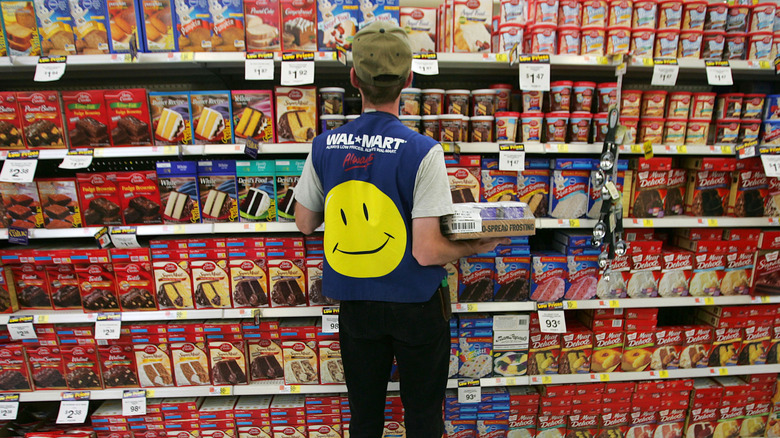
Walmart is investing heavily in automation across the board, between bringing in remote-operated forklifts to installing automated inventory trackers. For instance, employees who work on the loading docks at certain Walmart distribution centers are being trained to operate the FoxBot autonomous forklift developed by Fox Robotics. The system can do triple the work of one employee. Maurice Gray, general manager of a Walmart Distribution Center in Brooksville, Florida, describes the job like playing Tetris, explaining on Walmart Corporate, "Instead of unloading the pallets manually, associates become conductors –- considering the best, most efficient way to unload trailers based on their own experience. I'm watching players become coaches, and I couldn't be more impressed."
AI initiatives are working hand-in-hand — or robot-to-robot — with physical automation advances to direct products where they need to go more quickly and efficiently. Walmart is a global company, so getting Great Value products from where they're made to the shelves where they're sold is a massive undertaking. Artificial intelligence sifts through data and predicts where products will be needed. The aim is to get things to the consumer faster with the least amount of manual labor. These systems are also programmed to flag items that are overstocked in one location and reroute them to locations where they're lacking. When it comes to perishables like produce and other food items, this reduces food waste in a significant way, not to mention the money it saves the company.
2. Introduction of digital shelf labels
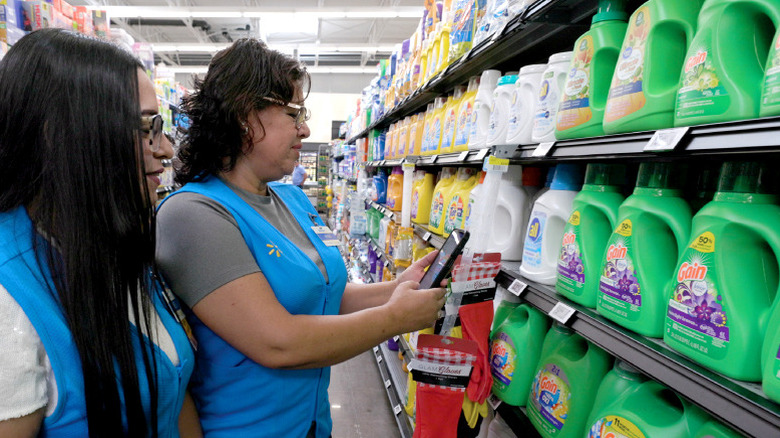
One change that will directly affect consumers is the installation of digital shelf labels or DSLs in Walmart stores. What are DSLs? They're little, individual screens that replace the price labels on the fronts of shelves, the ones that list those unit prices to help you save money. DSLs don't look like phone screens, which is a good thing, or strolling the Walmart aisles might feel like being stuck inside a video game. These use e-paper technology. Think Kindle displays, easily readable but unaggressive. The screens are also interactive, often including QR codes that consumers can access with their phones for more information on a particular product.
This new development means employees are no longer tasked with mindlessly slapping price decals on products by the hundreds, which, in turn, means no more mad dashes from the register to the far end of the store for a price check because the decal got lost, and no more death glares from shoppers in line behind you for making them wait. Since the tags are linked to the Walmart system, price updates, markdowns, and other changes happen remotely, which means that prices should be up-to-the-minute.
There are also LED lights on these DSLs, including a "Stock to Light" feature to show employees where attention is needed and a "Pick to Light" indicator meant to help employees fulfill grocery delivery orders more quickly. Walmart plans to have DSLs operational in 2,300 stores by 2026.
3. Employee retraining at Walmart Academy

As automation increases, Walmart's staffing needs will logically decrease, so what does that mean for current employees? The company employs about 1.6 million people in the U.S., so shifting to AI and automation will affect a lot of them. Take the implementation of DSLs, for instance. According to Walmart Food and Consumable Team Lead Daniela Boscan, writing for Walmart Corporate, "DSLs allow us to update prices with a few clicks. A price change that used to take an associate two days to update now takes only minutes with the new DSL system. This efficiency means we can spend more time assisting customers and less time on repetitive tasks."
With that in mind, Walmart has plans in place to transition employees to working with AI and automation via investments in AI literacy. It calls this "upskilling," and the company has reportedly invested $1 billion in a program called Walmart Academy to make it happen. The academy focuses on training hourly employees to move into more specialized roles the company anticipates needing to fill going forward. Associates don't have to wait, either. They can start learning their first day on the job.
According to Walmart's rating on the customer review platform Trustpilot, the general consensus about its employees is, to put it bluntly, incredibly bad. Like one-and-a-half stars bad. So if the company is serious about retraining, it may want to work on getting off lists of supermarket chains with the most unhelpful employees. Just a suggestion.
4. Implementation and expansion of instant checkout
Walmart is leaning into AI in a move toward what it calls "agentic commerce," which isn't what you think. The agent it's talking about is a chatbot. Say goodbye to your search bar. Forget about the keyboard. You can just ask for what you want, and Walmart's ChatGPT-enabled app will tell you what you need to know. The helpful little bot is a happy face named Sparky, and it can comb through those endless customer reviews for you, help you make your shopping list, send it off to be filled, and tell you what time your groceries will be delivered to your door.
If you're out of dinner ideas, you can check Walmart's recipe library, choose what looks good, and add the ingredients to your list or delivery order with one click. The recipe library even tells you the estimated cost of the dish per serving, so if you're on a grocery budget, you can calculate down to the penny. You can even ask Sparky to get creative and help you assemble, say, a Christmas charcuterie board; it won't argue. It'll present you with options you can click and add to your cart. It's called "conversational commerce," and it's here to stay, so we might as well befriend Sparky and put it to work.
5. New ways to pay
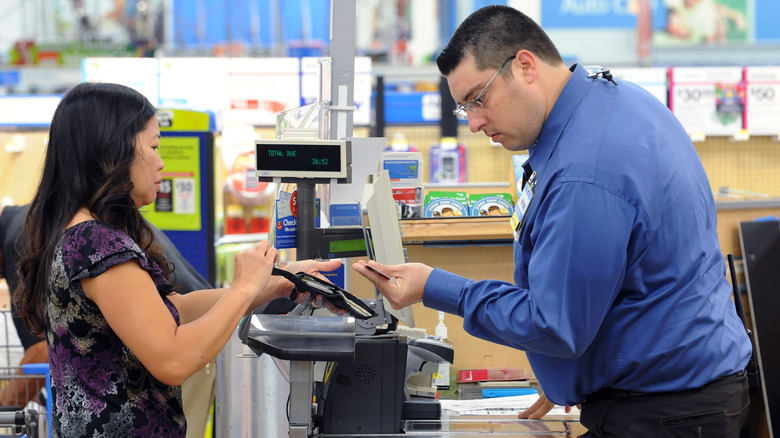
Walmart is incrementally transforming the way customers pay for groceries with new technology, although shoppers still have to pause at the exit while their receipts are checked against their purchases. The newest innovation is called "Scan and Go," and it's almost what it sounds like but not quite. The way it works: You scan the barcode of each item as you put it in your cart. When you're done shopping, the app sends you a QR code. You head to self-checkout, scan that code, pay, and go. You're essentially saving the time you'd spend scanning each item at the register as you bag your goods. Of course, self-checkout lines can be long, so if saving time is a priority, do some research into the worst day of the week to grocery shop and plan accordingly. Pro-tip: As you scan, put your items directly into your reusable shopping bags so you really can just scan and go.
There is one area in which Walmart's tech is lagging behind most other retailers, and that's the tap-to-pay option. Apple Pay and Google Pay are of no use to you at Walmart, although you can go contactless by using Walmart Pay. Be aware, though, that Walmart is using this feature to collect customer data, so if you don't like the idea, good old cash or sliding your credit card into the slot still works just fine.
6. Personalized ads

Along with the AI advances that help consumers, there are, of course, those advances that help manufacturers. One of these is what Walmart obliquely calls "sponsored prompts," but we might call "annoying ads." We're talking about all those pop-ups that make you wonder if your home tech is spying on you. The short answer is: Yes, it is. But probably not in the way you think.
Say, for example, that you sign up for Walmart Pay. To use it, you have to program in your credit card number and plenty of other personal information. Once Walmart has that info, it can then track your specific purchases, your shopping routine, and other things that are above this writer's pay grade. And that's where the pop-up fun begins, at least for the advertising people. Manufacturers pay to have specific products appear in prime spots on your screen, for example. They also pay to reach "high-intent customers," meaning those who are regular buyers of a particular shampoo or dog food. How do they know this? Walmart Pay.
There is an upside to this kind of "personalization," should you choose to see it, and that's the fact that the ads you're seeing are becoming less random. If you don't have kids (or dislike them), you're less likely to be assaulted by an ad for Huggies, and that's a plus. But if you want to keep Walmart out of your personal business, steering clear of Walmart Pay is a good first step.