

The Spices That Give Polish And German Pickles Their Signature Kick
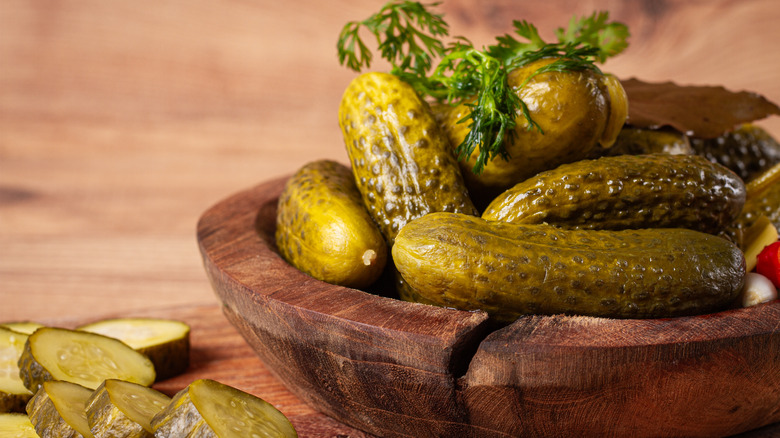
As a fan of all things pickles, do you ever find yourself bored with the same old, same old? Your taste buds might be ready for something new, and you might find yourself in a pickle, unsure of which variety from the abundance that pickles have to offer to choose from. If you are up for taking things up a notch with a notable kick of spice to complement the briny, crunchy pickles, look no further than Polish and German pickle varieties. Unlike more familiar varieties like dill pickles, the former two feature a spice-forward tasting profile. And by spice, we don't mean "spicy" like in the case of hot peppers, but rather the aromas and flavors from ingredients in your spice rack. In a number of ways, Polish and German pickles are quite similar to dill pickles. However, one key difference is the inclusion of spices and herbs that bring nuance and depth to the humble pickle.
Herbs and spices like peppercorns, mustard seeds, and dill are added during the pickling process to impart the distinct taste of these European pickle varieties. Both types are usually pickled in wooden barrels that also contribute to their standout taste. So, if you fancy the extra kick from the spices, consider switching out the more conventional dill pickles with Polish and German pickles to a variety of dishes. Be it a pickle grilled cheese, an old-school peanut butter and pickle sandwich, or using crunchy pickles as a low-carb swap for bread, you can impart the signature tasting notes of both German and Polish pickles to your creations for some fun variety and improved flavor.
What makes German and Polish pickles unique
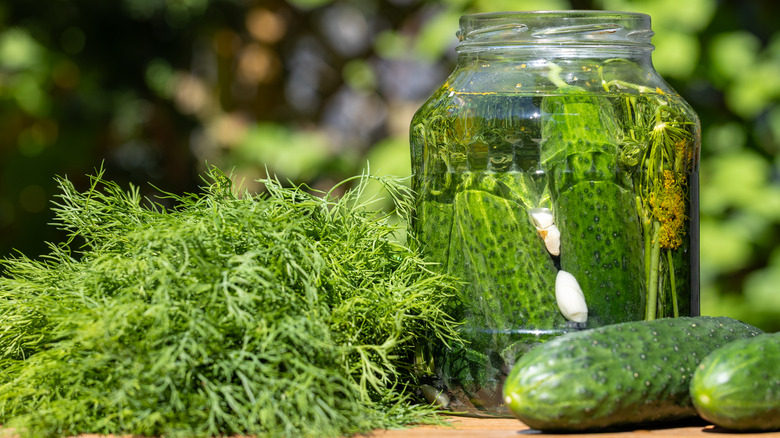
Chances are you don't have the wooden barrels that are commonly used for making German and Polish pickles lying around in your home. If you do, good on you! If not, you can still savor the signature taste of these pickles with ease using the listed spices and tapping into the science of pickling. German and Polish pickles, traditionally known as "Senfgurken" and "Ogórki Kiszone," respectively, require just a handful of basic ingredients, most of which are the same that go into a classic dill pickle recipe. Each kind has some variations in ingredients, in that German pickles tend to have a slightly sweeter profile from the sugar that is added to the mix. As a result, every bite bursts with notes of sweet, sour, and herbaceous spice. On the other hand, Polish pickles are more garlic and spice-forward and don't quite hit the sweet flavor profile. So, what you're left with is a more zesty, savory pickle with an added complexity in flavor thanks to the spices.
Another standout characteristic of German and Polish pickles is that some of them are a result of not just pickling, but also require a fermentation period. Pickling and fermentation, though they might seem similar on the surface, are very different from a scientific standpoint, and to the tuned palate, even in taste. In fact, some tasters prefer the added funk from the fermentation more than the outcome of simply soaking cucumbers in a vinegar solution. It seems safe to say that the fermentation, paired with the added spices, makes German and Polish pickles a special gastronomic treat.