

How Bread Bowls Went From A Medieval Staple To A Match Made In Heaven For Chowder
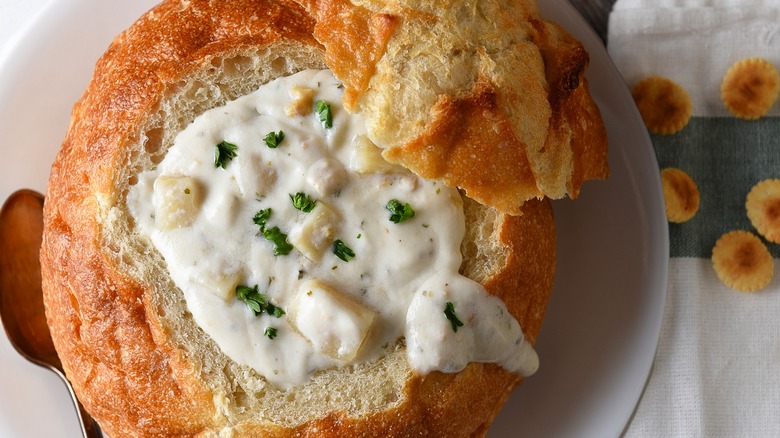
It's hard to imagine life without bread bowls. They're incredibly filling, make it so you have fewer dishes to wash afterwards, and are ripe for experimentation. You could, for example, make a bread bowl out of cornbread instead of the usual types you see at restaurants. Instead of soups and stews, you can serve a salad inside of one. If you're big on variety, you could do what Panera did with its double bread bowls and serve two dishes in a single loaf.
At the end of the day, however, some dishes are timeless for a reason. One of the very best ways to enjoy a bread bowl is with a creamy serving of New England clam chowder, a dish that traces its origins all the way back to the California Gold Rush of the mid-1800s. Bread bowls themselves, however, go even further back, with an early predecessor dating back to the Medieval Ages.
As with most food origins, the invention of the bread bowl as we know it today — a hollowed-out loaf — is steeped in legend more than recorded fact. The most popular story is that an unnamed Irish nobleman created it as a vessel for soup, which he then served to an English duke in an effort to impress him. The duke supposedly enjoyed himself so much that he funded the opening of a bread bowl shop in Dublin. There are no known historical records of this ever happening, however, though the story is widespread.
The Medieval precursor to bread bowls
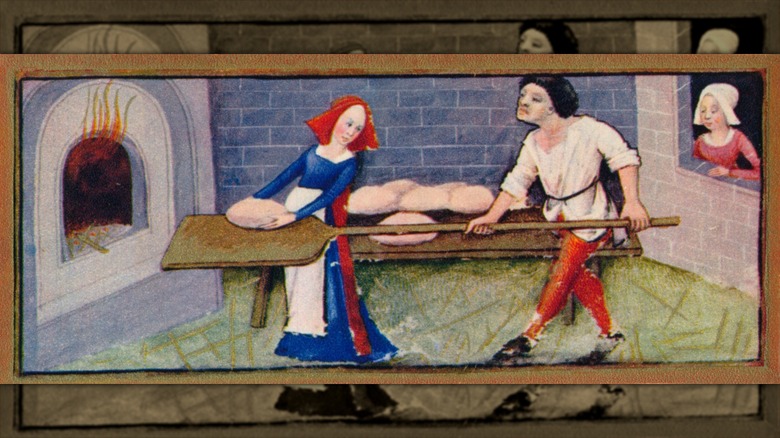
It's likely that bread bowls came about as an evolution of trenchers, which were stale slices of bread used as plates during Medieval times. It's unclear exactly when trenchers were invented, however. While some point to the Ancient Greeks due to the word "trencher" being used in "The Aeneid," this assumption is based on 17th century English writer John Dryden's translation of the epic. The use of the word may have been a misunderstanding coming from Dryden's own preconceptions regarding bread; the Greeks were more likely to use bread as a utensil or napkin rather than a plate.
What we do know for sure is that by the 15th century, trenchers had become such a dining staple in Medieval England that rules of etiquette had been formulated around them. John Russell, Usher to the Duke of Gloucester, prescribed several guidelines for the preparation, presentation, and serving of trenchers in his 1450 manual, "The Boke of Nurture." In it, he wrote that trenchers should be made with four-day-old loaves of bread, which confirms how tough they originally were and, in turn, explains why people didn't really eat them the way we do modern bread bowls. Similarly, most pastries weren't for eating until after the 16th century; they were just bread shells meant to be disposed of afterwards.
It wouldn't be until nearly 400 years later where we would see the beginnings of bread bowls as we know them today. The Gold Rush in the late 1840s brought masses of hungry miners to California, who subsisted on sourdough loaves popularized by French bakers in the state. Those same miners would pair the bread with clam chowder, paving the way for the hearty meal we all know and love.
How clam chowder came to San Francisco and started the bread bowl craze
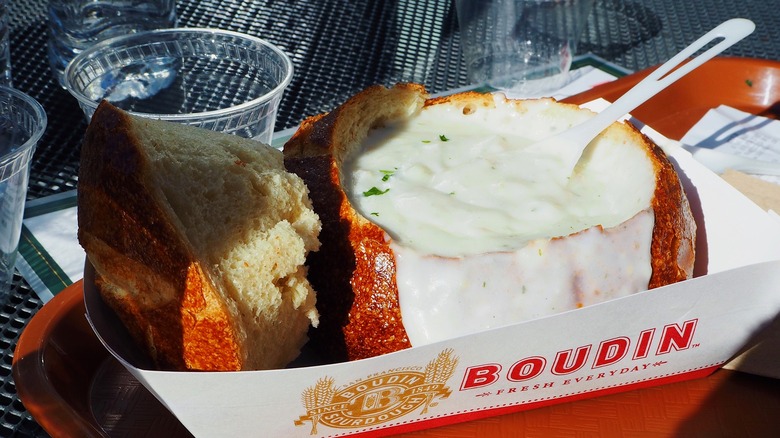
It was only a matter of time that the prospect of instant wealth attracted folks from New England to the Gold Rush. Recipes for their style of chowder made their way to the Wild West, and the abundance of seafood in the Bay Area made it a veritable hotspot for the soup. It was also around this time that Boudin Bakery, claimed by many to be the first to serve clam chowder in a sourdough bread bowl, was established.
It's unclear when Boudin started serving its chowder in sourdough bowls, but it's likely that the bakery played a big role when San Francisco wanted to boost chowder sales in the 1980s by marketing it with sourdough. The pairing is ideal in every sense. The sourness of the bread balances out the richness and umami of the chowders (as long as you use New England-style clam chowder instead of the vastly different Manhattan-style); the soup's thickness makes it more difficult for the bowl to absorb so it doesn't get soggy until you're done with the meal; and it's much less wasteful than Medieval trenchers because the bread is still edible.
These days, the dish's two components are so commonplace that you can make it at home yourself by dropping by Trader Joe's for an instant bread bowl and filling it with a canned clam chowder worth buying on repeat. If you ever do find yourself in the San Francisco area, however, do yourself a favor and try a bowl. At the very least, you can taste some of the history behind one of the Bay Area's most iconic comfort foods.