

10 Old-School Thanksgiving Side Dishes You Don't Really See Anymore
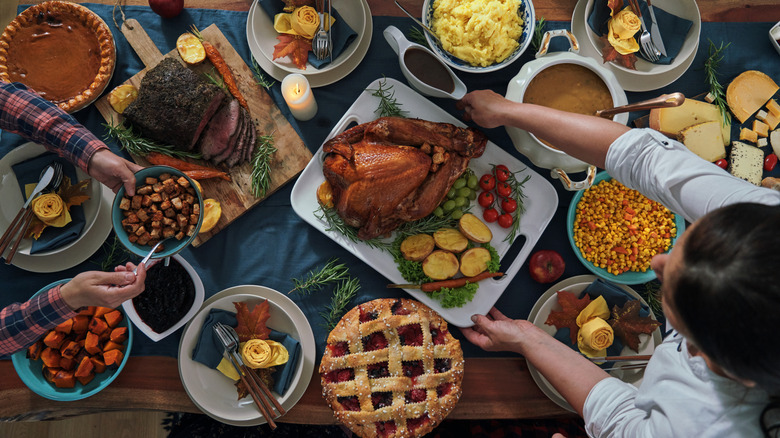
Thanksgiving is one of the few holidays of the year when it truly is all about the food. Giving thanks, being grateful, and spending time with people you don't get to see often is all fine and dandy, but, frankly, what most people are really there for is the towering plate of mashed potatoes, cranberry sauce, gravy, turkey, and, if there's room left, (which there always is) — the pies. It's also arguably the only holiday in the year where the staple protein — turkey or ham (depending on your household) — is upstaged by the side dishes. After all, no Thanksgiving would be complete without the sides, and if they didn't make an appearance on your table, you arguably wouldn't have a Thanksgiving at all — you'd just be eating dry, sad turkey with company.
These side dishes, as with any food, have evolved over the years. While some turkey day staples, including mashed potatoes and gravy, have been staples of the holiday table for what seems like forever, there are some dishes that have been lost to the annals of time, either because they've been replaced by some tastier alternative or because of some other social, economic, or environmental reason. If you're looking to throw a retro Thanksgiving this year, or are overdue for some holiday nostalgia, you're in the right place. Here are some of the once-popular Thanksgiving dishes that we just don't see much anymore.
1. Ambrosia salad
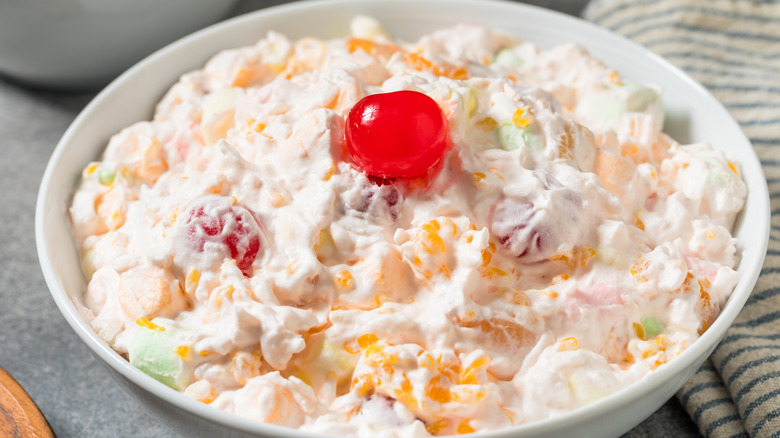
In case you haven't already been able to guess, a lot of the classic Thanksgiving side dish recipes that we remember from years past revolve around some interpretation of a "salad." And the king of loosely defined salads, ambrosia, is all the evidence you need that "salads" don't need to include greens or vegetables at all. Ambrosia salads vary based on who's making them, but you'll often see recipes made with mandarin oranges, canned pineapple, mini marshmallows, maraschino cherries, whipped topping, sour cream, and even mayonnaise.
Ambrosia salad was once a symbol of luxury, but has since been relegated to the confines of history — some would say, thankfully. Its heyday was in the 1800s and 1900s, when it graced many Thanksgiving tables, potlucks, and more. Its tropical components were hard to come by at that time, which meant that preparations of it were reserved for the wealthiest of families. It's very beloved among Southern diners as well, and has spawned many regional variations, including frog eye salad, which is affiliated with the followers of the Church of Jesus Christ of Latter-day Saints and is made with acini di pepe pasta, and Watergate salad, which surprisingly has nothing to do with the Watergate scandal. It's difficult to pinpoint a reason why ambrosia salad has fallen out of fashion (spreading mayonnaise on canned fruit might have something to do with it), though, if you like its concept, you should have no problem finding recipes to try it at home.
2. Oyster dressing
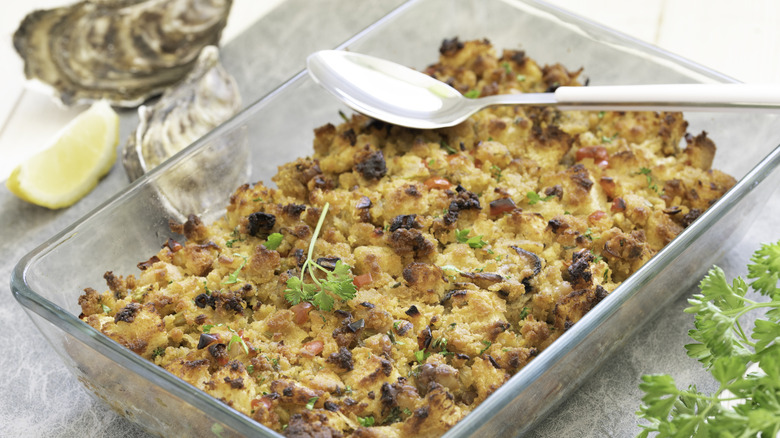
Turkey is the king of the contemporary Thanksgiving table, but holiday feasts not long ago also featured another unique protein: oysters. It's hard to pinpoint the exact time when oyster dressing first made its appearance, but the proliferation of the mollusks in the 20th century probably had something to do with it. Despite the fact that they were a dime a dozen in the ocean, oysters still maintained some degree of status in the culinary community (think ritzy-sounding dishes like oysters Rockefeller), meaning that many families only prepared them for holidays or special occasions — like Thanksgiving. The briny and salty flavor of the oysters was an excellent companion to the neutral-tasting turkey, and it added a little extra protein to the Thanksgiving plate. However, once oysters were overfished or driven from their habitat due to pollution, the dressing too started disappearing from holiday tables.
Like all Thanksgiving side dishes, the recipe for oyster dressing varies based on who's making it. It has many of the same ingredients as classic stuffing — including bread, celery, spices, and egg — but adds both the shucked oysters and their brine for flavor. Some folks will still prepare small platters of it today, though it's not nearly as popular as it once was.
3. Mashed turnips
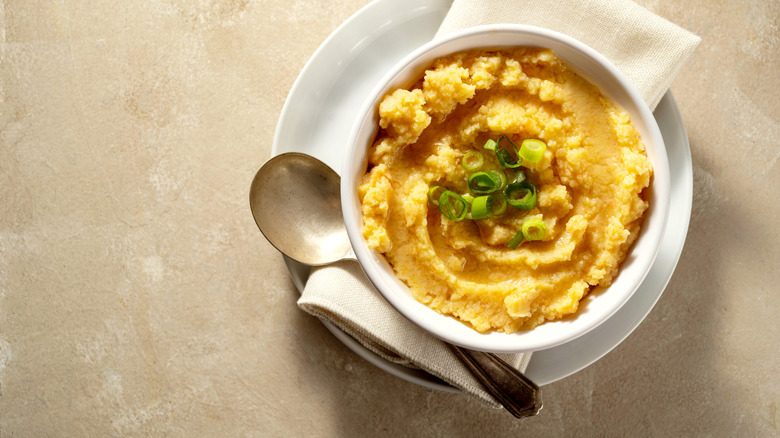
No one will think twice about a hefty bowl of mashed potatoes being passed around the Thanksgiving table. But while the humble spud is getting all of the spotlight, another mashed vegetable is waiting in the wings: mashed turnips. The turnip, a hearty root vegetable, has a slightly sweet flavor and is less starchy than potatoes. While they aren't as creamy as a bowl of classic mashed potatoes, they are relatively easy to prepare: cut them into pieces, boil them, and mash them with butter and seasonings.
So why haven't turnips received quite the same press as potatoes, given that they can be prepared and served in a similar way? Well, it may be because people just haven't had them prepared well. Some have noted that turnips can taste sulfuric if they're overcooked, and people may not be familiar with all the delicious ways that this vegetable can be eaten and served. Turnips are also historically associated with being lowly vegetables, meant for peasants and the poor. While it may not have the show-stopping quality of a beautiful turkey or colorful cranberry sauce, we would argue that mashed turnips are due to make a comeback on Thanksgiving menus.
4. Corn pudding
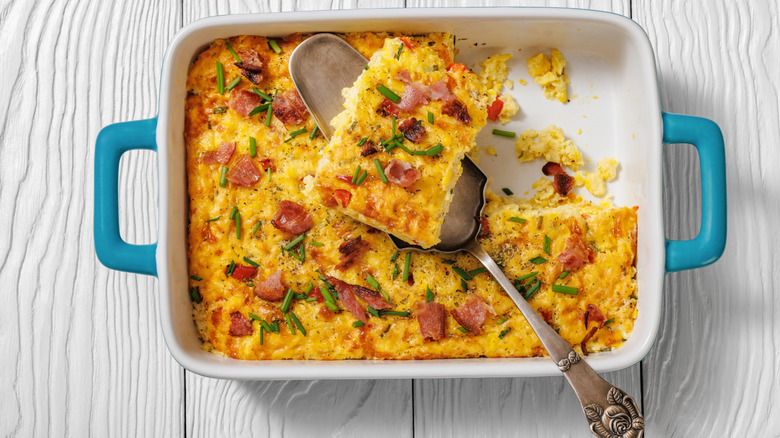
You may have had cornbread on Thanksgiving, but what about corn pudding? It's kind of like a cross between creamed corn and cornbread. Yellow corn is blended with eggs, leavening agents, seasonings, flour, heavy cream, and butter, and baked in a casserole dish until firm. Unlike traditional cornbread, corn pudding is usually spooned out of its baking vessel and onto the Thanksgiving plate.
The regional variations of corn pudding are numerous. For one, some folks also prepare theirs with crumbled Ritz crackers on top for extra crunch. The Pennsylvania Dutch version of the recipe is made with dried corn that has been rehydrated in milk overnight, while some cooks will use cornbread mix as the base of their recipe in a pinch. There's also a slightly sweeter preparation known to New Englanders as Indian pudding. This old-timey Thanksgiving dessert, which was a favorite of First Lady Abigail Adams, combines cornmeal and molasses to create a lumpy, curdled, and mushy dessert that tastes better than it looks — especially when it's topped with a scoop of vanilla ice cream.
Regardless of how it's prepared, we think this is one of the hidden gems of Thanksgiving's past. Believed to be a dish of the pre-colonial era, it arguably became more popular once colonists started to cultivate corn on American shores. Though corn pudding and its variations have mostly been replaced by — frankly bland — dinner rolls, we still hold it in very high regard.
5. Chestnut stuffing
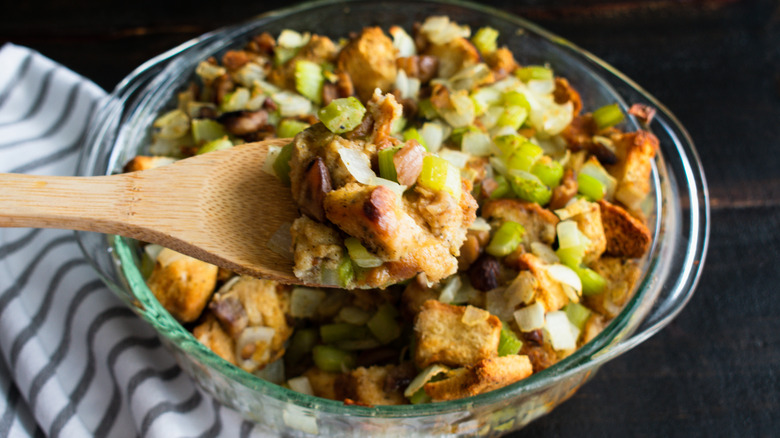
Nothing says old-timey Thanksgiving fare like putting things into stuffing that don't seem like they belong — right? Sure, many people associate chestnuts roasting over an open fire with Christmas, but this nut has made its way into Thanksgiving side dishes over the years as well. This dish, like oyster dressing, brings together the ingredients we recognize in modern stuffing, plus roasted chestnuts. There was a time when chestnut trees thrived in the Eastern U.S., and the nuts were often harvested by early settlers around the holiday season. As such, this tasty nut found its way into a range of dishes, including stuffing. However, all that changed with the proliferation of chestnut blight in the United States starting in the 1800s. This disease killed off a lion's share of the American chestnut population, though efforts to cultivate disease-resistant strains and other types of chestnut have allowed chestnuts to make an appearance back on tables — slowly but surely.
It's easy to see why this dish was popular when chestnuts were still aplenty; the creamy texture of the nut is an excellent foil to the dried bread, aromatics, and crunchy celery. However, given that the tree population still hasn't rebounded and most folks have settled on their own stuffing recipe, it's fair to say that chestnut stuffing may just be relegated to historic cookbooks.
6. Giblet gravy
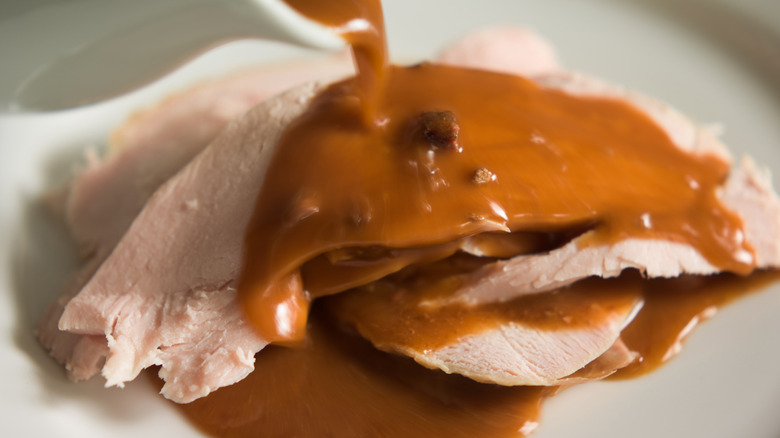
If you grew up in a frugal household, you may remember your family saving the giblets that came with the Thanksgiving turkey to make gravy. "Giblets" is a catch-all term for the organs of the bird, including the heart, liver, and gizzard (which grinds up the food the bird eats). Some folks group the neck of the poultry into this category, but it's technically not a giblet.
It might seem like these organs are destined for the trash, but they actually do make a delightfully savory stock or gravy to serve with Thanksgiving dinner — and some people will even add them to their stuffing recipe. To prepare the former, the organs are stewed in a pot with water, aromatics, onions, and celery. Uniquely, Southern-style giblet gravy is often adorned with chopped hard-boiled eggs as well, which are added to the flavorful stock with milk and cornstarch to make it extra rich. Some say that giblet gravy has more flavor than a gravy made from pan-drippings, but you may just have to try it yourself and compare.
And if giblet gravy is truly more flavorful than one made with pan drippings, why isn't everyone freezing their giblets? After all, if your bird comes with them, why not use them to their fullest? Well, some people have an aversion to this part of the bird (as well as organ meats as a whole). You also need to make a stock first, which may not be conducive to getting a quick gravy on the table. But for a special occasion like Thanksgiving, it's surely well worth the effort.
7. Tomato aspic
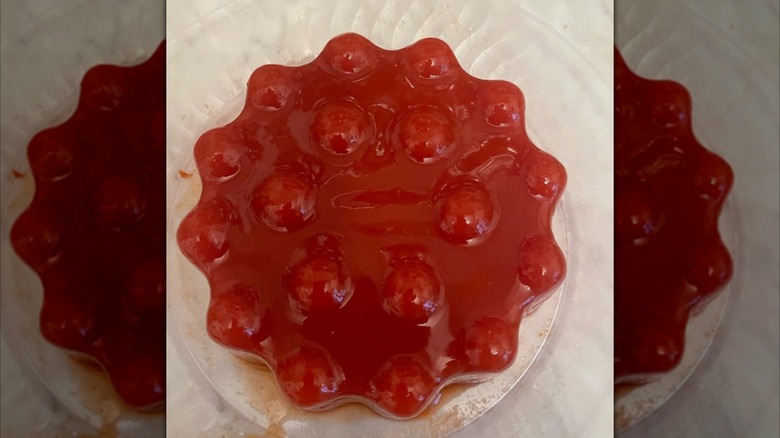
Aspic may sound like something straight out of a science textbook, but it's actually an umbrella term used to describe savory gelatin made with stock, bone broth, or consommé. As the mixture cools, the natural gelatin causes it to congeal, giving it its signature wobbly texture. Often, aspic jelly is encased in a mold, usually with things suspended inside of it. Some people have gone so far as to encase baby octopi and hard-boiled eggs in this wobbly and wiggly showstopper, and not even Thanksgiving fare is immune to its gelatinous charm. Enter: tomato aspic.
This dish is like the lovechild between a Bloody Mary and Jell-O. Tomato juice, Worcestershire sauce, lemon juice, celery, and more are mixed with gelatin, set in a mold, and left to harden. Southern preparations top it with mayonnaise — preferably Duke's. Some recipes will also use a stock to make the base — making it a true aspic — while others will use powdered gelatin: either unflavored or lemon.
We're going to go out on a limb here and say that most people are probably glad that tomato aspic never really made it past the golden age of Jell-O — up until around the 1960s. However, some might have fond memories of slicing into this jiggly, special treat during the holiday season. We'll just take our Bloody Mary in a glass, sans Jell-O, thank you very much.
8. Grape salad
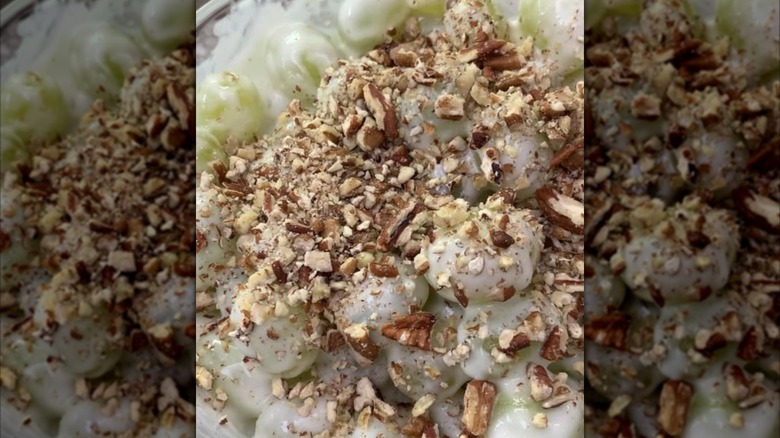
If you're looking to take a walk on the vintage side for Thanksgiving, ditch the store-bought pumpkin pie and try another potluck favorite: grape salad. There was a lot of pushback from Minnesotans when the New York Times assigned their state grape salad in its "The United States of Thanksgiving" piece, claiming that there was some sort of connection between this sweet "salad" and Minnesota. While the connection between the state and the dish is suggestive at best, what we do know is that some Thanksgiving plates, long ago, did have grape salad on them — it probably just wasn't ones in the Midwest.
Instead, its likely origin is the South – seeing that it shares many similarities with ambrosia salad. The difference is that this recipe swaps out the canned fruit for whole grapes and brings the mixture together with cream cheese, sour cream, brown sugar, and chopped pecans. While you may still be able to find it at church gatherings, potlucks, and Thanksgivings (though probably not in Minnesota), the novelty of its ingredients has worn off, and its sugary flavor and texture may make some eaters dread it.
9. Mincemeat pie
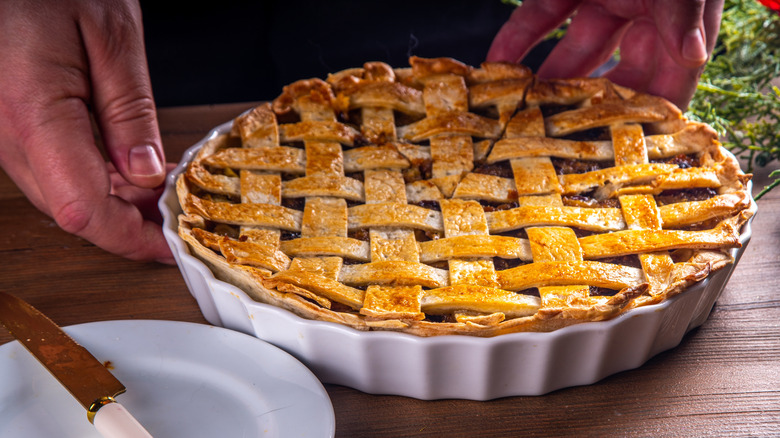
Mincemeat pies are more than just chopped ground beef stuck between a pie crust. Mincemeat was originally popularized in England as a method to preserve meat without the need for smoking or salting it. These pies were once made with chopped meat (often mutton), dried fruits, spirits, and suet. The recipe also has a religious connection; cinnamon, cloves, and nutmeg were added to the filling to symbolize the gifts of the three wise men, and the pie was baked in a manger-shaped mold. It's no wonder that this religiously significant dish caught on with the Puritans, who likely brought the idea for this dish to the English colonies.
Though mincemeat pies have a religious connection to Christmas, they were also a common addition to Thanksgiving tables. When settlers prepared this pie, they made it with the foods that were available, including apples, beef, and cider. The dish was seen as a celebratory one, as its ingredients were relatively expensive (especially in the early years of the Spice Trade). Today, these pies may still be beloved by English ex-pats, but the mincemeat pie's popularity has definitely been eclipsed by the big three of the Thanksgiving holiday: apple, pecan, and pumpkin pie.
10. Cranberry soufflé
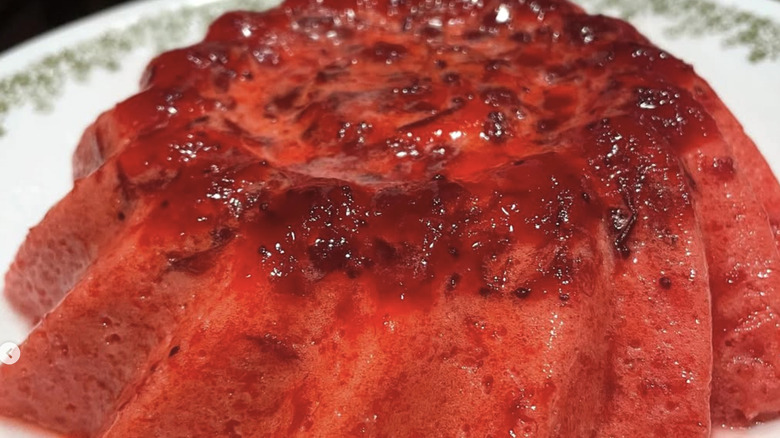
Anyone who has made a soufflé before can confirm that it's more difficult than it looks. However, this soufflé is arguably easier to make ... it just comes down to how you feel about Jell-O. This straight-out-of-the-'50s dish goes by two names: cranberry soufflé or cranberry soufflé salad. The recipe features a delectably sweet iteration of other Jell-O dishes of the era, made with unflavored gelatin, lemon juice, canned cranberry sauce, peeled and diced fruit (apples, oranges, or pineapple), chopped walnuts, and — the kicker — mayonnaise.
Why mayonnaise was added to this dish, we don't entirely know — perhaps to balance out the tartness of the cranberries? It might also have something to do with the fact that one iteration of the recipe was printed as an advertisement for Hellmann's mayonnaise (billed as "cranberry surprise"). Regardless, it's fallen out of favor in the years since Jell-O mania — though that hasn't stopped folks from taking to Reddit to share their fondest memories of grandma's Thanksgiving cranberry soufflé salad served on Thanksgiving and Christmas.