

6 Things To Look For When Shopping For Vintage Kitchen Knives
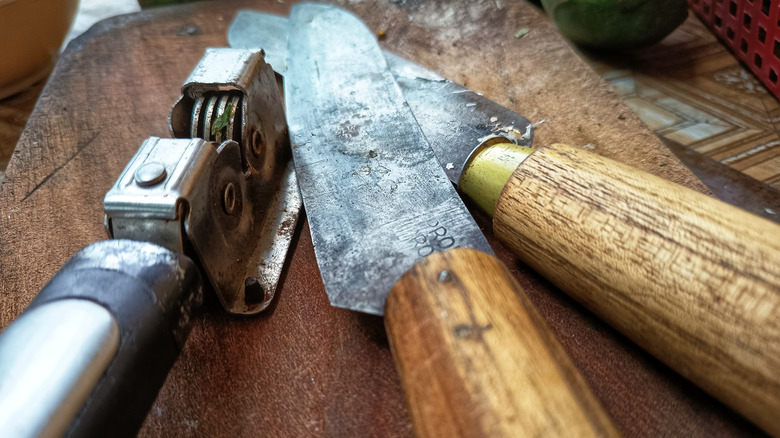
There's a certain allure to pretty much anything well-made and vintage. It's an aesthetic nostalgia that hints at faded legacies of craftsmanship, of lost arts obscured by the machinery of automation. There's a flipside, of course: a sea of old junk that just doesn't fit the cozy narrative we tell ourselves about forgotten eras of industrious creativity. Kitchen knives are no exception to this duality. While the chaotic sharps bins in the cutlery section of your local thrift shop might seem foreboding at best, there could well be treasure buried among the bent blades and steak knives pocketed at TGIFridays in 1998. To help you navigate this dubiously rusty jungle, we've enlisted the insights of two culinary luminaries.
The first is Josh Donald, co-founder of Bernal Cutlery in San Francisco, which has become something of a pilgrimage site among chefs and blade enthusiasts. The shop carries an array of Western and Japanese knives and offers traditional Japanese whetstone sharpening services. This is the domain of experts, a church for slicers, dicers, and seekers of the perfect brunoise.
The second is the visionary chef Andrew Sargent, who (spoiler alert) recently earned the title of Next Gen Chef in the first season of the cooking show of the same name on Netflix. Sargent is also (or first and foremost, depending on your perspective) sous chef at Thomas Keller's internationally renowned, 3 Michelin Star restaurant Per Se in New York City. And Sargent really, really loves knives.
1. Look for classic styles, like chef's knives
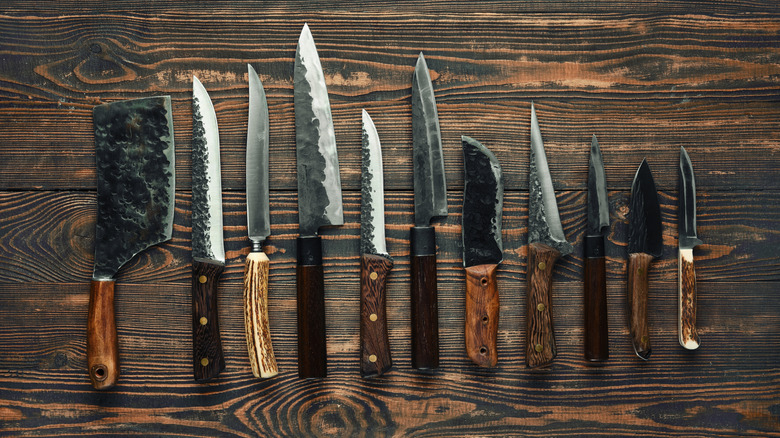
Yeah, that giant meat cleaver you spotted at the thrift store might look cool, but unless you're shopping for décor or enrolling in butchery classes this semester, you'll probably be better off focusing on more practical options. One of the most important lessons you can learn in the kitchen is how much easier any given job will be when you have the right tool. It's a cliché for a reason, and the classics are classics for a reason.
While popular styles are also the most likely to show wear, you may come across a gently used or even a like-new blade. People haven't changed that much over the years — rest assured there were impulse buys in the 1980s motivated by the sudden yet ultimately fleeting conviction that somebody was going to become an unrivaled home cook (thank you to Martha Stewart and her favorite recipes that will never go out of style). Those knives are out there, emerging unscathed from dusty moving boxes, and chances are you'll find them to represent the classic knife styles.
"For most people that would start with a chef knife, a utility knife, [and a] paring knife. However, the most desirable sizes are the hardest to find; 8-inch chef knives from the great old makers are very hard to come by, as are paring knives. They either get used up or lost in the case of paring knives," says Josh Donald of Bernal Cutlery. You didn't expect a treasure hunt to be easy, right?
2. Watch out for pitting -- it's a death sentence for knives

The most important thing to look for might not be a rare maker, but an uncommon condition. Knives can be rehabbed to an extent, but there is a point of no return, and most old knives are sadly past it. According to Chef Andrew Sargent, "Anything vintage loses the mystique if not properly cared for. Many things can be rehabbed, but pitting is a death sentence, as is a bad heat treatment."
Pitting is a sure sign of material loss, something that can compromise the integrity of your blade. The more pitting, the more corrosion it attracts. "A little rust isn't too concerning, but the goal is to find something someone knew how to care for," Sargent says.
Pitting isn't the only ... pitfall, however, and it's important to consider whether restoring any particular blade is worth the time and potential cost. "Condition is always key. 'This was a nice knife' is less compelling than 'this is still in great condition,'" Josh Donald warns. "Always look for bends. Sight the edge and spine like a rifle and look for significant bends and warps. Handmade stuff can have some: A little is okay, but a lot is not. Busted handles are tough unless you plan on making or having someone make a new one. It takes a lot of time and money if you don't do it all the time or plan on hiring someone competent to do it."
3. Be flexible. For the oldest knives, seek out the larger blades
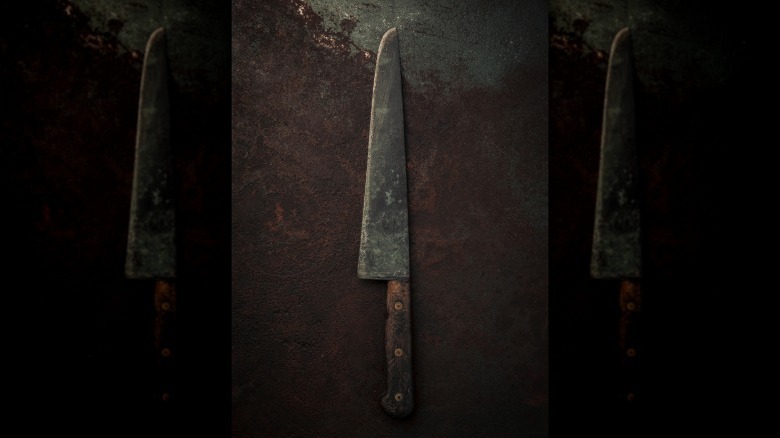
Rifling through your grandparents' attic with the hope of finding one specific item is probably a fools' errand, and so is a narrowly dogged pursuit of one particular knife make, model, style, and size. You're also not likely to get very far by refusing anything that isn't in absolutely perfect condition.
"One is far more likely to find a vintage chef knife a little bigger than you might reach for or have on hand. Get used to the idea of working with a 10-inch (or even 12-inch) chef knife. These are much easier to find than today's standard 8-inch," Josh Donald says.
There's an added appeal to these slightly less wieldy blades, though; they're physical relics of traditional cooking styles. "Using old knives hints to how people used to use knives, and most professionals used larger knives 50, 75, 100-plus years ago ... Finding old knives that are high quality and in usable or easily restorable condition is not easy. You'll need to be flexible."
4. Pick out high carbon by looking for the stamp
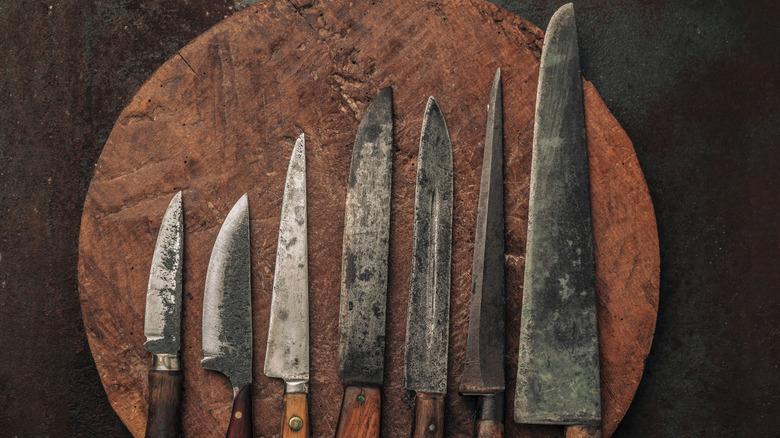
The vast majority of kitchen knives fall into one of two categories: carbon steel and stainless steel. High-carbon steel is harder than stainless steel and is prized for the fine edges that can be achieved in the hands of an expert as well as its ability to maintain those edges. But it is also more reactive to acidic materials, develops a rusty patina, and requires more care.
Some high-carbon blades will carry a stamp indicating their material composition. This is, obviously, the easiest way to spot one and something you should look out for. Failing that, there are some other methods, such as seeking out a dark patina or checking for reactivity with lemon juice (although this test is probably best performed in your home, as opposed to, say, at your local flea market).
"As far as vintage knives worth the investment, I think anything pre-1990s carbon steel that's devoid of rusting is legitimately a good investment, assuming good care has been taken and the purchaser knows best practices," Andrew Sargent says. "If I'm looking for something vintage, I'm probably looking at high carbon."
5. Only certain brands are worth your time

You don't have to develop an encyclopedic familiarity with the craft kitchen knife industry in order to find something worth keeping, but a few guidelines can keep you from passing over a diamond, like Ina Garten's favorite German knife brand. "In good condition, always buy carbon steel Wüsthof, Henckels, Sabatier (sometimes stainless), Russell Green River, LF&C, the list goes on," Josh Donald says. "There are a million great old makers. Here in the states, the most common countries of origin are the U.S. (of course), Germany — look for Solingen (but not everything from Solingen is valuable, FYI. There has been a ton of more mass-produced stainless from the '70s, '80s to now) ... There were lots of great Sheffield cutlers, and they were the top of the heap before the U.S. Civil War."
Meanwhile, Andrew Sargent, ever the adherent to Japanese cutlery, keeps a less expansive list. "I'm not the biggest proponent of Western knives in general, but a vintage Sabatier is a dream find ... I think you'd be hard pressed to beat finding a genuine Murray Carter on the thrift store market."
Where dream finds are concerned, Donald is a bit more elaborate: "The genie of the thrift store in a good mood would reveal to me a nearly unused late 1800s Tichet 10-inch chef knife. I would be nearly equally as happy with any lightly used 1920s or older European or American knife [or] while we're at it, a boxed 1860s to 1900 San Francisco-made carving set by Michael Price or Will & Finck."
6. Brands that aren't worth your time

Consensus seems to be that most mass market consumer brands just aren't worth their space in the drawer. Generally constructed of lower-quality steel, these blades are manufactured with a focus on efficiency of production rather than an economy of movement in the kitchen. The best design might well lose out to one that's easier to roll out. They tend to be duller, wear out faster, and just aren't made with the same consideration for ergonomics. Many of these are "stamped knives," meaning they were cut from a sheet rather than forged, and don't last as long. To put it simply, the household names that are generally comforting when it comes to your countertop stand mixer or air fryer (see our guide to the best ones money can buy) are probably best avoided when it comes to knives, especially when they're pre-owned.
"Often when I would rub the genie of the thrift store's lamp, it would give me a box of cheap '90s dollar-store knives that smelled like a dirty diaper was hidden at the bottom," Josh Donald says. "Never buy Chef's Choice, Cuisinart ... avoid anything that says 'German Steel' or 'Japanese Steel.' 99% of the time that means it was not made there."