

7 Canned Clam Chowder Brands, Ranked Worst To Best
We may receive a commission on purchases made from links.
Clam chowder is not something that, on its face, sounds or even looks that appetizing. And as a kid growing up in New England to non-New England parents, it took most of the courage I could muster to finally try it at some seaside eatery one summer in Massachusetts, which has a long history with clam chowder. Until that point, I had been horrified by almost all seafood that crossed my path. But glancing around at the other patrons, some near my age, happily chomping fried clams and slurping down chowder, peer pressure worked its magic. If they were enjoying it this much, why couldn't I? My surprised parents let me order one, and it came in a heavy, cream-colored ceramic cup, with a crinkly packet of dry, salted oyster crackers. Starting with that first cup, I became a convert to the creamy soup, complete with its mysteriously jagged chunks and chewy bits of clam.
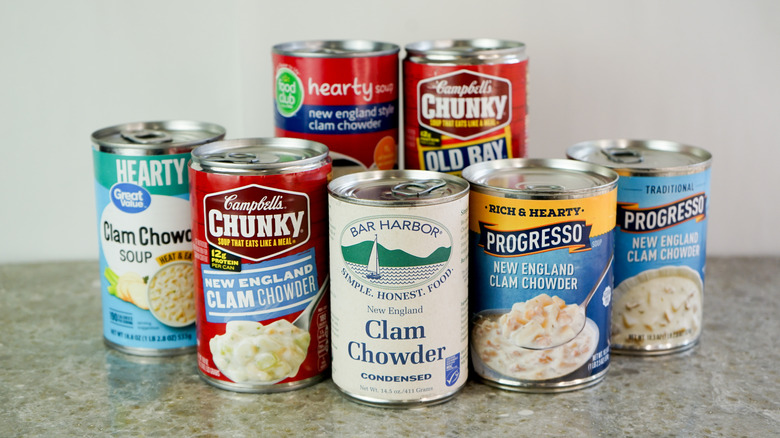
So, as the reluctant bearer of New England roots, I took it upon myself to pick out the best canned clam chowder found most places west of the Atlantic today. A good New England-style clam chowder should have actual, identifiable clams, clam flavor, well-cooked pieces of potato, and a savory, creamy base that tastes more like an ocean brine than gloopy heavy cream. Beyond that, there's a lot of leeway. I ranked these canned clam chowders based primarily on the flavor of all the main ingredients together. I also factored in the consistency and, to a lesser extent, value, though most canned soups are very affordable. Here are the results.
7. Campbell's Chunky New England Clam Chowder
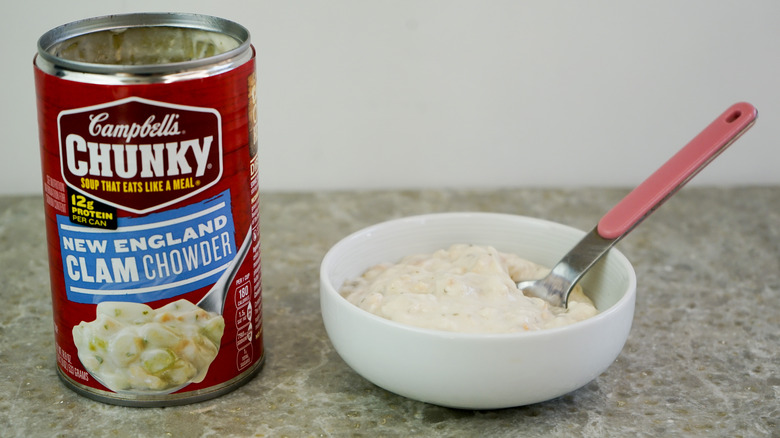
Whatever infinite potential clam chowder has, Campbell's Chunky New England Clam Chowder just hasn't reached it. There was something decidedly off about this bafflingly popular version of the soup. While the consistency was thick enough to stand a spoon up in –- so packed with stuff! –- this chowder had a truly unpleasant, dusty non-food taste that overshadowed everything good about clams, veggies, and cream. It deserves this spot at the bottom of our ranking.
After studying the nutrition label, I have a theory as to the culprit. The fourth ingredient in Campbell's Chunky clam chowder, after clam stock, potatoes, and clams, was vegetable oil: "corn, canola and/or soybean." This wasn't unusual –- in fact, some version of vegetable oil was the fourth ingredient in most canned chowders I tasted –- but canola here was unique, and I find that it can deliver a bitter off-taste to many foods. After that, there are at least five other ingredients (or maybe more accurately, substances) that I'd have a hard time pronouncing, let alone identifying. My guess is that a clam chowder laden with so many chemicals and processed oils was bound to deliver a decidedly artificial taste. Leave this one to collect dust on the shelf –- it's not worth the sacrifice to your taste buds.
6. Traditional Progresso New England Clam Chowder
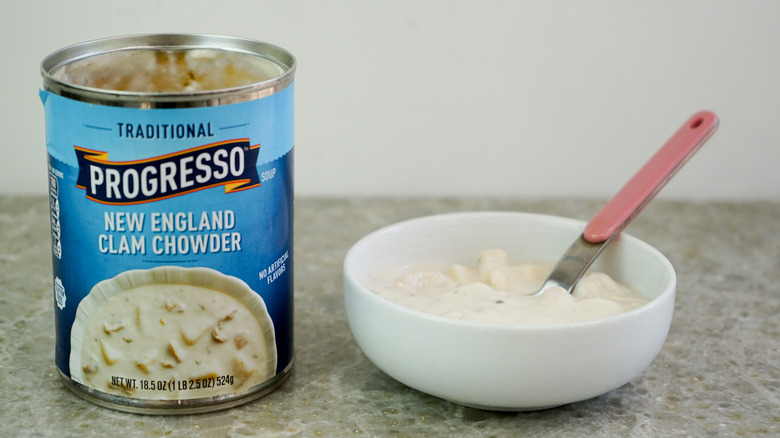
Progresso's "traditional" take on the humble New England clam chowder was slightly better than Campbell's –- but not by much. This chowder's consistency was also nice, and it was a notch more creamy-looking, with a lighter white color and smoother feel. But here, a cringe-inducing metallic note tasted almost like the can had bled into the chowder. That's probably not actually the case –- modern-day canning does a great job of insulating food against its aluminum container, and I'm a big proponent of using canned goods as part of a healthy kitchen lineup.
But still, what should be a rich, savory spoonful was drowned out by whatever was going on here. Maybe it's a highly processed vegetable oil, soybean this time, listed high up in the ingredients again? Could it be the potassium chloride? Sodium phosphate? Maltodextrin? It stands to reason that the more artificial ingredients are lurking in a clam chowder, the worse it will taste. I was happy to find real cream on the label, but it could easily leave the rest behind. Other clam chowders on this list were more than adequately canned with fewer preservatives –- Progresso should be able to live up to the same standards.
5. Food Club Hearty Soup New England Style Clam Chowder
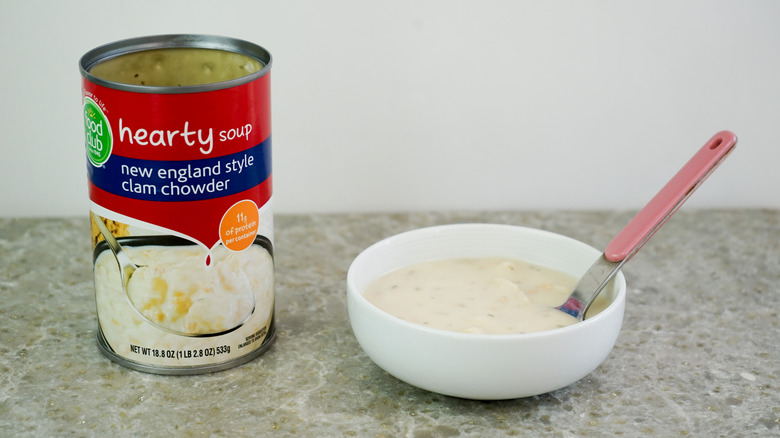
This private label store brand, Food Club, is sold at grocery retailers around the country, and I picked it up at my local small grocer. At an even more affordable price than most other clam chowders, and a slightly larger can size, this soup offered hope that it would deliver a good value. The soup base was much thinner than that of other chowders, though that's not a problem in itself. In fact, most other chowders resembled stew more than soup, but I found myself mixing the contents of the can, hoping to turn up more substance, and came up mostly empty-handed. This clam chowder was noticeably short on potatoes, veg, and clams.
It was also notably less creamy than other chowders and more brothy than anything else. Here again, soybean oil was the fourth ingredient. On the other hand, there were slightly more recognizable ingredients in Food Club's chowder: celery, dehydrated onions, wheat flour. Accompanying them were, again, stabilizers and sodium-based preservatives, but at least there was no "off" flavor or weird aftertaste. Food Club's chowder also wasn't overwhelmingly salty like many canned soups are. If anything, this chowder's worst offense was a thin consistency and a mild taste. It still had enough to beat out the most prominent clam chowder offerings from soup giants Progresso and Campbell's.
4. Progresso Rich & Hearty New England Clam Chowder
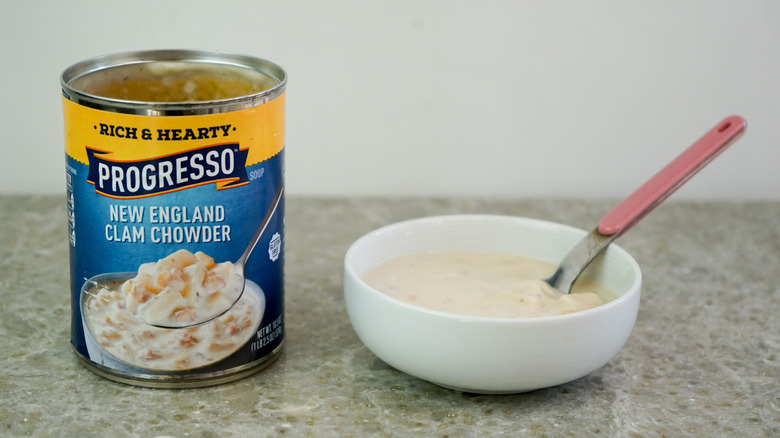
Along with the oddly metallic clam chowder in its "Traditional" soup lineup, Progresso's "Rich & Hearty" soup range also offers a clam chowder, which I expected to pack a creamy, chunky, flavor-bomb punch in comparison. In reality, the two Progresso clam chowders weren't vastly different. Both were about the same thickness, and unless my portioning was off, the "Rich & Hearty" version wasn't noticeably more loaded with chunks of potato or veg.
That said, it did taste a little better. Progresso's Rich & Hearty New England Clam Chowder still had a metallic twinge compared to the other brands, but less so than its "Traditional" counterpart, and I wouldn't have picked up on it without comparing it to every other soup. Curiously, the Rich & Hearty chowder was slightly more tan than white in color, with less of a creamy, dairy-rich gloss and more of a thickened broth feel. It also seemed to ease off a little on the salt compared to the other Progresso chowder. The flavor struck me as a bit more umami than the traditional version, with a deeper flavor. This clam chowder was a middle-of-the-road option, with little in the way of seafood complexity, but a good texture and plenty of chunky ingredients.
3. Campbell's Chunky Old Bay Seasoned Clam Chowder
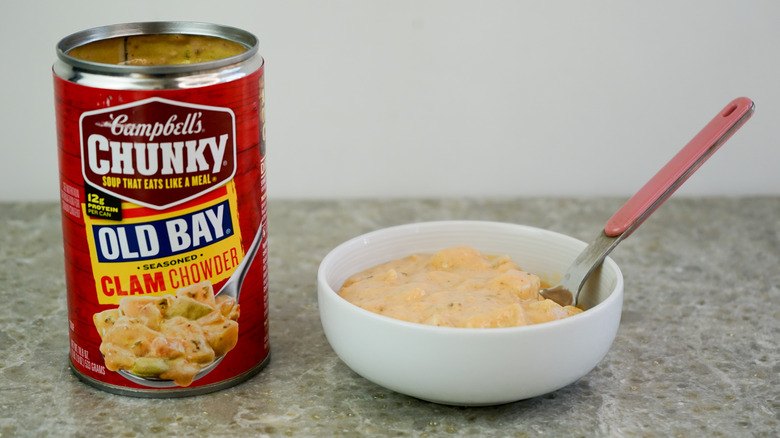
I recently learned that people put Old Bay seasoning in their clam chowder, and it shouldn't have come as a surprise. The warming blend of celery, paprika, mustard seed, and spices such as allspice and clove have long been a favorite of seafood aficionados, though Old Bay is associated more with a Mid-Atlantic crab cake than a New England chowder cup. In Campbell's twist on the classic, however, this spice blend does a lot of heavy lifting. In addition to lending the chowder a pleasant, orangey hue, it also masks whatever sins the company's New England style was hiding.
No off taste here, and the Old Bay gives just enough of a kick to add interest without taking center stage in what is still very much a clam chowder. Celery flavor was more pronounced in this soup, and there were no strange artificial notes. Old Bay lent the slightest bit of heat to the chowder, but not enough to scare off the spice-sensitive. This Campbell's Chunky Old Bay Seasoned Clam Chowder was the thickest of the bunch, almost making me wonder if it would separate and congeal, but as long as it's kept warm, it shouldn't be a problem. Old Bay Seasoned Clam Chowder, you have a new fan.
2. Bar Harbor New England Clam Chowder Condensed
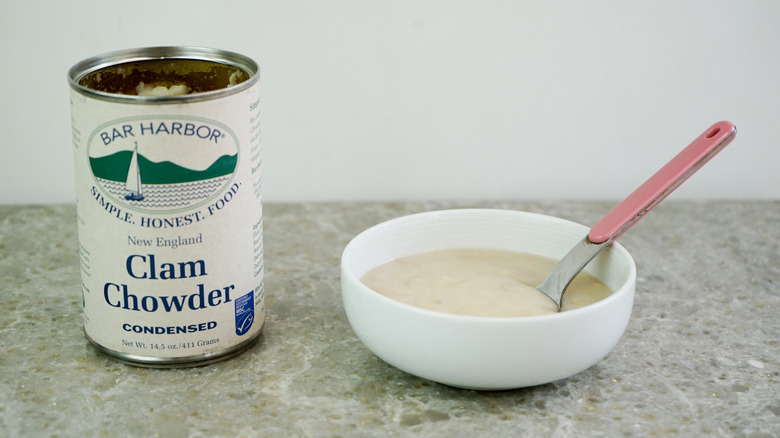
With the Bar Harbor New England Clam Chowder being the most pricey soup in this lineup, I expected great things from this authentic-seeming and beautifully packaged can. Bar Harbor was based in Maine for over 100 years and was the state's longest-standing seafood cannery until 2024, when it announced it would move operations to Delaware. According to its website, Bar Harbor traces the sources of its seafood under a certification known as MSC (Marine Stewardship Council). The classic can was the sole condensed soup of the lineup and the only one without any unrecognizable additives: all real ingredients here.
Perhaps because of these distinctions, though, the texture when cold was unappealing -– solid, matte, and grainy. But after adding a little water, heating, and mixing the soup vigorously (it's the best way to improve gloopy canned soup), it settled into a smoother consistency. There wasn't a lot of cream here –- it had an almost gelatinous, starchy thickness thanks to wheat flour and tapioca starch. But even lacking the gloss and emulsified uniformity of the more processed clam chowders, Bar Harbor's was the only one that really tasted like the ocean. With its complex, slightly briny depth, Bar Harbor's soup momentarily transported me back to that seaside seafood joint, salty wind blowing through the open windows and seagulls cawing.
This chowder is as thick as you want to make it (and as creamy, if you add dairy), but decidedly un-chunky: it really is a soup. I personally prefer heftier pieces of potato, celery, and clam, but it was mostly the odd texture and look that put this second on my list –- the flavor here was definitely the most authentic to a New England clam shack.
1. Great Value Hearty Clam Chowder Soup
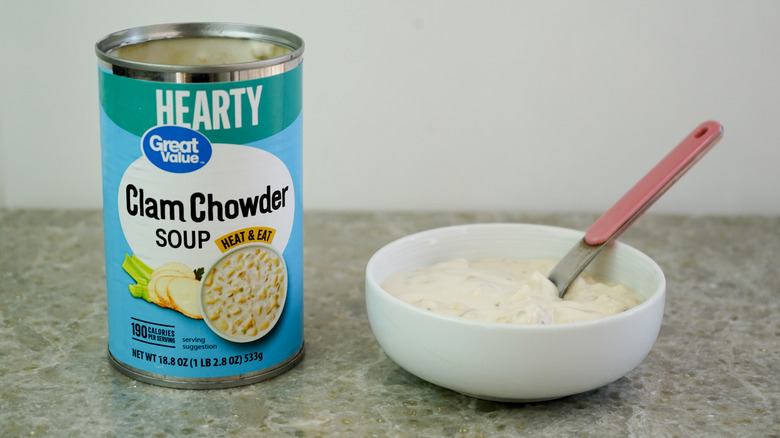
Though it pains me a little to reach this verdict, Walmart's clam chowder almost blew all the others out of the water (pun intended). Great Value Hearty Clam Chowder Soup by far balanced the flavor, texture, look, and value of its soup the best of all the brand names. Even with some of the same soy-based additives that I saw in other soups, this ingredients list was shorter and more easily understood than many of its competitors –- in other words, there were arguably fewer "artificial" components. With a silky smooth base, a savory richness, and a mild but definitely clam-like clam flavor, this chowder was proof that canned chowders don't need all of that to hold together perfectly well. No weird off taste here. Not too thick, not too thin. Just satisfying, creamy seafood soup.
When it comes to the other ingredients, Walmart won out here, too. Celery pieces were physically intact, not just whispers on a sea breeze. The potatoes were cooked to perfection: bite-sized cubes that were just soft enough, not slightly hard like in Progresso's "Traditional" chowder or mealy like in Food Club's. Surprisingly and affordably, Walmart's Great Value really delivers on its generic brand name's promise with the Goldilocks of canned clam chowders. I ate spoonful after spoonful of this clam chowder before realizing I should probably save room for the others. To me, that's as good a sign as any of a winner.
Methodology
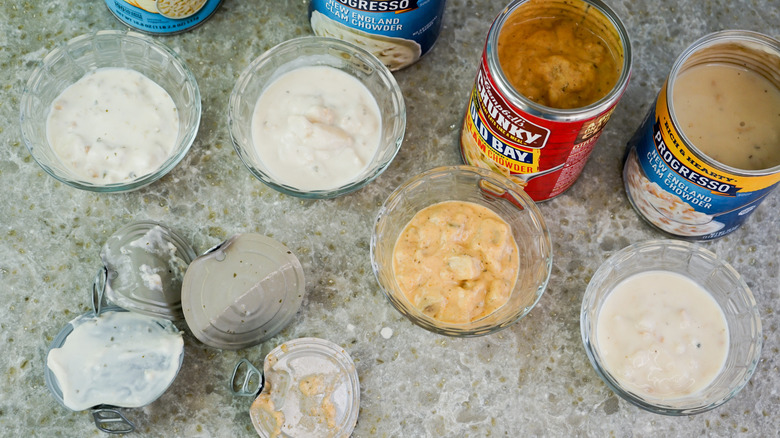
For this ranking, I chose only canned New England style (which is different than Manhattan style) clam chowders. These soups were a combination of the most popular clam chowders, according to online search results. Plus, they were readily available at local grocery stores. I omitted soups marketed as "healthy choice" or low-sodium. I used the microwave to heat a small portion of each in a glass bowl and tasted them side by side, comparing them a number of times to their companions to get a final ranking.
I prioritized flavor above all, including the balance of flavors of the main components: the creamy base, usually made with clam stock and some kind of dairy; the clams themselves, and potatoes and other vegetables, usually celery. Could I taste all the ingredients? Did they taste good together? I also considered the texture of the clam chowder with these ingredients in mind: Was it thin and watery? Was it starchy and heavy? Was it so thick with ingredients that it no longer resembled a soup? Were the ingredients prepared well and in sizes that were easy and enjoyable to eat? Less critically, I took into consideration the visual appeal of the chowder, and its value, meaning the quality compared to the price. However, all the canned clam chowders I evaluated cost less than $6, and all but one were less than $3, making them an affordable meal for most.
For something more creative, consider clam chowder as one of the canned soups that totally upgrade mac and cheese. For recommendations beyond clam chowder, check out our best and worst canned soups to buy at the grocery store.