

15 Ingredients You Should Be Adding To Your Bologna Salad
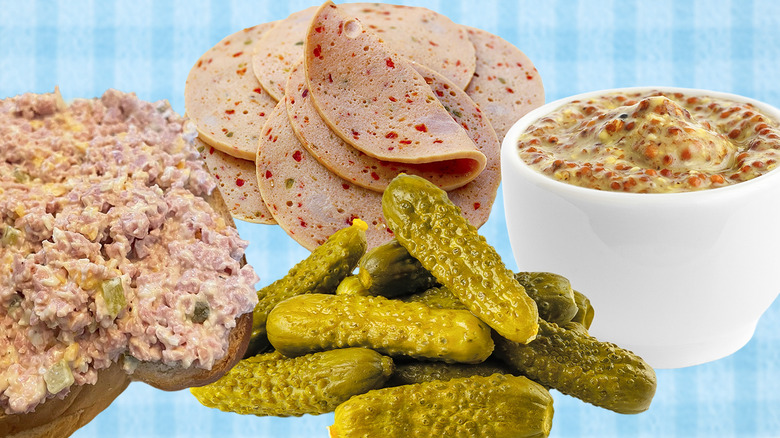
When it comes down to it, most of what we revere as culinary innovation is a form of irreverent traditionalism; using tried-and-true recipes as a jumping-off point for self-expression. From French fusion to modernist barbecue, these recipes are a reliable template for groundbreaking inventiveness. However exciting it may be, it can also irritate purists. So, as we are taking on the country comfort food of bologna in this story, it might not be something you want to share with your grannie.
Bologna takes its name from a city in northern Italy, and the modern-day American version is a direct descendant of the mortadella sausage produced there. Made from a finely ground paste of meat and spices, most bologna is a kind of pork sausage, but beef or a blend of the two is not uncommon. Bologna salad traces its roots to the Great Depression, when bologna was a cheaper option than ham, and turning it into a salad stretched the ingredients, making it appealing to the struggling families of the time. In the decades since, this simple and affordable sandwich spread has become something of a comfort food. The spread is made from ingredients like hard-boiled eggs, mayonnaise, pickle relish, mustard, and seasoning, which are chopped up, mixed together, and eaten with crackers or in a sandwich.
While there is certainly wisdom in the Southern maxim, "if it ain't broke, don't fix it," it's perhaps best left to the garage door, and ignored in the kitchen. In that spirit, most of these ideas came from trial and error, years of culinary experience in rural specialty food kitchens, and long smoky days in the barbecue pits. Try one, try them all, or use this as a jumping-off point for generating your own creative ways of angering your (real or theoretical) elders.
1. Country ham

Yes, ham salad is an entirely separate convention, but who says you can't combine favorites? Salt-cured, smoked, and aged for months (at a minimum), country ham — not to be confused with your garden-variety city ham — is an intense pork with a funky, occasionally nutty flavor that varies from region to region based on terroir and technique. Specialty varieties made from well fattened, peanut-fed heritage breed hogs may age for well over a year, and possess an indescribable complexity. These do, however, tend to come with an equally fattened price tag, and may defeat the affordable purpose of the humble bologna salad.
Whatever variety, the judicious addition of this smoky, salt-laden super-pork adds a depth of flavor that will elevate your bologna salad to the realm of the ambrosial. If you live in the South, country ham is somewhat widely available in slices. Give one or two a quick pan fry over medium high heat, allow to cool, and trim off any obvious bits of fat. The cooked ham can then be tossed in the food processor with your bologna and other ingredients, but if the slices are particularly thick, a quick rough chop may be advisable before this step.
2. Roasted garlic

Bologna can stand up to a lot of flavor, and carries the pungent and sweet luxuriousness of roasted garlic perfectly. There are two primary methods for infusing your meat salad with this tried-and-true palate enhancement. The first is perhaps the most obvious: cut a bulb in half (or wrap a few cloves in foil) and douse with olive oil, then pop it in the oven at 350 degrees Fahrenheit until slightly translucent and golden brown. Once cooled, macerate the cloves in the olive oil (or peel and empty the contents into your food processor) and add to your bologna salad for a permeating umami bomb.
The second option is a bit more sophisticated, or at least sounds that way: garlic confit. There are myriad recipes available online, but the basics of making this Very Fancy (read: French) condiment are as follows: simply chop the ends off a few garlic cloves, toss them in a pot on the stove, and cover with olive oil. Bring it to a simmer over medium heat, then reduce to low, and let it go until tan and tender. How much of this to add to your salad is up to you, but you'll want to keep texture in mind and possibly adjust your mayonnaise component to compensate for the added moisture.
3. Pickapeppa sauce

Created in 1921, this dark, Jamaican condiment boasts a clove-forward, raisiny sweetness that carries a carnival of savory spice. According to the official website, it contains ingredients from seven countries, reflecting the cultural melting pot that characterizes the Jamaican people. Their secret blend includes house-made cane vinegar, tomatoes, mangoes, raisins, and West Indian peppers, and is aged in oak barrels for a year, imparting an earthy smoothness while allowing the various flavors to meld into something that other sauces should consider aspirational.
Most likely, you've either never heard of Pickapeppa, or you love the sauce. While known for the unexplainable flavor that results from pairing it with cream cheese, it's no stranger to sandwiches, homemade barbecue sauce recipes, or mac and cheese fritters. So far as the present use case is concerned, it will offset the saltiness of your bologna while opening a whole new world of flavor. This works especially well if you sub out sweet relish for dill pickles.
4. Dill pickles

The first commercially produced pickles were brought to market in 1860, and today the dill is nearly as prevalent in sandwich shops as sliced bread. Seemingly indifferent to culinary regionalism, every day at lunch this humble, herbaceous spear performs the essential labor of providing a crisp, acidic counterbalance to fatty deli meats far and wide. Which is exactly why it works so well in bologna salad.
While most traditional recipes call for sweet relish (or pickles), this substitution takes a page from the noble Cuban sandwich. Opting for a finely chopped dill transforms the salad spread into something else entirely. It's somehow lighter, more refreshing, and complex all at once. Compared to relish, the enhanced crunch supplies textural interest and contrasts with the squishy monotony of the standard version. Caution is advised, however, as it is very easy to turn this salad into a salt lick without the sweetness offered by more sugary ferments.
5. Sriracha aioli

Ok, pretty much any aioli works as a fascinating substitute for mayo, but the impulse is to follow the lead of chefs everywhere and grab the rooster sauce. A fairly recent addition to the hot sauce pantheon, Sriracha, as we know, it has only been around since 1980. A rich, thick, garlicky, not-too-hot condiment with a cult following, this stuff has been used in everything from liquor to desserts, and becomes even more accessible when mixed into mayo. It works so well, in fact, that the pairing feels almost fated. This subtlety sings in perfect harmony with the bold flavors of the traditional bologna salad, and it's easy to adjust the spice level to suit your own particular tastes.
Rather than unnecessarily complicating things by attempting an aioli from scratch, simply mix Sriracha together with your preferred commercial mayonnaise product (Duke's, for example), add a dash of lemon juice, and proceed with your bologna salad as usual. If you're loath to add an extra step, you can always opt for convenience over artistry and just pick up a bottle of Sriracha Mayo.
6. Smoked paprika

The dishes that would suffer from the addition of a little smokiness are few and far between, and bologna salad is certainly not among them. And while many recipes do call for paprika, most don't call for the smoked variety.
Originally an Aztec creation, paprika (or pimentón in Spanish) was introduced to Europe by Spanish explorers. Produced in sweet and hot varieties, the peppers are traditionally dried and smoked over an oak fire before being stone-ground into a fine powder. Paprika can range in color, but true Spanish smoked pimentón is a rich and deep red with a subtle sheen to it, almost like velvet theater curtains.
Earthy, occasionally pungent, sometimes nearly herbaceous, and never overwhelmingly hot, paprika is an alchemical ingredient. If you think of flavors as musical instruments, with cloves and coffee being bass notes, and vinegar and citrus playing fiddle or flute, paprika is a guitar. It's that midrange that ties everything together. Combine that with the smokiness it brings to the table, and you've got a more complete composition. It works in almost any dish, and your bologna salad is no exception. Add a teaspoon or two to your dry ingredients and enjoy the fireworks.
7. White pepper

Most people include black pepper in their bologna salad, and that makes sense; black pepper is the most traded spice in the world, accounting for 20% of the global spice trade. Meanwhile, the white variety is often overlooked. Derived from the same plant, black peppercorns actually contain white peppercorns within them. To remove the dark outer shell, the peppercorns have to be soaked for up to two weeks before processing. This results in a subtle fermentation that produces the funkier, richer white peppercorn.
Earthier, smoother, and not so insistently hot as its more common counterpart, white pepper is a small alteration that has an added benefit — it seems to carry flavors through the aftertaste much longer (keep this in mind the next time you've got a soup that falls flat at the finish). It doesn't have to be one or the other, either. Go for a half-and-half blend with the black stuff if you're particularly keen on the black pepper pop.
8. Dijon mustard

The standard is yellow. But really, what couldn't be improved by subbing out the hot dog standard for something a bit more refined? Yes, this involves putting French stuff in your "Very American" concoction. But if the Statue of Liberty can be both French and as American as it gets, it's a good bet your lunch will be safe from accusations of foreign interference.
Originating in (you guessed it) Dijon, France, the city's namesake condiment is texturally smoother, but sharper on the palate, so it's best to cut your proportions down a bit when substituting here. Made with mustard seeds, spices, salt, vinegar, and white wine, Dijon is a remarkably versatile and creamy spread that, while effectively marketed as the aristocratic dab of choice, doesn't turn its nose up at simple, working-class cuisine.
So grab that jar of Grey Poupon from the nearest limo (if you got that reference, there's a decent chance you're already furious about this article) and leave the squeeze bottle to its matching school bus. The white wine will bring an elegance to the country kitchen that hasn't been seen since those antique doilies made their debut.
9. Adobo seasoning

This spice blend is a Caribbean meat rub, and as such is generally used to coat raw meats, but a dash or two works wonders for opening up flavors. Especially if you're not adept at building your own dry rubs. It's herbaceous, garlicky, and can have just a hint of heat. A true all-purpose seasoning, it goes well on pretty much everything.
Created by Spanish explorers in the Caribbean who found themselves lacking in familiar fresh ingredients, Adobo is essentially a powdery approximation of the traditional marinades that still define "adobo" in the Old World today. Generally containing paprika, oregano, cumin, garlic powder, onion powder, and turmeric, the stuff is something of a cultural chameleon that just seems to work in a wide range of cuisines. Add a light sprinkling at any point in the process, or use it as a finish before you close the lid on your sandwich.
10. Lemon juice

Like a ray of sunshine landing in your bowl, lemon juice brings some much-needed acidity that is somewhat lacking from the traditional recipe. Yes, there's acidity in pickles, but you can only heap on so much relish before your dish just ends up tasting like it was mixed in a pickle jar. You also wouldn't be incorrect to note that there's probably already lemon juice in your mayonnaise. While a fair point, there are times when it's good to be a little bit extra. This is one of those times (for lemon juice).
A dash of lemon might not seem like a profound culinary revelation, but the transformative results of it can be. Lemon sharpens flavors, plays off animal fat, and brightens the overall profile of your recipe. It's one of those things that sneaks its way onto well-balanced dishes before they arrive at your table, and the chef is betting you don't notice. Give it a shot. Well, not a shot. A few drops.
11. Worcestershire sauce

It's everyone's favorite condiment to mispronounce, and nobody on this side of the pond cares. And while the culinary world gets swept up in debating the enduring legacy or faddish failure of molecular gastronomy, Worcestershire sauce is proof that good food can, in fact, be born in a lab.
Blended according to a secret recipe developed not by chefs, but by chemists, Worcestershire is known to contain anchovies, molasses, vinegar, garlic, strong spices, and onions. This concoction is fermented, strained, then aged in wooden barrels, a process that allows the flavors to marry and mature. The result is a savory, briny concentrate characterized by a tangy richness and intense aromatic profile. You can use this umami-in-a-bottle as an alternative source of acidity, but restraint is key here. It will add more depth than clarity; a few drops will result in a flavor that just can't be imitated, while a few too many result in a flavor nobody will want to imitate.
12. Fresh parsley

So much more than a verdant garnish, this vegetal, peppery, refreshing herb has been used in Italian cuisine since time immemorial for its bright and fresh contrast to hearty pasta dishes. It can do the same for your bologna salad. A cousin to cumin and dill, parsley is bitter. One of the five flavor types (along with salty, sweet, acid, and umami), bitterness is necessary for balancing any dish, but especially one that so prominently features processed meat. It's also good for digestion, and let's face it, bologna and eggs are.... not.
Parsley contains the terpene (a type of flavor compound) limonene, which it shares with lemons, so they play well off each other. Like lemon juice, however, a little goes a long way here, though the appealing pop of bright green makes it tempting to overdo. Rinse and finely chop a good handful, then fold it into your salad before serving.
13. Capers

Little morsels of ecstatic salinity. Caviar of the vegetable kingdom. Triumphant finish of smoked salmon brunches and pasta puttanesca alike, these pickled flowers feel haughty, but they'll be right at home in any meat salad.
Created from the tightly closed buds of a Mediterranean shrub, capers are a heavily brined, gently floral delicacy that has been used in both healing and culinary applications since the ancient Greeks got hold of them, and likely well before. They're even said to reduce flatulence, which might come in handy if you're committed to trying out every suggestion on this list.
Add a spoonful to the food processor if you'd like them evenly incorporated, or toss them in at the last minute and give the dish a gentle stir for a more intermittent surprise. Just don't play too fast and loose with these things, or you'll end up with a spread that tastes more like caper salad than bologna salad. Not that there's necessarily anything wrong with that.
14. Shredded cheddar

Some bologna salad recipes call for cheese. Most do not, but given the prevalence of cheese on bologna sandwiches, this seems like something of an oversight. Rectify the omission by going boldly into that good dairy.
Cheddar and meat have a well established relationship, with the former offering textural interest, balancing flavors, and complimentary robustness to the latter. The combination is so ubiquitous that you probably don't need to actually taste it to know how it'll turn out. Just think about it for a second. Good, right?
Proportions here are wide open to personal inclination, so go wild. Or don't. Add however much you'd like in with the rest of your dry ingredients, or wait until the end of the process if you'd like to keep the cheddar shards more or less intact. Experiment with aged and white cheddars if you want a bit of detectable sharpness, but the smoother, standard-issue yellow iteration will work just fine.
15. Grilled or smoked bologna

This is no simple trick. It will take some effort, specialized equipment, and a trip to the butcher. Do it right, however, and you'll have performed a kind of magic.
Let's face it: smoked meats are just better, and bologna is no exception. So instead of masticating pre-sliced bologna, get a chub from the butcher. Score the sides and throw it on the grill. You'll want to do this over medium-high heat: the goal is to get a subtle, smoky char on the outside, not to cook the thing (bologna is already cooked, so leaving it on there longer than necessary will do more harm than good). Turn it regularly so as to prevent a hard bark from forming, then pull it off and allow it to cool.
For this particular feat, charcoal and hardwood grills will work best, but a propane flame will still add a dimension of flavor that, even if all else is made according to tradition, will have you winning a blue ribbon at the county fair. If your county fair is into that kinda thing.