

If Your Parents Fed You These 10 Snacks, You Probably Grew Up In The '70s
We may receive a commission on purchases made from links.
The 1970s were a great time for snack foods. Supermarkets were rolling out more packaged options than ever, and TV commercials made sure kids knew exactly what to beg for at the grocery store. Lunchboxes were stuffed with convenience foods wrapped in brightly colored packaging and novelty foods with interesting textures and flavors were all the rage. Kids had tons of options for snacking, including classic '70s candies that went big on sugar, fun spreads, and crispy chips in an array of bold new flavors.
Kids weren't the only ones getting in on the fun, either — adults also had their share of favorite snacks, many of which doubled as popular 1970s appetizers that were easy to munch on at cocktail parties. Parents loved the convenience aspect, too. With more households shifting toward two working parents, there wasn't always time to cook something from scratch every time the kids got hungry. Being able to just pull a box or bag out of the cupboard and have something ready to go was a major win.
There are some snacks that only '70s kids will remember. If you've ever opened your lunchbox to find Space Food Sticks or a Koogle sandwich, then you know exactly what that was like. A handful of these treats were short-lived and disappeared within the decade, while others managed to hang on into the '80s or even the '90s before fading away. If you're in the mood for a little food nostalgia, here are some of the most memorable snack foods from the 1970s, some of which totally deserve a comeback.
1. Koogle
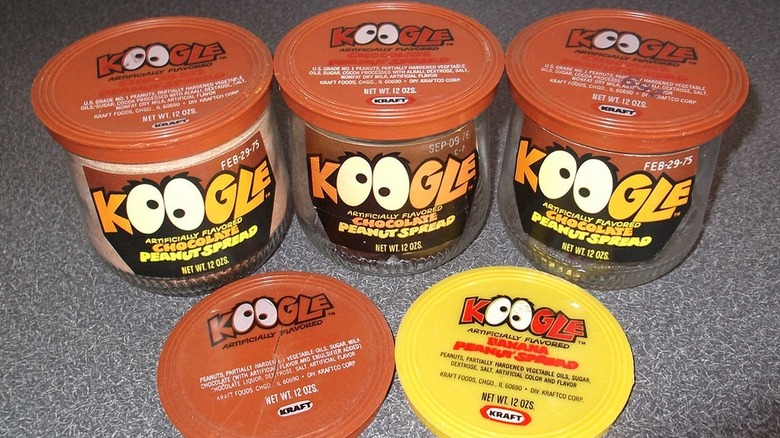
Peanut butter was nothing new in the 1970s. Evidence shows that the Incas were grinding peanuts into paste many centuries ago. In the late 1880s, American doctor and nutritionist John Kellogg began promoting peanut butter as nutritious replacement for meat, and by the early 20th century, commercial peanut butters were already on the market. In 1974, Kraft put a playful spin on the pantry staple with the launch of Koogle, a sugary peanut spread that came in flavors like chocolate, banana, vanilla, and cinnamon.
Unlike plain peanut butter, Koogle was marketed mainly towards kids. Early ads touted it as a creamy "peanut spread" that wouldn't stick to your mouth. Later, Kraft introduced the Koogle mascot, a large nut-shaped character with multiple googly eyes and a penchant for dancing. The ads claimed Koogle was perfect for spreading on bread, crackers, and buns. It could also be used as a dip, melted onto ice cream, or turned into frosting for baked goods.
Unsurprisingly, kids went wild for this sugary spread that was more like candy than protein-packed peanut butter. Sadly, that may have been Koogle's downfall. Critics began calling the spread out for containing mad amounts of sugar and very little nutrition. Many stated it was downright unhealthy for kids. By the late 1970s, public opinion was beginning to shift in a more health-conscious direction, and before the decade ended, Koogle disappeared from grocery store shelves altogether.
2. Space Food Sticks
When the Soviet Union launched Sputnik 1 into orbit in 1957, it sparked America's obsession with space. Over the next decade, the Space Race between the two countries hit a fever pitch, ultimately culminating in 1969 when Apollo 11 landed on the moon and Americans Neil Armstrong and Edwin "Buzz" Aldrin became the first humans to step on its surface. By the 1970s, the space theme was being used to market all kinds of products, but none had more clout than Pillsbury's Space Sticks.
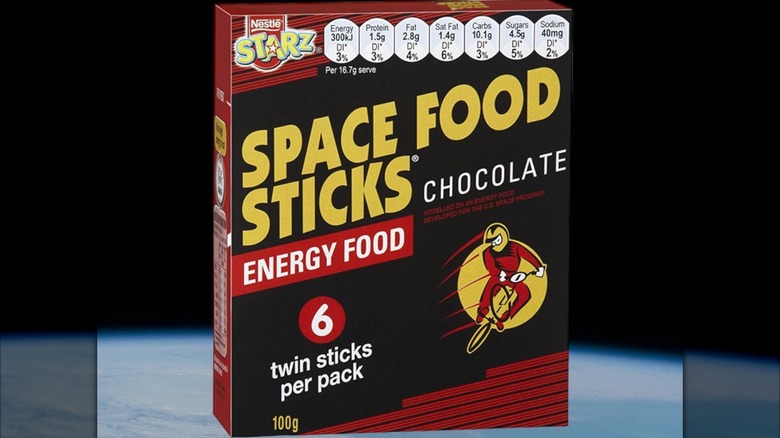
In the early 1960s, Pillsbury landed a government contract to produce food that would be safe and easy for astronauts to eat in space. Chief food technologist Howard Bauman led the project, and came up with the idea of compressed cubes of food. He later created compressed food sticks that astronauts could eat through small openings in their helmets. Those sticks were essentially the prototype for today's popular protein bars.
Pillsbury originally marketed Space Sticks to the public as a "balanced energy snacks." The chewy sticks came in three flavors — chocolate, peanut butter, and caramel — and were individually wrapped for convenience. Although the NASA project was a huge selling point in the beginning, Pillsbury rebranded them as "Food Sticks" in 1971, hoping to distance the product from the common perception that space food was dry and unappetizing. It seemed to work, as the sticks remained popular all the way up to the 1980s.
3. Screaming Yellow Zonkers
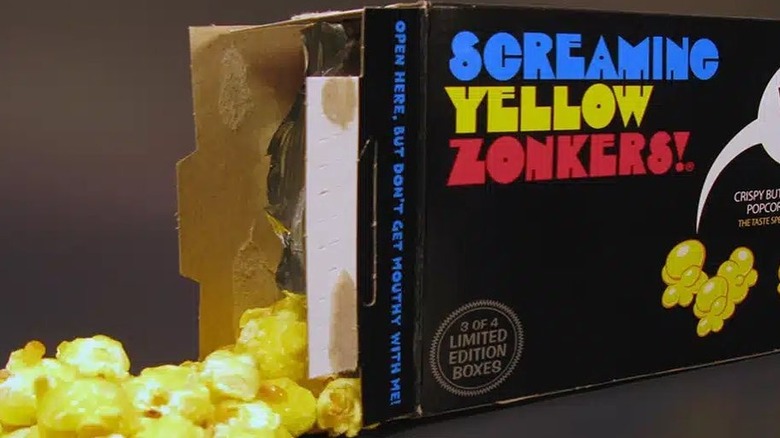
For those who have never had Screaming Yellow Zonkers before, the name might bring to mind mouth-puckering lemon candies or something equally as zingy. However, this popular 1970s treat was actually pretty easy on the tastebuds with its crispy, mild popcorn coated in a sweet butter glaze. That being said, it was a vibrant neon yellow color, so the name did make some sort of sense.
Launched in 1968, Screaming Yellow Zonkers were created by the Lincoln Snacks Company out of Lincoln, Nebraska. The company also produced Poppycock and Fiddle Faddle, both of which were snack mixes featuring glazed popcorn and nuts. When the company came up with its non-nut glazed popcorn snack, it needed a name and an identity, so it turned to an ad agency in Chicago that really took the ball and ran with it.
The creative geniuses at Hurvis, Binzer & Churchill came up with the zany name Screaming Yellow Zonkers and designed the snack's signature black boxes that were printed with cheeky writing. One box might have instructions for what to do with the snack, like "read to them" or "dress them up," while another might tell you the mating habits of the Zonkers. People loved the quirky packaging and advertisements, and most importantly, the taste. The snacks were on the market all the way up until 2007 when Conagra acquired Lincoln Snacks — they even made a brief reappearance in 2012.
4. Marathon Bars
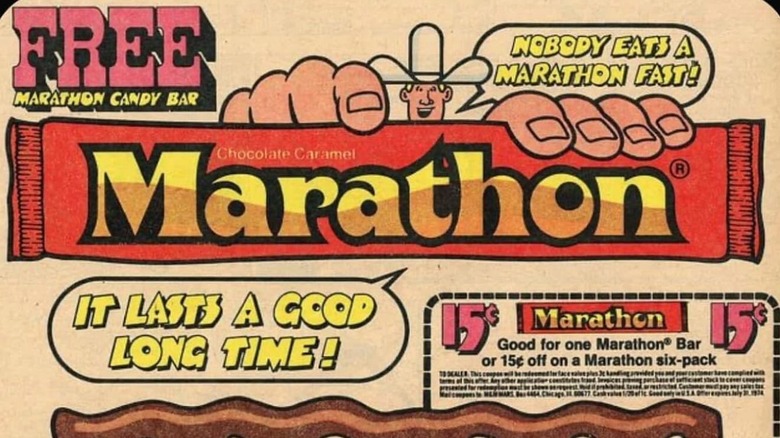
There were plenty of candy bars to choose from in the 1970s, but for many kids and adults alike, the Marathon Bar was the top choice. Part of that had to do with the candy bar's unique design. It featured cords of chewy caramel woven into a braid pattern, then covered in smooth milk chocolate. In addition, it was a full eight inches long, and even had ruler marks on the bright red and yellow packaging to prove it.
The Mars Candy Company launched Marathon Bars in 1973, along with a catchy ad campaign. The television commercials featured a cowboy character named Marathon John, who was played by John Wayne's son, Patrick Wayne. Marathon John was always coming up against villain-like characters who liked to do everything fast, so he would hand them a Marathon bar, telling them they couldn't eat it fast because, "It lasts a good long time."
Unfortunately, Marathon Bars didn't exactly last a good long time on the market, as they were discontinued in 1981. For those who dearly miss the braided bars, there is an alternative. Cadbury Curly Wurly Bars are essentially the same thing — ropes of caramel that are braided and covered in milk chocolate. They're produced in the U.K., but U.S. buyers can snag Curly Wurly Bars on Amazon. You may also be able to find them at specialty candy stores that offer imported treats.
5. Doo Dads
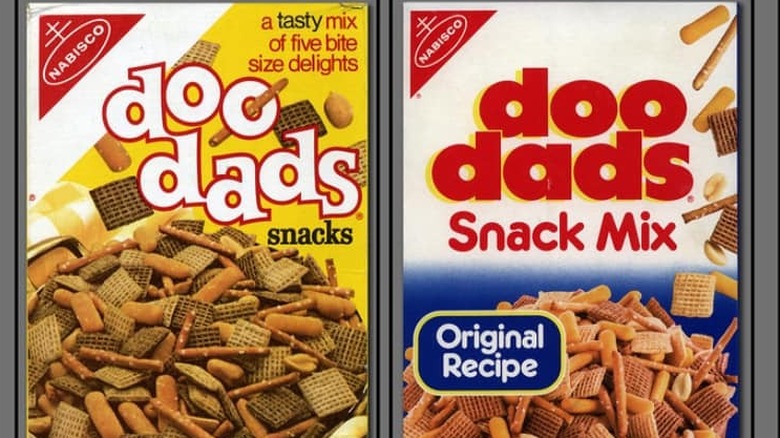
Doo Dads were the kind of snack you could toss on the table at a party and watch disappear. Introduced by Nabisco in the late 1960s, the snack mix was made up of crunchy pretzels, roasted peanuts, Cheese Tid-Bits (another Nabisco snack product), rice squares cereal, and wheat squares cereal. They came in the Original Recipe flavor with savory seasonings and a Cheddar n' Herb flavor.
It's highly likely that Chex Mix was the inspiration for Doo Dads. The Ralston-Purina printed the first recipe Chex Mix was printed in Life magazine in 1952 as a way to promote its Wheat Chex and Rice Chex cereals. The original recipe called for Wheat Chex, Rice Chex, and nuts tossed in melted butter, Worcestershire sauce, and garlic salt before being baked. It became a wildly popular snack, although it was mainly a dish people whipped up themselves at home. The first pre-made Chex Mix didn't hit grocery stores until 1985.
Nabisco was ahead of the game with Doo Dads, as people loved the convenience of being able to simply open a box and pour out a ready-to-go party treat. In addition, many say the flavor was far superior to Chex Mix. Doo Dads remained popular all the way up to the 1990s, then disappeared from shelves, much to the dismay of fans. Many miss the snacks so much that they've pleaded with Nabisco to bring them back. There's even a Change.org petition calling for their return.
6. Jell-O 1-2-3
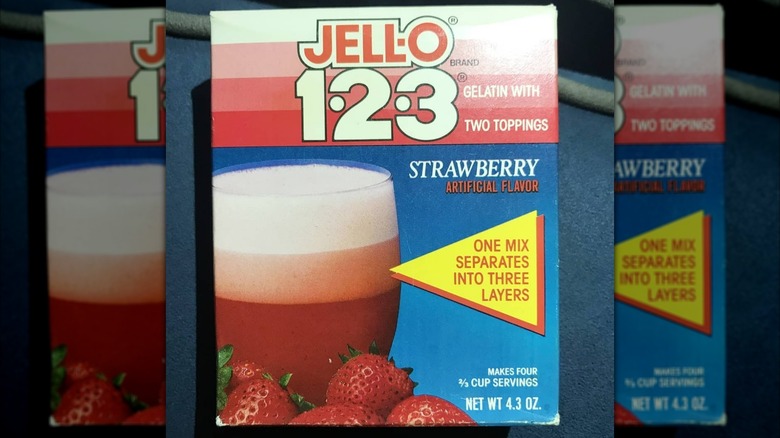
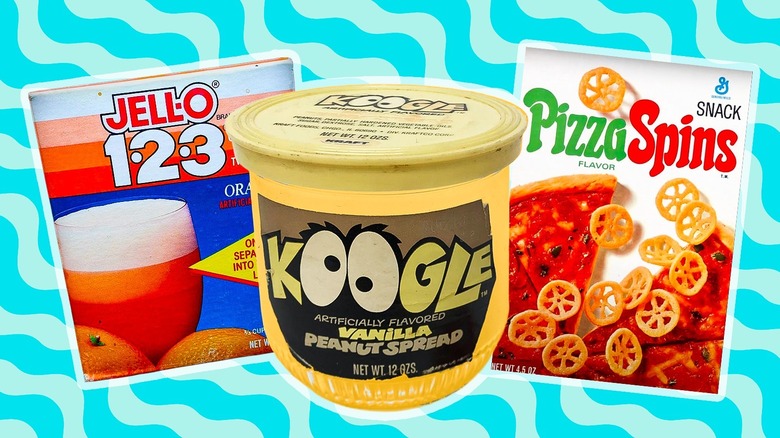
By the 1970s, Jell-O was well and truly ingrained in American culture. Invented by a carpenter named Pearl Waite in 1897, the powdered gelatin product really took off in the early 20th century. Home cooks incorporated it into a wide range of dishes, from fruity desserts to quirky 1950s foods like savory Jell-O salads. By 1969, Kraft had acquired the brand and released a new Jell-O product featuring a twist on the same old jiggly texture.
Jell-O 1-2-3 was a layered dessert described as "gelatin with two toppings." Early ads claimed that the dessert would form three layers right before your eyes. One layer was creamy, another fluffy, and the third was fruity gelatin. The dessert came in five flavors: orange, raspberry, strawberry, cherry, and lime. While it did indeed form three layers, it was a little more complicated than simply mixing it and watching it transform.
The instructions for making Jell-O 1-2-3 called for multiple steps, including blending the powder mix with hot water on low speed, then cranking things up to high speed, then adding ice cold water and blending again. It also suggested pouring dessert glasses half full with the mixture, then going back and filling them up in the exact same order. The final step was to chill it for three hours. Although it had novelty appeal when it first came out, Jell-O 1-2-3 didn't keep the sales momentum going, so it was eventually discontinued in the mid-1990s.
7. Pizza Spins
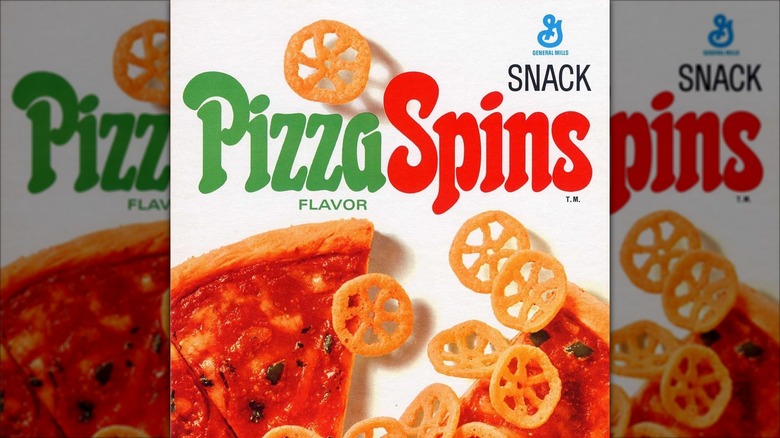
As convenience foods took off in the mid-20th century, advances in food technology made it possible to package flavors that mimicked full meals. General Mills' Pizza Spins launched in 1968, and they promised "all the true delicious pizza flavor in a munchy, crunchy, mouth-sized snack." The packaging was green, white, and red to bring to mind the colors of the Italian flag, and it boasted flavors like Parmesan cheese, tomatoes, pepper, and spices.
Pizza Spins weren't the only snack that General Mills created with other foodstuffs in mind. Bugles were meant to taste like freshly roasted corn, Onyums were designed to taste like bite-sized onion rings, and Potato Crisps had crispy french fries in mind. Out of all those products, Bugles is the only one that's still being produced today, which is odd considering that Pizza Spins did considerably well, even winning a Putman Food Award in 1969.
Despite the fact that Pizza Spins had a slew of fans who loved the crispy pizza-flavored pinwheels, the product was discontinued in 1975. It's unclear exactly why General Mills took it off the market, but to this day, there are still fans who call for its return. If you're among those who miss the savory snack, many say the closest thing to old-school Pizza Spins is Cheez-It's Snap'd Extra-Crunchy Margherita Pizza flavor.
8. Danish Go-Rounds
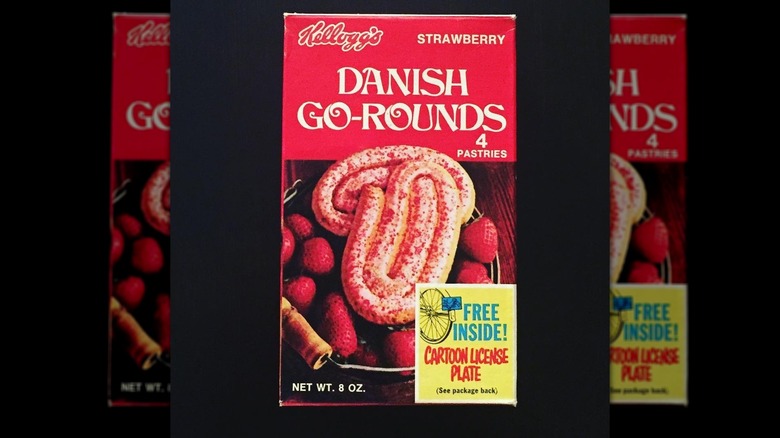
It's hard to overestimate how hugely Kellogg's hit gold when it debuted Pop Tarts in 1963. In fact, the original batch sold out so quickly that the company had to issue an advertisement apologizing for running out of stock. Even today, the Pop Tarts range of flavors are wildly popular. CNBC reported that $3 billion worth of boxes were sold in 2022 alone. The success of the product prompted Kellogg's to experiment with other toaster snacks, one of which was Danish Go-Rounds.
Launched in 1968, Danish Go-Rounds were spiral-shaped pastries filled with jam and covered in a no-melt icing just like Pop Tarts. They could be eaten as-is or warmed up in the toaster. One ad claimed it was "like having a 24-hour bakery at home." There were six flavors of Danish Go-Rounds, including Honey Crunch, Blueberry, Strawberry, Brown-Sugar Cinnamon, Cinnamon-Raisin, and Orange. Kellogg's suggested the pastries were perfect for breakfast, parties, and coffee breaks.
Although Danish Go-Rounds initially did well, they only lasted until about the mid-1970s, when Kellogg's phased them out for a product named Danish Rings. Those were in turn discontinued in 1980. It's unclear why Danish Go-Rounds were given the axe, but it may be that Kellogg's just wanted to focus more on its wildly successful Pop Tarts. The grown-up Danish treats still have die-hard fans, though. As one Reddit user said, "I LOVED these things! WHY they don't make them anymore is a mystery to me. They were MUCH BETTER than Pop Tarts!"
9. Betcha Bacon
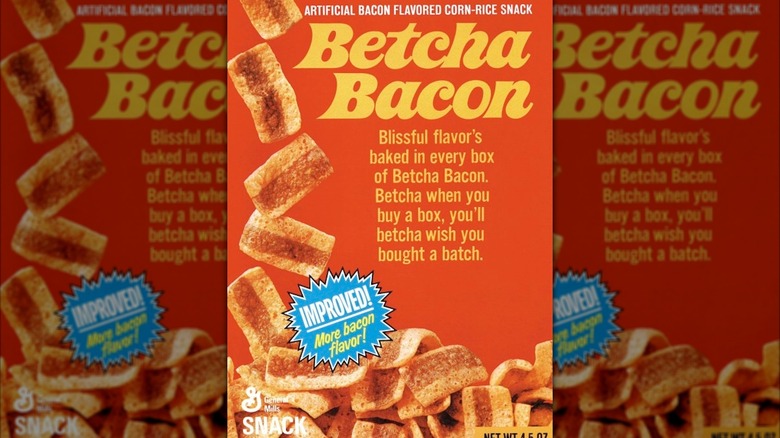
If bacon can improve a burger, a salad, or even breakfast itself, why not crackers? That was the thinking behind Betcha Bacon, General Mills' short-lived but memorable bacon-flavored snack from the '70s. The box featured a fun tongue-twister slogan that read "Blissful flavors baked in every box of Betcha Bacon. Betcha when you buy a box, you'll betcha wish you bought a batch." In our opinion, though, the promise of salty, umami bacon flavor in a crispy snack was probably enough to draw people in without the silly slogan.
General Mills introduced Betcha Bacon in the early 1970s, and described the product as "artificial bacon-flavored corn-rice snacks." They may not have contained real bacon, but the snacks certainly played the part, as each cracker was shaped and shaded to look like a mini strip of bacon. In addition to the bacon flavor, some say the crackers also offered slight hints of buttermilk and cheddar cheese.
For all the bacon lovers out there, it's probably hard to imagine how a bacon-flavored snack wouldn't be a massive hit. However, judging by the fact that Betcha Bacon disappeared around the mid-1970s, we can assume that sales probably weren't cutting it. Even today, there aren't too many bacon-flavored snacks on the market. The closest thing to Betcha Bacon is Frazzles, which are bacon-flavored potato chips from the U.K. (or crisps, as they're called across the pond).
10. Carnation Breakfast Bars
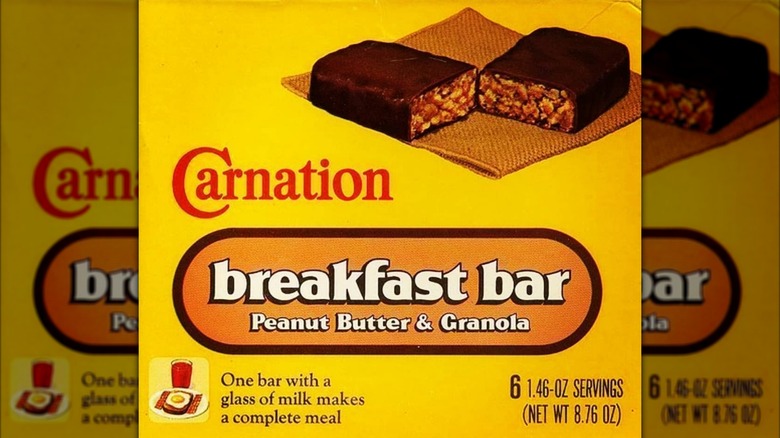
Pillsbury's Space Food Sticks proved that people were open to the idea of portable snacks that could double as meal replacements, and Carnation quickly followed that trail. The company had already found success in 1966 with its Instant Breakfast powder packets, which you could stir into milk for a quick, nutrient-boosted drink. By 1975, they took the concept one step further with Carnation Breakfast Bars, which promised the convenience of a full breakfast in the form of a chocolate-covered bar.
The bars came in several varieties, including chocolate chip, chocolate crunch, granola with raisins, cinnamon granola, and granola with peanut butter. Early ads claimed that when paired with a glass of milk, one bar could give you the same nourishment as a plate of bacon and eggs. Kids liked them because they were sweet and chewy, while adults appreciated having something easy to grab on the way out the door.
Carnation Breakfast Bars stayed popular through the 1980s, but sales began to slide in the '90s, leading to their discontinuation in 1997. Fans clamored for their return, and the company briefly revived them in 2014. The relaunch never gained much traction, though, and by 2020 the bars had disappeared again, leaving nostalgic snackers still hoping for a comeback.