

How To Get Thick, Velvety Froth From Soy Milk Every Time
We may receive a commission on purchases made from links.
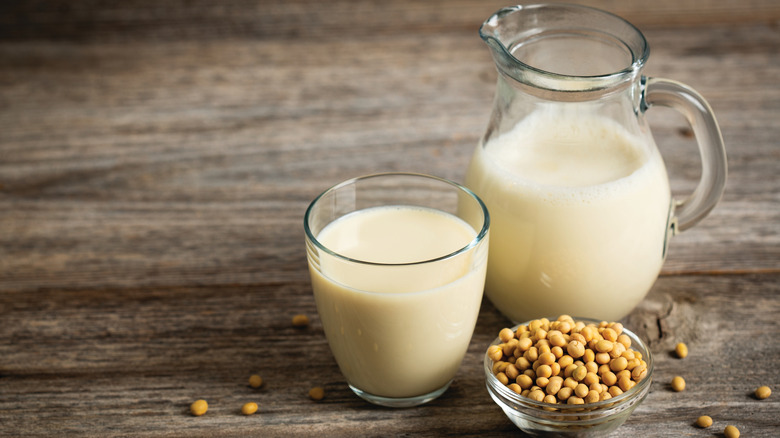
If there's one thing that's better than the taste of a perfect latte, it's the feel of one. Whether hot or over ice, that thick, frothy foam is the key to a delectable mouthfeel and even serves as a canvas for some creative latte toppings. But the thrill of great foam means, on the flip side, bad foam can be pretty disappointing — and it seems that many plant-based milks, like soy milk, are particularly susceptible to this. Of course, you can froth non-dairy soy milk for lattes and cappuccinos, but it can be tricky to get used to. Fortunately, Chowhound reached out to an expert to help you nail the art of velvety soy milk foam.
Andrea Allen, the co-founder of Onyx Coffee Lab since 2012, knows all about frothing milk — the 2020 U.S. Barista Champ and 2021 World Barista Runner-Up can mix it up with the best of them. And luckily for you, she's come through with exclusive advice on how to perfectly froth your soy milk. For her, it's crucial to choose the right kind of soy milk, as not all will be best-suited to maintaining their foamy stability. "My advice would be to purchase an alternative milk that is formulated for baristas or for steaming," she said. "These products are engineered to produce foam and also to stand up to heat." As for the heat, 140 to 160 degrees Fahrenheit is the standard to avoid burning. It may be a simple solution, but you won't hear us complaining while sipping on a foamy beverage.
Why some soy milks just won't work

Not all non-dairy milks are the best choice for your latte. And likewise, not all types of soy milk will hold their foamy form as well as others. But this is why Andrea Allen recommends certain kinds of the stuff — kinds that have been produced with frothing in mind. "Foam is created when fat molecules in a milk style beverage wrap around an air bubble via steam from a steam wand. The lower the fat content of the 'milk,' the more difficult it is to make slick, heavy foam," said Allen. And while soy milk is a plant-based milk with its fair share of protein, its molecules are weaker in comparison to dairy-based ones and therefore won't froth as well.
Luckily though, it seems that non-dairy milk producers have heard the cries of their consumers. "Many alternative milk beverages are now formulated for steaming with the addition of binders, so it's much more doable to have foam on a soy or oat hot espresso beverage than in previous times," according to Allen So as long as you choose a soy milk that's made with this in mind — she recommends Pacific Foods Barista Series — happy frothing days should be ahead.
Use the best tool for the job
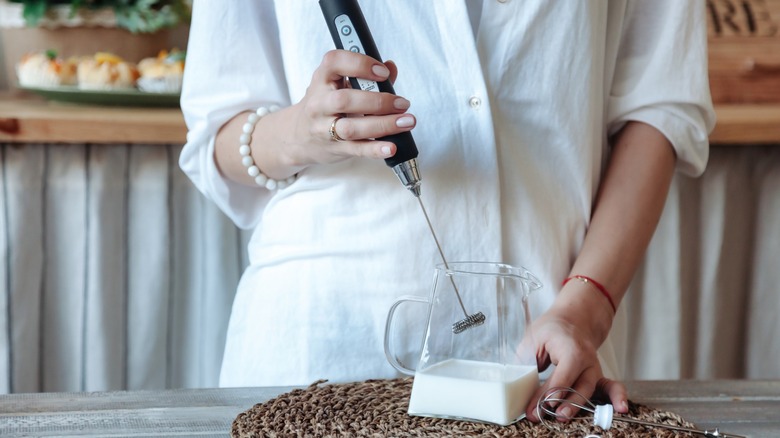
Having the proper soy milk is one thing, but you're not going to get very far unless you have the proper implements for making good foam as well. There's a variety of milk steamers and frothers on the market, so we also asked Andrea Allen for some insight as to which might be best for soy milk. "I'm a big fan of the handheld frother," she responded, elaborating that with this tool, "You can create foam in hot milk or cold, create cold foam style beverages, or just mix things up."
Using one of these frothers is fairly simple, and in all honesty, there's not too much of a difference in frothing soy milk with one of these as opposed to cow's milk, except you might find yourself wanting to add just a little bit more air than normal. As for a streamer such as what might adorn your home espresso machine, Allens thinks that's a fun tool to use too, though you'll want to steam your soy milk slowly and gently. And in either case, be sure not to burn the liquid. Since soy milk proteins are more delicate than those in cow's milk, you don't want the foam to get too hot or else you risk curdling your milk. But, of course, if you're going the cold route, there's no need to worry there. Both options are on the table, just make sure to keep an eye as you're frothing in either instance. As long as you follow these tips, you can just chalk up stubborn un-foaming soy milk as yet another myth surrounding soy you should stop believing.