

The Nostalgic Reason Maker's Mark Labels Itself Whisky, Not Whiskey
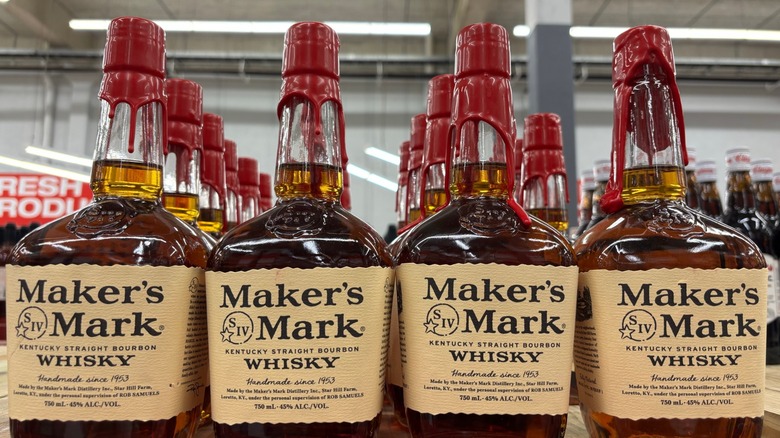
Whether you're looking to make a classic paper plane cocktail or even a unique vanilla tomato water cooler, you can't go wrong with a bottle of Maker's Mark bourbon to get the job done. The drink has been around for a while, coming into the market in the 1950s. And even though the brand is now owned by Suntory Global Spirits, there is still a strong sense of heritage within the Maker's Mark line of products. Part of this is due to that immediately recognizable red wax dip that seals every bottle, but there's an often overlooked part of the bottle design that can be a clue to the eagle-eyed bourbon enthusiast: it doesn't use the American spelling of whiskey.
This isn't a random choice or mistake — rather, it's a hearkening back to the familial roots of the Samuels, the family that established Maker's Mark. Although the brand was established in the '50s, the Samuels family had been making spirits long before that. And since they were originally Scottish, they spelled whiskey as "whisky," in line with all other Scottish whiskies. So using "whisky" on each bottle of Maker's Mark is actually quite a touching, subtle tribute to the history of the family enterprise — and now you can appreciate that small gesture, as well.
Does it make a difference if you call it whiskey or whisky?

To keep the "e" or drop the "e," that is the question. At least, it seems that's the question when it comes to labelling your grain liquor. In truth, there's no inherent difference between bottles labelled "whiskey" and those labelled "whisky." Really, it's just a clue as to where it came from geographically or what traditions may have influenced its fabrication. It tends to be the case that American and Irish whiskeys keep the "e" in the word while Scottish, Canadian, and Japanese whiskies drop it.
However, culture and tradition do play a small part. For example, Japanese whisky uses that spelling of the word as a way of tipping the proverbial cap to Scottish whisky, which played a huge role in establishing Japanese whisky distillation and culture. And it's with this kind of mentality that Maker's Mark uses the Scottish version of the word. It doesn't suddenly turn Maker's Mark into Scotch — it's still very much a wheated bourbon subject to all the regulations surrounding that class of spirit. However, like Japanese whisky, it's sometimes nice to look back at your lineage and see how far you've come — especially if that reminiscing is taking place over a tasty glass of whisk(e)y.