

The 9 Best Ways To Light A Charcoal Grill Without Lighter Fluid
We may receive a commission on purchases made from links.
Charcoal grilling comes with its fair share of risks. From opening your grill lid and ruining your food to using lighter fluid and giving it a chemical flavor, there are a lot of ways it can go wrong. In fact, lighter fluid is often used as a charcoal con in the charcoal versus gas grill debate, so it's really time to stop using it. Unfortunately, lighter fluid is handy: a few squirts and boom! Your charcoal is going. One can't help but miss such simplicity, especially because charcoal isn't the easiest thing to light.
"Charcoal is difficult to light on its own because it is almost pure carbon, so it doesn't have the helping hand that materials like wood have, as they contain volatile gases that help get a fire started," explains Gareth Lloyd Jones, waste management expert at the U.K. waste removal company, HIPPO. "Charcoal also requires a consistent high temperature in order to ignite and burn, which is difficult without the help of other substances." The good news is, lighter fluid isn't the only "other substance" in the world ... which is good, he says, because lighter fluid is both bad for the environment and gross.
"Lighter fluid is the shortcut that ruins the payoff," agrees David Figueroa, certified grillmaster and president of Melinda's Foods. "It leaves a chemical residue that clings to the charcoal and seeps into your food. You spend hours sourcing the perfect steak, seasoning it with care, and then risk it tasting like petroleum." We can all agree that's not worth it, so here are 10 alternative ways to light your charcoal grill instead.
1. Charcoal chimney
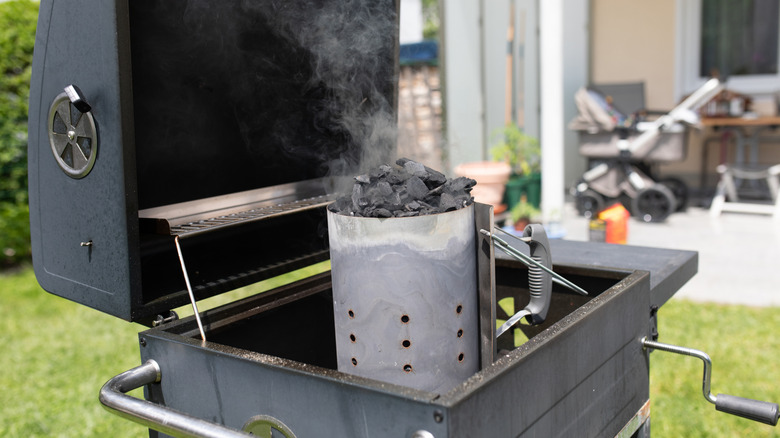
First up, a charcoal chimney is an excellent lighter fluid alternative when you want to grill more cleanly. It helps address one of the main problems with charcoal, which is that it doesn't catch easily. "It needs steady, consistent heat to get going, which is why tossing a single match won't work," says Dennis Littley, the lifelong professional cook behind Ask Chef Dennis. "Building enough flame and airflow to ignite the coals properly takes some patience and the right method."
A charcoal chimney is that method, Littley says. "Start by loading it with charcoal, place newspaper underneath, and in about 15 minutes you'll have a full batch of glowing coals ready to go," he instructs. "It's quick, reliable, and often my go-to method whenever I'm grilling." If you don't get junk mail, says Scott Thomas, owner of The Grillin' Fools, you can always use junk mail instead. "Call it my own personal recycling system," he laughs.
Make sure you take care, though. "Be careful dumping the chimney and finding a place to put it after the coals have been dumped," Thomas says. "Do not set it on a wood deck while still hot." (I can confirm this. My husband and I used to barbecue all the time, and we once used the charcoal chimney on the deck. Even with the grill-safe mat underneath, we set the porch on fire. Just a little bit, though.) In terms of tools, try either the Kingsford Heavy Duty Deluxe Charcoal Chimney Starter or Weber Rapidfire Compact Chimney Starter.
2. Vegetable oil and paper towels
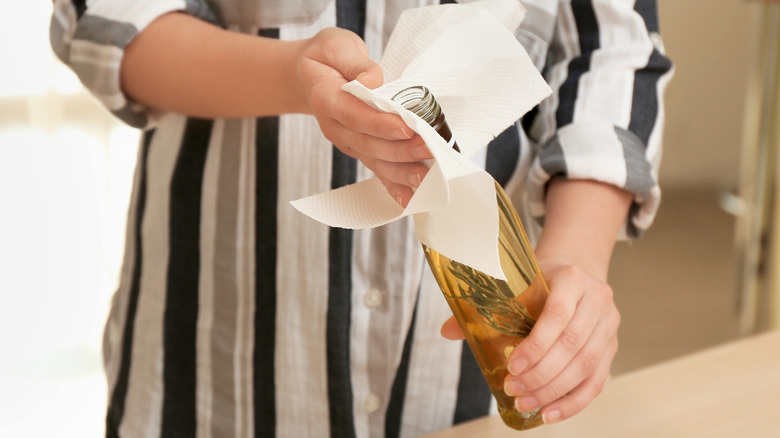
Yes, pure oil is flammable. Yes, paper towels are as well. In combination, they work well as a fire starter that helps you avoid nasty chemicals. Indeed, this is one of Alton Brown's favorite charcoal-lighting hacks ... but you've got to do it the right way, otherwise your kindling will flame out before you can get it near your charcoal grill.
To make it work, says Rae Robertson, chef de cuisine at The Darling Oyster Bar, you have to give the bricks time to catch. Ball up a few paper towels, then moisten them with vegetable oil or another cooking oil. Place the charcoal around the paper towels before lighting them, so that you trap those flames underneath and give them a chance to do their work on the charcoal. "Sometimes you have to add a little bit more oil to get them all to catch," she says.
This is a great substitute for a charcoal chimney, Dennis Littley says, giving you options if you're on the road or simply don't have one. "It's inexpensive, easy to do at home, and a much better option than lighter fluid," he says. Gareth Lloyd Jones adds that it's low-waste and long-burning, providing the sustained heat required to ignite the charcoal. To make it even more environmentally friendly, try a product such as Caboo Tree Free Paper Towels.
3. Alcohol and cotton balls

At risk of sounding like a bunch of pyromaniacs, the experts and I humbly submit another flammable combination for your consideration: alcohol and cotton balls. "Cotton balls dipped in plain rubbing alcohol ignite fast and burn long enough to light a pile of coals," Dennis Littley says. "It's a simple DIY option that works surprisingly well and doesn't add any off-flavors. Just always make sure you're using basic alcohol, not anything with additives." The same goes for cotton balls, which can be more or less eco-friendly (Organyc 100% Organic Cotton Balls are a good option).
Petroleum jelly is another option that will catch quickly. "Yes, Vaseline is very flammable," Scott Thomas says. The only problem is that this solution can flame out fast, once again leaving you with a moment of pyromania and zero lit coals. You may find you need to use a lot of cotton balls to get this solution to work. However, if you can trap the tinder inside the pile of coals, it's more effective. "If used in conjunction with a charcoal chimney, then just a handful as the heat is concentrated in the tube," he says.
4. Organic fire starters
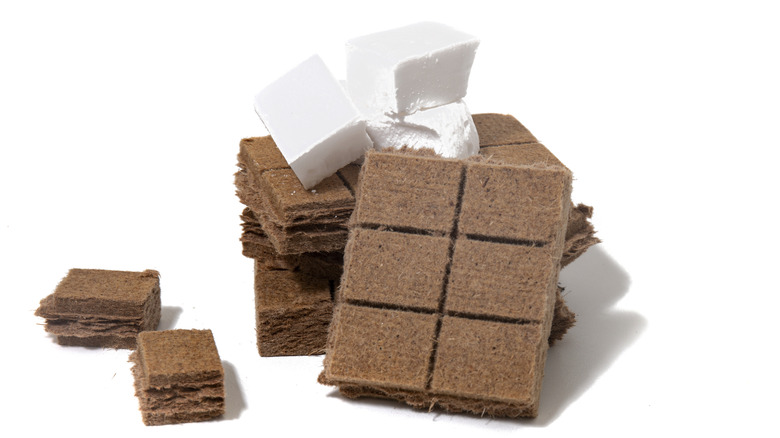
Fire starters — a.k.a., fire lighters — are just what they sound like. Brands such as Inflame Fire Starters or If You Care FSC Certified Firelighters provide you with a surefire way to light your charcoal grill without one drop of lighter fluid. "A quick and easy method for lighting a charcoal grill without lighter fluid is by using organic fire starters made from compressed wood shavings, sawdust, or wax," Gareth Lloyd Jones says. "They set alight really easily and have a great burn time. They're also free from any harmful additives and won't leave chemical tastes on your food."
To use them, spread a few fire starters in the bottom of your grill and then pile your lump charcoal or briquettes around them. Light them carefully, and they will immediately light your coals for you. Depending on what brand you buy, you may not even need more than one, David Figueroa explains. "Jealous Devil Boom! Firestarters are built for speed and consistency," he says. "Compact, powerful, and designed to work even in wind or damp conditions, they're one of the best modern fire starters on the market."
If you want to make sure you've always got a grill-lighting method around, these are a good way to go. Dennis Littley keeps them around for backup when he doesn't feel like getting his charcoal going himself. "They're easy to use, safe, and dependable, which makes them perfect for home cooks who want a stress-free way to start a charcoal fire," he says.
5. Electric fire starters
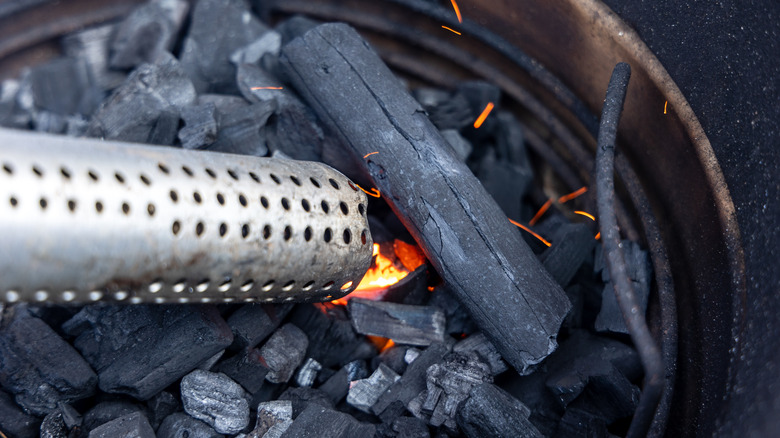
Rather than using flammable substances, you can also put the power of electricity to work for you when lighting your grill. "An electric fire starter works like a heating coil," Dennis Littley says. Its unadorned bend of metal heats up when plugged in, transferring that heat to your unlit charcoal and causing it to catch. "First you plug it in, then tuck it under your coals, and they'll be glowing in a matter of minutes. It's reusable and doesn't leave behind any taste, though you'll need an outlet nearby." For frequent grilling, he says, it's one of the simplest and cleanest methods you'll find. The 600W Electric Charcoal Starter Fire Lighter is one online possibility.
Just make sure to use the right amount of charcoal for your barbecue, in addition to making sure to light it the right way. Setting up your grill for burgers, for instance, requires that you plan for different grilling zones, and therefore, you've got to have enough charcoal to spread the coals around without losing too much heat. You don't want to light all your charcoal, only to find out you need more — an electric fire starter takes a minute and doesn't cause coals to catch fire immediately like some of these other methods.
6. Gas torches
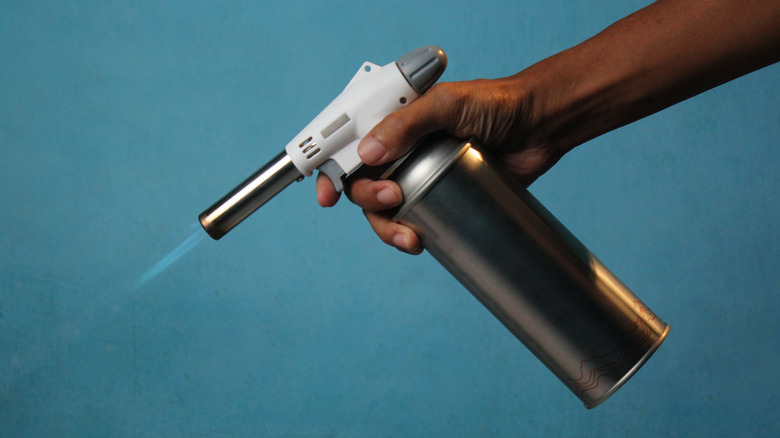
While we often think of gas and charcoal as being at opposite ends of the grilling spectrum, they're actually a match made in heaven when it comes to getting your grill going without lighter fluid. Enter the butane torch, a tool used for everything from welding to caramelizing the tops of crème brûlée to making resin art. "It sounds silly to use gas for charcoal, but it works," Rae Robertson says. "Direct heat blasts the bricks, and the high intensity helps catch the coals. It also helps if they are stacked together or close to each other, so they can all catch together to ignite." David Figueroa confirms that butane torches are powerful, reliable, and get coals going in seconds. "It's dramatic, fast, and gives you precision over where the burn starts," he says.
To get the best result, says Scott Thomas, start with a smaller pile of coals and blast them with the torch until they glow a consistent red. Then, pile on more charcoal carefully. "The heat from the hot coals on the bottom will travel up and light the rest of the pile," he says. Consider a product such as the Sondiko Butane Torch with Fuel Gauge if you want to give this a try yourself.
Believe it or not, that's not the only way to use gas to get your charcoal going. If you've got a charcoal chimney but no easy tinder to hand, you can place it over a burner on the gas grill instead. "Light that burner and set to high," Thomas instructs. "Give it about 15 minutes, and that chimney will be full of red-hot coals."
7. Paper, newspaper, or egg cartons
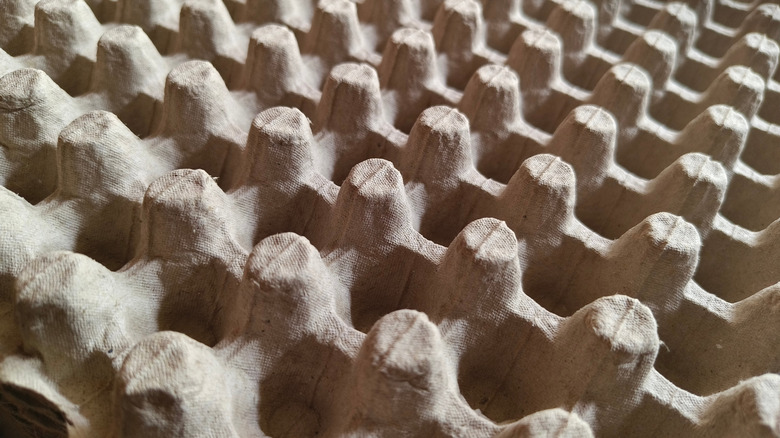
As we've been discussing various organic substances to use in place of lighter fluid, it won't surprise you to know there are several others that will get your charcoal going as well, including paper, newspaper, and egg cartons — all of which you can use without oil, alcohol, or a charcoal chimney, as long as you do it right.
"Good old scrunched-up newspaper or a cardboard egg box are an excellent way to light charcoal grills while reusing household items you'd otherwise throw away," Gareth Lloyd Jones says. "All you have to do is roll sheets of newspaper and torn parts of egg boxes, pop them under your charcoal, and light." Jones advises you don't use newspaper on its own, though, because it burns out so quickly. "While it can be a good initial spark, you may want to partner it with another method." Rae Robertson loves egg cartons as well. "They're usually made of compostable materials and will catch quickly without producing chemicals or residue," she says. "I usually stack a few bricks inside the half of the carton and light the carton. It cradles the bricks and lights them pretty quickly."
Egg cartons can even light a pile of charcoal on their own if you don't have any newspaper to hand, and you can get four sessions out of each dozen. According to Scott Thomas, all you have to do is rip the top lid from the bottom, cut both in half, turn one quarter upside down on the grill, and make a briquette or lump charcoal pyramid around it. Light it up and wait 20 minutes; that's it.
8. Firewood or fatwood
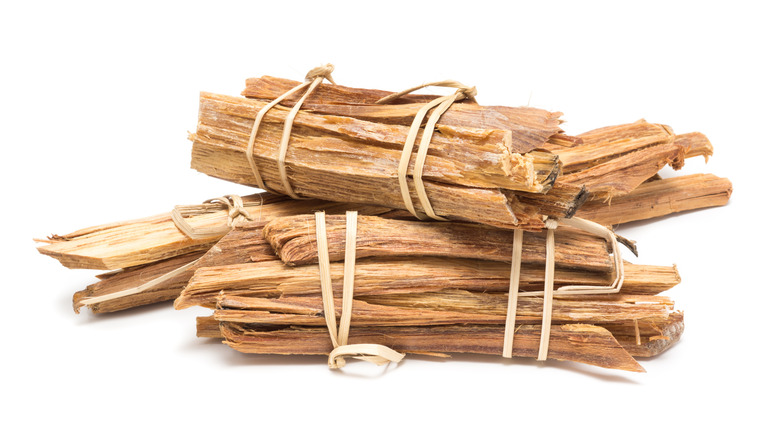
While you might find wood to be a temperamental barbecue fuel, it is nevertheless a handy alternative to lighter fluid when grilling with charcoal. "There's more than one way to spark a perfect flame," David Figueroa says, and fatwood is one of them. One of the biggest problems with charcoal is that the little splinters on the outside of the logs have been burned away in the charcoal-lighting process, so there's nothing to catch fire, Scott Thomas explains. Bringing some of the fresh, flammable wood back in the form of fatwood, such as Fatwood Fire Starter Sticks, can be helpful.
Speaking of wood, you can also use it to give your charcoal-cooked food more flavor. "If you want to take your next cookout to the next level, use smoke wood, but also toss on a chunk of onion or a few cloves of fresh garlic (or both)," Scott Thomas says. "The onion and garlic will not produce much visible smoke, but you will definitely be able to smell it. When the smell diminishes, add a bit more. They burn up fast, but the flavor profile is amazing."
9. Doritos, baby
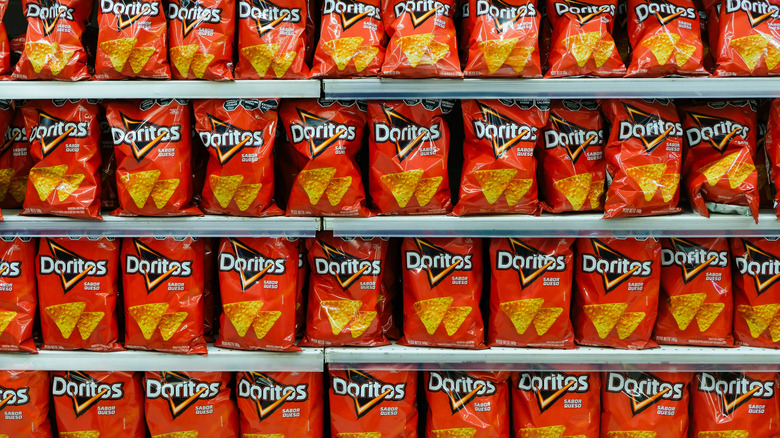
"If you want to really get a conversation going, grab that bag of stale Doritos," Scott Thomas says. Yes, really. "A small pile of the chips will light up nicely. I'm not kidding." Who could really complain about having a Doritos Flavored Tortilla Chips Variety Pack around, anyway? Plus, it smells much nicer than lighter fluid. "That stuff smells awful," Thomas says. "Sure, it brings back the nostalgia of my youth when that's just how we lit the grill when I was a kid, but it's not good for the food." If you do need to use lighter fluid, he says, make sure to let that charcoal lit with lighter fluid burn down for a good 30 to 40 minutes so all that fluid can burn off.
A few more tips to get you going with non-lighter-fluid approaches? First, be patient. "Always wait until the coals are gray and glowing before you start cooking; that's how you know they're ready," Dennis Littley says. "If you rush the process, you'll end up with uneven heat and food that tastes smoky for the wrong reasons. Patience, on the other hand, results in clean, delicious cooking ... the way charcoal grilling should be.
Second, when you're done grilling, make sure your used charcoal is completely cool before you dispose of it. "It should then be disposed of in a non-flammable container," Gareth Lloyd Jones. "Many types of charcoal, particularly hardwood lump charcoal, can be added to your compost pile in small amounts to improve soil aeration, but again, but again, only after it has completely cooled down!"