

10 Dishes Americans Love That Seem Absolutely Strange To Everyone Else
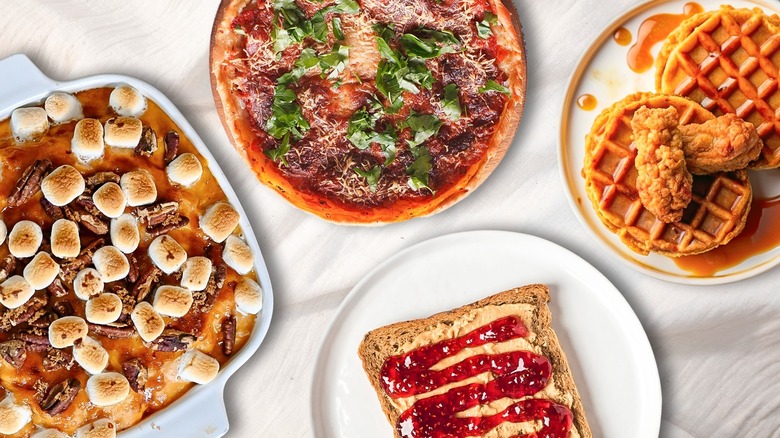
Every country has foods that make perfect sense at home, but don't really translate in other places. For the U.S., that list is longer than you might think. Some dishes that are widely known and well-loved in the States often make people in other countries scratch their heads. As a Canadian, I grew up with tons of American foods that I absolutely adore, but even for me, there are a few dishes that are baffling.
When you grow up with certain foods that scream comfort and childhood memories, it seems almost inconceivable that they're not universally loved. However, that's not always the case. Take peanut butter and jelly sandwiches. In the U.S. and Canada, they're about as ordinary as you can get. However, in many other countries they're often seen as an odd, cloying mash-up. That's partly because some of the ingredients aren't popular in other countries, but more so that the combination of flavors and textures is just off-putting to many people.
Then there are dishes that maybe you had to grow up with to love. Like, what even is sweet potato casserole? Many people get the mashed sweet potatoes part, but then adding sugar and marshmallows on top? For those who haven't tried the dish (and even some who have), that part just seems bizarre. And those aren't the only dishes that confuse people outside of the States. These are 10 American dishes that people in other countries find odd, over-the-top, or just downright wrong.
1. Sweet potato casserole
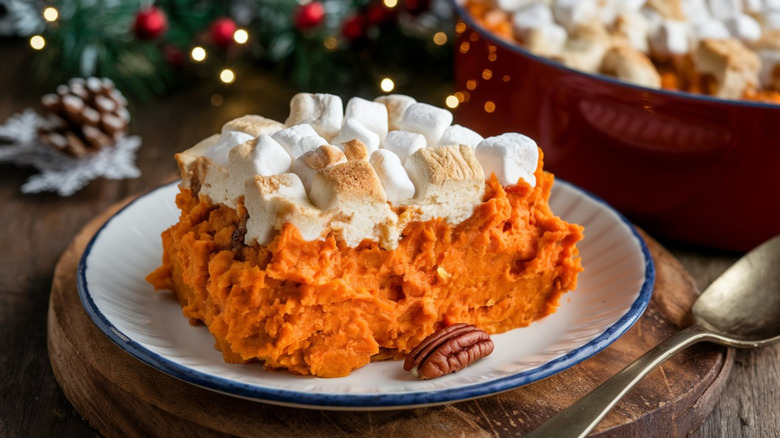
Come fall, Americans and Canadians celebrate Thanksgiving by getting together with friends and family to feast on good food and remember what they're thankful for. Typical dishes you'll find on both sides of the border include turkey, mashed potatoes, gravy, stuffing, cranberry sauce, and roasted vegetables. However, one dish that you'll often see in America, but very rarely in Canada is sweet potato casserole. It typically consists of boiled or baked sweet potatoes mashed with butter and brown sugar, then topped with marshmallows and baked.
Sweet potatoes are native to the Americas, so it makes sense that they made their way into Thanksgiving feasts. Some historians believe that sweet potato casserole evolved from sweet potato pudding recipes, which appear in cookbooks as far back as the late 1700s. According to Saveur, the first recipe for sweet potato casserole with marshmallows came from a 1917 booklet. It was written by Boston Cooking School Magazine founder Janet McKenzie Hill, who had been hired by the Angelus Marshmallows company to develop recipes to promote its product.
Today, sweet potato casserole is a must-have for many American Thanksgiving spreads. But for those not familiar with it, the dish seems truly outlandish. One Reddit user even created a thread devoted to it titled, "Like a dish someone in Europe made up to mock Americans." Many people find it odd that the dish is sweet, but served as a side instead of a dessert. Others think the marshmallows take it a step too far. However, many Americans say you shouldn't knock it until you've tried it.
2. Peanut butter and jelly sandwiches
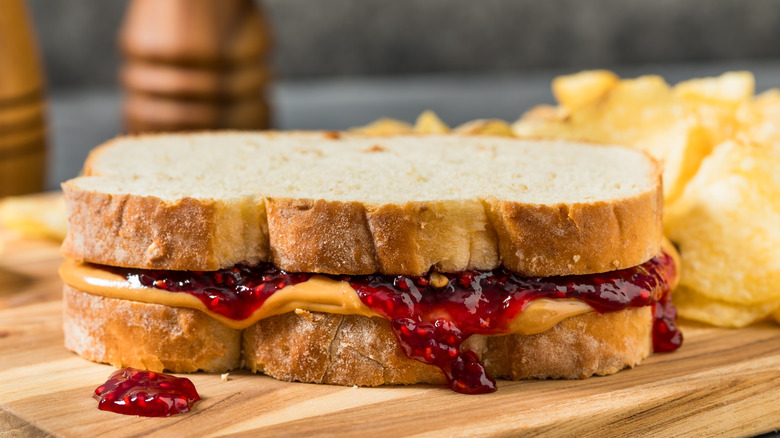
If you grew up in North America, there's a good chance that peanut butter and jelly sandwiches were a big part of your childhood, and they may still be a staple in your household today. In America, the sandwich is so beloved that April 2 has even been declared National Peanut Butter and Jelly Day. It's easy to see why the sandwich has been a go-to for generations. It's easy to make, easy to eat, and travels relatively well. Plus, many say you can't beat that sweet and salty flavor combo.
The PB&J sandwich first gained traction in the early 1900s, when both peanut butter and packaged sliced bread became widely available. Many sources cite Julia Davis Chandler as the creator, based on a recipe that was published in the Boston Cooking School Magazine in 1901. Chandler recommended making finger sandwiches with thin layers of bread, peanut paste, and currant or crab apple jelly. The sandwich really took off during the Depression, when people realized it was a cheap way to pack protein in.
While it might be unthinkable for some to live in a world where PB&Js don't exist, many people from other countries find the concept to be disturbing. Some are confused because in their countries, jelly refers to products like Jell-O, so they wonder why anyone would want to make a sandwich with jiggly gelatin and peanut butter. Plus, peanut butter isn't really popular in many countries, so it's not a common sandwich ingredient. In addition, there are many who believe combining sweet and savory flavors is just wrong.
3. Chicken and waffles
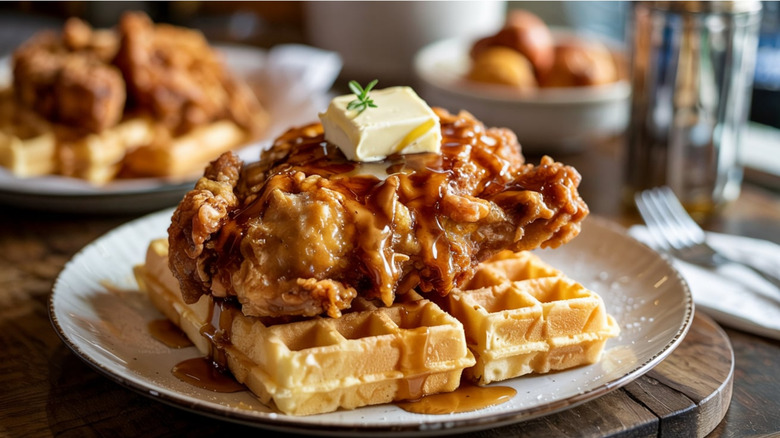
Speaking of sweet and savory, chicken and waffles is another dish that many people outside America find perplexing. The dish is pretty self-explanatory — you have crispy fried chicken laid on top of golden fluffy waffles, often with a drizzle of maple syrup or perhaps some honey. Some people also go ultra-indulgent with a pat of butter or kick things up a notch with hot sauce.
It's not surprising that fried chicken and waffles came together into one dish, considering that both date back centuries in the U.S. The Pilgrims brought waffles to America via the Netherlands, and fried chicken has been around since early colonial days, brought over either by the Scottish or enslaved people from West Africa. We don't know who first combined the two, but we do know that it was popular as far back as the 1930s, when it was on the menu at Well's Restaurant in Harlem, New York.
Despite the dish's popularity in many parts of the U.S. and Canada, there are plenty of people who think it's simply absurd. One Reddit user said, "I honestly thought it was a weird inside joke the first few times I saw it." The main issues that people have with it are that it mashes together two dishes that are typically eaten at different times of day. As another Reddit user said, "Why would you want oily chicken for breakfast? Or covered in sugar?" And once again, there are the sweet-savory detractors, many of whom also believe bacon and maple syrup don't belong together.
4. Root beer floats
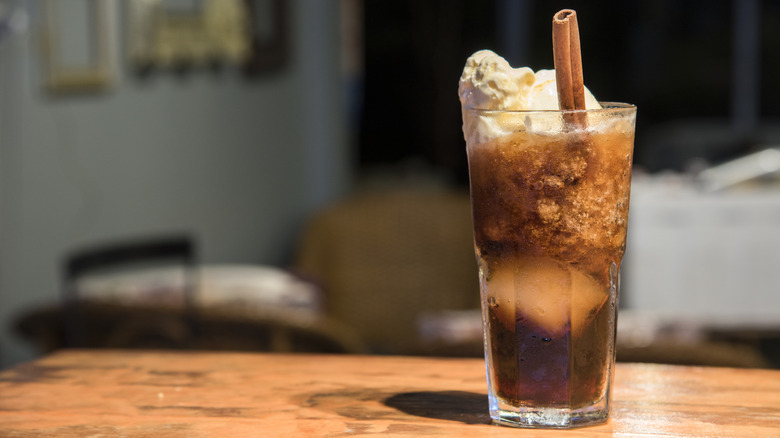
Is there anything more American than a root beer float? For many people, it brings to mind old-timey soda fountains or childhood memories of special treats at diners and ice cream shops. The formula is simple: you scoop some vanilla ice cream into a glass and pour some root beer over top. It's sweet, creamy, slightly herbaceous, and bubbly. But while Americans often see it as pure nostalgia, many people abroad don't share the love.
Root beer was inspired by drinks Native Americans made with indigenous ingredients like sassafras and sarsaparilla. In the late 1800s, a Philadelphia pharmacist named Charles Elmer Hires created his own concoction with an array of roots and herbs and called it root beer. Not long after, legend states that a man named Frank J. Wisner created the first root beer float in Colorado when he concocted what he called a "black cow" beverage inspired by the snow-capped Cow Mountain. However, there is some debate over how true that legend is.
Regardless of who truly invented the root beer float, it went on to become one of the most popular ice cream floats in America. In other places, though, it doesn't go over so well because many people can't handle root beer's distinctive flavor. As one French commenter on Reddit said, "I think for most of us, the taste you find in root beer is a very common flavor in cough medicine or mouthwash. Thus, for us it just tastes like a medicine-flavored soda which is ... very weird."
5. Deep dish pizza
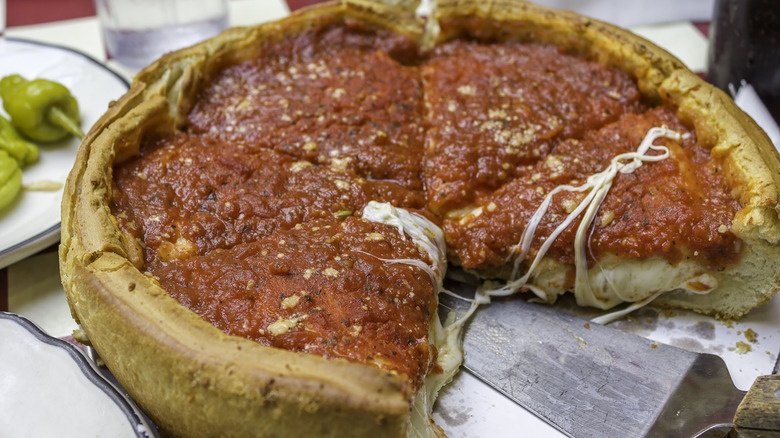
Pizza may have originated in Italy, but it's beloved around the world, especially in the United States. There are numerous different styles of pizza across the country, from wood-fired Neapolitan-style pies to thin-crust New York slices and Sicilian-style squares. One style that gets more than its fair share of derision is Chicago-style deep dish pizza. In fact, many people both inside and outside the U.S. wonder if it can actually be called pizza at all.
Deep dish pizza was created in 1943 at a restaurant called Pizzeria Riccardo (later renamed Pizzeria Uno) owned by Ric Riccardo and Ike Sewell. What makes the pizza unique is that it's cooked in a round cast iron pan about 2 inches tall with dough that's amped up with butter or oil. The dough gets topped with ample amounts of mozzarella and fillings like sausages and peppers, and then a final layer of tomato sauce. The result is a pie with a thick, buttery crust and ultra-gooey center.
Ask an Italian what they think of deep dish pizza, and they'll probably tell you it has nothing to do with pizza. Some compare it to a "torta salata," which is a savory Italian pie. Even at home, some chefs don't believe it's part of the pizza family. For example, Graham Elliot told Eater, "I feel like it's a lasagna with a crust." For many, it's just too sloppy and over-the-top. However, for all the haters, there are just as many people who say it looks pretty tasty and that they'd be willing to give it a try.
6. Grits
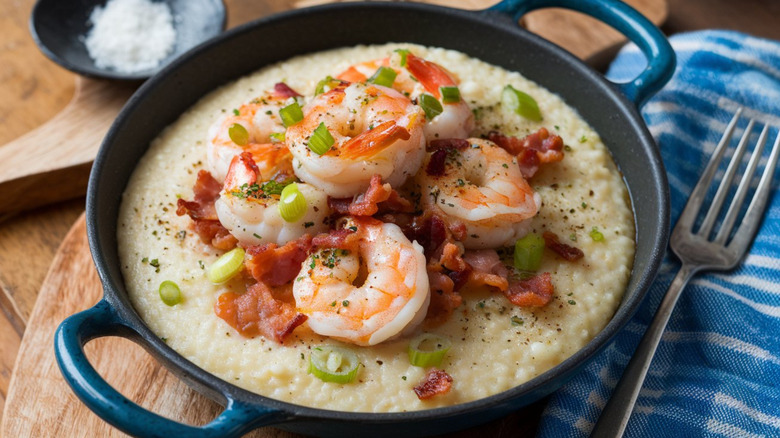
Few people outside the United States — or even the South for that matter — really understand what grits are. The name alone confounds many people. As one British YouTuber said, "Even the word grits sounds like ... gravel." For some people, their only frame of reference is the movie "My Cousin Vinny," but beyond that, they're not sure what grits are made of, what they taste like, whether they're supposed to be sweet or savory, or even what time of day they're typically eaten.
Despite the fact that grits might not be very well-known outside of America, they're actually one of the country's oldest dishes. Native American tribes have a long history of grinding maize and boiling it. When European colonists arrived and encountered the dish, they called it grits, which means "coarse meal." Grits became a staple in the South because they were easy to store, simple to make, cheap, and versatile.
Some people compare grits to polenta, but there are a few differences between the two. For one, polenta is made with ground flint corn, while grits are made with ground white or yellow corn or hominy. In addition, grits tend to have a creamier texture than polenta if cooked properly and more corn flavor. And while many are right in assuming that grits can be bland like porridge, they're often jazzed up with ingredients like butter, stock, cream, and cheese. Grits can be savory or sweet, eaten any time of day, and paired with a variety of toppings, including shrimp, bacon, eggs, and fried fish.
7. American cheese
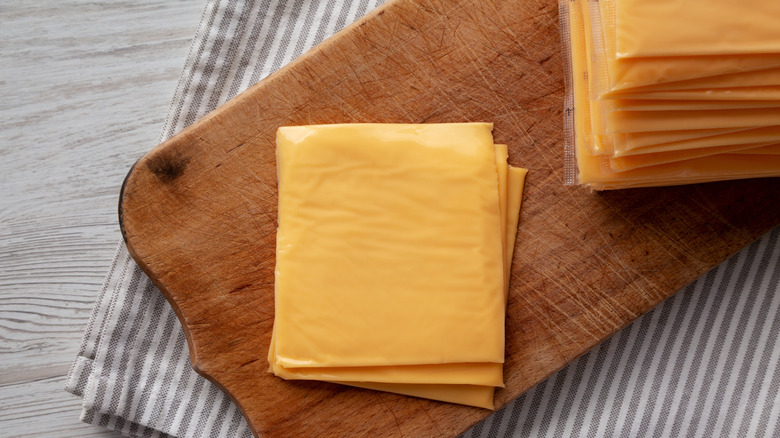
Scroll through Reddit threads about American foods that people find weird and American cheese will almost always make the list. This includes both the processed orange cheese slices that come individually wrapped in plastic and Cheez Whiz. And, of course, spray-can cheese is absolutely horrifying to many. Adjectives used to describe the products include "artificial" and "soft cardboard." One Reddit user even called American cheese "an abomination and an affront to nature itself."
The processed cheese that's so maligned by many was invented in the early 1900s by James Lewis Kraft, a Canadian who immigrated to Chicago. His goal was to make cheese that would keep indefinitely without spoiling, and the result was processed American cheese. Cheez Whiz was also a Kraft invention. In 1965, Nabisco unleashed Snack Mates canned cheese on the world. The name changed to Easy Cheese after Nabisco sold the brand to Kraft in the 1980s.
Like many Americans, I grew up eating Kraft cheese slices on burgers, in sandwiches, and even as a snack on their own. Sure, there's not enough actual cheese in the product to legally call it cheese, but the slices are great when you need something that's quick, easy, and melts like a dream. And while Cheez Whiz and spray cheese may be unappealing to many, they do have their fair share of fans. It's just a shame that the processed stuff gives American cheese a bad name, since places like Wisconsin turn out world-class cheeses that often win international awards.
8. Biscuits and gravy
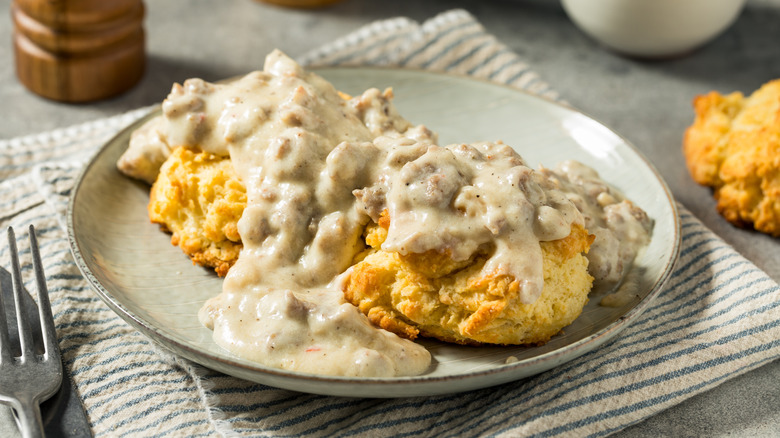
Nothing says breakfast comfort food in the American South quite like biscuits and gravy. Even outside the Southern states, the dish is well loved for its hearty mix of soft, flaky biscuits smothered in a rich, creamy gravy. But for some people outside the U.S., the dish looks and sounds like a disaster. A lot of that comes down to semantics and cultural expectations about what constitutes breakfast.
The first problem that people from other countries often get stuck on with biscuits and gravy is the "biscuits" part. In places like the U.K. and Australia, biscuits refer to cookies. Therefore, it sounds appalling to slather savory gravy over sweet cookies. American biscuits are typically made with flour, lard, and baking powder, so they're not exactly sweet. But to many outsiders, they're pretty similar to scones, which are typically eaten with sweet ingredients like jam and clotted cream.
Then there is the gravy, which many people assume can only be the brown variety made with the drippings of animal fat and stock or broth. However, biscuits in America are typically served with a white gravy that's often made by cooking sausages, stirring flour in to create a roux, then adding milk and cooking it until the gravy is thick and creamy. For the uninitiated, the sight of crumbly scone-like biscuits smothered in creamy white gravy may be a shock to the senses. However, once they try it, many people become instant converts.
9. Corn dogs

Corn dogs may just be the perfect fairground food. They're easy to make, and simple to eat on the go. You'd be hard pressed to visit a fair in the United States or Canada and not see them being sold at concession stands. But many people from other countries aren't sure exactly what a corn dog is. The concept is pretty simple: a hot dog skewered on stick, dipped in cornmeal batter, and deep-fried.
The origins of the corn dog are a little murky. Many sources suggest the birthplace was a hot dog stand in Oregon called Pronto Pup. The story goes that a batch of hot dog buns was ruined in the rain one day, so owners George and Versa Boyington improvised with cornmeal batter. They introduced their treats at a livestock exposition in 1941, and the snacks were a hit. However, some say there is evidence that corn dogs were around prior to that in places like Texas, Oklahoma, and New York.
While some people might not be familiar with the name "corn dog," they may have something similar in their home countries. You can find battered sausages at some chip shops in the U.K., as well as street food stands in Argentina, where they go by the name "panchukers." In Canada, corndogs are often called Pogos, and Australians call them Dagwood dogs, dippy dogs, and Pluto Pups. Some say that Korea has perfected corn dogs by using sweet and savory batters and adding ingredients like cheese, dried ramen noodles, and sweet potatoes.
10. S'mores
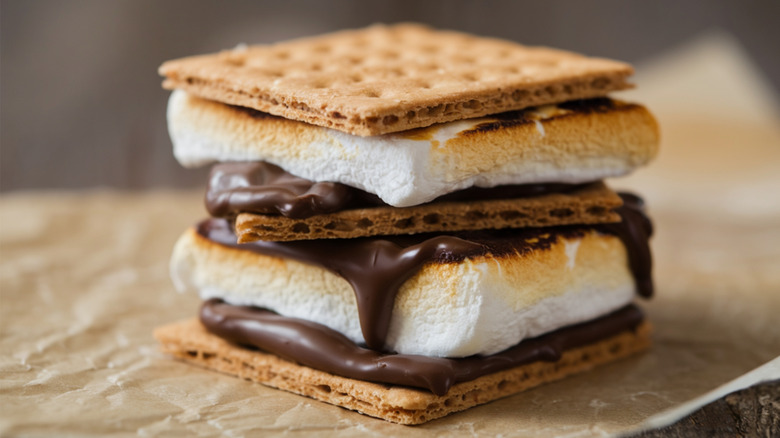
S'mores are so tied to American and Canadian camping culture that it's hard to imagine sitting around a campfire without them. Part of the appeal is they're fun to make. You skewer a marshmallow on a stick, roast it over the fire until it's charred and melty, then sandwich it between two graham crackers with a piece of chocolate bar (usually Hershey's). You can also get creative and add fun ingredients to s'mores like fruit and Nutella. Try explaining s'mores abroad, though, and you'll probably get some blank stares and possibly even a grimace or two.
One of the reasons that s'mores have never really taken off in other countries is that graham crackers aren't widely available outside North America. In places like Europe or Asia, you won't find them in grocery stores, which makes the whole recipe impossible to pull off as intended. People might try to substitute with plain biscuits or digestive cookies, but it's not quite the same thing as the slightly sweet, crumbly crackers made with graham flour.
Even when people do manage to recreate s'mores, the flavor doesn't always win them over. One Reddit user said, "I find them absolutely disgusting and way too sweet. Combined with the sugar from the graham crackers, marshmallows, and presumably Hershey's chocolate (which, let's be real, isn't chocolate), it's just a sugar bomb." Some even take it a step further and say that Hershey's chocolate tastes like vomit thanks to the presence of butyric acid in the chocolate, and that certainly doesn't do s'mores any favors.