

15 Kitchen Design Trends From The '80s That Still Hold Up Today
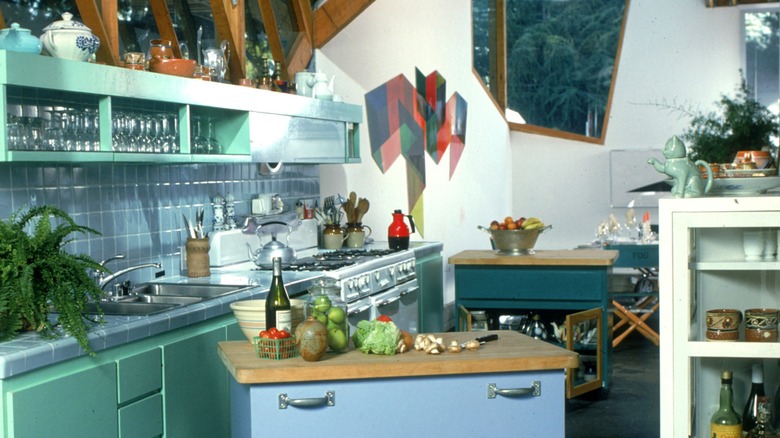
Say what you will about feathered hair and polyester leisure suits, but the interior decor of the '80s left a lasting impression — especially in the kitchen. Not only do many defining elements of the '80s kitchen hold up today, but they're having a real moment. We talked to a handful of interior designers and other design experts about what they're seeing make a comeback, and we discovered which trends of the decade have real staying power.
"Design always cycles, but I think the resurgence of '80s elements is partly a reaction to years of all-white, minimalist kitchens," Brad Thornton, founder and lead designer at Thornton Projects, exclusively tells Chowhound. "People crave warmth and personality." Preston Butler of Butler Lighting agrees. "Styles always seem to circle back after 30 or 40 years," Butler tells Chowhound. "The '80s mixed a lot of fun and creativity with practical design, and that's appealing when you've seen nothing but plain white kitchens for the last decade." All this to say, we are pleased to inform you that the sterile white and greige nightmare of the last decade may be dead. Long live the '80s!
1. Open-plan kitchens
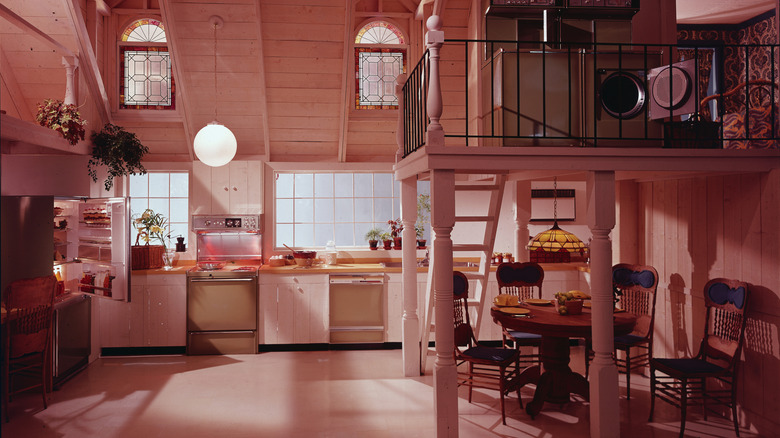
If we look at the big picture, the '80s was about celebration and wealth — excess even. What better way to celebrate the ethos of the decade than with a space that encourages togetherness and social gatherings? Enter the open-plan kitchen. The closed-off work spaces of earlier decades, which kept heat, noise, and kitchen smells contained, gave way to open floor plans that merged the kitchen with living or dining rooms. Starting in the 1950s with Frank Lloyd Wright's home designs, the kitchen had evolved into a more integrated part of the household — perhaps even its hub and center. While the trend emerged in the 1950's, it took home construction some years to catch up. These days, it's unusual to see a modern home layout without an open floor plan. "The open-plan kitchen isn't going anywhere," says Preston Butler. "It started gaining steam in the '80s when folks began treating the kitchen like part of the living space instead of a closed-off room." It's the details, however, that set the '80s kitchen — and its resurgence — apart.
2. The kitchen work triangle
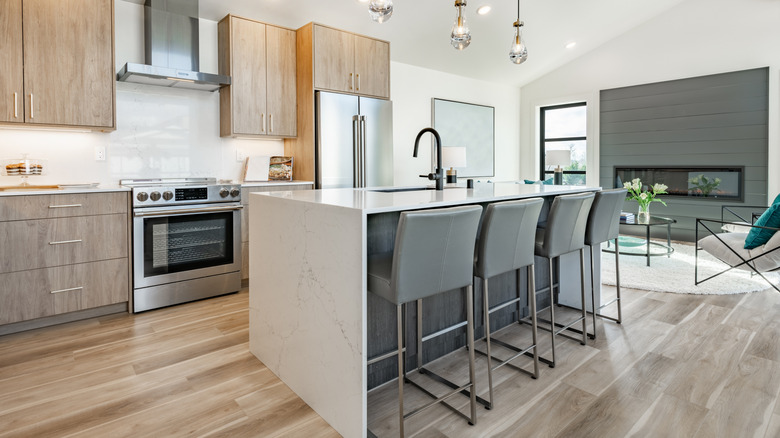
Any good chef will tell you one of their most important parts of their job is economy of movement. This means being efficient with their own body and not repeating trips or motions unnecessarily. But having a kitchen layout that maximizes efficiency is also critical, even at home. The '80s ushered in the rise of the kitchen triangle design: having the refrigerator, stove, and sink laid out in a triangle formation to reduce walking distances between "zones" of the kitchen.
"The efficiency of the work triangle was huge in the '80s, and for good reason. Keeping the refrigerator, sink, and stove in close proximity allows for easy movement while cooking," Brad Thornton explains. "Even as kitchens have evolved into more social, open spaces, that core principle of thoughtful workflow is the difference between a kitchen that's beautiful and one that's a pleasure to use," he continued.
Matthew Coates, president and principal architect of Coates Design Architects + Interiors, echoes this. He tells Chowhound, "Something that has stood the test of time is the idea of breaking a kitchen up into real, working 'zones,'" adding that the kitchen triangle was central to this setup, "with added little treats such as a desk area or a 'breakfast bar.'"
3. Glossy finishes
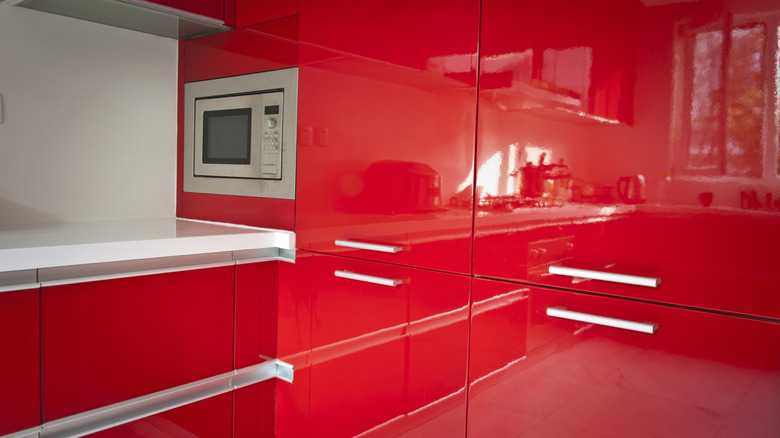
The '80s were also a time of glitz and opulence, and shiny surfaces were everywhere, from glass tops to gold bathroom fixtures. Glossy finishes came on everything from flat-pack furniture to lacquer dining sets to laminate surfaces. According to Preston Butler, though, gloss has gotten a refresh. "Glossy finishes have a place too, as long as they're done right," he says. "The new versions are tougher and less flashy than the old stuff, but they still give cabinets that clean, light-catching look."
Pairing gloss with matte finish also offers an eye-catching pairing, says Matthew Coates. "The contrast was delicious then and it still is." Think glossy slab cabinets with light wood framing; shiny subway tile backsplashes against melamine countertops; or a shiny dining set against soft, matte carpeting — even etched mirrors showcase the concept on a small scale. According to Interior designer Andrea Sinkin of Andrea Sinkin Design, customers are embracing the trend. "Glossy white cabinets that were a trend in the '80's are back for modern and minimal kitchen design — it's sleek, easy to care for, and very neutral," she tells Chowhound.
4. Wood cabinets
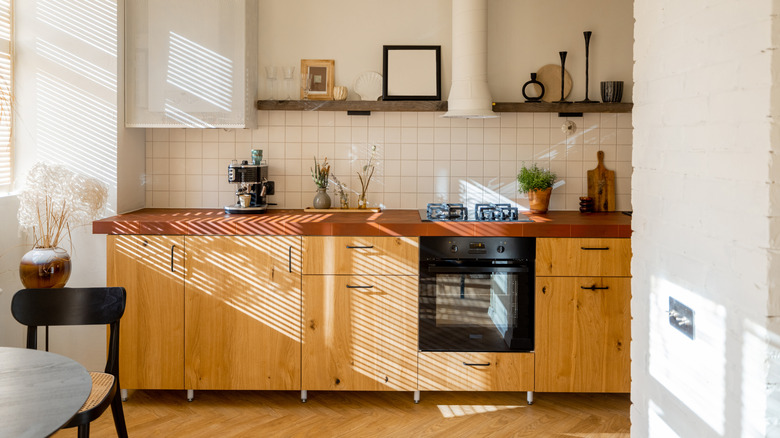
Among all our other trends, experts agree most on one feature of '80s kitchens that's stuck around and has even made a recent resurgence: natural wood cabinets, especially oak. We're not talking about that scourge on almost every rental property you've ever set foot in – those clunky honey oak cabinets that give "landlord special" a new meaning. No, this time around, wooden cabinets are chic and customizable.
Thomas Borcherding, owner and lead designer at Homestar Design Remodel, agrees: "Oak is becoming increasingly sought after." According to Borcherding, clients gravitate toward the appeal of wood grain and oak's affordability. "Oak is the least expensive species of wood that my cabinetry manufacturer offers. With the soaring cost of remodels, this matters a lot." He acknowledges that, "Oak as a material has been tainted by the less than flattering yellow stains commonly paired with it," but he adds that today's cabinets have more contemporary stains and finishes. This makes it so much easier to clean sticky or grimy wooden cabinets.
Brad Thornton tells Chowhound that he even likes a warm finish: "I love the unapologetic use of warm wood cabinets — especially rich walnut and oak — paired with deep, saturated colors." Matthew Coates, on the other hand, would go for walnut or rift-sawn white oak.
5. Slab-front and Euro-style cabinetry
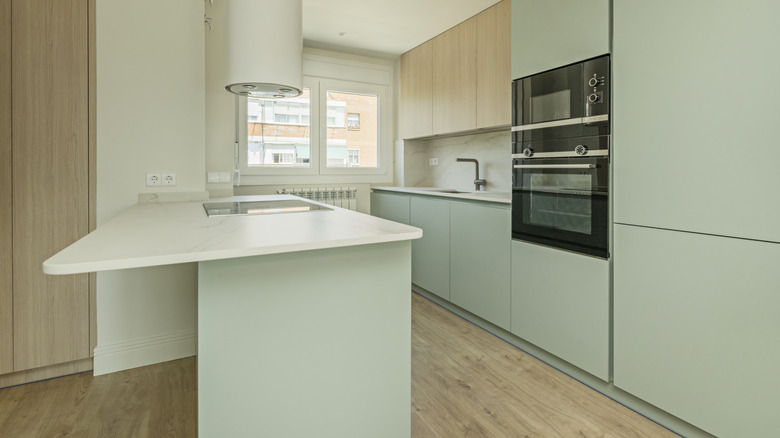
Move over shaker and craftsman-style –- simpler times have returned to kitchen cabinet fronts. Slab-front cabinetry is just that: a flat pane with no bells and whistles. With no adornments or raised details, these surfaces create a clean, unified look to go with the utilitarian kitchen triangle. Not to mention, they're much easier to clean. They're traditionally associated with frameless Euro-style cabinetry and flat pack furniture, and they come in many forms. Matthew Coates points to "slab-front cabinetry in dramatic veneers," and others mention the high-gloss finish. Then there are the white-and-wood melamine cabinets that every DIY-er was so busy replacing and painting over in the last decade. We're here to tell you they are very much making a comeback. Slab cabinets create an uninterrupted, smooth wall of storage and lend an air of timelessness to any kitchen — or a blank slate you can pair with other opulent '80s details.
"Frameless, modular cabinets weren't just a style choice; they gave you more storage and cleaner lines that feel right even now. Full-height pullouts saved you from crawling into dark cabinet corners," Judi Cooper, principal interior designer at Kitchens Inside Out, tells Chowhound.
6. Big islands and peninsulas
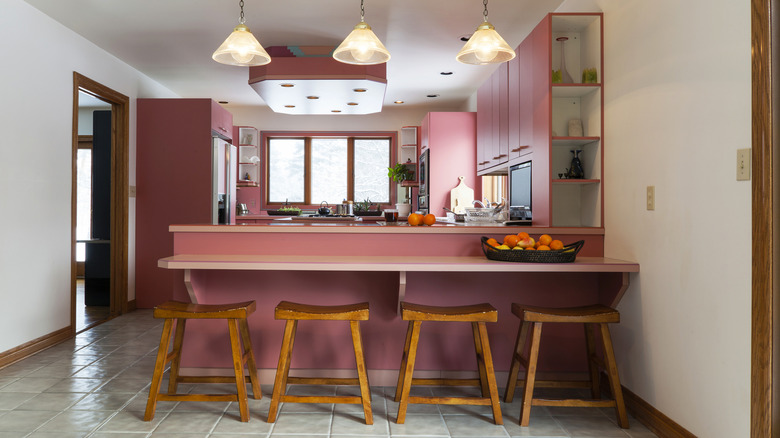
Large kitchen islands and peninsulas are already a staple of modern interior design that go hand in hand with the open-plan kitchen. The kitchen island or peninsula offers a focal point to family time or social gatherings that can tie together a sprawling kitchen-living space area. "Big islands and peninsulas weren't just for cooking," says Preston Butler, "they were for serving food, hanging out, and talking while you worked. That setup still makes sense today because it keeps people connected instead of stuck in separate rooms."
Andrea Sinkin concurs with this point: "There were a lot of columns and '80s designs inspired by Greek and Roman design — these would often frame an open kitchen to divide it visually from the living area." Sinkin also points out the double-height island, a two-tier surface that could further define the kitchen and living areas, while lending a sense of luxury. Think one side for food prep and the other for seating or casual dining. Islands and peninsulas also provide plenty of storage and counter space — a must-have for cluttered households.
7. Asymmetric shelving
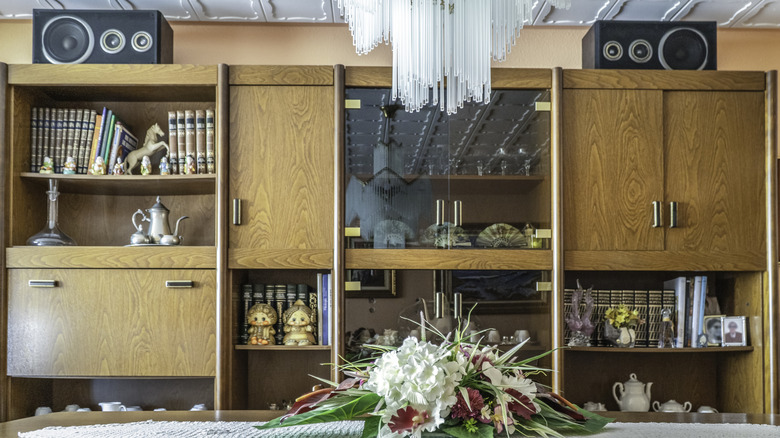
Apart from opulence and efficiency, the '80s were a time of quirky, modernist shapes: oversized details, wiggles, dots, and curves. Think Memphis design, partially a reaction to the sleek, austere lines and seriousness of midcentury modern design norms. These designers harnessed inexpensive materials, bright primary colors, and cheeky, sometimes impractical shapes to make a statement. Their shelves were no exception: triangles, diagonals, wild patterns, and multiple colors made a strong statement.
Thomas Borcherding says asymmetric shelving was among the elements he loves bringing back from the '80s. And although you may not be able to balance plates on a diagonal shelf, there are other ways to incorporate the unexpected into shelving. For instance, consider shelves on one side of a kitchen or dining room, scattered floating shelves that don't follow a pattern, or a bookcase broken up into uneven compartments for some visual interest.
8. Geometric tile
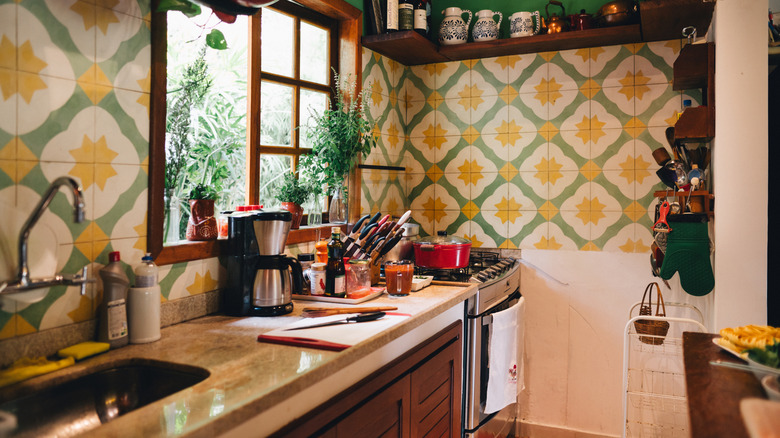
Dive into an old home decor book and you'll find that many 1980s spaces leaned hard into a "more is more" aesthetic: wild patterns, unexpected shapes, and contrasting textures. Geometric tiles were the epitome of this aesthetic, and you could find them in floors, on walls, and yes, friends, even on a tile kitchen countertop. While many home renovators make a beeline for tile countertops, hammers in hand, others are giving wild tile countertops a try. The shine and pattern can add a welcome contrast in the kitchen, and they're a surprisingly versatile (no pun intended) and resilient material. But if you're not ready for wiping down that grout yet, a tile backsplash can be the perfect spot to make a bold statement with loud shapes: checker patterns, triangles, art deco-inspired sunbursts. "Geometric tile and unapologetically bold colors are creeping back into my projects," says Thomas Borcherding, and there are infinite ways to customize. A geometric tile kitchen floor can look more modern and maximalist than ever with the rest of the kitchen balanced to your taste and style.
9. Unexpected color pairings
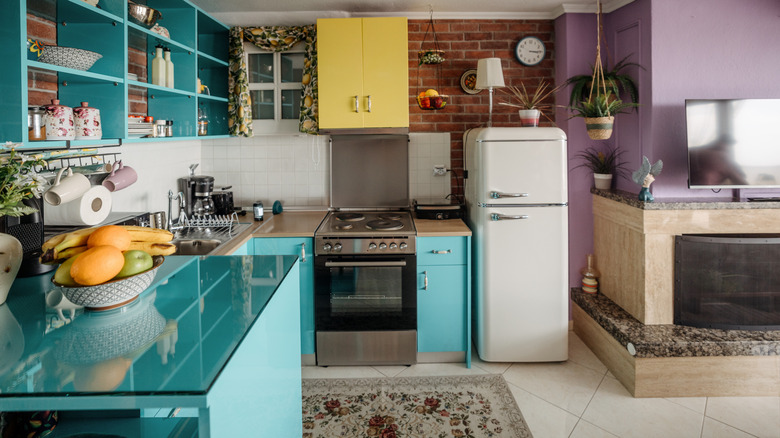
The 1980's were unafraid of a crazy color combination (Memphis design, anyone?) and a hue bumped up to 11. While you may not be ready to embrace wall-to-wall emerald green carpets, for example, saturated colors can look beautiful in small doses (think lighting, cabinet hardware, wall trim, dishes, and accents) or in big ones, like kitchen cabinets all in one hue.
The '80s were all about unexpected color pairings, too. "Color blocking is back," Preston Butler says. "Bold colors against neutrals, or even strong colors against each other, can make a backsplash or a set of cabinets stand out without taking over the whole space." Kitchens had bursts of color in the most unexpected of places — curtains on kitchen windows but also on ceilings or the edges of shelves. According to Brad Thornton, though, modern designers know when to hold back. "We're reinterpreting those hallmarks with a lighter hand: keeping the richness of wood but refining the profiles, embracing bold color but with more nuanced palettes that can feel fresh," says Thornton.
10. Mixed materials
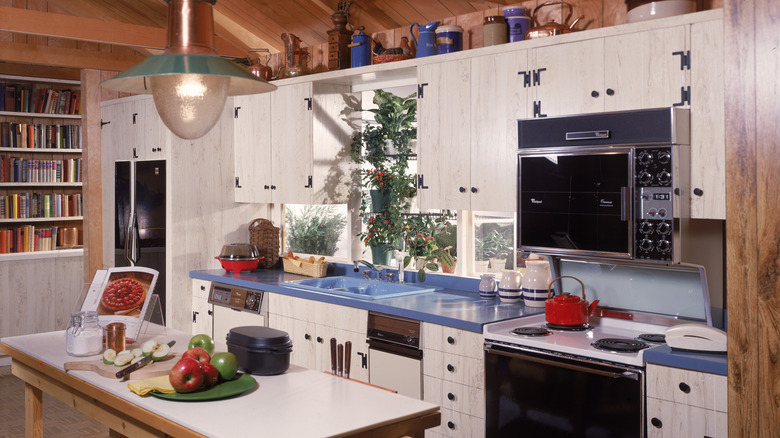
The 1980s were also known for their mashup of materials that often somehow worked, and it's a part of kitchen design that has stuck around. According to Matthew Coates, "the '80s were completely unapologetic about mixing up materials ... just anything goes kind of attitude ... metal and wood, glass and stone." Think tessellated stone tables with glass tops, wooden cabinets with chrome-trimmed appliances and tile floors. Today, mixing materials is still very much alive and well, though Andrea Sinkin says updated materials have been exchanged for more dated ones. You can even mix and match kitchen countertop materials.
"Now we look back on what worked and what feels familiar [in the '80s] but we update with new shapes, colors, and special details," Sinkin explains. "Like in the '80's we did a lot of glass front cabinets, but now we do them with antiqued mirrors, metal mesh, and glass fronts as well for display." A number of designers mentioned brass and chrome. "Chrome finishes are still a solid move in small doses — on a faucet, a shelf bracket, or a thin toe-kick reveal," adds Judi Cooper.
11. Pastels
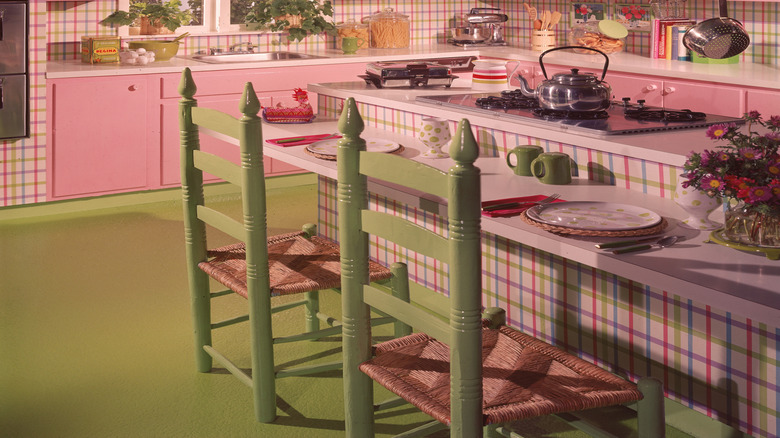
A counterweight to the minimal, all-white modular kitchen or the chrome-and-leather bachelor pad look of the '80s was the pastel explosion. Pastels have been on the upswing in modern kitchens, too, but they still have nothing on the all-pink laminate-and-tile masterpieces of the '80s, complete with almond and off-white appliances. But Thomas Borcherding says, "Color-wise, soft pastels paired with saturated accents feel just as fresh today as they did in 1985." HIs favored pastels are cobalt blues, soft pinks, and mint greens. "They have that '80s energy, but today's versions are more refined and easier to live with long term," he explains.
Alhough '80's pastels are often associated with bathrooms (those pink swans!), try a saturated eggplant drawer pull on a lavender drawer, or a jewel toned floor mat on pastel tiles. No one said a pastel kitchen couldn't also be a chef's utilitarian dream, either. According to Matthew Coates, "Even though the hues of the era were vibrant and rich in pastels, the layouts were generally rather sensible, and that holds true today too."
12. Integrated lighting
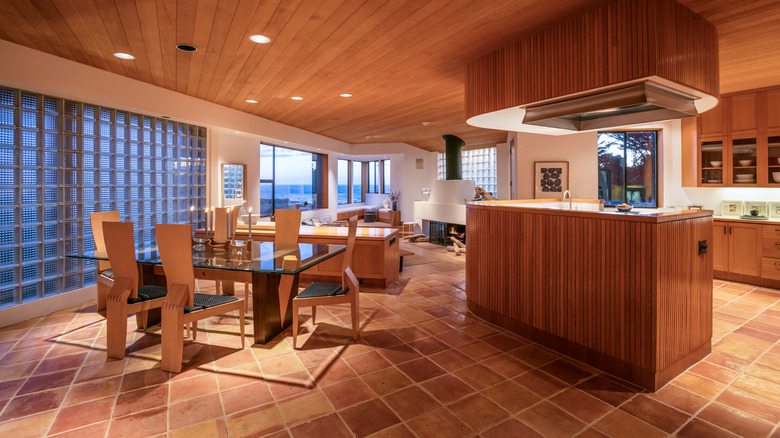
There's something about recessed lighting glinting off polished, dark surfaces that harkens back to those bachelor pads of the '80s. This era was chock full of new lighting concepts, shapes, and builds, and while today we just can't seem to escape the boob light, a strip of under-cabinet lighting can still create quite a moody atmosphere. True to '80s form, the ethos of integrated lighting can be as functional as it is fashionable — especially today. It can optimize space and blend seamlessly into a ceiling, leaving room for other decor, with no visible wires or fixtures.
Of under-cabinet lighting, Matthew Coates says, "Back then it was fluorescent and stuttering, but now it's LED and gorgeous." You're likely to get a lot more mileage out of your LED lights, and they're perfect in the kitchen for a late night glass of water or a movie night in. Preston Butler agrees: "Integrated lighting started showing up more in the '80s, and it's even better now. Under-cabinet strips, small puck lights, and adjustable LEDs make it easy to switch from bright task lighting to softer evening light."
13. Statement lighting
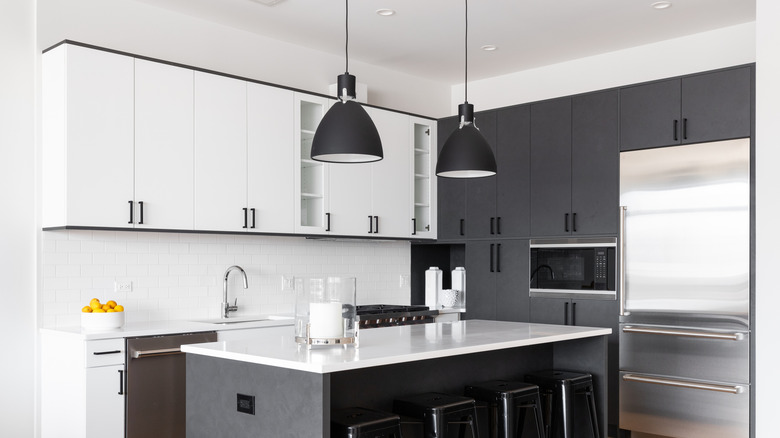
Big pendant lights and statement lights have stuck around kitchens for the long haul. Although though their shapes and profiles may have changed through the decades, they really gained momentum in the '80s. Oversized pendant lighting especially, Brad Thornton says, played into the adventurous geometry of the era. Orbs and discs are some of the best kitchen lighting fixtures inspired by the '80s, and they might just give your kitchen table or island the kick you didn't know it needed.
Statement lighting can also highlight zones for multiple uses, which remains critical to modern living spaces. Kitchens in the '80s even incorporated desks into kitchens or had TVs built into walls. While we may not go that far today (maybe we should, though), lighting can still do more than just illuminate, particularly with the elegant and low-effort layer lighting kitchen trend. As Judi Cooper explains, "The decade's obsession with layered lighting still makes sense: Start with ambient light to fill the room, add task lighting where you work, and finish with accents that add energy to the room."
14. Curves and waterfalls
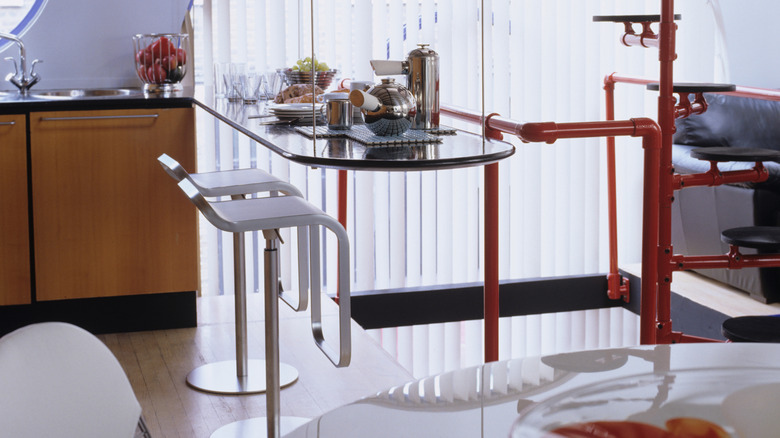
For a time in the early '90s to late 2010s, most rooms in the house sported 90-degree angles as far as the eye could see. During the recent midcentury modern revival, sofas' rounded edges mostly turned square; laptops and PC's un-bubbled, counter and desk edges sharpened, and chair legs narrowed. Thankfully, curves and rounded corners in all their inviting, organic glory have made a triumphant return — and it's one trend you're not likely to have missed in recent years. See: wiggle mirrors, curvy sofas all over the place, and those tufted wavy rugs.
In the kitchen, the curve can take on many forms, but designers pointed to the most elemental. "Curves in cabinets or island corners can take the edge off a space," Preston Butler tells Chowhound. "It makes the kitchen feel more comfortable while still looking modern." Thomas Borcherding mentions the waterfall counter and notes that rounded elements feel "fresh and timeless" in natural wood and stone. "How many kitchens do you encounter that feature prominent rounded design accents as opposed to 90-degree corners?" asks Borcherding pointedly. Judi Cooper adds, "Rounded island corners and bullnose counters soften the hard edges and make the room feel like it's ready for company."
15. Chunky or integrated hardware
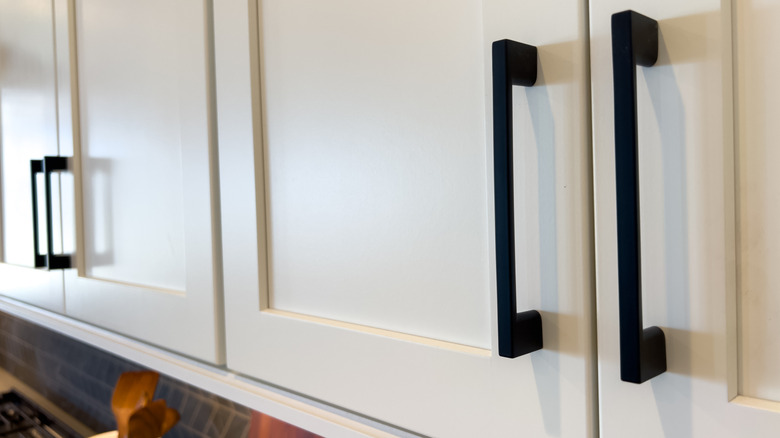
It's all too easy to skip over furniture hardware and pulls, but a bad drawer handle is an overlooked cabinet fix that can boost your kitchen's style. The '80s prized minimalist hardware on kitchen cabinets and drawers, but the material and color were often a study in contrast, like bright white knobs on light wood cabinets. Designers still use "chunky hardware and drawer pulls," Matthew Coates tells Chowhound. "Those huge tubular pulls still look great when done in matte black or brass." And Brad Thornton shares that "chunky integrated pulls" were an exciting part of bringing back '80s geometry.
You'll notice a lot of '80s interior kitchen design had no handles — cabinets might have had full width finger pulls, cutouts, or hardwood finger pulls, while hardware and pulls that protruded made a statement. Another handy storage holdover included full height pullouts, Judi Cooper tells Chowhound, which "saved you from crawling into dark cabinet corners." Ultimately, Cooper says, "Elements of the 80's are finding their way back into the kitchen because people are ready for more strong shapes, unapologetic color blocks, and playful details in their homes."