

We Compared 9 NA Beers To Their Full ABV Counterparts
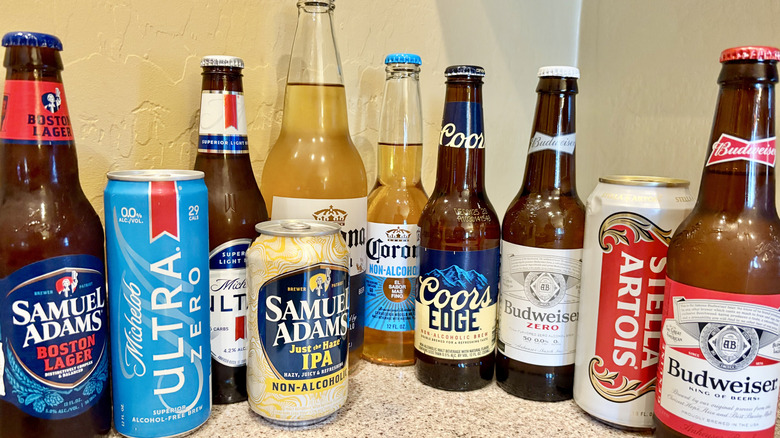
The list of non-alcoholic versions of popular beers continues to grow, which is great for people who love the taste of beer but could do without the liquor. Gone are the days where your only choice was O'Douls (or going to a specialty liquor store). Now, there's a range of options out there on typical grocery store shelves, from lagers and light beers to dark beers and IPAs. And while non-alcoholic beer is oftentimes more expensive than ABV beer, it's always nice to have more to choose from.
But exactly how similar do NA beers (which are different from alcohol-free beers, by the way) actually taste when compared to their alcoholic versions? It turns out it's a real mixed bag. We chose these NA beers based on popularity and availability and tasted them side by side for the most truthful comparison possible. Here's how nine NA beers compare to their full ABV counterparts.
Heineken vs Heineken 0.0
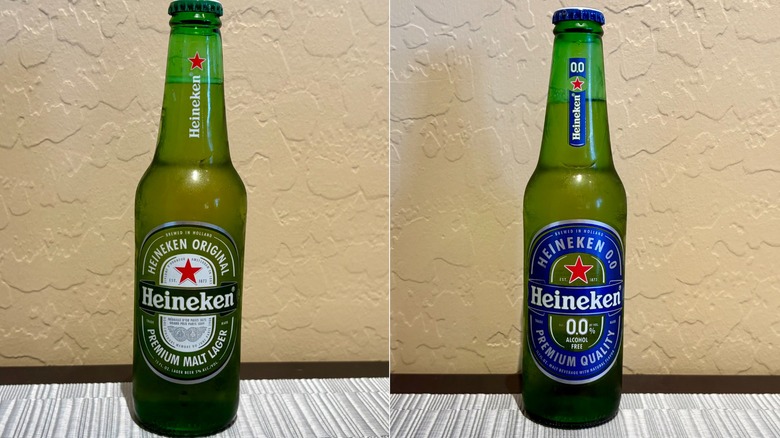
Heineken is a light-tasting beer hailing from the Netherlands, and its non-alcoholic counterpart claims to taste similarly but with 0% alcohol and only 69 calories. After taste-testing both of them at the same time, I can safely say this is actually true. I was sort of astonished by how similar these two beverages were to each other. Had I not known I was drinking Heineken without alcohol, I do not think I would have noticed.
Heineken 0.0 doesn't have as much carbonation and is a bit less refreshing — but only slightly. These two malt beverages taste pretty much the same. Now, Heineken isn't the most complex or greatest-tasting beer in the world, so perhaps my expectations just weren't very high, but I was blown away by how good Heineken 0.0 tasted. However, in a very confusing conclusion to tasting these two beers, I actually liked regular Heineken more than I remembered, and at the same time, I was not really able to tell the difference between the two. Way to go, Heineken 0.0 — you taste just like your ABV counterpart.
Stella Artois vs Stella Artois 0.0
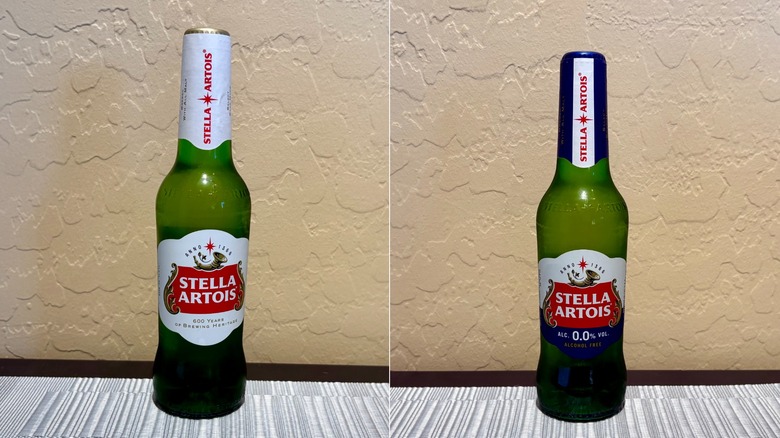
Stella Artois is a clean, crisp beer that is easily drinkable and quite light in body. The brand's non-alcoholic version, Stella Artois 0.0, is said to also have that clean finish and great taste ... but how true is this statement?
Well, in perhaps the best accidental taste test ever, I took a sip of what I thought was regular ABV Stella but was actually Stella Artois 0.0, and I immediately thought, "Something's wrong with this." It was just a little off, and that's because it was actually the non-alcoholic version. It did sort of taste like Stella Artois; it was Stella Artois adjacent, at least. It's just that it also had this really unpleasant aftertaste. And sure, most of the NA beers had an aftertaste, but this one was maybe one of the worst. So, in a blind taste test, Stella Artois 0.0 tastes like an ABV Stella Artois that has gone bad. It was as if a Stella Artois had somehow imploded in its own bottle and formed a new, vaguely similar substance.
Michelob Ultra vs Michelob Ultra Zero
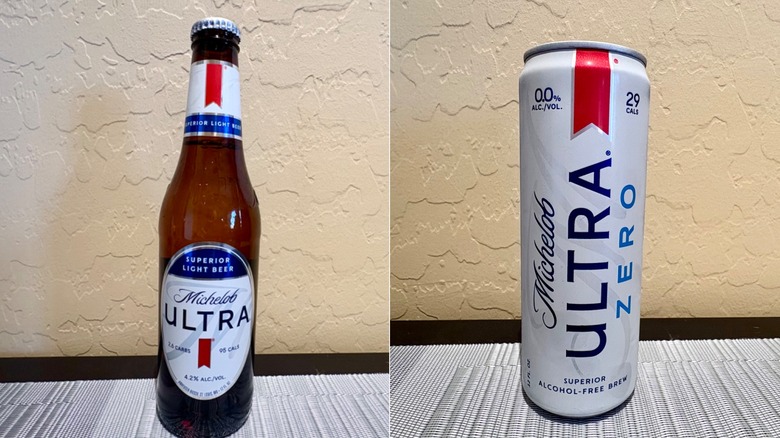
Michelob Ultra is one of the lightest beers out there. To be honest, even the alcoholic version only barely tastes like beer. That's not to say it's not good — it's just an extremely light beer. I wasn't sure how it could possibly get any lighter, but I was curious to find out. And, as it turns out, Michelob Ultra Zero basically tastes exactly like a Michelob Ultra. Well, almost exactly.
If you don't regularly drink Michelob Ultra, you probably wouldn't notice a difference between the two drinks. I asked my brother, a casual fan of Michelob Ultra who barely ever drinks it (or any beer), to taste-test the non-alcoholic version and compare it to its alcoholic counterpart, and he couldn't tell the difference at all. Personally, I drink Michelob Ultra on occasion, and I could tell only the slightest of differences. It was a tiny bit flatter, like perhaps it had maybe been opened and then put back in the fridge for a couple of hours. Michelob Ultra Zero does have more carbs than its alcoholic sibling, but it's slightly lower in calories.
Peroni Nastro Azzurro vs Peroni Nastro Azzurro 0.0
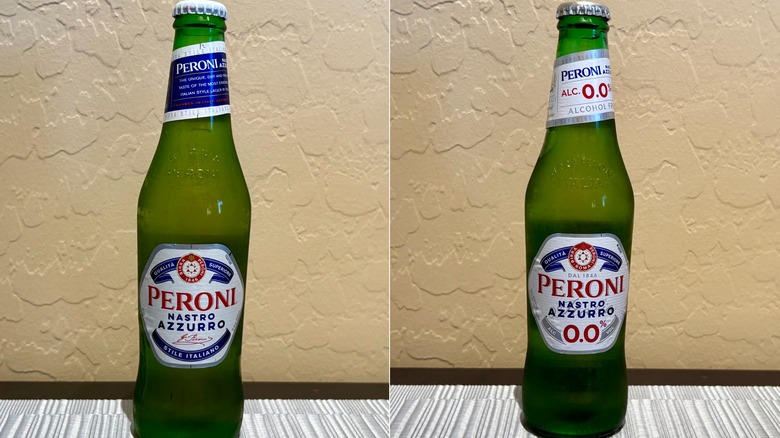
Peroni Nastro Azzurro is an Italian favorite, and it's very light in body, crisp, and clean-tasting. The brand's NA version, Peroni Nastro Azzurro 0.0, also contains ingredients grown in the north of Italy and is advertised as having the same refreshing taste. And this time, it's totally true. Of all the NA beers on this list, Peroni 0.0 tastes pretty much exactly like the full ABV Peroni. The brand has really done it.
If someone were to hand me this NA beer without telling me it was non-alcoholic, I would definitely think I was drinking a regular old Peroni. It's just as refreshing and has that same crispy taste. Sure, it does veer off at the last minute in the direction of that classic NA beer aftertaste, but only slightly. The aftertaste is much less prominent here and almost not noticeable, which is pretty huge for an NA beer. Congratulations to Peroni; it has mastered the non-alcoholic version of its great-tasting beer. I'm shocked and glad to be drinking this.
Corona Extra vs Corona Non-Alcoholic
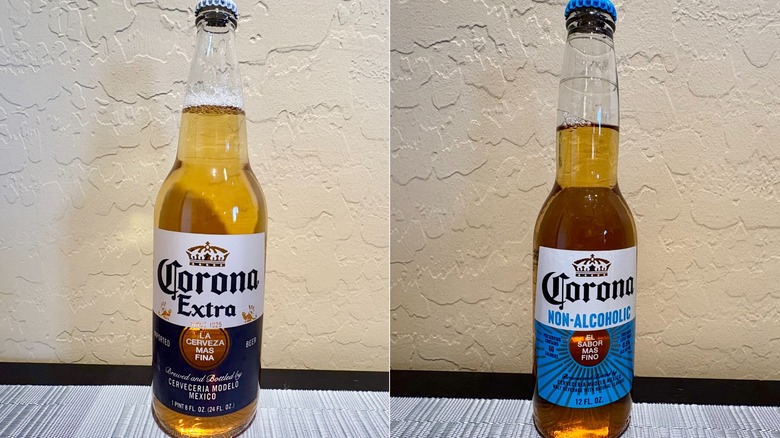
Corona is a popular Mexican lager, with many light variations, such as Corona Light and Corona Premier, that sort of taste like watered-down versions of itself. And despite many people thinking that Corona Non-Alcoholic tastes identical to regular Corona, this was not my experience at all. Sure, Corona Non-Alcoholic vaguely tastes like Corona, but it's very muted and flat flavor-wise (and also carbonation-wise).
Now, the experience might be much different should you add a lime (or 12). This might add the bite I'm looking for when I take a sip of a Corona. But honestly, the first thing that I thought upon tasting this NA beer was, "Against all odds, Corona keeps finding ways to make its lighter beers worse." Unless you absolutely love the taste of Corona variations and would be okay with even the flattest version of it, the best way to drink this beer is most likely to add it to a 4-ingredient Corona sunrise mocktail.
Samuel Adams Boston Lager vs Samuel Adams Just The Haze
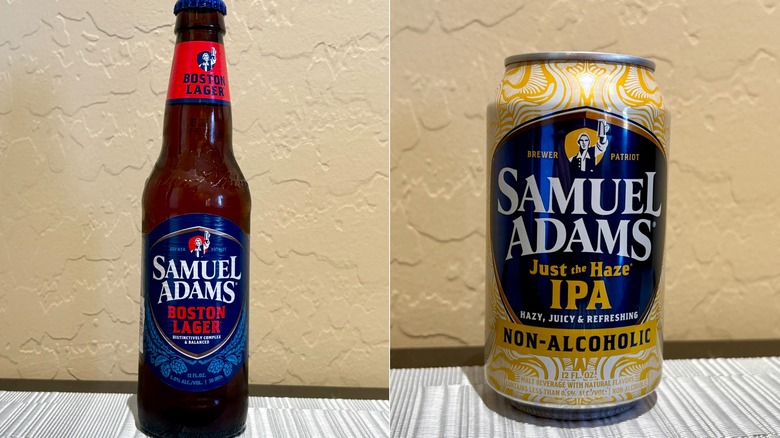
There are many types of Samuel Adams beers, and they're all very flavorful. Boston Lager is the classic choice and most ubiquitous option. It's smooth, bright, and oh-so-easy to drink, with sweet notes of caramel and toffee. So, how does Sam Adams' non-alcoholic option, Just the Haze IPA, compare in terms of flavor?
Honestly, the brand did a good job on this one. Just the Haze IPA tastes exactly like a Samuel Adams beer with alcohol might taste (for the most part). It's hazy just as described. It's definitely one of the more flavorful and complex non-alcoholic beers out there. Most importantly, it tastes like a real IPA. But that's up until that very last second, when the aftertaste swoops in and shouts, "There's no alcohol in this, actually! Here's an unidentifiable final taste." That said, it's still got that light bitterness and great body that an alcohol-added Sam Adams IPA should have, despite being a little juicier than usual. All in all, it's a great non-alcoholic beer for IPA (and Sam Adams) lovers.
Guinness Draught vs Guinness 0
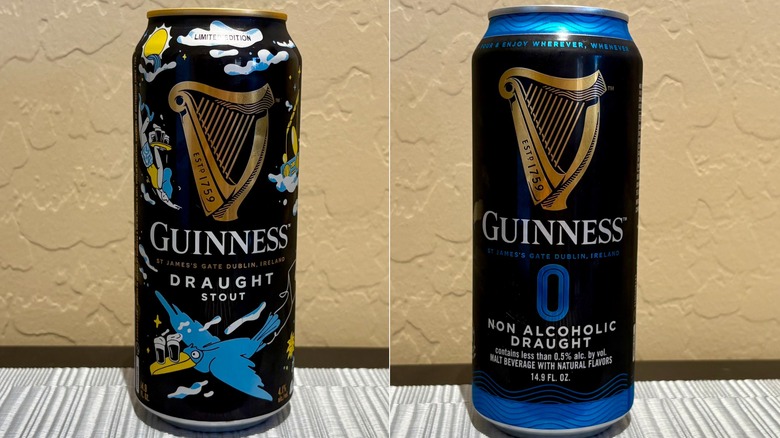
Guinness is the lone dark beer on this list and actually one of the only darker beer brands with a non-alcoholic version available at most grocery stores. Its non-alcoholic counterpart, Guinness 0, claims to have the same smooth taste and dark color of the popular Irish stout. And to be fair, it does have the same hue, and it comes pretty darn close in taste.
Right off the bat, it tastes like Guinness. It's full-bodied, smooth, and certainly one of the better NA mimics. It's not as tasty as a full ABV Guinness and doesn't quite get the flavor perfect, but if you're looking for a non-alcoholic almost-Guinness, you've got yourself a winner here. There is one caveat, unfortunately, and that's that Guinness 0 suffers from the same terrible aftertaste scenario that accompanied a drink of Stella 0.0. You sip it and think, "Oh, this is definitely a Guinness." And then, a moment later, you say, "Hm, there's something wrong with this one." I'd say it's about 90% there (minus that aftertaste), and hey, that's still pretty good.
Budweiser vs Budweiser Zero
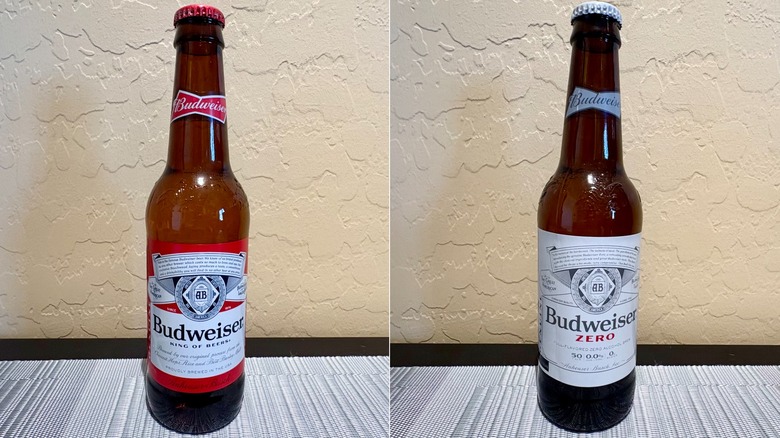
Budweiser doesn't have much going on to begin with. It pretty much tastes like "generic beer," which, to some people, is enough, and all the respect to them. The self-identified "King of Beers" comes in many variations (Bud Light being the worst cheap beer brand out there in our opinion, sorry!), but how similar in taste to Budweiser is Budweiser Zero, the brand's non-alcoholic version?
Upon sipping back and forth, and I do seriously mean this, Budweiser Zero tastes like a regular Budweiser wearing a jacket. It's a muddled, muffled version of its ABV sibling, holding back what little flavor it had to begin with. Budweiser Zero is a flat Budweiser, and for some reason, I liked it better. In a blind taste test, I do not think I'd be able to identify it as Budweiser, but then again, I don't think I'd be able to identify Budweiser as Budweiser. They're essentially the same thing, but one is flatter and more muffled in flavor than the other because it's wearing a jacket. I really can't stress this extremely confusing analogy enough. It's the only sentence that kept running through my mind as I tasted these drinks.
Coors Light vs Coors Edge
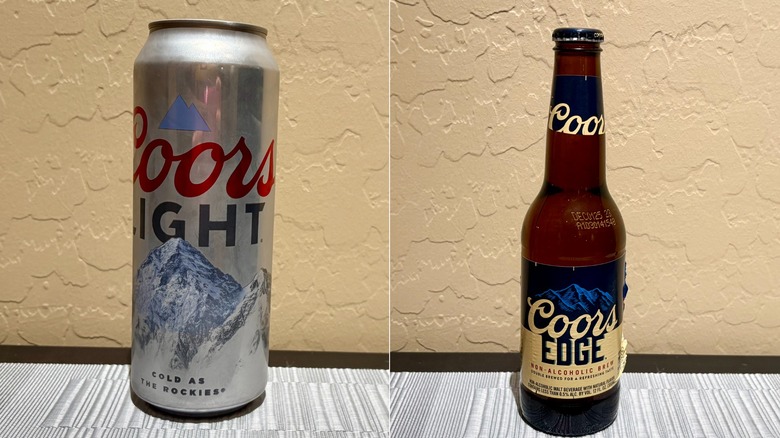
Coors and Coors Light have a distinct taste that can best be described as "college." This is not a critique — the Coors brand is popular, and it's cheap (and there are always ways to make cheap beer taste better). But how does its non-alcoholic version, Coors Edge, compare to the rest of the Coors family?
Coors Edge is a lot like Coors Light on paper. It's also low in calories and carbs, leading one to believe that it would taste similar, and it initially does. When you first take a sip of it, for about half a second, it indeed tastes like a Coors Light. But what happens next is quite confusing.
It immediately falls off a waterfall and, for another moment, vaguely resembles a Coors Banquet. This lasts for but a moment, and then it nosedives again to give you that classic NA "generic beer" aftertaste where it doesn't really taste like anything identifiable. This is not negative. I actually enjoyed Coors Edge, despite it shapeshifting through various Coors tastes and eventually not tasting like Coors at all.
Methodology
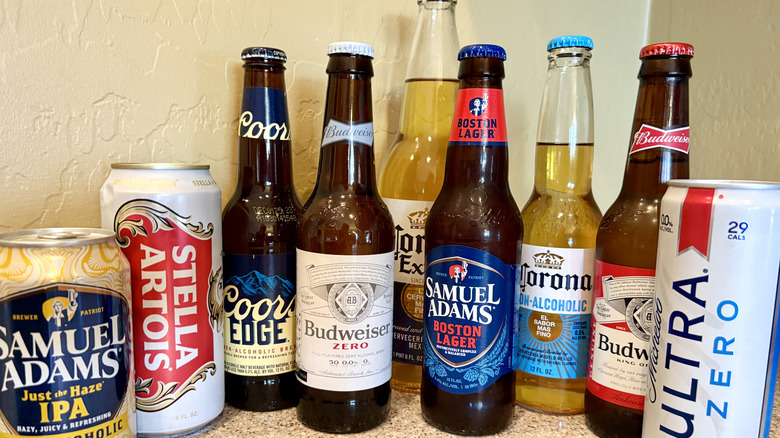
These nine beers and their NA counterparts were chosen based on overall popularity. These are all brands of beer that most people know about and are available pretty much anywhere beer is sold. Each pairing was taste-tested at the same time. I would take a sip of the ABV beer, followed by its NA version, and compare the flavors. Of course, my own taste buds should be taken into account, as not all mouths are the same.