

The Sad Story Behind The McDonald's Brothers
Most of us have never lived in a world without McDonald's. The fast-food chain is not only a dependable place for a quick meal, but also a deeply embedded part of America's cultural history. With its colorful cast of cartoon mascots, valuable Happy Meal toys, and earworm advertising jingles (ask an older relative what's in a Big Mac, and their reply will almost certainly be set to music), McDonald's has not only made itself ubiquitous, but unavoidable. And with restaurants in over 100 countries around the world, McDonald's has become a global icon as well.
The name most commonly linked to the success of McDonald's is Ray Kroc. But while even McDonald's corporate website credits him with building the chain into what it is, he was neither the original founder of the restaurant nor the designer of its game-changing model for producing and delivering food quickly and inexpensively. The credit for these goes to Richard ("Dick") and Maurice ("Mac") McDonald, two New England brothers who had moved to Southern California in search of fame and fortune. But while they built a successful regional chain and transformed the restaurant industry, they never received the public credit – nor the full share of McDonald's profits — that they deserved. Here is the bittersweet story of the unsung fathers of fast food.
Their father's financial struggles gave them an entrepreneurial streak
When the McDonald brothers set out to make their way in the world, they didn't have a grand vision for a restaurant empire. Their driving goal was to avoid the sad fate of their father: A loyal employee of a shoe factory for 42 years, he had worked his way up to foreman before being abruptly fired for being too old. This was not only a devastating shock to him, but also to his two sons. The brothers realized the only way to avoid a similar future was to take full control over their own careers.
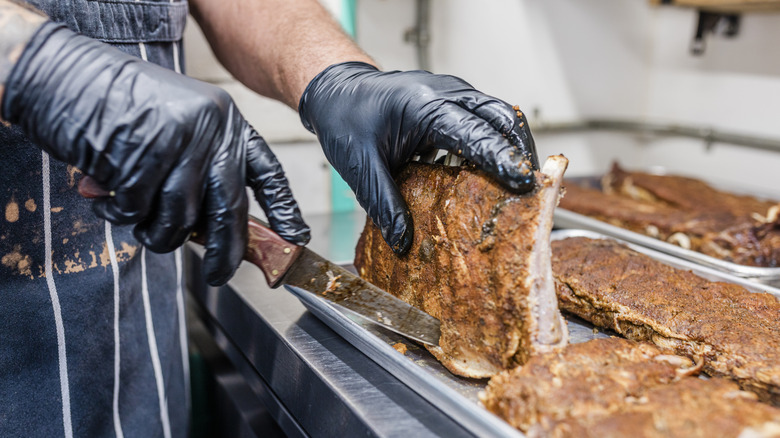
They set their sights on life in California, with older brother Maurice heading out first and Richard following him a few years later. Ever resourceful, they started and ran several businesses before settling on the streamlined hamburger concept that would become today's McDonald's. They had a natural instinct for efficiency and were quick to jettison ideas that didn't work and lean into things that did. For instance, the very first McDonald's started as a barbecue joint and pivoted to hamburgers when they realized that their simple, classic burgers were their best-selling item. But throughout their careers, financial security, not world domination, was their priority. They even turned down a partnership with Carnation that would have taken their regional chain national. "We are going to be on the road all the time, in motels, looking for locations, finding managers," Maurice told Richard. "I can see just one hell of a headache if we go into that type of chain."
The brothers had dreamed of a fortune in the film industry

The McDonald brothers weren't originally drawn to Southern California by the prospect of flipping burgers. Like many ambitious young people during the 1920s, they were drawn by the promise of the new and growing film industry. And it didn't take long for them to find work — both soon obtained steady jobs at Columbia Movie Studios. But like most entry-level jobs, their gigs were grueling and poorly compensated; even then, $25 a week didn't go far. Even worse, the brothers found no opportunities for advancement. If there was a way to move up from hauling sets and lights to directing and producing, they never figured it out.
Cutting their losses, they shifted their focus and opened a movie theater. This, they thought, would allow them to stay involved in film while keeping control over their professional lives. But while their theater was in an attractive area that should have garnered a lot of customers, they didn't count on a huge obstacle: the Great Depression. Would-be moviegoers were pinching pennies, and after seven years of struggling to stay afloat, the brothers closed the theater. The only business in the area that seemed to be thriving, they noticed, was a root beer stand. This inspired their next professional pivot.
They ran other restaurants before landing on their burger concept
Financially drained after the closure of their theater, the McDonald brothers had to launch their next business – a modest, open-air hot dog stand — on a shoestring. They built the stand themselves and purchased windfall oranges at a discount to make fresh juice. Back then, fresh orange juice brands from Southern California's many orchards were a common local refresher. They also made the smart decision to locate their stand near a busy airfield that attracted a steady stream of sightseers who'd regularly stop by for a quick meal during breaks from plane-spotting. (The fact that the airfield was a popular location for film shoots was another draw for the brothers.)
The business thrived, and the brothers decided to expand. Their next restaurant, McDonald's Barbecue, was a drive-in that featured carhop service as well as meaty offerings, such as burgers and pulled pork smoked on-site. For local teenagers, it became the place to see and be seen, and the McDonald brothers started to see real money rolling in. Later, Richard McDonald would credit their success to the brothers' collaborative, flexible working relationship. "If I was around and had to make a decision, I never said, 'I've got to wait for my brother to get back and discuss it with him.' He did the same," he said in an interview with the Chicago Tribune. "You make a bad decision, no big deal – you just try to make the next one right."
Their architect hated Richard's idea for golden arches
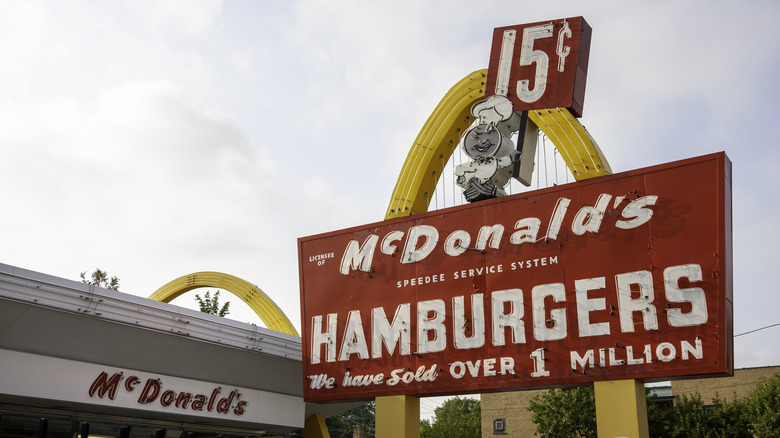
While the McDonald brothers' drive-in was thriving, they couldn't help noticing its inefficiencies, such as high staff turnover and the ongoing cost of replacing broken dishes. They took the radical step of closing it down and rebooting it as a quick-serve, counter-service-only takeout. They trimmed the menu to a short list of premade popular items, such as burgers, switched out glasses for paper cups, and ditched the carhops for a smaller team that operated like an assembly line, cooking food, assembling orders, and serving customers. This new high-volume, low-cost format not only attracted customers, but also curious would-be restaurateurs eager to learn the McDonald brothers' secrets. Spotting another opportunity, the brothers decided to offer franchises of their restaurant, complete with setup instructions.
The brothers wanted the restaurants in their new chain to stand out, so they hired architect Stanley Meston to create an attention-grabbing design. But the most striking feature of early McDonald's restaurants — a pair of tall, golden arches framing the ends of the building — was Richard McDonald's idea. "I was drawing some sketches late one evening in an effort to give the new building some height because it looked too flat," McDonald recalled. But Meston hated the arches so much he issued an ultimatum: Lose the arches or find another architect. So the brothers did an end run around Meston; they agreed to an archless design and then hired a neon sign manufacturer to install large neon arches post-construction. Along with the old-school fast food logo came a cartoon chef named Speedee, one of the mascots you've probably forgotten about.
Their success caught the eye of traveling salesman Ray Kroc
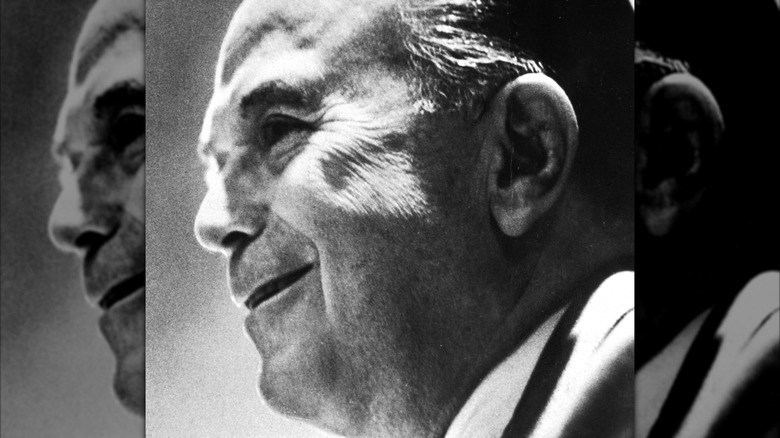
Long before McFlurries became a favorite around the world, milkshakes were the chilly treat of choice at McDonald's. Seeing their popularity among their fast-growing customer base, the efficiency-minded McDonald brothers devised a system to produce a lot of them quickly: They invested in eight Multimixer blenders, each capable of whipping up five milkshakes at a time. The prepared milkshakes held well in the refrigerator, which helped ensure they'd always be available no matter how busy the restaurant got.
This unusual setup caught the attention of Ray Kroc, a Multimixer sales rep. Even busy, high-profile restaurants typically had only one or two Multimixers, and Kroc needed to know why a suburban hamburger stand needed eight (later, 10) of them. Intrigued, he traveled to California to see for himself. Upon arriving in the parking lot shortly before lunchtime, he was greeted by the sight of fast-moving throngs of customers moving up to the counter, each getting their order in mere seconds. Flabbergasted, he asked Richard McDonald when the crowd would die down. "Sometime late tonight," McDonald replied. At that moment, Kroc knew one thing: He wanted a piece of the action.
The brothers had a difficult relationship with Ray Kroc
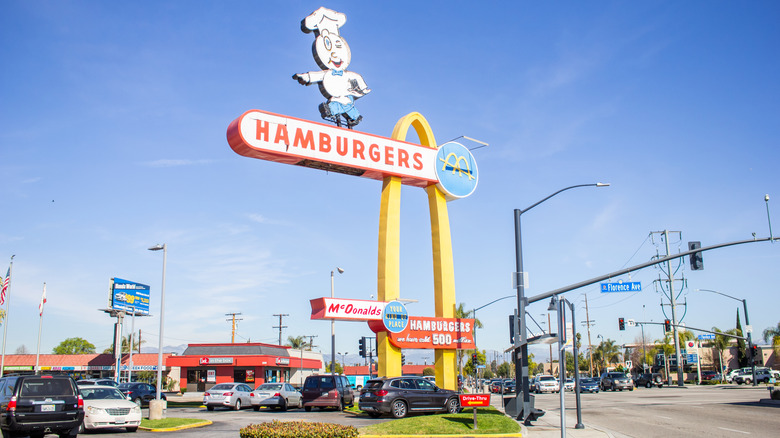
Ray Kroc's visit to the McDonald brothers' restaurant marked the start of McDonald's transition from a small regional chain to a global brand, but it also marked the beginning of the end of the brothers' involvement in the restaurant. Impressed by the restaurant's popularity and efficiency, Kroc told the brothers he envisioned the chain going national and offered to run their franchise operation. The brothers, uninterested in the extra work and travel needed to scale up their business aggressively, agreed. Within a year — in 1955 — Kroc opened his first McDonald's franchise in a suburb of Chicago.
But while Kroc respected the McDonald brothers' innovative service model, he didn't have much respect for the brothers themselves, calling them a "'queer pair." By 1961, Kroc bought the restaurant (and the McDonald's brand name) from the brothers for $2.7 million. As part of the sale, he made a deal with the brothers to share a half-percent royalty on all future sales. This detail, however, wasn't put into writing, and the brothers never received any royalties. Even more galling, in his memoir, Kroc publicly took credit for the success of McDonald's, even claiming to be the founder and declaring his Chicago-area franchise to be the first-ever McDonald's. Naturally, this didn't sit well with the McDonald brothers. "Until the time we sold, there was no mention of Kroc being the founder,” Richard McDonald told The Wall Street Journal (via The New York Times) in 1991. ”If we had heard about it, he would be back selling milkshake machines.”
Richard remained at peace with the decision to sell McDonald's
The McDonald brothers lived to see their restaurant grow from a single outlet to a global powerhouse, complete with special menu items just for international locations. But despite having their name prominently displayed on thousands of busy restaurants around the world, they received little public recognition for their work and none of the shared profits that Ray Kroc had promised them. So while Richard McDonald had maintained a civil working relationship with Kroc, his feelings about him were, to put it mildly, mixed. "Ray Kroc was kind of a touchy subject," McDonald's grandson, Jason McDonald French, told CBS News.
Still, McDonald was grounded enough to accept his fate with equanimity. He and his brother had come to California with the goal of becoming millionaires by the time they were 50, and while it's not clear if they made this deadline, the $2.7 million sale price for the restaurant means they both achieved the financial part of that goal. And unlike a lot of today's plutocrats, the McDonald brothers were content with local success and were happiest close to home. For this reason, McDonald later said he had no regrets about selling the restaurant. ”I would have wound up in some skyscraper somewhere with about four ulcers and eight tax attorneys trying to figure out how to pay all my income tax,” McDonald told writer David Halberstam (via The New York Times).
The brothers' descendants treat their legacy like a family secret
Imagine having a last name linked to a business known and loved around the world. Then imagine knowing that your grandfather and grand-uncle founded it. Most of us would proudly brag about this family heritage and share insider lore about our celebrated relatives with anyone who would listen. This is not the case, however, for Richard McDonald's descendants. "As children we weren't allowed to talk about it," McDonald's grandson, Jason McDonald French, told CBS News. "Our parents didn't want us going around saying that we were the grandson of Richard McDonald. It's always kind of been that family secret that no one talked about. We never really advertised it."
Still, French said, he is proud of his grandfather and his accomplishments. And with the 2017 release of the Ray Kroc biopic, The Founder, which portrays Kroc's takeover of McDonald's in all its backstabbing glory, French said the family was pleased to see his grandfather and great-uncle finally get the recognition they deserved. "We were overjoyed with the fact that the story's being told the right way and that it's being historically accurate," he told CBS News. And like his grandfather, he's sanguine about Kroc's failure to share the restaurant's profits. "My grandfather was never bitter over it. Why would we be bitter over something that my grandfather wasn't bitter over?" he told CBS News.