

8 Types Of Wood You Need To Avoid When Barbecuing
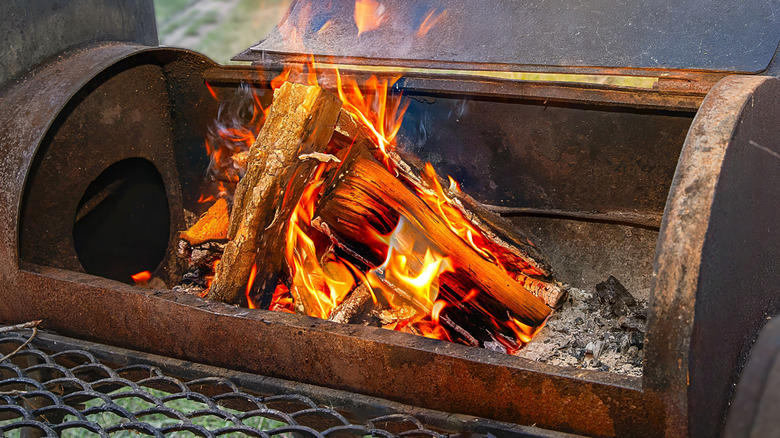
Whether you're a grizzled, ribbon-winning competition barbecue veteran or a "please don't burn down the back yard" beginner, you know the wood you choose to fuel your fires is important, and will largely, without pity or remorse, determine the success of your cook. Plain and simple: Bad wood makes bad smoke, and smoke is the reason you're going to all this trouble in the first place.
Heath Riles is the current king of the barbecue realm. His team, Heath Riles BBQ, earned the right to call themselves the 2025 Grand Champions of the World Championship Barbecue Cooking Contest that happens in Memphis, Tennessee, every spring at the Memphis in May International Festival. The guy knows his wood. Riles warns that burning either the incorrect species of wood or the right species in the wrong condition will put out "the wrong type of smoke that can make the meat bitter or harmful."
Some general guidelines: choose hardwoods over softwoods, check for damage, and, when in doubt, choose hickory. While we have our own ideas about the best types of wood for grilling and smoking, Riles rides with hickory for barbecuing due to its versatility. "I personally think hickory is the best all around wood to use," he continues, "while some woods like post oak tend to over-power most smaller meats but do work with large cuts of meats like briskets or shoulder clods." So brush up on your basics, fire up the smoker (you can even turn any grill into a smoker if you don't have one), and invite over the neighbors. But if you're using any of these woods, don't expect your guests to leave happy. They could even end up leaving sick if you don't choose wisely.
1. Anything treated
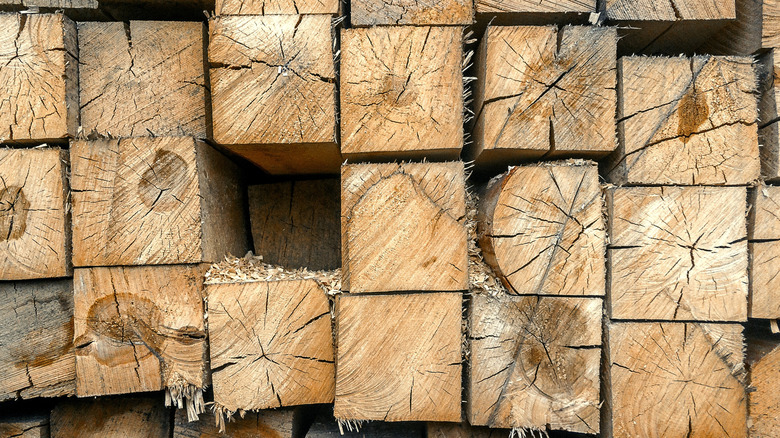
To treat wood, a mixture of preservatives, which can contain dangerous chemicals like copper and arsenic, are forced deep into the wood via alternating cycles of pressure and vacuum. The process works so well, the chemicals actually penetrate the cellular structure of the wood. In other words: That stuff doesn't wash off.
If you choose to burn treated wood in your smoker, you're putting more than the flavor of your meat at risk. You're going to be breathing in some pretty harsh chemicals, and your food is going to be infused with them as well. Plus, burning treated wood can produce toxic ash, and that's not easy to clean out of your smoker.
Besides being dangerous and toxic, the smoke would be heavy and acrid. That's not the flavor profile you want. There would be a thick fog of toxicity just sitting on your meat for the entire length of the cook. Even if the food was edible, it would taste terrible.
2. Anything green
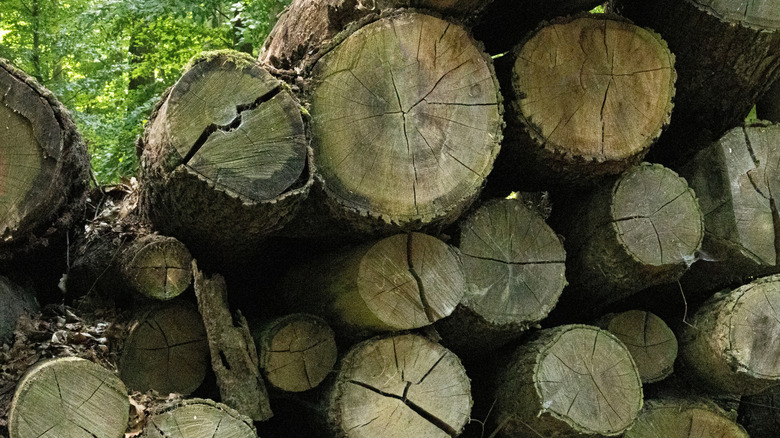
Burning green or newly-cut wood won't harm your health, but it will definitely hurt your reputation. The problem is twofold: both the composition and amount of the smoke are unsuitable for serious barbecuing. First, the smoke from burning green wood contains creosote, that same dark, tarry substance that has kept chimney sweeps in business for centuries. The amount of creosote released correlates directly to the amount of smoke, and when burning green wood, there's a lot.
Green wood is wet wood, and all that moisture content has to evaporate. If the smoke is wet and the cook is long (which it will be), that means more of that creosote flavor soaks into your food. You'll be the laughing stock of the neighborhood. So postpone, and let it dry. Or, it might be a good time to give your smoker a break and try to create the flavor of smoked meat without one.
3. Anything moldy or rotten
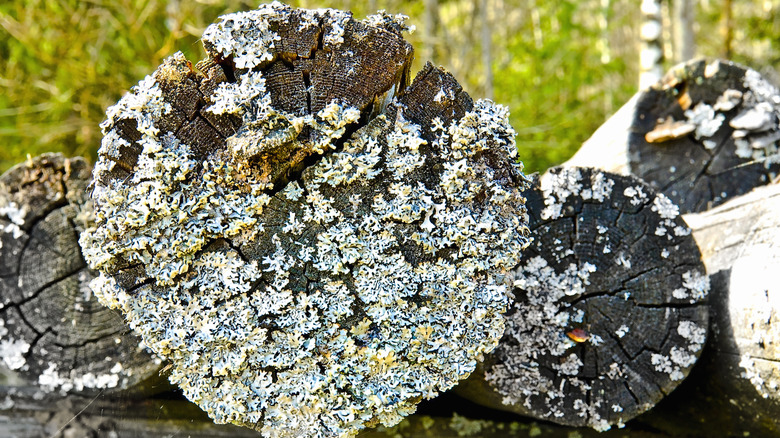
So this one should be obvious, but it needs to be reiterated. Burning moldy or rotten wood in your smoker is a serious health hazard. If there is mold on the wood, burning it can release toxic mold spores into the air. And into your meat. When Heath Riles says that it's the type of thing that "can make the meat bitter or harmful," the barbecue champion is, of course, right on the money. He's also leaving the gory specifics unsaid.
Inhaling firewood mold can cause asthma attacks, set off allergic reactions, and worse. There's also the risk of toxic exposure, which can lead to more serious symptoms, like persistent headaches and fatigue, which may require medical intervention. Plus, if you get toxic mold spores in your smoker, you'll have to replace it. Hopefully, you won't burn moldy, rotten wood. If you do, though, here's a link to the best wood smokers according to reviews, just in case you're in the market for one.
4. Pine

Now we're getting down to specific woods to avoid smoking. We're singling out the noble pine first because it is the perfect avatar for a particular kind of wood that is less than ideal for smoking: softwoods. Among the woods Heath Riles would never work with are a litany of popular American softwoods. He lists, "pine, cedar, redwood," among the woods he refuses to use, either in competition or at home. Soft woods have high resin content, and burning them typically gives off a sooty, bitter smoke. Pine is no exception. Meat smoked with pine can taste over-smoked and unpleasantly acrid.
Even compared to other softwoods, pine stands out as one of the worst choices. One of the reasons is its tendency to pop and shoot out embers, making the fire harder to control. More worrisome, though, is its low density and relatively quick burn times. That means you'll need lots of it, and you'll spend way more time tending the fire than if you'd just gone with hickory.
5. Cedar

Ever wanted your pork shoulder to taste and smell like a rich person's closet? You do you, but to serious smokers, cedar wood is a strict no-go: Save it for the grill. The major differences between smoking and grilling are time and temperature. When you grill, you're exposing food to high, direct temperature for a relatively short amount of time. Smoking, on the other hand, provides low, indirect heat over a sustained period of time. What's good for your 20-minute cedar plank salmon isn't going to work for a 12-hour pork butt.
Another problem: All of that resin that's present in softwoods is in cedar, too. Complicating matters further is the fact that cedar is an extremely oily wood. Again, that means bitter smoke as well as a lost weekend spent scrubbing your smoker.
6. Elm
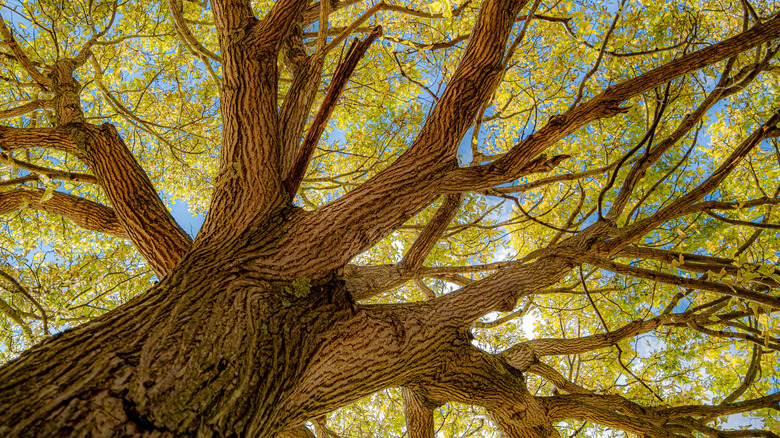
Elm trees can either be softwood or hardwood, depending on the type. Hard elms, sometimes called "rock elms," are a little denser than soft elms like the American elm and the red elm. However, even the densest rock elm still isn't hard enough for smoking. They may technically be hardwoods, but they burn like softwoods. The smoke that results from burning elm trees has a pungent, almost acrid smell and a bitter taste. The meat will taste over-smoked, even if you've taken all the necessary steps to prevent over-smoking.
Now seems like a good time to sing the praises of hickory again, since it's pretty much the anti-elm. Hard, fragrant, and pleasant to burn, with none of the downsides, provided it's well-seasoned. Hickory is also traditional to Southern barbecue. "I would choose hickory wood [for smoking any meat] because it is more traditional than anything else to what I grew up eating," Heath Riles says about his favorite wood.
7. Redwood
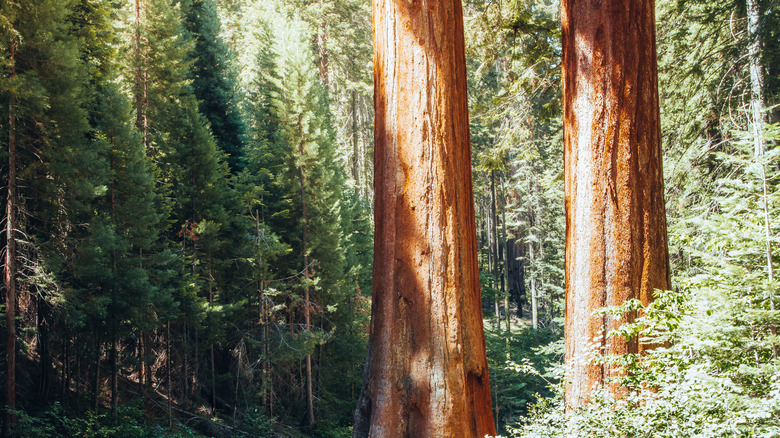
Redwood trees are big, beautiful, and full of sap. It's that last part that makes them unsuitable for barbecuing. That sap carries nutrients throughout the tree, making it essential for life. Since redwoods are so big, they need and produce lots of it. Burning the sap will result in dense, foul-smelling smoke that will infiltrate both your meat and your immediate area. Pass.
But wait, there's more: Remember resin, that unpleasant stuff that all softwoods have? Redwoods have so, so much resin. There's also plenty of oils and terpenes, so the smoke is sure to be extra bitter.
Redwoods, like all trees classified as softwoods, are conifers. A general rule of thumb in barbecuing is to stay away from anything that has needles and cones, redwoods included. Stick with trees with leaves. Use any wood that doesn't have sap and resin, and your smoke is immediately better.
8. Wood scraps
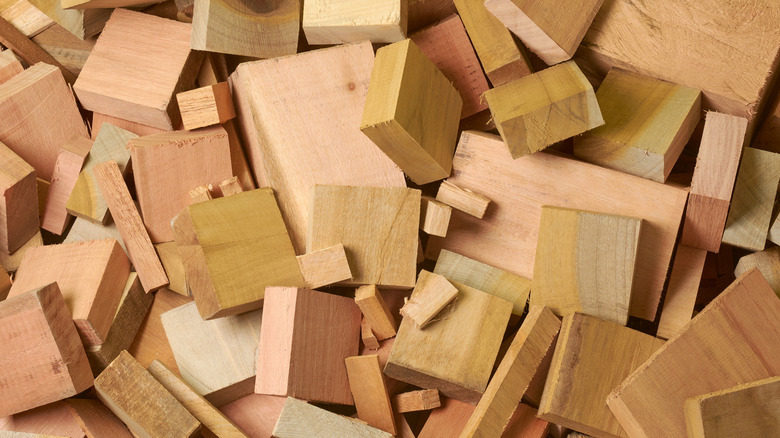
It's tempting to burn whatever you have lying around. Two birds, one stone: you get to eat barbecue and get rid of some junk at the same time. Unless you know exactly what you've got, though, just don't do it.
Obviously, different woods produce different smoke with different flavors. If you don't know what you're burning, it's hard to predict what the end result is going to taste like. If your scraps consist of different types of wood, you're going to get different flavors from each piece. Another problem is timing. Every type of wood in your scrap heap takes a different amount of time to burn. That means you'll have to pay constant attention to the fire to keep a consistent level of heat.
We should point out that we're not talking about high-quality wood chip blends made specifically for barbecuing. Those can be great, particularly if you're smoking on a grill, and even the experts like using specific wood chip blends. Still, I'm with Heath Riles, the Grand Champion, who puts it plainly, "Hickory is the best."