

7 Strange But Popular Meals From The '60s That You Don't Really See Anymore
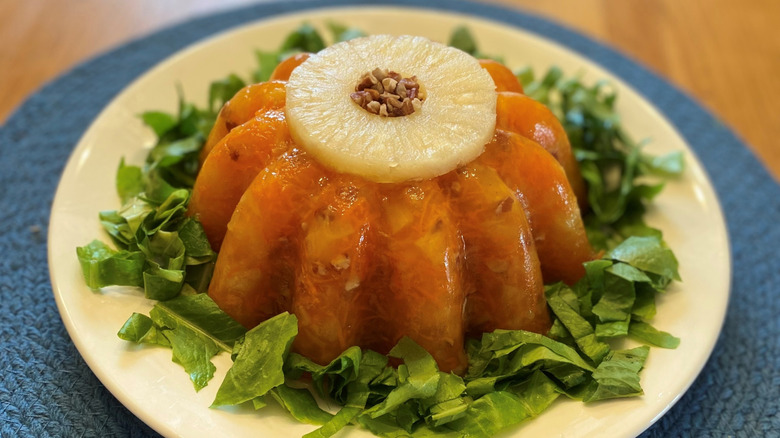
In the 1960s, American home cooking was heavily influenced by the culinary trends of the decade, from the rise of quick and convenient frozen meals to an emphasis on global cuisine brought on by celebrity chefs such as Julia Child. However, some popular meals from the '60s come completely out of left field; they are not particularly convenient to prepare and, in fact, are downright strange, both in their towering and jiggly presentations and in their unusual flavor and ingredient combinations.
Many conventional recipes from the 1960s are still enjoyed today, but this article is not about those. Instead, keep reading for a look at seven strange dishes from the decade that, despite their once-popularity, you would be hard-pressed to find on a 21st-century kitchen table or at a 2020s dinner party. Some of them will undoubtedly be familiar (their novelty has kept their memory alive), while others have become relics of a decade filled with gelatin and mayonnaise.
1. Frankfurter Crown Casserole
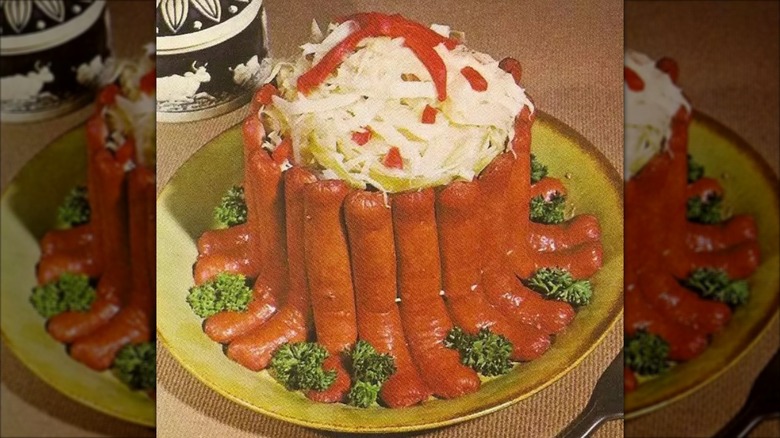
When it comes to one of the strangest meals of the 1960s, few dishes are as showstopping as the Frankfurter Crown Casserole. The recipe was popularized by Campbell's, which published it in both print advertisements and cookbooks.
A Frankfurter Crown starts as a casserole of condensed cream of mushroom soup, onions, potatoes, and green beans. Halved hot dogs are lined around the dish's edges before the entirety is baked for a brief 30 minutes (all of the ingredients are fully cooked, after all) and garnished with crumbled bacon. Despite its eerie resemblance to a savory cake, the casserole is soup-based, and a spoon, rather than a knife, is certainly required for serving.
Although Campbell's iteration is perhaps the best-known recipe for the Frankfurter Crown Casserole, it is not the only one. In the late '60s, Weight Watchers also published its own recipe, which nixes the creamy condensed soup and is instead made with apple cider vinegar, savoy cabbage, poppy seeds, and canned pimento.
2. Cheese Noodle Ring
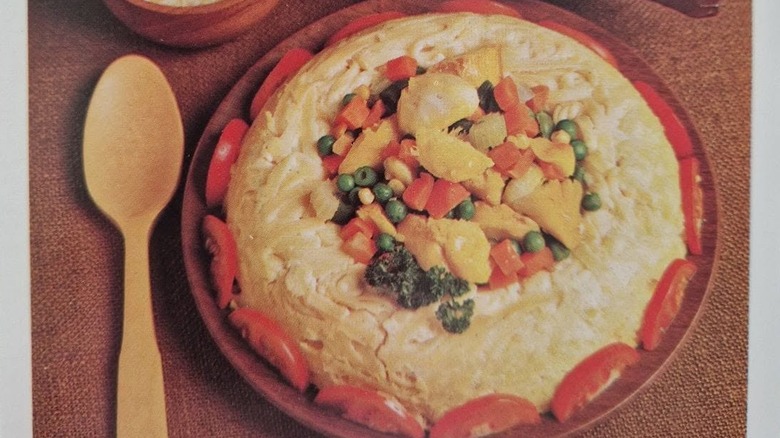
This shareable entrée combines many familiar ingredients — noodles, cheese sauce, eggs, and a healthy serving of butter — but presents them in an especially interesting way. Instead of being cooked in a soup or baked in a deep-dish casserole, 1960s recipes call for this cheesy pasta dish to be served in a massive ring.
While Cheese Noodle Ring recipes from the late '50s and '60s have slight variations, their bones are the same: Mix short, flat, and wide noodles with a cheese-based sauce (some recipes call for milk, and butter, while others just require the grated cheese itself), pour into a greased ring mold (the same kind that a retro household might use to make one of the desserts that defined the 1960s), and bake in the oven at low heat.
Once a Cheese Noodle Ring is cooked, the real fun can begin; the ring is plated, and its center is then filled with a cook's choice of concoction. Different recipes suggest smoked cod with vegetables, tuna in mushroom sauce, chicken in celery sauce, creamed fish, or simply vegetables.
3. Potato Pan-Burger
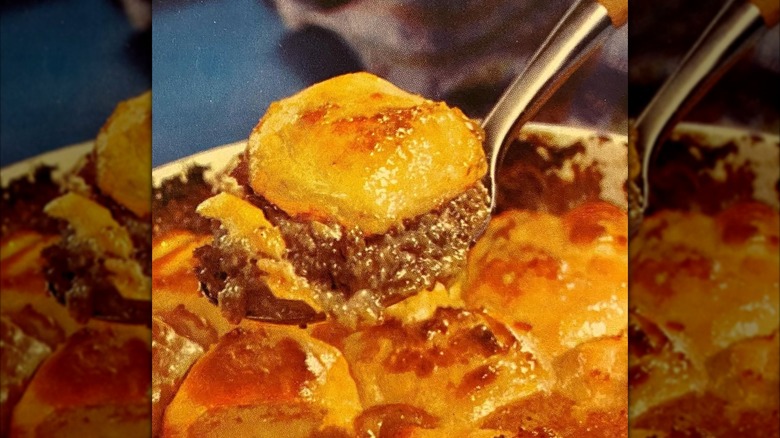
To create this dish, a Pillsbury Bake-Off Senior Best in Class winner from Phoenix, Arizona, combined two popular dishes: Russian stroganoff and Irish potatoes. The result, the Potato Pan-Burger, was published in 1962 in "Pillsbury's 13th Grand National Bake-Off Cookbook," in which the winner was named Mrs. Richard Philabaum.
Given how the meal was invented, it's no surprise that the Potato Pan-Burger relied on two Pillsbury ingredients: the Pillsbury Instant Mashed Potato Flakes and the Pillsbury Best All Purpose Flour. The dish's filling features ground beef, simmered with onions, flour, beef broth, ketchup, cream of mushroom soup, and sour cream, while the "Potato Puff Topping" features the potatoes, made rich with milk and butter, thickened with flour, and kept fluffy with baking powder (although there are plenty of other ways to make instant mashed potatoes taste expensive). The result is a meal not dissimilar, in ingredients and composition, to a cottage pie, but its Franken-dish origins have earned it a spot on this list.
Later iterations of the dish have stayed fairly loyal to this original recipe, but there have also been some minor tweaks. For example, another version of the recipe, published by Pillsbury in 1968, features Pillsbury Brown Gravy Mix in the filling.
4. Summer Salad Pie
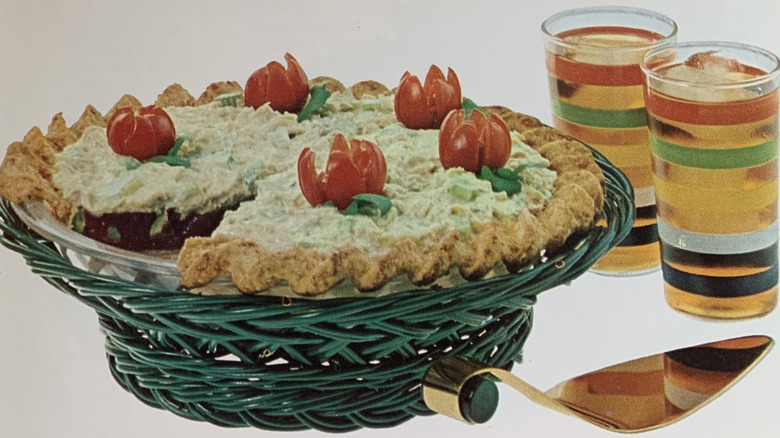
Perhaps one of the most outlandish recipes on this list is the chilled, savory pie, popularized by its publication in Betty Crocker's 1963 cookbook, "Dinner in a Dish." It combines so many of the strangest tropes of '60s cooking, from its vinegary, jellied filling to its savory twist on a sweet-format dish.
The Summer Salad Pie boasts a filling of lemon-flavored gelatin, tomato sauce, vinegar, Worcestershire sauce, and Tabasco; mix-ins of celery, pimento-stuffed olives, and onion; and a homemade pie crust baked with cheddar cheese. Tuna salad, made with mayo or salad dressing to taste (but lacking one powerhouse ingredient that makes tuna salad pack a punch), is the final touch.
This was not Betty Crocker's only old-school savory pie, but it is one of her most intriguing. Over the decades, the Betty Crocker brand has published recipes for pies with broccoli and cheddar, Buffalo chicken, and cheeseburger fixings. Perhaps the closest in composition to the Summer Salad Pie is the 2013 Impossibly Easy Chef's Salad Pie, complete with smoked turkey and ham, Swiss and cheddar cheeses, ranch dressing mix, and shredded lettuce — and, notably, not an ounce of gelatin or tuna in sight.
5. Jell-O Salad
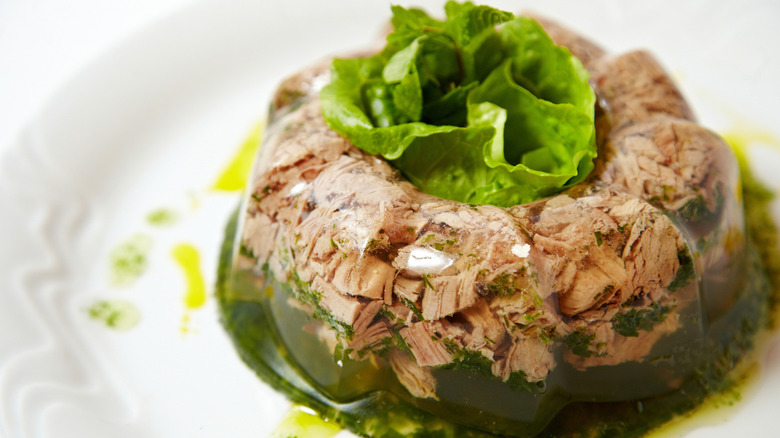
Of course, a roundup of the 1960s' strangest and most obsolete dishes would not be complete without a nod to the series of Jell-O salads (which once represented wealth and status) that came out of the decade. Encasing salad ingredients in gelatin was such a trend in the '60s that Jell-O released a line of savory gelatin mixes — including Mixed Vegetable, Celery, Seasoned Tomato, and Italian Salad — with flavors made especially for salads.
Even without these savory riffs, Americans were using sweet Jell-O flavors as the bases for dinnertime salads throughout the '60s. Some of the most eyebrow-raising combinations from the decade include Cherry-Catsup Salad, with cherry gelatin, ketchup, celery, nuts, and olives, and Sea Dream Salad, which consisted of lime gelatin, cucumber, vinegar, onion, cayenne, and, for some protein, a topping of cooked shrimp.
In addition to its limited-time salad flavors, Jell-O fueled the popularity of these savory salads throughout the late '50s and '60s, with advertisements encouraging cooks to repurpose their leftovers into Jell-O salad. Some of the salad mix-ins the brand recommended were fish, eggs, and potatoes.
6. Party Sandwich Loaf
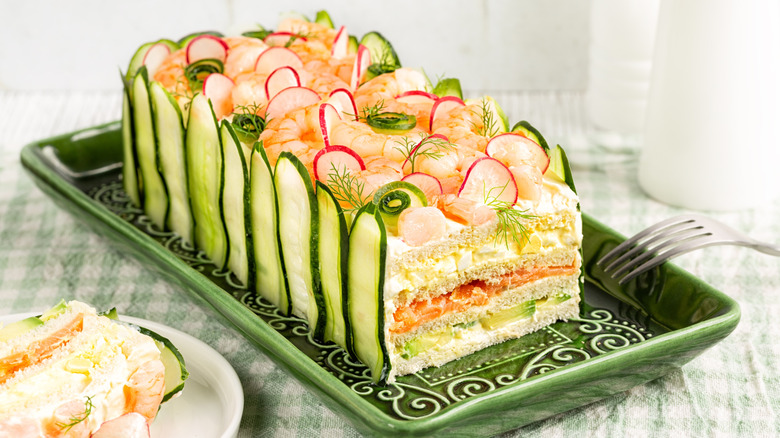
The Party Sandwich Loaf was a dish meant to entertain guests. Rather than present them with a table of finger sandwiches, they could delight in cutting themselves a slice of a massive, savory sandwich designed to look like a cake. And instead of plaguing your guests with the difficult decision of choosing the filling for their own sandwich, why not combine multiple fillings in one?
Typically, one sandwich filling was assigned to each layer of the loaf. Various '60s recipes recommend different ingredients, but common layers across them include ham, egg, shrimp, and chicken salads, as well as mixtures of ham and pickles, cheese and pecans, and chicken and bacon. So long as the finished product contained multiple sandwich layers and was "frosted" with a mixture of cream cheese and mayonnaise, complete with the occasional dash of food coloring, it fit the bill for a Party Sandwich Loaf — a popular '60s recipe, but perhaps a harder sell for the dinner parties of today.
7. Dried Beef Log
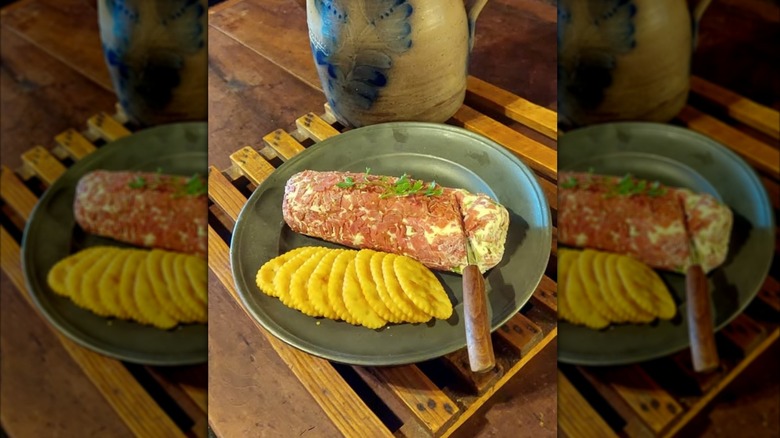
This is one such case of the name of a '60s meal sounding far less appetizing than what its recipe actually contains. The concept of a Dried Beef Log might not immediately get you excited for dinnertime, but its ingredients might.
Dried Beef Log recipes typically start with a core of cream cheese, Parmesan cheese, prepared horseradish, and stuffed green olives. The softened cream cheese mixture is formed into logs, chilled, and then rolled in an ingredient that we don't see nearly as often anymore: a wartime-era dehydrated beef product called dried beef, sometimes referred to as chipped beef. The final Dried Beef Log, another dish fit for entertaining guests, is recommended to be served with crackers.
Although you might not see a Dried Beef Log at the next dinner party you attend, you might see a similar, more current riff on it: the party cheese ball, composed of the same cream-cheese core and a coating of the ingredients chosen by the host. Popular recipes include cheese balls rolled in pecans and parsley, dried cranberries, and loaded baked potato fixings.