

I Tried 8 IKEA Food Court Items & Ranked Them Worst To Best
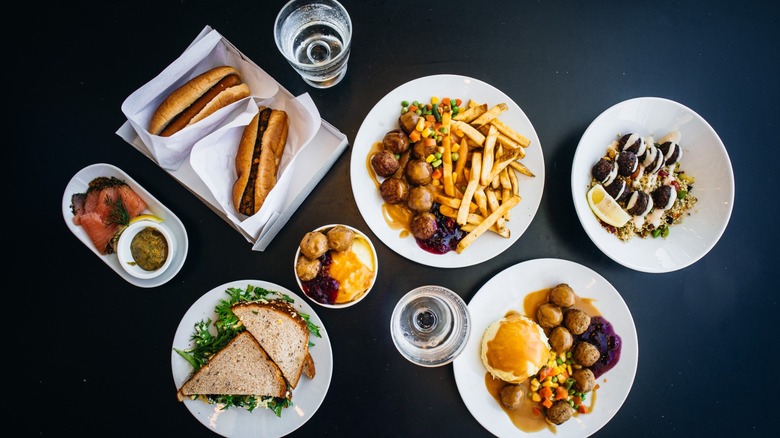
IKEA's affordable food court is as famous as its Billy bookcases and Kallax shelving units, helping the Swedish brand quietly expand its easygoing, utilitarian, and very Scandinavian approach to life throughout the world.
But over the last few years, IKEA has quietly been expanding its food offerings beyond hot dogs and Swedish meatballs, all with the goal of sustainability in mind. The company has added plant-based options, diversified its desserts, and begun looking beyond Sweden to the Middle East and even India in some of its local menu. It used to be that every IKEA store you walked into, you knew exactly what you would find on the menu. Now, the offerings are more diverse and localized, and the items can vary based on availability.
I'm a recipe developer and blogger who truly loves to dine in IKEA. For this comparison, I assembled a group of adult tasters and took them to IKEA. We ordered every entree available that day from two separate areas of the food court: the IKEA Swedish Restaurant, the main sit-down cafeteria-style area offering hot plates and full meals, and the Swedish Bistro, the quick-service counter near the store exit, where you'll find hot dogs and portable dishes. It's worth noting that both menus are more extensive than what's covered here; the selection changes frequently by location, and some items, including the salmon filet meal with the veggie medallions, which is one of my usual favorites, were unavailable on the day of our visit. Each item was evaluated on taste and presentation. So, here's the story of the day I tried eight IKEA food court items, and ranked them from worst to best.
8. Veggie Dog
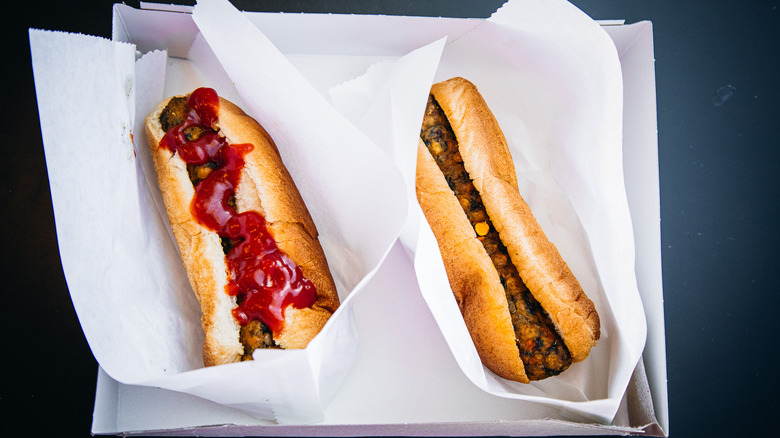
On paper, the Veggie Dog sounds like a great idea: a plant-based alternative to IKEA's famous meat hot dog, priced for less than a dollar. That was the thinking behind the product. According to IKEA, it was introduced in 2018 in an attempt to offer a product that would be as "loved as the iconic IKEA hot dog" but would also help people lead "a healthier and more sustainable lifestyle." The result, however, leaves much to be desired.
The IKEA veggie hot dog doesn't even try to look like a hot dog. It's filled with kale, lentils, quinoa, onions, and wheat protein – most of which are visible to the eye. It feels granulated in texture, and though the flavor feels cohesive, it doesn't fit with what you'd expect a hot dog to taste like. In fact, it most closely resembles Indian dal, due to its Indian-inspired seasoning.
If IKEA had billed this as an affordable Indian lentil sausage packed with protein, it would have had its own appeal. But as a hot dog-wannabe, it falls rather short of the billing. As a fellow taster said, "A kid would taste it and feel cheated."
7. Hot Dog

The IKEA Swedish Bistro Hot Dog is likely one of the best value-for-money food items available in North America. It costs less than an airport bottle of water, and it packs actual nutrients from the real beef and chicken that it's made with. And IKEA manages to make it appealing in scent and appearance, as well as in price.
The iconic hot dog has a 40-year history in IKEA. In the 1980s, the chain launched the IKEA Hot Dog and its founder Ingvar Kamprad priced it at 5 Swedish Krona, which was half the price of most of his Swedish competitors. Today, IKEA sells over 100 million hot dogs every year, making it one of the biggest hot dog vendors in the world.
At first blush, the IKEA Hot Dog looks like you'd expect – a hot dog in a soft bun. The IKEA beef and chicken sausage is dense and filling, the bun is soft and familiar, and the condiment station does its job. There are no fancy hot dog condiments in most IKEA Swedish Bistros, just ketchup and mustard, and the IKEA Hot Dog doesn't even really need them.
It has a good flavor, and as soon as you wander into the Swedish Bistro area, you're met with the captivating smell of the steaming hot dogs. One of our tasters noted that they get one every time they set foot in an IKEA. On the downside, it's not a high-end hot dog. The bread is average, the sausage is okay, but that's what you expect for this price. The IKEA Hot Dog ranked low in our assessment, not because it failed, but simply because, as a plain Hot Dog, it's just not that interesting when compared with IKEA's other offerings, which don't cost much more than a dollar. But if a dollar is all you've got to spend, this is a solid purchase.
6. Egg Salad Sandwich
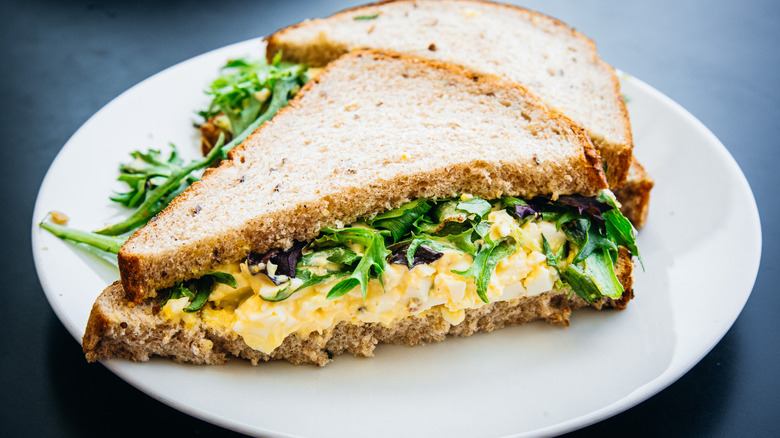
There is usually no reason to get excited about an Egg Salad Sandwich, and IKEA's entry, available in the IKEA Swedish Restaurant, is no exception. It's an easy, relatively healthy, familiar, and wholesome lunch option, and it looks the part.
Multigrain bread, a generous scoop of egg salad, and a handful of mixed greens. It's the most affordable entree in the IKEA Swedish Restaurant, and it looks just that: middle of the pack, not exciting, but not bad, either.
The bread feels soft but flavorful due to the addition of seeds and the mix of flours. It would have probably been less exciting if it was plain white bread, so the multigrain feels welcome. The greens, a mix of arugula and baby kale, are healthy, flavorful, and have body. And with bread and greens, the sandwich feels healthy.
We all noted the satisfying texture, which wasn't totally uniform and made for an interesting chew. However, the major disappointment here was the complete lack of even the most basic of seasonings, like salt and pepper. It felt like eggs, mayo, greens, and nothing else, and while that may be satisfying for some, it felt a bit flat for our group. If this were your lunch, you'd be happy, but I'd want a pickle or a lemon wedge on the side.
5. Marinated Salmon
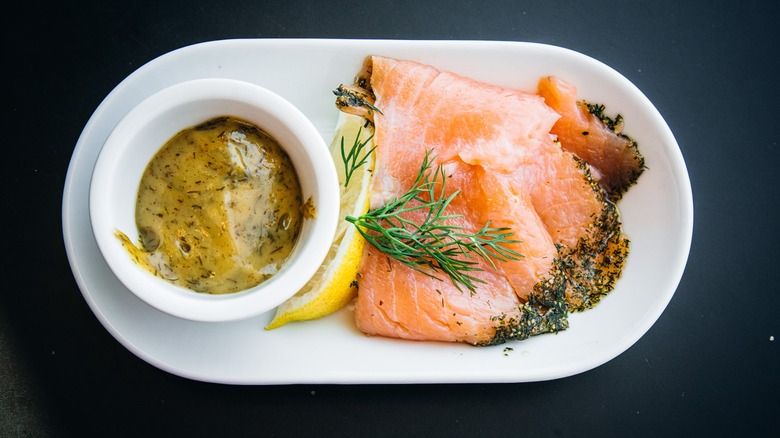
In my personal opinion, the Swedish Marinated Salmon, also known as gravlax, is the store's silent sleeper hit. Some people feel similarly, with a Business Insider reviewer claiming it's "by far" the best dish in the IKEA Swedish Restaurant. But that review was based on the dish's earlier version, served with a side of greens for $5.49, which somehow felt like a more complete dish, and closer to a salad. Now, priced at $4.49, the dish comes with only two slices of Marinated Salmon and the store's fabled mustard sauce. Big difference? Maybe not, but to me, it feels like a whole other dish entirely.
The Marinated Salmon itself is meaty and plump, and the two slices have body to them and don't feel overly thin. They have a heavy herb coating on their edges, which consists of dill and lemon pepper. But the dish's biggest downfall is its relative blandness. Diners often pass it by on their way to more exciting entrees, like the full meals in the hot bar. It feels like too much money for a starter, and not enough substance for a lunch (I usually pair it with a side rainbow salad from the salad bar for a full meal). And on its own, it lacks the salty flavor of a typical cured salmon. But with the honey, mustard, and dill sauce, which is salty and balances it out, the dish does come full circle.
Overall, the IKEA Marinated Salmon feels like the unexpected choice, worth ordering if you're looking for something lighter that feels truly Scandinavian. But is it the best dish on the menu? Not when you actually taste it alongside others, and consider its price per bite.
4. Falafel Meatballs Entrée
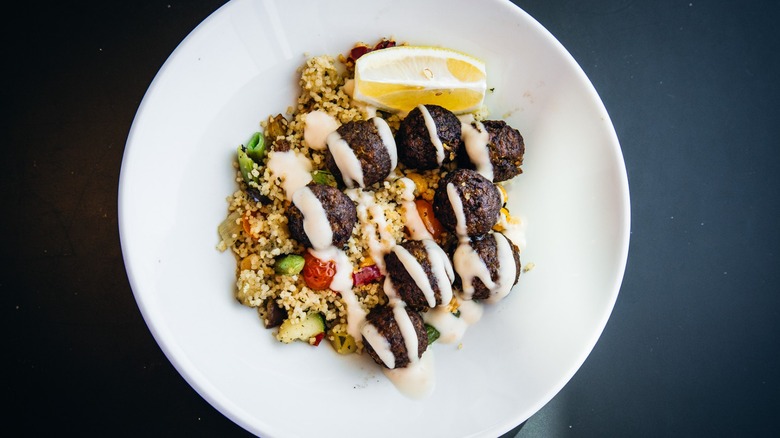
The Falafel Meatballs with Vegetable Couscous are one of IKEA's newest offerings in the IKEA Swedish Restaurant, introduced across the U.S. in early 2026. They were also one of the most controversial things we tasted that day.
Let's start with the positives. The falafels themselves earned genuine praise around our table. The flavors were well executed, and as someone who grew up eating falafels weekly in the Middle East, I know my falafel. The texture was a bit different, closer to the store's meatballs than traditional falafel, but it didn't feel wrong. As the balls are made out of chickpeas, zucchini, onions, and spices, that makes sense, because zucchini does not belong in a typical falafel. The aioli sauce that came with the dish felt like a variation of toum garlic sauce, and it was potent but really nice, flavorful, and sharp.
Where the dish fails is the couscous, if you can even call it that. Made with what looked closer to Israeli pearl couscous — which is actually a form of pasta, rather than traditional couscous, which isn't even a grain – this salad feels wrong from the first bite. On our plate, there were green beans, roasted tomatoes, chickpeas, raisins, zucchini, and eggplant, but I've seen mushrooms and different combinations in other IKEA photos of the dish. The result was mismatched and off-putting.
Overall, IKEA describes the dish as the latest in its meatball variations, and an attempt to offer an international, upscale dish in the IKEA Restaurant. And while the falafel balls were interesting, and the attempt itself commendable, the dish just doesn't feel like it's really there. Perhaps with a bit of editing, as IKEA has been known to do, in a few years it'll be a mainstay.
3. Plant Balls Entrée
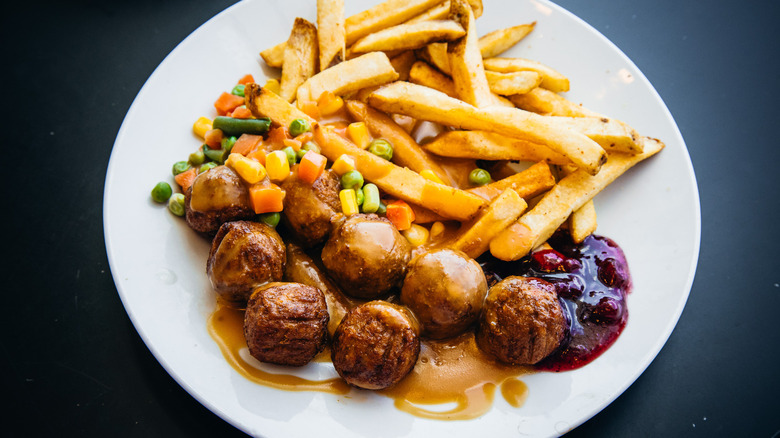
The first of the items we tasted from IKEA's dish of Plant Balls with gravy, Lingonberry Jam, and potatoes was the plant balls. The dish immediately became our third-favorite item in this ranking. It should be noted that the plant balls typically come with a side of mashed potatoes, just like their regular meat counterparts, but we requested them with fries, so we could evaluate the fries as well.
A direct response to the success of the IKEA Swedish Meatballs, the Plant Balls are made with yellow pea protein, oats, potatoes, onion, and apple, and look nearly identical. They have the same oval shape, the same brown gravy, and the same spoonful of jam. They can also be bought in bulk in the deli section, and taken home, and I'll be the first to admit to often having a pack in my freezer for my finicky children (we love air frying them).
Unlike with the Veggie Dog, here the ingredients were completely blended, and the meatballs felt really cohesive. The texture was toothsome, and very close to a regular meatball. The pairing with the sauce was seamless. One taster who spent a few months living in Sweden and who loves IKEA's Swedish Restaurant said that the flavor felt truly Swedish.
The Plant Balls are a great alternative to meat for reluctant vegetarians, or those trying to reduce their meat intake, because they don't feel like you're eating vegetables but some sort of meat. It pairs nicely with the gravy and the lingonberry jam. If you or someone in your group eats plant-based, then the IKEA plant balls are a great option that is miles better than its Veggie Dogs.
2. Swedish Meatballs Entrée
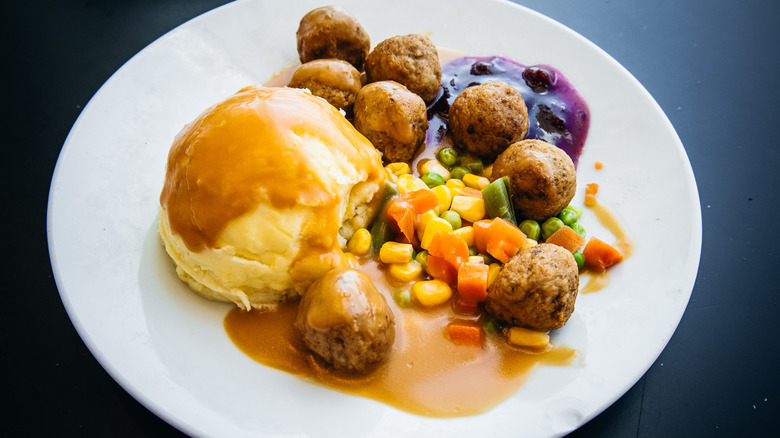
I'm going to start by being honest: the Swedish Meatballs are probably the reason most people know that IKEA has a restaurant in the first place. Now celebrating its 40th anniversary, this dish is as endemic to the store as its flatpack furniture. The Swedish Meatballs remain, as ever, unchanged, a cluster of small meatballs drizzled with a rich brown gravy, alongside a scoop of Mashed Potatoes, and a spoonful of Lingonberry Jam in a deep burgundy color. They also come accompanied by some frozen veggies, but let's continue with honesty: no one cares about those.
The meatballs are more heavily seasoned than the Plant Balls, and their texture feels a lot denser. They are meaty in a pleasant way, and gently seasoned, letting the gravy and jam do most of the flavor accompaniment. The mashed potatoes taste like real potatoes, and though they are very smooth, likely showing that they are ground in large quantities by machine, they are also clearly made out of real spuds.
To everyone at our table, this was a winning combination. The play of the mashed potatoes, the gravy, and the lingonberries is the perfect trifecta of salt, acid, and sugar. There's no novelty here, but there's good old taste and value for money.
1. Swedish Meatball Sundae

The number one entry on our list feels, to me, like a cop out. The Swedish Meatball Sundae is not, as you may think, a dessert. It's the IKEA Swedish Bistro's solution to the question of what to do with the meatball plate when you want it to be portable.
This is IKEA's meatball dish distilled down to its barest and most essential parts. Gone are the frozen veggies or peas. The entire dish is just a mound of mashed potatoes, which are topped with three or four meatballs, some gravy, and some lingonberry jam, all served in a small paper cup. It costs $2.50, a fraction of the meatball plate's price, and takes seconds to pass. It feels truly utilitarian, instantaneous, and magnificent.
I loved this dish because it was the perfect combo, allowing you to get all of the IKEA flavors in one shot. It works as a great on-the-go meal because it gives me every flavor that I need. In a rush and with limited money to spare, I would take this any day over a hot dog.
In short, the IKEA sundae was our favorite entry of the bunch because it continues the proud tradition of symbolizing everything the IKEA Swedish Restaurant stands for: food that is delicious, delightful to the senses, with great variety, and offered at a good price. This may not be the newest, most exciting, or shiniest item on the menu. But it's the simplest, fastest, most utilitarian, reliable, and beloved – and isn't that IKEA in the first place?
Methodology
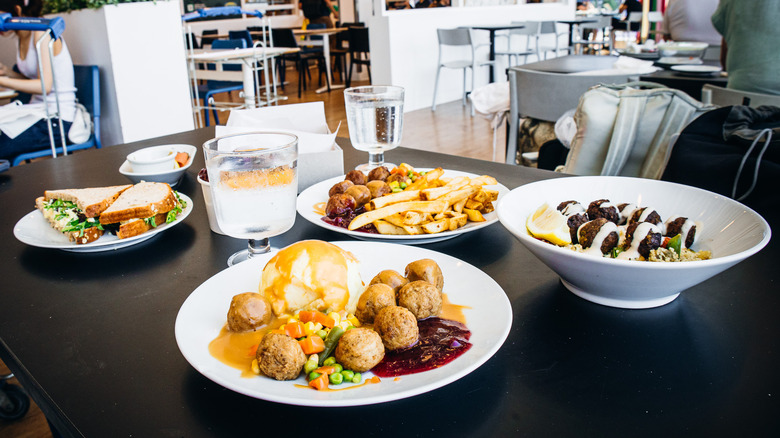
Unlike many other rankings I've done, my IKEA tasting was fraught with debate and questioning. As IKEA's approach to food is heavily influenced by its "Democratic Design" approach, it felt strange to judge it only by the food and not to reflect on its politics. This approach aims to reduce your carbon footprint, and to help inspire and promote sustainable living among its customers at affordable prices.
To rank our eight items, we assembled at IKEA on a random Friday and ordered every available entree item from both the main IKEA Restaurant and the IKEA Swedish Bistro. Some staples, like the salmon filet and veggie medallions, were unavailable. We were told other dishes were being phased out. It was clear that IKEA was in a period of transition, and the chain's commitment to growing its plant-based options was also clearly evident.
To try and give each dish a fair chance, we tasted it all at once, without reheating or adding seasoning beyond what was included in the plate. Items were evaluated on their taste, visual presentation, and uniqueness relative to IKEA's traditions. In our rankings, I tried to represent a consensus rather than a single taster's preference.
It is important to note that, unlike twenty years ago, today's IKEA is no longer one-size-fits-all. Its menu offerings change by country, and the availability varies by location and by day. This, more than anything else, shows why IKEA's Swedish Restaurants remain important. Cafeterias remain a place where anyone, regardless of their socioeconomic status, can get a decent plate of food for a reasonable price.