

What's The Average Lifespan Of A Refrigerator?

A reliable fridge takes up a decent amount of space in your kitchen, but it doesn't take up space in your mind. It runs, keeps food cold, maybe makes ice, and that's that. When your fridge starts giving you trouble, however, it becomes all you can think about. Refrigerators can be expensive, and when yours stops running the way it once did, it might be hard to decide whether it makes more sense to replace it or repair it. According to the U.S. Department of Energy, refrigerators typically last for 12 years. This is pretty on par with the average lifespan of other major kitchen appliances — wall ovens last for 10 to 15 years, as do cooktops.
There are several factors that play a role in how long you can expect your refrigerator to last. Keeping the coils at the back of your fridge clean can help it hold up over time. Twice a year, pull your fridge out (it's a pain, we know) and vacuum the coils to keep them dust-free. When the coils are dirty, your fridge doesn't run as efficiently, so keeping them clean can help it last longer. Simply cleaning out your fridge regularly can also help lengthen its lifespan. When your fridge is uber-loaded with stuff, airflow can be negatively impacted, which can strain your fridge's compressor. Toss leftovers and expired food once a week to keep the air flowing through your fridge.
Should you repair or replace your not-so-new fridge? How to decide
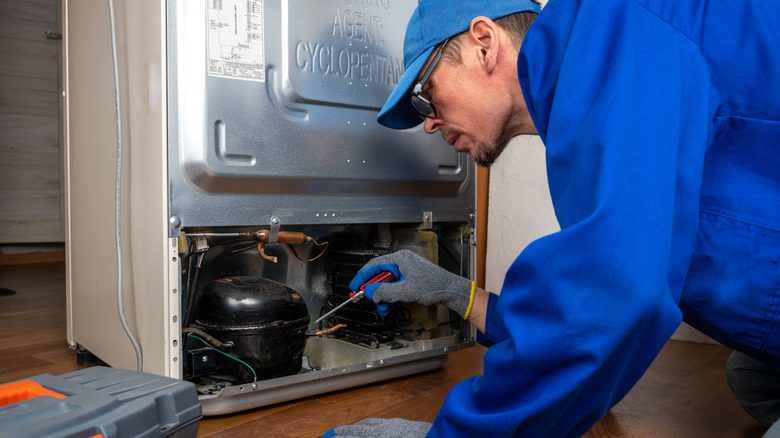
If your fridge is acting up, it's time to decide whether it makes more sense to call a repairperson or replace it altogether. According to Consumer Reports, 62% of refrigerator repairs are successful on the first attempt, so it's worth calling a repair professional if your fridge is acting up for the first time. Some issues — like a damaged door gasket — can be fixed easily, while others — like a failing compressor — are more complicated. If you decide to repair your fridge, ask the repairperson for their opinion on how long the repair is likely to hold up, and keep an eye out for annoying signs you can't ignore that mean you need to replace your refrigerator, such as hot spots on its exterior.
Cost is certainly a consideration when you're deciding whether to repair or replace your refrigerator. While it might be cheaper to repair your fridge in the short-term, regular repair bills can add up over time, and it might eventually make sense to replace the unit altogether. On average, it costs upwards of $1,000 to get a new fridge installed, though new fridges can range anywhere from $500 on the low end to more than $12,000 if you're after a super-upscale model. If your fridge is at the end of its decade-long lifespan and you're short on cash, you've got options. There are several ways to snag a fridge for free, including checking out online marketplaces and reaching out to local nonprofits.