

What Is Bistecca Alla Fiorentina And The Best Tips For Cooking It
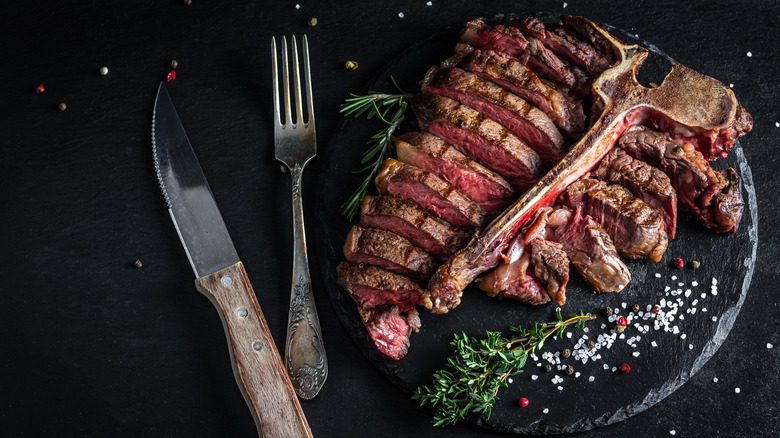
Italian cuisine is known for being indulgent, and few dishes are as decadent as bistecca alla fiorentina. Hailing from the city of Florence, this massive cut of steak is often considered one of the most underrated Italian comfort foods thanks to its rich, beefy flavor. It's not particularly difficult to make at home, but there are some key things to know about the steak and how to cook it if you want to serve up a version similar to what you might find in an Italian restaurant.
To unlock the secrets of what makes a truly great bistecca alla fiorentina, we spoke to Zach Allen, culinary director of All'Antico Vinaio. On April 24th, Allen and his team are launching Florence Underground, a dinner series centered around bistecca alla fiorentina at the Santa Monica branch of All'Antico Vinaio, so the timing was perfect to get his insights. He gave us some expert tips on everything from choosing the right cut to proper cooking techniques and how to serve it for the most authentic experience.
If you're looking to add bistecca alla fiorentina to your repertoire of Italian dishes, these tips can help you get it right at home. And if you happen to be in the Los Angeles area between April 24th and June 26th, you can sample the dish in all its glory at All'Antico Vinaio along with a full Tuscan spread and optional wine pairings. The immersive dinner experience is by reservation only, served family-style, and limited to just 30 seats per night.
What sets bistecca alla fiorentina apart from other steaks?
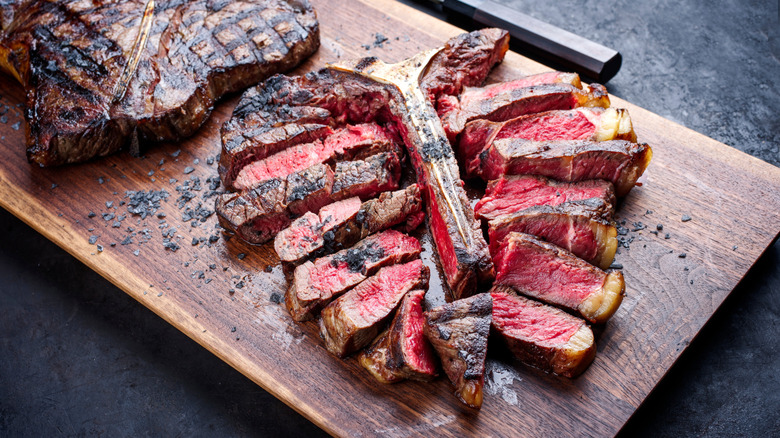
Bistecca alla fiorentina is essentially a porterhouse steak, which is a larger version of a t-bone steak with a tenderloin steak on one side of the bone and a New York strip on the other. However, there are a few key characteristics that set bistecca alla fiorentina apart from your regular porterhouse. For one, it's traditionally made with a cut from the Chianina cow, which is a large breed from the Chiana Valley in Italy's Tuscany region. The breed is renowned for its deeply flavored meat.
The size is also another defining element of this iconic steak. Ideally, it should be thick and hefty. As Zach Allen told us, "There are conflicting camps saying exactly the minimum size, but most agree it needs to be more than 1 kilogram and many say 1.2 kilograms." For folks in the U.S., that's between 2.2 and 2.6 pounds. Allen explained further, "Also, others say tre ditti (three fingers) or quattro ditti (four fingers) as the size, but obviously this varies widely by whose fingers are being referenced."
Then there is the cooking method. Traditionally, bistecca alla fiorentina is cooked over a wood-fired grill to give it a smoky flame-kissed flavor. It's seared on the outside to give it a nice crust, and grilled to rare so that the inside is tender, juicy, and red. In addition, the seasoning is usually quite simple, with many people just adding salt and olive oil so that the flavor of the meat really shines through.
Start with a thick, high-quality cut
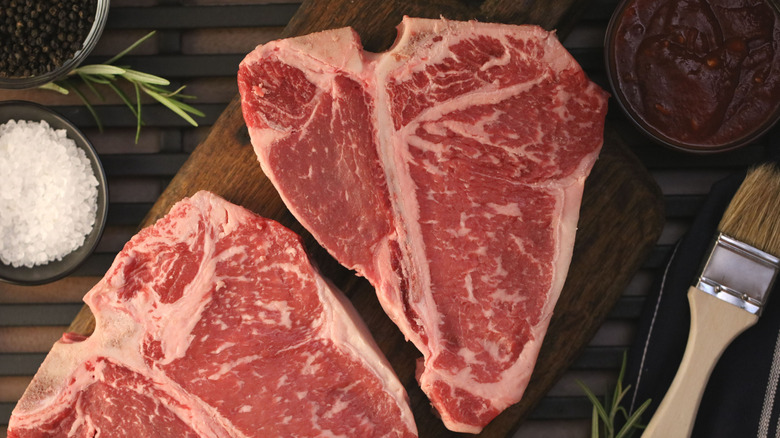
A great steak starts with a great cut of beef, and that's particularly true for bistecca alla fiorentina. As mentioned, Chianina beef is the usual go-to, but Allen pointed out that it can be hard to find outside of Italy, and even in regions other than Tuscany. "A great substitute is grain-finished Black Angus," he said. Originating in Scotland, this breed of cattle is known for having well-marbled meat. That marbling helps keep the meat tender and moist during cooking.
What the cow eats during its lifetime can also make a difference in the texture and flavor of the beef. For example, there is a flavor difference between grass-fed and grain-fed beef, with grass-fed beef being leaner and slightly earthier, and grain-fed beef being fattier and richer. Grain-finished means that the cows mainly grazed on grass, but were fed grains towards the end of their life. That gives you some of the earthy flavor from the grass diet with extra marbling from the grains.
Beyond quality, pay attention to how the steak is cut. As mentioned, a proper bistecca alla fiorentina should be thick because it needs to be able to handle high heat without overcooking in the center. If the steak looks thin or uneven, it won't cook the same way. At the butcher counter, ask for a center-cut porterhouse with a generous tenderloin and strip on either side of the bone.
Prep the steak properly before it hits the grill
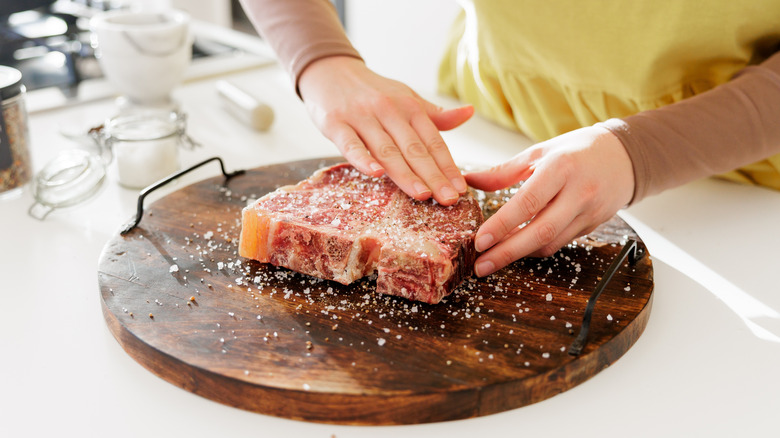
Bistecca alla fiorentina is a rustic dish that doesn't require a whole lot of preparation. However, there are a few steps you can take before the meat hits the grill to ensure you get the most out of it. Zach Allen told us, "First, the steak should not be straight out of the refrigerator." Allen's pro temperature tip for evenly cooked beef is to let some of the chill dissipate. He said, "Let the meat sit on a rack or pan open for at least one hour at room temperature."
The reason you don't want your beef chilled when you put it on the grill is because the heat will take longer to reach the center. By the time the center reaches the proper temperature, the exterior may be dry and overcooked. With big cuts like a porterhouse, letting the meat come to room temperature first (also called tempering) is especially important for that even transfer of heat.
While your meat is tempering, this is a great time to give it some seasoning. Allen recommends salting the meat both before and after cooking. "The first time with kosher salt and finish with a flaky salt at the end," he said. There's no set-in-stone rule for how far in advance to salt your steak, although many believe that at least 40 minutes prior to cooking is a good rule of thumb because that gives the salt time to fully penetrate the meat.
Make sure your grill is screaming hot
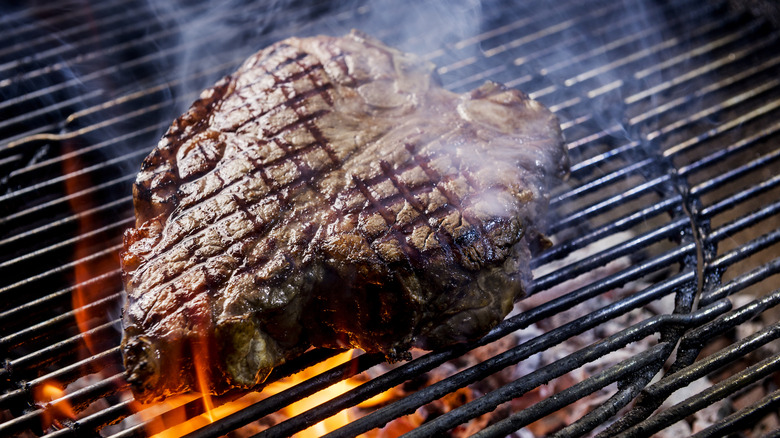
As mentioned, the traditional way to cook bistecca alla fiorentina is over a wood-fired grill, but charcoal will also work to infuse it with a bit of smoke. Regardless of what cooking fuel you're using, Allen told us you want your grill as hot as it can reach. He said, "Ideally, build a fire on one side to grill the steak on and one side without fire to move the steak to bring [it] to the ideal temperature."
That intense heat is what will give your bistecca a beautiful outer crust. It's all about the Maillard reaction, a process similar to caramelization where the sugars react with the amino acids in the meat and create a crispy brown layer on the exterior. The Maillard reaction can only happen when the temperature is between 285 and 330 degrees Fahrenheit, so you need your grill to be blazing hot when you first throw the meat on.
If you don't have access to a grill, a cast iron skillet or pan can also do the trick, and the same high-heat rule applies. The easiest way to tell if the surface is hot enough is to use an infrared thermometer or a surface thermometer. In lieu of that, you can look for visual cues like oil smoking slightly in the pan. For stainless steel pans, you can also use the water droplet test: Just add a drop of water to the pan, and if it bounces and rolls around before evaporating, your pan is likely hot enough.
Try a two-step cooking method
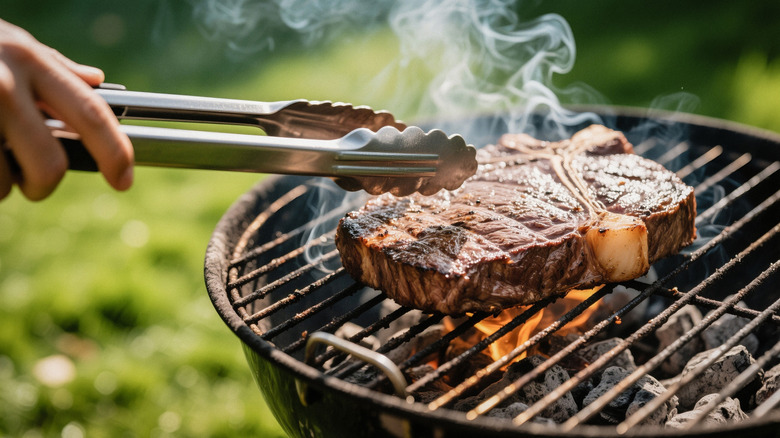
Larger cuts of beef can be tricky to cook, particularly a porterhouse, because you're dealing with two steaks in one. Fortunately, Zach Allen has a pro tip for how to cook porterhouse steak so the inside stays irresistibly juicy. He recommends a two-step process where you cook the steak in two separate sessions. "I believe the two-step process for cooking the beef yields a more tender and juicy steak," he said.
For the first step of Allen's process, you sear one side of the steak on the grill, rotating it about 90 degrees after a few minutes, then repeat that process on the other side until the internal temperature is about 85 degrees. "Pull the steak off the grill and let [it] rest for a minimum of 10 minutes," Allen said. "During this rest, the steak will climb to about 90 degrees." The final step is grilling both sides of the steak again (on the area of the grill with no fire) until the internal temperature is about 108 degrees.
Purists will tell you that bistecca alla fiorentina should be cooked rare, which means you want the internal temperature to be about 120 degrees. Allen's method will get you there thanks to carryover cooking (more about that next). Of course, there's nothing to say you can't cook your steak to medium rare (130 degrees), medium (140 degrees), or even more if that's the way you like it. Either way, a meat thermometer is a must for getting your internal temperature just right.
Don't skip the resting time
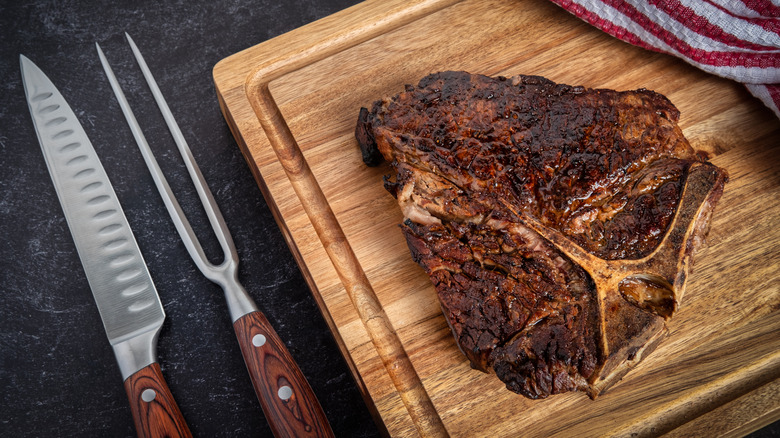
As soon as the steak comes off the grill, you might be tempted to slice it right away so that you can serve it while it's still piping hot. However, most chefs will tell you that it's a major mistake to cut into meat right off the grill. What you want to do instead is let your meat rest for a bit, as this will make it more tender and juicy. Allen recommends letting your bistecca rest for at least three to five minutes before slicing it.
While there are many dubious cooking myths when it comes to cooking meat, the resting method is actually backed by science. When meat is in direct contact with heat, the muscle fibers tense up, and the juices are forced into the center of the meat. If you cut into the meat as soon as it comes off the heat, the juices will spill out, leaving some parts tough and dry. Resting allows the muscle fibers to decompress and the juices to absorb back into the meat.
It's also worth noting that the meat will continue to cook slightly even as it's resting. This is called carryover cooking, and it can result in an increase of about 10 degrees to the internal temperature. So, if your end goal is rare steak, you want to pull your steak off the grill when the internal temperature is about 110 degrees. Let it rest for at least five minutes, and when you slice it, the steak should be a perfectly tender, juicy rare.
How to serve bistecca alla fiorentina
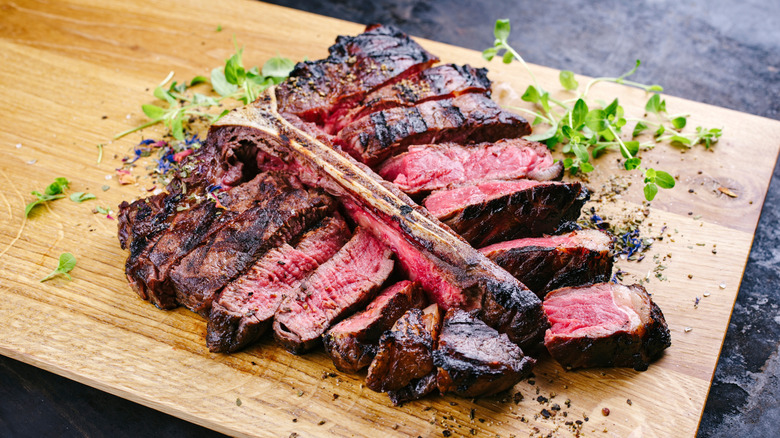
Bistecca alla fiorentina isn't typically just dropped onto a plate and served like any other steak. Historically, it's meant to be shared, with the steak carved into thick slices and served family-style. According to Zach Allen, the steak should be cut into slices about ½ to ¾ of an inch thick. "Once placed back on the plate with the bone, finish with a rub of fresh rosemary, Tuscan extra virgin olive oil, and flaky salt," he said.
As for sides, simple, rustic dishes that complement the steak without detracting from it work best. After all, the meat should be the main star. Allen recommends roasted potatoes, sautéed spinach, and white beans. If you want to add a bit of freshness to the meal, consider adding a simple green salad or an arugula salad with cherry tomatoes.
While bistecca alla fiorentina can certainly be a meal all on its own, you'll often see it served as a "secondo" course, which is the main protein course in a line-up of traditional Italian restaurant courses. The meal might start with antipasti like cured meats or cheese, followed by a primo dish such as pasta or soup, then the bistecca with contorno (sides), and a simple dessert to finish. At home, you can keep things simple by following the same idea. Start with something small, add a light first course if you want, and let the steak be the main event.
Classic wine pairings
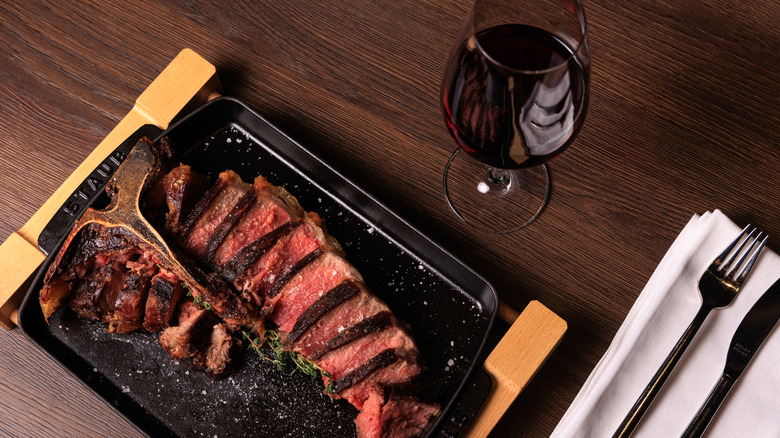
A steak as substantial and succulent as bistecca alla fiorentina calls for a good glass of wine. Red wine and beef are a natural pairing because the tannins in the wine react with the proteins in the meat, balancing out the fatty sensation of the meat and the astringent nature of the wine. Salt can also make the red wine feel more rounded. With that in mind, it's worth looking for red wines that have a decent amount of tannins and enough acidity to cut through the richness of the meat.
If you want to stick to traditional pairings, many people recommend bold Italian reds with bistecca alla fiorentina. Popular choices include Sangiovese-based wines like Chianti Classico and Brunello di Montalcino. A fruity Barbaresco can also pair nicely with the beefy flavors of the steak. And if you want to branch out, a full-bodied Pinot Noir can add notes of dark red fruit to complement the smokiness of the meat, and a bold Zinfandel can mellow out the intense beef flavor.
While red wines are the obvious pairing for red meat, white wines can also work well, provided they have enough body to stand up to the beef. Think an oaky chardonnay with buttery notes, a Hermitage Blanc with a luscious mouthfeel, or a rich Riesling. Orange wines (aka skin contact wines) can also be a good pairing because the juices are fermented with the skins, and that gives them more beef-friendly tannins.