

Cooking With $10 Vs $50 Olive Oil: Does It Really Make A Difference?
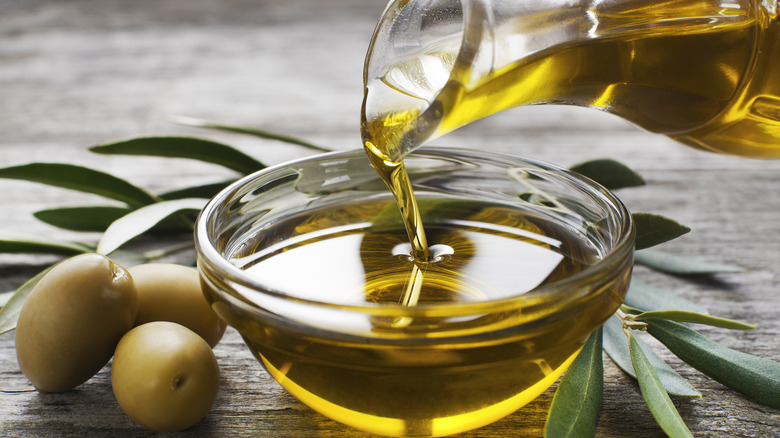
Imagine this scenario: you're at the grocery store, you need to replace your olive oil before you can cook for the evening, and you're looking over the rows and rows of olive oil, trying to decide what to grab. Do you reach for the plainest, cheapest bottle to protect your checking account, or do you splurge and go with the fancier, more expensive bottle that looks like it's straight out of the Italian countryside? Does it really matter?
The short answer: yes! Yes, it does. After talking to several chefs across America and even one from Italy, we'll get into how not all olive oils are made equal. Sometimes you can use a lower-cost oil — and sometimes you really do want to grab that pricier version to enhance your meal. It all depends on what you're making and what kind of experience you want to have. Take a look at the tips from our esteemed chef experts below, and next time you get bleary-eyed while shopping, you'll be well-prepared!
Use cheaper oil for high-heat cooking, or as a foundation
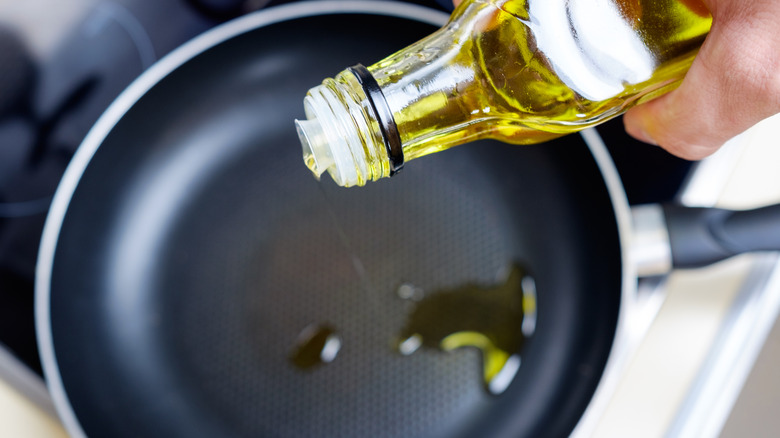
There is one very clear example of when not to waste an expensive bottle of olive oil: if you're sautéeing, searing, or frying, it's okay to choose a less expensive option. Tim Bodell, Executive Chef at Rustic, tells us that when you're working with high heat, a lower-quality oil is totally fine. Bodell says, "All those delicate aromas and flavors that you pay for in a premium oil just get cooked out. A good, everyday extra-virgin olive oil works perfectly for the base of a dish, then you can save the expensive stuff for the finish."
Another time to use the cheaper stuff is when the other flavors of what you're working with will overpower the oil. Chef Dustin Everett, Executive Chef at Fish Cheeks, notes that cheaper olive oil "is also a great option for dishes like a gently simmered pasta sauce with garlic and shallots, where the oil serves as a foundation rather than the focal point, allowing the other ingredients to shine."
Victor Gothelf, Executive Chef at Port Sa'id, agrees and offers more examples. "Once I'm above 350 degrees Fahrenheit, I'm burning away the grassy and peppery notes that I'm paying for in a higher-quality oil," he says. "So in cases like sautéing onions and garlic, roasting vegetables, frying eggs or proteins like schnitzel, or making sauces, I'll use a more affordable olive oil."
Use pricier oil for raw food, finishing, and drizzling
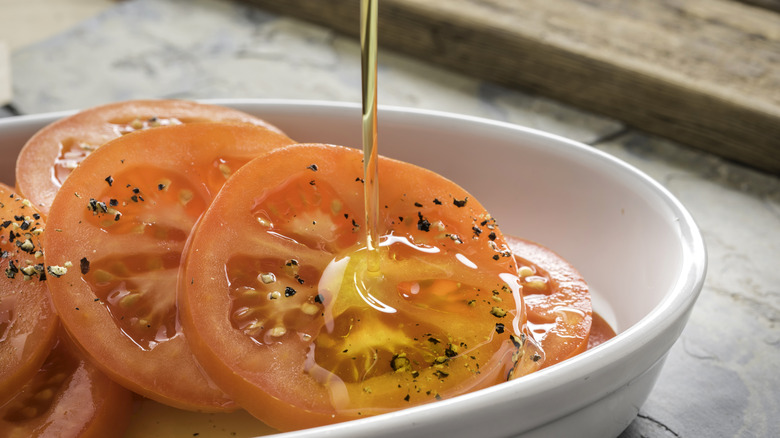
Although the choice to go pricier may sting your wallet, it will delight your taste buds — reach for the more expensive oil on specialized dishes where the taste of the oil will shine. As Chef and Owner Victor King of The Essential says, he'll use a more expensive oil "any time I have a really excellent piece of fish to eat raw, but the real winner is tomatoes." That's why you'll often see drizzled oil on top of a caprese salad at a restaurant, for example. Max Wittawat, Executive Chef at Bangkok Supper Club, agrees. "I like to use a high-quality olive oil on simple, ingredient-driven dishes, like a tomato salad or drizzled over toasted sourdough," he says. Both of those plainer items will allow the flavors of the oil itself to come through as a compliment to the food.
Kit Garrett, Owner of Red Hog, provides even more examples: "Something with a lot of raw ingredients (salads, fresh crudité, desserts) or when finishing some freshly grilled vegetables — anytime you want to let all the good ingredients speak in harmony together."
While many of these chefs emphasize fish and veggies, don't forget about using an expensive oil to finish red meat. Chef Bodell reminds us, "After we grill the steak ... we finish it with a generous drizzle of a really good, peppery olive oil. That moment — when the oil hits the hot, charred meat — is where you really taste and smell the quality." Although I hadn't tried olive oil on steak before, this was something that Chef Marc Murphy had mentioned in our conversation about getting a perfect sear on steak, as well.
High quality olive oils smell better
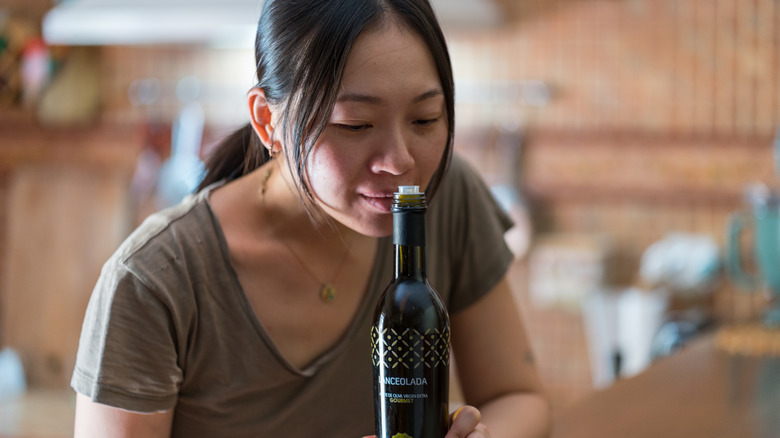
One big difference between $10 olive oil and $50 olive oil is the smell. Frankly, a cheaper oil doesn't have much smell at all or might smell greasy, while a more expensive oil will have a distinct smell, taste, and even color. If you've never taken a whiff of good (expensive) olive oil, now's the time to try it!
Chef Martin Lazarov, Head Chef at Principe di Belludia, says it best: "A good oil smells fresh, has natural bitterness and spice, and is harmonious overall. If the oil is flat, anonymous, or heavy, it isn't quality, regardless of price." He continues, "Oil is an ingredient, not a mere condiment. The aroma builds the first aromatic impression of the dish."
What should you be looking or sniffing for? Chef Wittawat says, "Higher-quality olive oils tend to have a deeper green color and a fresh, grassy aroma." Chef Gothelf agrees, "I forget the price and use my senses. Smell is number one, I'm looking for fresh-cut grass, leaves, or green almonds. If it smells flat or waxy, I avoid it." Chef King puts it more simply: "If it doesn't smell appetizing, it isn't. Bad olive oil smells like a bog." So don't be afraid to trust your instincts! If the olive has little to no smell, it's probably best for starting the dish, not finishing or dressing.
Pricier, cold-pressed oils can offer a better taste
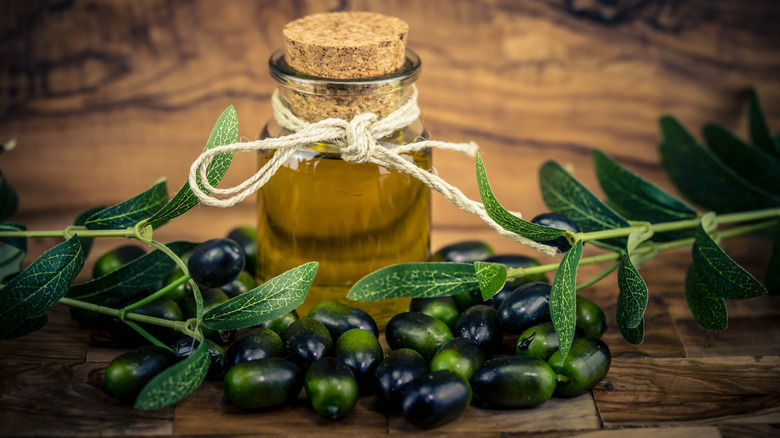
In addition to the smell, if you have the option, taste your oil, and the difference between a cheap and a more expensive oil will be easy to discern. A pricier olive oil is almost always higher quality with more complex flavors that will make you want to taste more! Chef Bodell advises, "A cheaper oil might feel greasy or have a flat, sometimes even metallic on the finish. A really good oil is totally different. You'll feel a little peppery kick in the back of your throat, which is actually a good sign, and the flavors are bright like fresh-cut grass or green tomatoes."
Chef Gothelf elaborates: "For me, high quality comes from early harvest olives, cold pressing to preserve aromatics, and single-origin sourcing for clarity of flavor." As for the taste itself, "I want a slight bitterness and a peppery burn at the back of the throat with a clean finish that isn't greasy. The texture should feel alive and sharp, not heavy."
If you're at a grocery store and/or in a rush, one way to check the quality without tasting is looking at the label for something cold-pressed, as Chef Gothelf mentioned. A cold-pressed oil often retains more of its aromatic qualities and nutrients than olive oils processed through heated machinery. Chef Lazarov expands on that idea: "The quality of oil starts primarily with the raw material and freshness: healthy olives, harvested at the right moment and pressed quickly. What makes the difference then are cold extraction, low acidity, and proper storage."
High-end olive oils tend to take longer to spoil
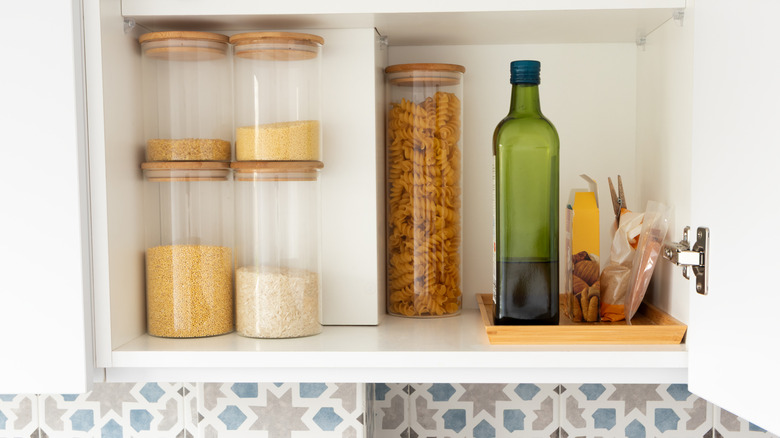
While it's true olive oils at both price points can eventually go bad, as Chef Bodell explains, the quality of the oil helps keep it better tasting for longer: "The best olive oils start with olives that are harvested early. But just as important is how quickly those olives go from the tree to the press. The best oils are pressed within hours of being picked. That short window helps prevent oxidation and keeps the oil fresh, vibrant, and true to the fruit."
Cheaper oil is more prone to oxidation in a shorter amount of time, which gives it a spoiled taste — and if that happens, you definitely want to throw it out. Chef Bodell continues, "The only oil that can really 'ruin' a meal is oil that's past its prime ... If you use an old, oxidized bottle to dress something delicate – like an Insalata di Mare– the stale flavors will coat your palate." He also mentions that rather than checking the "sell by" date, you should always check the "harvested" date (if available) on the bottle, to make sure you have accurate information.
Especially with a pricier oil, make sure you are storing it correctly, too, just like a nice bottle of wine. Chef Wittawat recommends "Olive oil should be kept away from heat, light, and air." He points out that if you live in a hot and humid climate, you might want to consider even storing your olive oil in the refrigerator.
Premium olive oil may be more versatile
The final way to think about the difference between $10 olive oil and $50 olive oil is that the more expensive version can be used on many more occasions, on a multitude of dishes, which will ultimately give you more bang for your buck. While a cheap olive oil may be more wallet-friendly, you're only ever going to be able to use it in one place: at the bottom of your pan. Chef Wittawat mentions this versatility in one of his personal favorites: "Lately, I have been using an extra virgin olive oil from Omed that I really enjoy. It has a clean, well-balanced flavor with a fresh quality and a subtle peppery note, which makes it versatile enough to use across a range of dishes without overpowering the other ingredients."
However, across the board, our chef experts agree that you should choose your oil like you choose your wine — different bottles for different experiences. Executive Chef/Owner Emil David of Perso and Ciao explains: "In many ways, olive oil is similar to wine. Finding the right one takes a bit of tasting, research, and trust in the brand. Factors like the origin of the olives, the producer's reputation, and their production methods all play an important role."
When in doubt, try a few different kinds of olive oil to find what you like! Not all favor profiles are going to be your favorite, just like any complex varietal. Practice observing, smelling, and tasting — practice makes perfect! Chef Bodell wraps up the idea nicely by saying, "Olive oil is like wine; it brings a sense of place ... Match the oil to the intensity of the moment, and you'll get the most out of both."