

The 10 Biggest Controversies To Go Down At Texas Roadhouse
Texas Roadhouse has built a reputation as a go-to spot for hearty steaks, fresh-baked bread, and a lively, family-friendly atmosphere. From its neon signs to country music and line-dancing servers, the chain has found a winning formula that's allowed it to surpass Olive Garden as the top U.S. casual dining chain. Over the years, Texas Roadhouse has expanded rapidly across the U.S., becoming a familiar name for both casual diners and special occasions. And while we've already talked about things to know before you eat at Texas Roadhouse, like the overall vibe and menu options, we didn't mention that the chain has also faced its share of controversies over the years.
From viral TikTok videos to legal battles and labor disputes, these incidents have sparked conversation among both casual diners and industry watchers alike. Though none of these controversies have derailed the chain's overall success, they've certainly shaped public perception and highlighted areas where operations or policies came under scrutiny. Below, we take a closer look at some of the most notable controversies and scandals surrounding Texas Roadhouse, diving into what happened, how the company responded, and the overall fallout. Whether you're a die-hard fan or cautious first-timer, these stories paint a bigger picture, giving context to the brand's triumphs along with its challenges.
1. In 2008, a cook was caught putting hair in a customer's steak

In what could possibly be one of the grossest — and most notorious — food-tampering incidents in restaurant history, a cook at a Texas Roadhouse in West Bend, Wisconsin, intentionally contaminated a customer's steak with his own hair after an order dispute in February of 2008. The issue began when diner Kevin Hansen ordered a steak but received it more well-done than he expected. The chain is typically pretty focused on customer service, even letting patrons pick out their own steak. So, although Hansen didn't initially intend to send it back, an assistant manager encouraged him to take a new steak to go.
According to court documents, cook Ryan Kropp felt that the complaint was Hansen's attempt to get free food. After preparing the replacement steak, Kropp cut a slit in it and placed his own hairs inside; a coworker heard Kropp proclaim this. The steak was sent out in a to-go box and taken home by Hansen, who discovered the hair the next morning and filed the incident report with the police. He initially said he didn't consume any hair, but his amended complaint says he did. There is no mention if the steak was cooked to his liking the second time around.
Kropp was fired by Texas Roadhouse and charged and convicted of placing foreign objects in an edible. Hansen sued Texas Roadhouse, alleging negligent supervision and breach of implied warranty. A jury initially awarded him nearly $150,000 in punitive and compensatory damages, but in 2012, the Wisconsin Court of Appeals overturned the ruling, saying that the restaurant's actions didn't cause Kropp's conduct.
2. There was a sexual harassment suit involving a location manager in 2014
Despite being regarded by many as one of the best chain steakhouses to eat at if you're on a budget, especially with the family, Texas Roadhouse's reputation was marred by a serious, very much not family-friendly workplace misconduct controversy. In 2014, the U.S. Equal Employment Opportunity Commission (EEOC) filed a federal lawsuit against a Texas Roadhouse franchise location in Columbus, Ohio, and its management company, alleging widespread sexual harassment and retaliation.
According to the EEOC's complaint, Eric Price, the managing partner of the restaurant, subjected female employees, including some as young as 17, to repeated sexual harassment between 2007 and 2011. The allegations included groping, humiliating remarks about bodies and sexuality, and pressure for sexual favors in exchange for favorable treatment or to avoid negative employment actions. Management allegedly bragged about hiring women based on their attractiveness and "screw-able" qualities (this phrase was specifically highlighted in the EEOC's press release about the case).
Complainants also reported retaliation for opposing or attempting to report the misconduct, including loss of hours, interference with work schedules, demotions, and hostile work environments. After multiple complaints over several years and the EEOC filing, Price was eventually fired in May 2011. For many, this took far too long, despite the ongoing reports. In 2016, the EEOC announced that the restaurant and its management company agreed to a $1.4 million settlement to resolve the lawsuit without admitting liability. The settlement also included offering reinstatement to victims, mandatory discrimination and retaliation training, and prohibitions to stated companies from rehiring Eric Price.
3. In 2016, a server was fired after racist tweets
One of the most jarring controversies in Texas Roadhouse history unfolded in July of 2016, when a server at the chain's Greeley, Colorado, location was fired after posting a racist and violent tweet that quickly went viral. The employee, identified in a news reports as Megan Olson, reportedly took to Twitter and wrote, "If we had a real life purge I would kill as many Mexicans as I could in one night," (via ABC7) a disturbing message that triggered swift backlash online and offline...all, allegedly, over a poor tip.
Screenshots of the offending tweet circulated on the restaurant's social media, prompting customers and community members to call out the establishment and call for action. According to company spokesman Travis Doster, the restaurant's managing partner was out mowing his lawn when he found out. "He immediately rushed to the restaurant, met with the employee who posted this disgusting tweet and she was terminated," said Doster. He went on to emphasize, "This type of offensive, discriminatory language has absolutely no place at Texas Roadhouse."
Olson later apologized on her personal Facebook page, saying, "I wrote hurtful, inconsiderate, insensitive and careless words and I understand the amount of people I have offended by that. There are no excuses for what I have done. I sincerely, from the bottom of my heart, apologize to everyone for my momentary lack of judgment. I want you all to know that I do not actually feel this way." Despite the apology, the decision to fire her was widely seen as necessary damage control.
4. Texas Roadhouse settled a suit for age discrimination in 2017
In 2017, Texas Roadhouse once again found itself settling with the EEOC due to a major age-discrimination controversy that spanned nearly a decade. The EEOC had originally filed a nationwide lawsuit in 2011, alleging that the steakhouse chain systematically refused to hire applicants over the age of 40 for front-of-house positions like servers, hosts, and bartenders, a violation of the Age Discrimination in Employment Act (ADEA).
According to the EEOC, managers at some locations discouraged or rejected older applicants by implying they wouldn't fit in with the brand's youthful, high-energy image. As part of its claims, the agency said the chain's recruiters and hiring officials made comments suggesting a preference for younger, fresher candidates, potentially dissuading those over 40 from being hired for customer service roles. To avoid another lengthy retrial, both sides agreed to settle. Texas Roadhouse agreed to pay $12 million to resolve the dispute without admitting liability.
The consent degree within the settlement also included some other important obligations for the company. Texas Roadhouse agreed to implement new hiring and recruiting practices designed to prevent age bias, hire a diversity director, and fund an independent compliance monitor to ensure these reforms were followed. The settlement fund was set up to compensate applicants over age 40 who had been denied front-of-house jobs between 2007 and 2014.
5. In 2018, a manager tried to cover up a breastfeeding mother
Some parents choose to breastfeed, some formula feed, and some do both. Sometimes they'll go well past the infancy stage (and with milk recalls that affect millions of people, you can't blame them). There are pros and cons to all options, but one of the cons of breastfeeding is that babies need to eat when they need to eat, and sometimes, that's while you're out in public. As a result, in the U.S., public breastfeeding is legally protected. In Kentucky, for instance, the law states, "a mother may breast-feed her baby or express breast milk in any location, public or private, where the mother is otherwise authorized to be," and breastfeeding is not considered indecent exposure.
Despite this, a disturbing and frustrating incident occurred at a Texas Roadhouse in St. Matthews, Kentucky, in November of 2018. Sadie Durbin was dining with her family and began nursing her seven-week-old daughter. Seeing this, the restaurant manager approached her with a large napkin and allegedly insisted she cover up because other customers had complained. According to Durbin's lawsuit, the manager attempted to place the napkin over the baby's face and her own breast, causing her to feel embarrassed and distressed.
Durbin posted her experience on Facebook, and the story quickly went viral, provoking public outcry and heated discussions about breastfeeding rights. Texas Roadhouse issued a statement saying the employees' conduct was "misguided and wrong" and that the chain supports the rights of mothers to nurse in its restaurants. The employee was placed on paid leave while management worked to reinforce training about breastfeeding laws.
6. A military dog caused a stir when it ate at a table in 2022
In late 2022, Texas Roadhouse made headlines for an unusual viral moment that sparked both praise and criticism: a military veteran dog sitting at a table inside a restaurant, eating a meal. The pup, described as having served alongside soldiers in Afghanistan, was being treated to a special steak and fries — reportedly part of a Veterans Day tradition at that location — when someone recorded the moment and shared it online.
Of course, the video quickly went viral, drawing attention to differing opinions about what's appropriate in a restaurant setting. Supporters highlighted the dog's service and reserved status, saying a well-behaved veteran animal enjoying a steak was heartwarming and deserved celebration. Critics, however, argued that a dog eating at a dining table and off of utensils was unsanitary and inappropriate, regardless of the reason.
One good outcome of the situation was that it highlighted Texas Roadhouse's ongoing relationship with the military community. The company offers discounts for military members and veterans at many locations and participates in national Veterans Day efforts; some locations even provide a free meal for Veterans Day.
7. In 2023, an employee endured racist abuse from customers
In May of 2023, Texas Roadhouse was once again thrust into the spotlight due to a racist incident, this time from customers rather than an employee. A viral video documented the deeply troubling incident at a West Chester, Ohio, location, where a server recounted the story of how a Black server named Arthur Mandy was verbally harassed by a group of diners, many of whom were dressed in Confederate-themed clothing.
According to local news coverage, Mandy was originally asked to serve a party of 11, but what began as a routine night quickly deteriorated as the guests ignored him, refused eye contact, and later began directing slurs, including the n-word, and consistently called him "boy" in a derogatory way. He said the barrage of disrespect and dehumanizing behavior caused him to step away and collect himself outside the restaurant.
Mandy's coworker posted the encounter on TikTok, where it garnered hundreds of thousands of views. Many commenters criticized the customers' conduct and called out the management's handling of the situation. A Texas Roadhouse spokesperson told local media that the company does not condone harassment or discrimination and strives for a respectful environment, noting that the guests were eventually asked to leave after several complaints, and that managers checked in on Mandy during and after the incident. The Cincinnati-area NAACP launched its own investigation, saying it hoped the exposure would lead to accountability for those who use racist language. While no legal action was pursued, the event did spotlight the racial discrimination that people of color often face in everyday interactions.
8. A woman claimed to overhear management plot against an employee in 2024

One of the more bizarre controversies swirling around Texas Roadhouse came in 2024 from social media and, notably, not from any legal filings against or from the company itself. In August of 2024, TikTok creator Tara Rule posted a video claiming she overheard a conversation between what she believed were Texas Roadhouse corporate managers at a location inside Washington, D.C.'s Reagan National Airport. According to the video's on-screen text, the group was discussing how to terminate an employee who was reportedly in the intensive care unit (ICU), allegedly by sending a fake benefits package designed to trick the employee's husband into signing away her job.
Rule's video quickly went viral, racking up millions of views and drawing widespread outrage online. The alleged conversation, if real, suggested a corporate willingness to deceive a disabled worker for termination purposes, a claim that struck a nerve with viewers aware that laws like the Family and Medical Leave Act (FMLA) and Americans with Disabilities Act (ADA) are meant to protect employees from these situations.
Now, importantly, Texas Roadhouse pushed back on these claims. In statements on sites like Facebook, the company said the TikTok claims were false and added that spreading unverified information about private conversations was inappropriate and misleading. Critics pointed out that speaking loudly in public areas like airports generally does not carry privacy protections, and many social media users weren't convinced by the brand's response. However, no official investigation or lawsuit was ever launched for this event.
9. In 2025, a Tiktok went viral showing staples in Texas Roadhouse bread
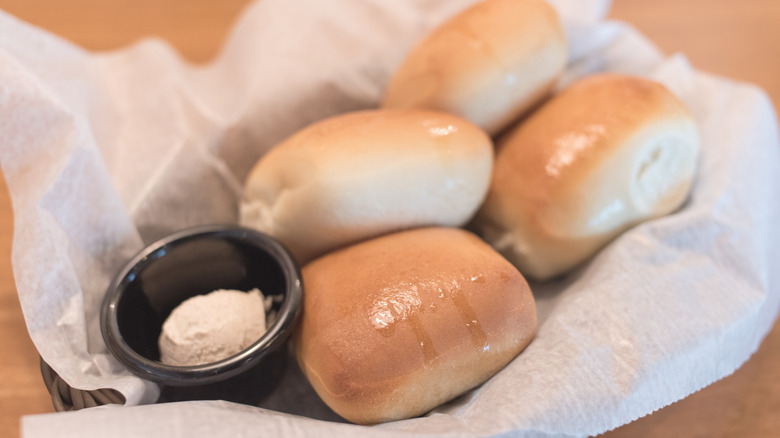
In August of 2025, a Texas Roadhouse in Walpole, Massachusetts, became the center of an online firestorm after a TikTok video showed staples baked into the chain's famous dinner rolls. The video, posted by TikTok user @maymonayy, shows her sister biting into what was supposed to be a freshly baked roll and discovering something sharp inside. Upon breaking apart the roll, the family says they found multiple unused staples embedded in the bread. Of course, the video quickly went viral, garnering millions of views.
After the video spread, local health inspectors reportedly visited the restaurant and said they didn't find signs of physical contamination in the kitchen or baking areas, according to a Texas Roadhouse statement to local media. The company also added that it was actively investigating the situation and had contacted the guests involved. However, accounts online vented frustrations over how managers addressed the family's complaint, including questioning whether the meal was fully comped as promised.
Critics pointed out how disturbing it was that staples could potentially make it into food, especially considering that foreign object contamination has led to some of the biggest food recalls in U.S. history. While no formal recall or lawsuit was announced in connection with this specific video, the incident quickly became one of those controversies that fueled a lot of attention for a while.
10. Over the years, Texas Roadhouse has had multiple suits against it for wage theft and labor violations
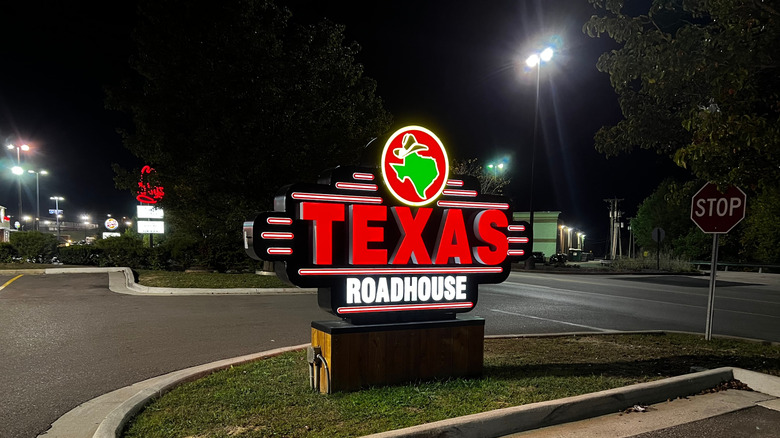
Over its decades in business, Texas Roadhouse hasn't just drawn attention for its steaks and rolls — it's also faced recurring legal troubles tied to wage and labor disputes. One of the most notable early controversies dates back to 2012, when the company agreed to settle a class-action lawsuit with wait staff for about $5 million. Employees claimed the chain violated Massachusetts law by retaining and redistributing their gratuities to managers and other non-tip-eligible staff, and by improperly applying a "tip credit" against minimum wage requirements. Under that settlement, Texas Roadhouse agreed to compensate affected servers and change how tips were handled.
In 2020, another high-profile fight involved tipped workers in Kentucky alleging their employer failed to pay minimum wage for certain job duties and improperly claimed tip credits under the Fair Labor Standards Act (FLSA). A federal judge ruled the case could proceed, allowing employees to pursue claims for unpaid wages. The case is still in litigation, as is a wage and hour class action suit filed in California in 2024.
And it isn't just wage claims. Official filings show Texas Roadhouse was charged in 2025 by the National Labor Relations Board in Indiana for allegedly violating workers' rights, including issues related to retaliation and coercive actions. Texas Roadhouse, for its part, has denied wrongdoing in these suits and typically has agreed to settle without admitting liability.