

9 Types Of Korean Side Dishes (Banchan), Explained
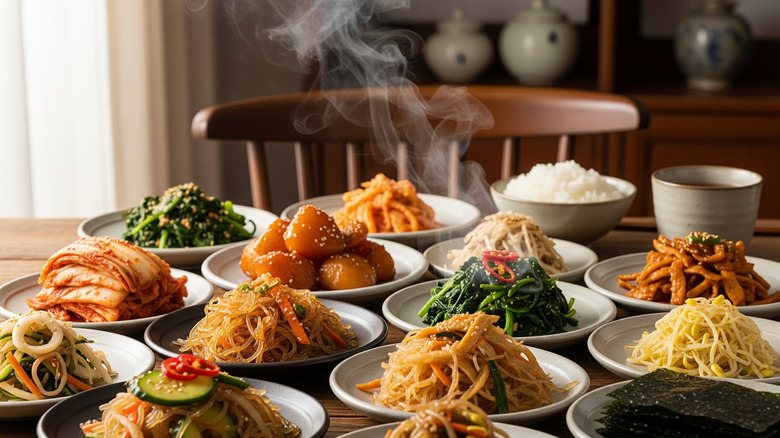
If you've ever eaten at a good Korean restaurant, you'll know that meals are basically incomplete without banchan. These small side dishes accompany almost every Korean meal and range from tangy fermented vegetables to highly seasoned bits of proteins. Banchan are meant to complement the main course and, most importantly, to be shared among everyone at the table.
This unique communal dining experience has been a part of Korean culinary tradition for centuries, with its roots tracing back to the Three Kingdoms period from 57 B.C.E. to 668 C.E. During the Joseon Dynasty from 1392 to 1910, the number of banchan was often a reflection of social status, with common folks having maybe a handful during meals while the royal court served a dozen or more banchan, along with rice, soups, and various proteins.
For me, banchan represents something deeper than just food. My tastes were shaped in part by my grandmother, Rumi, whose dishes were influenced by her upbringing in Seoul. While we are ethically Japanese, the flavors and aromas coming from our kitchen were a blend of both cultures. It wasn't uncommon to find gamja bokkeum mixed in with crisp bites of mochi or mu saengchae made with daikon radish instead of Korean radish. Banchan has been an integral part of my life since birth, and it's something I hope to pass down to future generations. If Korean cuisine is new to you, use this list as your guide to nine essential types of banchan you should try.
1. Kimchi
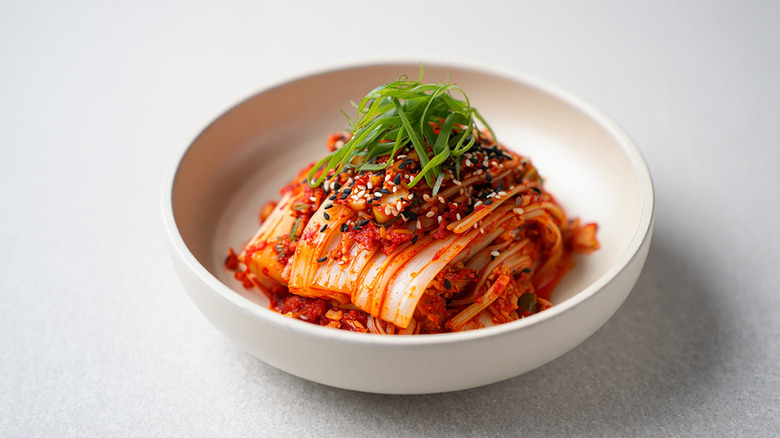
Kimchi is a fermented vegetable banchan that's seasoned with gochugaru (Korean red chili flakes), garlic, fish sauce, shrimp paste, sesame seeds, scallions, and ginger. It's by far one of the most popular banchan around the globe and is served at nearly every Korean meal. It's well-known for its tangy, spicy, salty, and umami flavor that develops as it ages.
The most common vegetable used in kimchi is Napa cabbage, which is often referred to simply as "kimchi" since it's the most loved and widely recognized variety outside of Korea. However, kimchi can still be considered "kimchi" if it's made with other vegetables. Think of kimchi as a method of preparation rather than a dish. You can take its core elements — fermentation and spicy, umami seasonings — and apply them to any vegetables or fruit that best suits your taste. Whether you make it with cucumbers, radishes, perilla leaves, or carrots, if you follow the fermentation process and the seasoning profile remains the same, you've created a delicious side dish of kimchi.
2. Namul
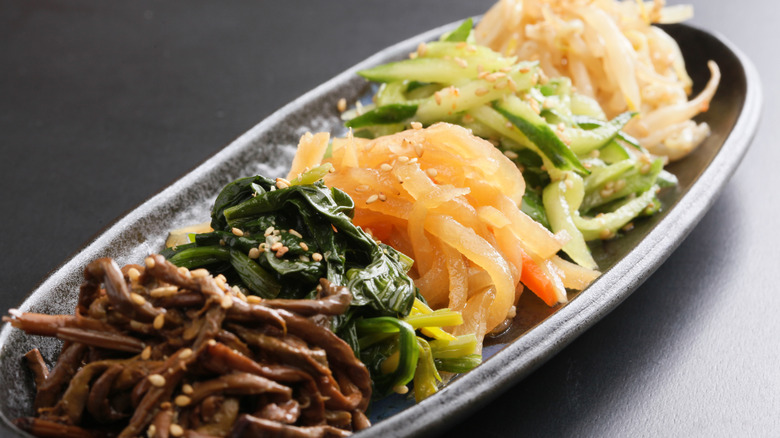
Namul refers to a wide category of seasoned vegetable side dishes that are typically blanched, steamed, or stir-fried and seasoned with sesame oil, garlic, sugar, salt, vinegar, soy sauce, and occasionally gochujang (Korean fermented chili paste) for a spicy kick. Namul is usually lightly seasoned, so the main characteristic of the dish is the freshness of the vegetables. The light seasoning allows you to taste the vegetables' natural flavor, while the sesame oil and soy sauce add a lovely richness without overpowering the dish.
It can be made with green leafy vegetables, bean sprouts, mushrooms, bracken fiddleheads, or starchy root vegetables. Namul is extremely versatile; it's a great way to showcase seasonal vegetables or use up any produce you might have wilting away in the fridge. It can be served warm, at room temperature, or chilled, depending on which dishes you pair with it. Oftentimes, a variety of namul containing spinach, mushrooms, and burdock root are used as components in the beloved Korean dishes you should try at least once, like bibimbap and kimbap.
3. Gyeran jjim
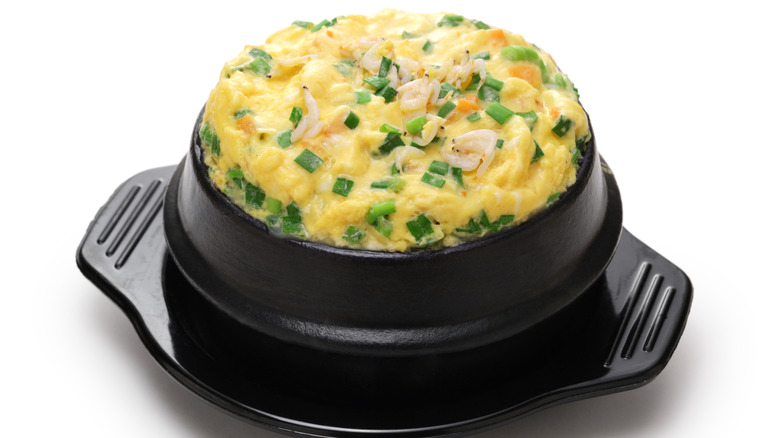
Gyeran jjim is a popular Korean steamed egg banchan made by gently steaming beaten eggs and anchovy broth to create an eggy custard-like texture that will surely make anyone's mouth water. It can also be made with saeu-jeot (salted shrimp) or fish sauce instead of anchovy broth, giving it a deeper umami flavor. The finished dish is often seasoned with a drizzle of soy sauce and sesame oil, then topped with some sliced scallions and sesame seeds. The rich nuttiness from the sesame oil pairs perfectly with the creamy, fishy flavor from the eggs, resulting in a delicious savory side dish that will complement any meal it's paired with.
This banchan is typically cooked and served in a traditional Korean earthenware stone pot called a "ttukbaegi." While it isn't necessary to have a ttukbaegi to make gyeran jjim, it's convenient to have one on hand since it keeps the eggs warm long after cooking, so you can enjoy the other yummy banchan alongside it on the table.
4. Myeolchi bokkeum
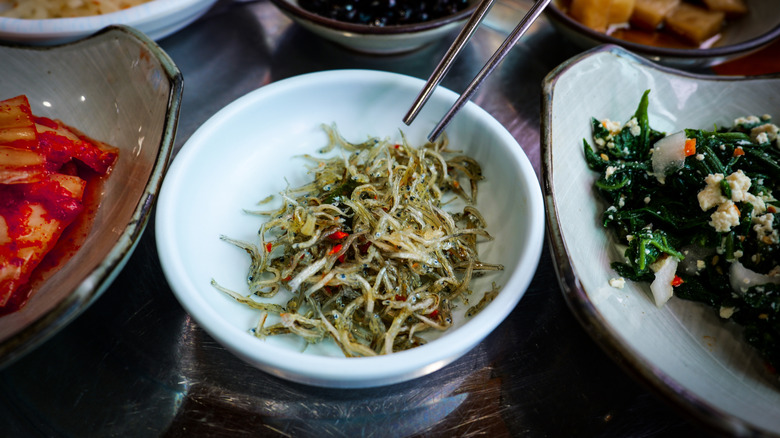
Myeolchi bokkeum is a banchan consisting of stir-fried dried anchovies flavored with a slightly sweet glaze made from honey, sugar, garlic, chopped nuts, sesame oil, and occasionally gochugaru. This unique banchan has a delightful and salty taste with a concentrated umami fishy flavor. If you're worried about it being overwhelmingly fishy, don't fret! The dried anchovies are typically stir-fried without any oil before adding the sweet glaze to get rid of any excess fishy flavor. Beyond the delicious flavor, stir-frying the anchovies gives them a super crispy texture that almost becomes caramelized from the sugary honey mixture, resulting in a crisp, umami-packed bite.
Unlike freshly made banchan such as namul, myeolchi bokkeum is considered a "mitbanchan," which is a category of well-preserved banchan that can be kept on hand and stored in the fridge for an extended period of time. It's commonly served with steamed white rice, kimchi, and other banchan dishes. You can also find it being served with Korean barbecue (follow these tips for an unforgettable meal) or paired with hearty, meaty stews like yukgaejang and kimchi-jjigae.
5. Hobak buchim
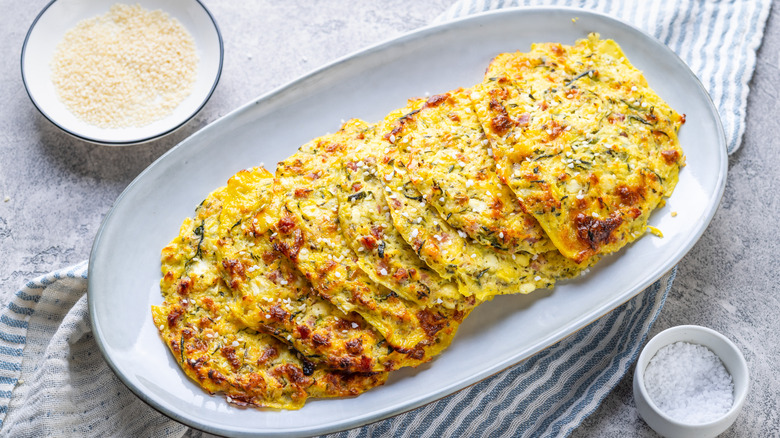
Hobak buchim are Korean savory pancakes made from thinly sliced zucchini and a simple pancake-like batter consisting of flour, salt, water, and egg. This delicious banchan is well-known for its crispy, golden-brown texture and its savory, simple flavor. It's super popular in Korea during the summer months with the abundance of summer squash and zucchini, which will last if you follow this freezer storage trick.
The zucchini is typically grated or julienned and then salted to remove any excess water. After it's salted and all of the water is wrung out, it's mixed into the batter and pan-fried in oil, often in a small, bite-sized fritter or one large pancake. It's commonly served with a tangy dipping sauce consisting of soy sauce, vinegar, and gochugaru that helps cut through the richness. Oftentimes, hobak buchim is confused with its cousin, hobakjeon, which are individual egg-battered slices of zucchini that are pan-fried until golden brown. However, hobak buchim specifically uses shredded or julienned zucchini and has a more pancake-like batter.
6. Ojingeochae muchim
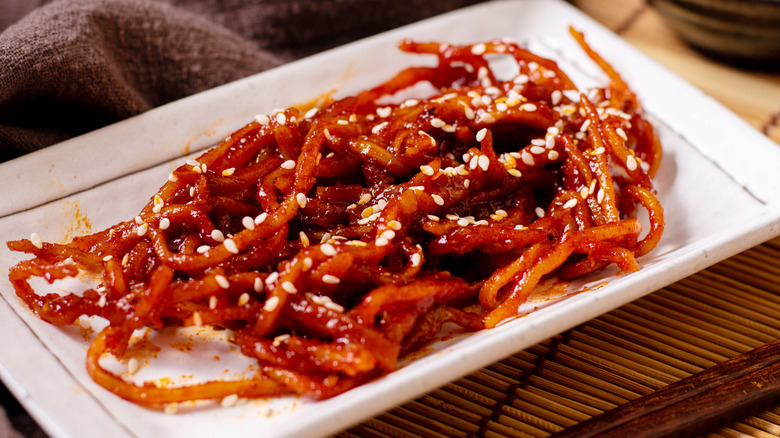
Ojingeochae muchim, also known as jinmichae, is a spicy seasoned squid mitbanchan made with sliced squid tossed with gochugaru, sesame oil, garlic, soy sauce, vinegar, and sesame seeds. Often described as a quintessential comfort dish in Korea, it's well-known for its addictive, soft, and chewy texture and its slightly sweet, savory, and spicy flavor.
This mouthwatering banchan is typically prepared by rehydrating dried squid, then mixing it with the bright red and salty sauce. Sometimes it can also be mixed with mayonnaise, giving it a creamier consistency and flavor, or with stir-fried fresh squid, resulting in a fresher, more fishy taste. It's a common school lunchbox item in Korea, often served alongside steamed white rice (use a kitchen towel for perfect fluffy rice every time) or as an anju (food served with alcohol). You can find it as a side dish at most Korean barbecue restaurants, where the fatty, grilled meat pairs perfectly with the salty, umami flavor of the seasoned squid.
7. Japchae
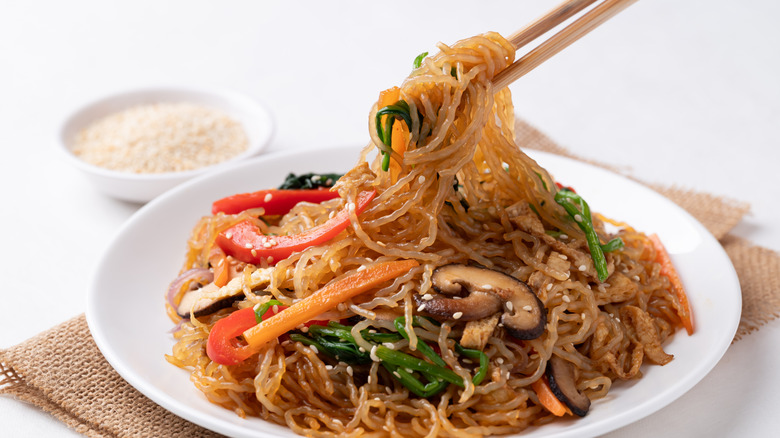
Japchae, otherwise known as dangmyeon bokkeum, is a banchan consisting of stir-fried sweet potato glass noodles mixed with thinly sliced beef, julienned carrots, onions, mushrooms, and spinach seasoned with a savory sauce. The sauce is made from a combination of sesame oil, soy sauce, minced garlic, black pepper, sugar, and honey, giving it a slightly sweet flavor with notes of nutty, umami richness. The noodles are made from sweet potato starch, which creates a unique chewy texture and translucent appearance.
Served as a banchan or as a main dish, japchae often comes on a hot sizzling stone platter or over a bed of steamed white rice, known as japchae-bap. Variations including a seafood version called haemul-japchae that often features squid, shrimp, or mussel and a delicious one called buchu-japchae that has thinly sliced garlic chives as the star ingredient, giving it a tasty, savory, garlicky flavor.
8. Mu saengchae
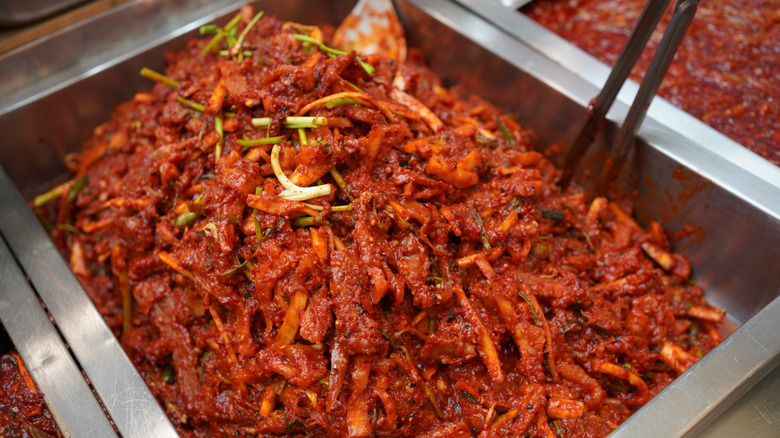
Another delicious banchan that you definitely need to try is the crisp and refreshing mu saengchae. It's made with thinly julienned raw radish that's dressed in a sweet, sour, and spicy sauce made with gochugaru, fish sauce, sesame oil, garlic, scallions, and sugar. It's well-known for its crispy, slightly crunchy texture and its spicy, tangy flavor that pairs perfectly with a plain bowl of steamed white rice or a delicious jajangmyeon (Korean black bean noodles).
Mu saengchae is typically made with Korean radish, a thick and plump radish commonly used in Korean cuisine. It can be found in most Asian grocery stores. It has a distinctive pale green top, a white bottom, and a slightly sweet, peppery flavor. It has an extremely dense and crunchy texture that makes it ideal for this delicious banchan. If you can't find any Korean radishes, you can easily substitute them with their cousin, the daikon radish.
9. Oi sobagi
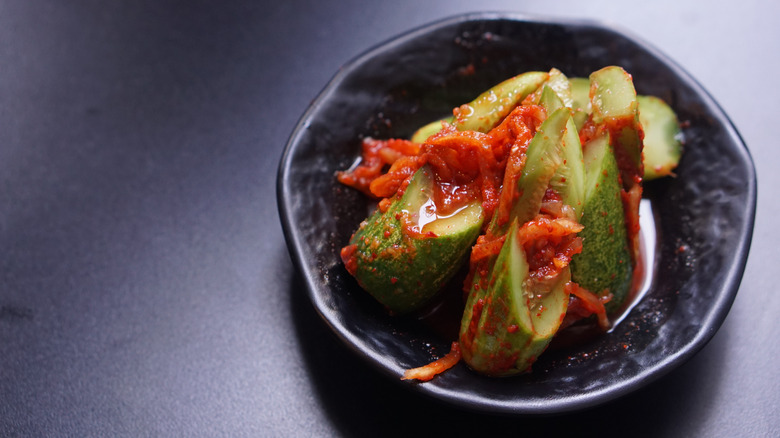
If you've dined at a Korean restaurant or shopped at the iconic Asian grocery store, H-Mart (check out our list of the best items to buy when you go there), you've likely encountered the delicious cucumber banchan called oi sobagi. This tasty banchan is made by stuffing split cucumbers with a mixture of garlic, chives, carrots, radish, fish sauce, sesame oil, and, of course, gochugaru. It's known for its satisfying, juicy, crunchy texture and salty, spicy flavor. It pairs well with braised meat dishes and spicy, bubbling tofu stews.
Oi sobagi is a summer staple in Korea, traditionally made with kirby cucumbers (Korean cucumbers) when they reach their peak freshness and abundance from May through August. These cucumbers have a firm, dense texture and a thin skin, which is perfect for stuffing with oi sobagi's savory filling. Typically, the cucumbers are cut into segments, then split into a cross shape, leaving one end intact to create a hole for the stuffing. Unlike Napa cabbage kimchi, oi sobagi is typically eaten immediately. It may also be left in the fridge to ferment for one or two days, giving it a mouthwatering, tangy, and slightly acidic flavor.