

Hold Off On The Rocks If A Scotch Falls Into This Category
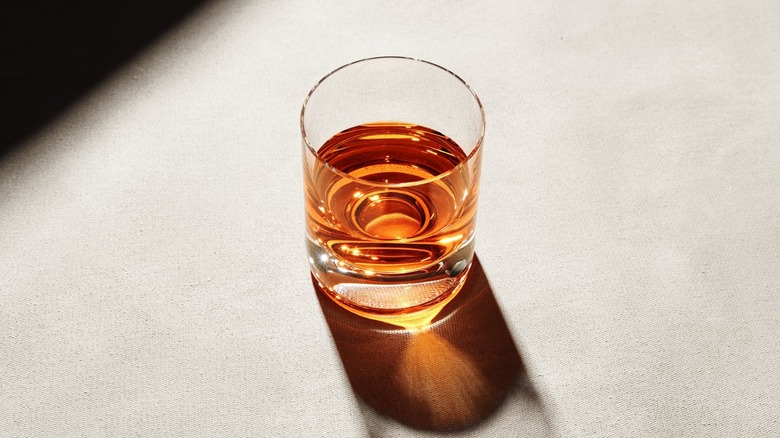
In the 2000 "Futurama" episode, "War is the H-Word," the character Zapp Brannigan verbally accosts his assistant over a supposed botched drink order: "Where's the little umbrella? That's what makes it a Scotch on the rocks!" He's completely wrong, of course. A Scotch on the rocks is a classic — and incredibly common — drink order that simply calls for Scotch poured over ice. But you probably knew that already. What you might not know, however, is that some Scotches are best drunk without any ice at all.
So, when is it best to order a Scotch neat? Some would argue that any Scotch is best when tasted neat, at least at first. This way, you're getting the full flavors and not missing any nuances. After all, the exact flavors vary widely depending on the grains the Scotch is made from and the aging process. That said, some Scotches are made basically with the quiet understanding that you're going to dilute them with ice or water before sipping. These tend to be your lower-end Scotches, aka the ones more commonly stocked in bar wells and on low shelves because they're more affordable and easier to stock up on. But they also tend to taste quite harsh without any dilution, so ordering them on the rocks is perfectly acceptable if not outright expected. On the other hand, high-end, rarer Scotches are smoother bodied and have considerably less burn to them. If the Scotch you're ordering falls into this niche, you should definitely put a pause on the rocks.
Why expensive Scotch sips more smoothly on its own
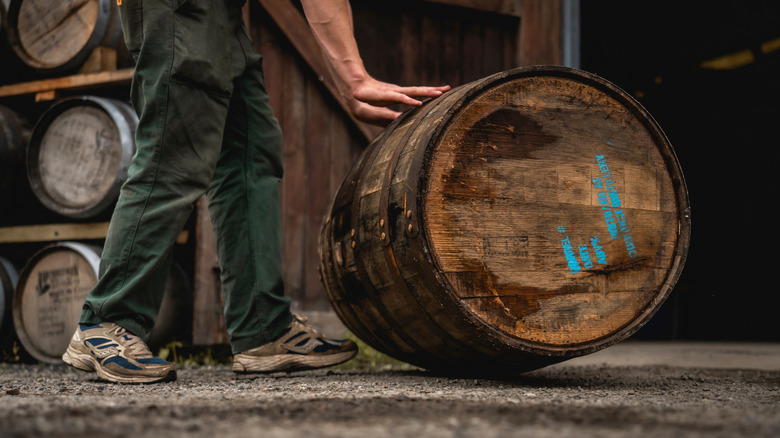
Expensive Scotch isn't pricey just because it comes from a well-regarded brand or, in some cases, comes in the creepiest bottle you'll ever see. It's pricey because of all the time and technique that goes into it. Scientifically speaking, the careful processes used to craft it are also what makes aged Scotch so much smoother to drink. Prolonged aging periods mellow out the whisky within the barrels by diffusing harsh ethanol compounds (known as congeners), and it helps the liquid take on more character from the barrel itself. When congeners are left unrefined, as is the case with cheaper, younger Scotches, they act as irritants and burn the palate while you drink.
Subsequently, Scotches that are aged for a long time also tend to be rarer, though you may also come across purposeful small batches made with unique ingredients from time to time. Be careful, though, with just assuming a rare Scotch means it's smooth — Fishky is a rarely-seen Scotch aged in literal fish barrels, and it does not get high marks at all in terms of taste.
Scotches you should always order neat (at least at first)

The simple truth is that, if you're a Scotch fan, you'll probably want to try every Scotch neat at least once. If there's too much bite on it for you, then you can go ahead and dilute it with water or ice until you find it enjoyable. Nevertheless, there are certain rarer Scotches that, first, you should only be ordering if you already know you like Scotch (they're pricey, so don't throw away your money on a liquor you don't like), and, second, you should definitely try neat.
For these, look to the top shelf for labels like Macallan Blue Label and smaller Glenlivet batches. Pay close attention to aging years — anything 12 years and up will be especially smooth, complex, and ready for neat sipping — as well as barrel types. Scotches aged in sherry barrels, for instance, have rich dried fruit flavors that may get lost when diluted.
Going beyond your basic order, how you actually drink any whisky also affects the experience. The correct way to drink Scotch calls for going slow and making sure you take in its scent as well as its flavor. Of course, if you're still feeling some burn or just think it tastes too strong after trying a few sips of high-end Scotch, there's nothing wrong with asking for some ice to add to it. At the end of the day, it's still a personal choice.