

10 Air Fryer Myths You Need To Stop Believing
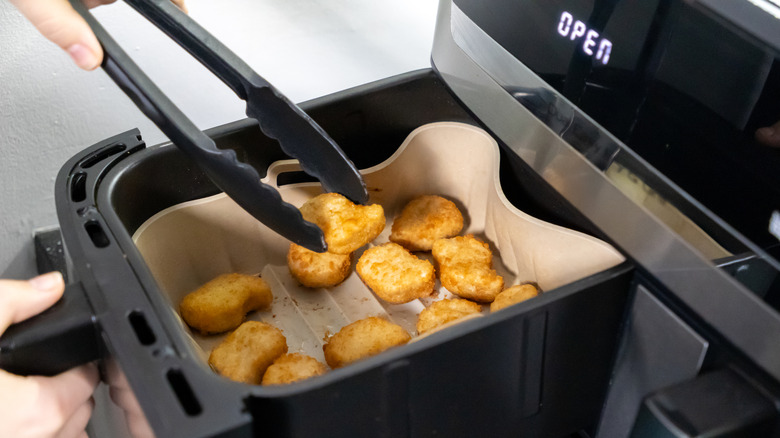
We may receive a commission on purchases made from links.
No appliance has taken hold of the hearts and minds of users quite like the air fryer. Unlike other cooking appliances, which have been around for decades, the air fryer made its appearance onto the cooking scene relatively recently (2010). Its creator, a Dutch engineer, developed the egg-shaped appliance in an effort to make french fries healthier. Though functionalities differ based on today's models, the basic premise remains the same: A fan circulates hot air around a heating element, cooking and crisping the food's surface in ways that other appliances can't. The popular basket feature also helps with this, as the air can travel around the food and cook all sides of it. However, you can also find models with French doors or trays that work similarly and offer an array of added features, including timers.
Nestlé representative Adam Graves estimated in an interview with CNBC that as of 2023, 60% of U.S. homes have an air fryer — a number set to grow as more and more people look for convenient, affordable, and relatively hands-off tools to make their favorite dishes. And with air fryers still being as popular (if not more) as they were when they first hit the market, there are bound to be some assumptions and myths circulating (pun intended) about them. In order to dispel the rumors, we reached out to some air fryer experts: Andreas Hansen, founder of Fritaire, and Coco Morante, author of "The Instant Kitchen Meal Prep Cookbook."
1. Myth: Air fryers require zero oil
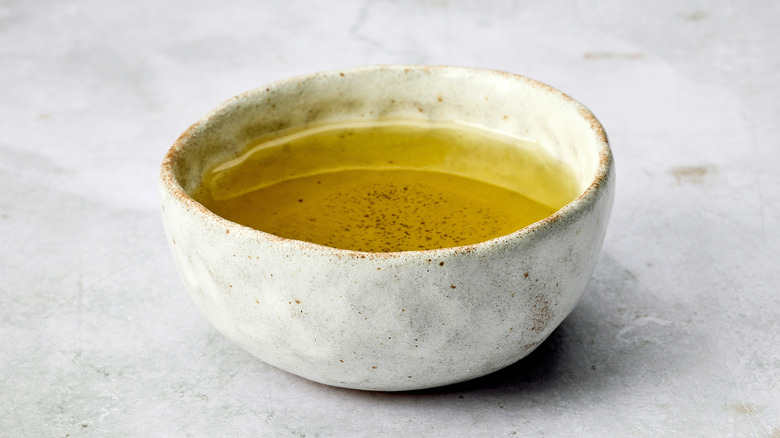
When Fred van der Weij first created the air fryer, he was after a healthier and less oily method of making french fries. As such, it's reasonable to assume that his creation, and subsequent high-tech iterations of it, would not require any oil like deep frying — the method he sought to make "healthier." However, as our experts pointed out, the idea that the air fryer doesn't need any oil isn't actually true. "The 'no oil' idea stuck because it's an easy headline," says Andreas Hansen, founder of Fritaire, which sells air fryers. "But good cooking still needs a little fat sometimes." Coco Morante, author of "The Instant Kitchen Meal Prep Cookbook," explains that the oil is important because it ensures the exterior of the food browns evenly.
However, it's worth noting that the amount of oil you'd use for an air fryer is nothing compared to what's used for something like deep-frying — or even shallow-frying. "A light coating can make a big difference for browning and flavor, especially with vegetables or proteins. We're talking teaspoons, not tablespoons," Hansen says. Morante uses no more than a tablespoon of oil per pound of veggies and shares that frozen fried food — like nuggets or fries — don't need any additional oil. "If you add more oil than you need, it will just end up pooling in the bottom of the air fryer underneath the cooking rack, so it's best to use just enough to coat the food," she says.
2. Myth: Preheating is always necessary
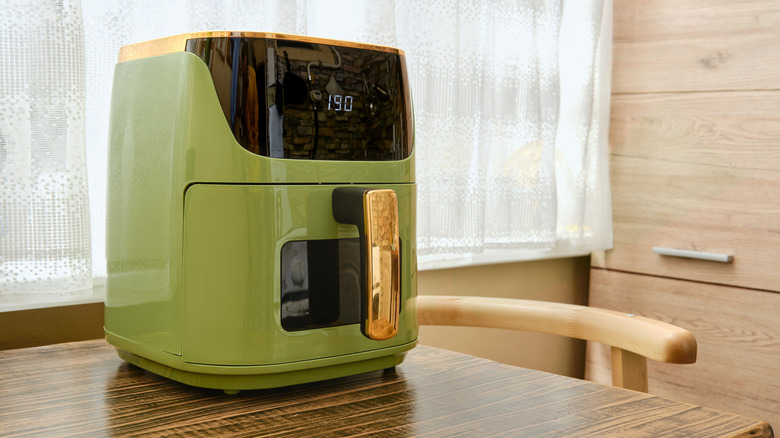
Among its benefits, the air fryer has been touted as a replacement for other home appliances, including the conventional oven. As such, you'd probably assume that, because you need to preheat a conventional oven, you'd need to do the same for an air fryer. However, this isn't the case — or at least, not always.
"Air fryers heat up so quickly that preheating isn't essential for everyday cooking," Andreas Hansen says. However, he does suggest using the preheating setting on your air fryer if you want to get your favorite frozen food extra crispy or sear a protein. Coco Morante agrees, explaining that the preheat function is great for foods such as fries, where you're craving the perfect crispy exterior and soft, pillowy interior. "Starting them in a hot air fryer ensures that result," she says. The good news is that the preheat cycle on air fryers, which are smaller than standard kitchen ovens, is rather quick, meaning you can have crunchy fries and nuggets ready in no time if you plan to use it.
3. Myth: Air frying and deep frying work the same way
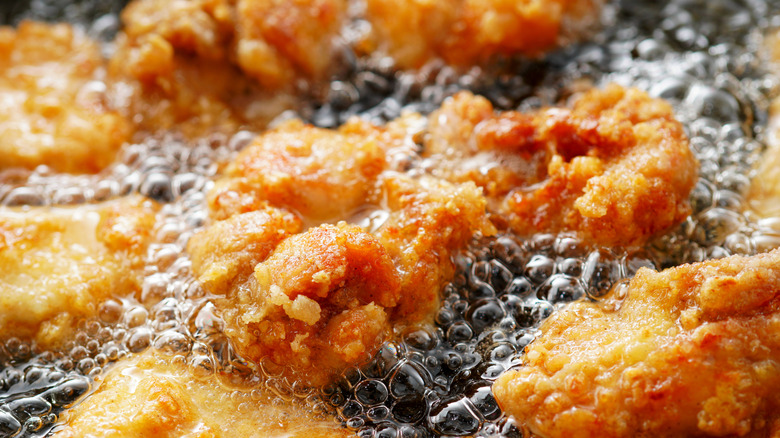
Air fryer does have "fry" in its name, so we can assume that it works the same way as all frying, right? Well, it turns out that your air fryer doesn't actually "fry" your food in the same way that dropping a chicken wing into a vat of hot oil would. This all comes down to the mechanics of the machine. Andreas Hansen explains that the way air fryers work is by circulating hot air around the food; it's the hot air that crisps it up and removes the moisture. In comparison, when you deep-fry something like a chicken wing, that hot oil is making contact with the batter or skin, transferring heat at a rapid pace but also soaking through into the food (anyone who has eaten a particularly greasy wing knows this to be the case). So, an air fryer is not frying in the normal sense; it works more like a highly efficient oven.
Coco Morante explains that the air fryer isn't just another convection oven, though. "I understand the comparison — a convection oven has a fan that distributes the hot air around too, helping the food cook more evenly. But air fryers do it so much better," she says, noting that an air fryer can ensure crispier food. And since there are perforations on the bottom of the rack (or, presumably, basket), you won't have to worry about foods getting soggy. In short, the air fryer is in a class of its own.
4. Myth: More expensive air fryers are automatically better
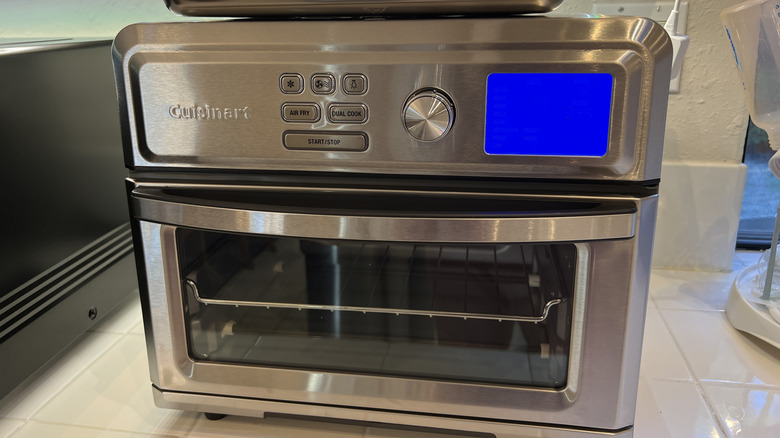
Like any appliance, air fryers run the gamut from budget find to high-end, luxury kitchen gadgets. You might assume, when combing through our list of the best air fryers that money can buy, that a higher-end appliance is going to be more high-tech, efficient, or just better than the one you'd find at Walmart. But, as Andreas Hansen says, "Price doesn't guarantee better results." In fact, Coco Morante tells us that some of the priciest air fryer models she's worked with are also some of the slowest to preheat.
However, a higher price may get you more features. There are a ton of different two-in-one (or more than that) machines that can not only air fry but also toast, roast, boast, ghost ... okay, you get the idea. Buying an appliance that has multiple functions can help you cut down on kitchen clutter, and it may be more effective than buying many different machines. Plus, some of these models allow you to set the timer, adjust the cooking time, do a delayed start, and employ all of these other features that can help you get dinner on the table faster. Not only should you consider the functionalities, but being able to troubleshoot any issues with your new favorite kitchen gadget is also just as important. "Go with a brand that has great customer service, rather than falling for a more luxurious model," Morante suggests.
5. Myth: Air frying is always healthier than other cooking methods
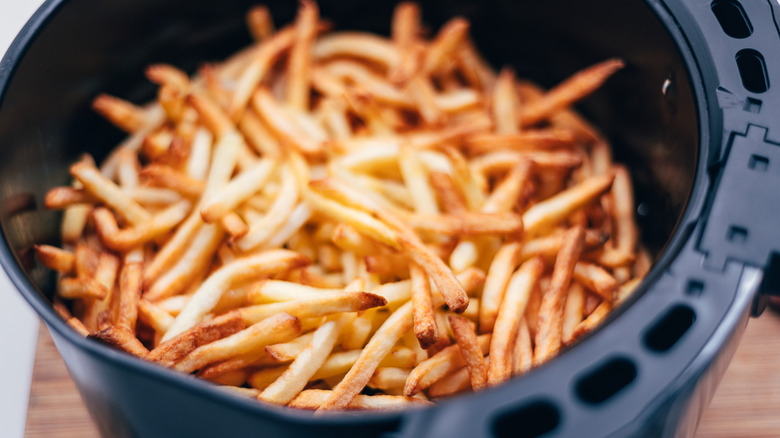
Think of it this way: If you bake a cake in an oven, then bake that same cake batter in an air fryer, is one going to be "healthier" than the other? Probably not. Andreas Hansen explains that whether the air fryer is healthier or not depends on how you're using it (and what you're using it for). Compared to deep frying, sure, an air fryer might use less oil, thus adding fewer calories to the food, but not all of the uses for an air fryer are alternatives to deep frying.
Hansen also recommends looking beyond oil use when considering whether an air fryer is a healthier alternative to other cooking methods. "It's also about temperature control, not burning coatings, and using safe materials. The appliance itself matters as much as the technique," he says. One tip that Coco Morante offers when it comes to ensuring a good cook on food is to use a uniform coating of oil. "In most cases, you can get away with a few quick sprays of avocado oil and still get a crisped up result," she says.
6. Myth: The range of foods you can air fry is limited
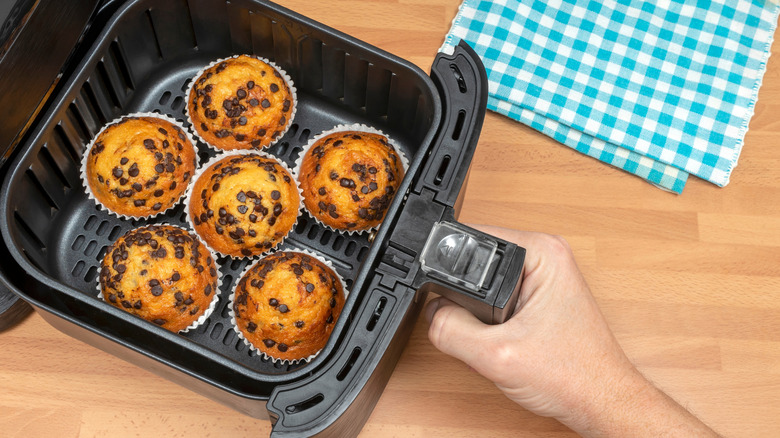
When you think of an air fryer, what comes to mind? Likely nuggets, chicken tenders, frozen fries and tots ... they all tend to be quick-serve, frozen bites. However, your air fryer can be useful for cooking more foods than you think. For one, you can use your air fryer for easy baking: Try an air fryer-safe, silicone muffin tin for cupcakes or breakfast treats, or make single-serve brownies or cookies. Air fryers can also be used for family-sized meals, making them a great investment for those living in large households. "For busy households, the speed and predictability are huge advantages, especially on weeknights," says Andreas Hansen. Coco Morante enjoys using her air fryer for reheating lunches as well as preparing broccoli for her kids; her family uses both their basket-style and oven-style air fryers daily.
Although air fryers can make quick work of many foods, there are also some things that really shouldn't be made in an air fryer — unless you're prepared to deal with a very big mess. "As far as what to avoid, I'd say anything with a wet batter is not going to do well," Morante says. "Tempura, beer-battered fish fillets, that sort of thing (the exception being the pre-cooked ones in the frozen food section). The batter would stick to your basket and drip through the holes, making a big ol' mess."
7. Myth: Air fryers need to be cleaned after every use
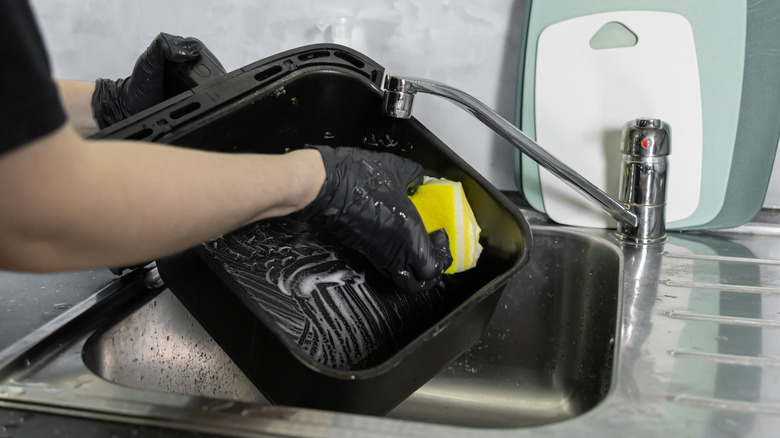
The last thing you probably want to do after you've eaten a meal is worry about cleaning the kitchen and all the appliances you use, but it's a must ... except when it comes to your air fryer. Now, should you leave the heating elements so coated with grease and grime that they become a fire hazard? Of course not, though Andreas Hansen says that a full wash may not always be needed: "You don't need to fully wash it after every single use, but you do want to clean it regularly and intentionally." If you're cooking vegetables or dry foods, a quick wipe or rinse of the basket or tray should suffice. Proteins, marinated foods, or anything greasy may require a more thorough washing. "When I make something like roasted broccoli, or a steak, or anything else that leaves residue on the air fryer basket, it does need to be washed," Coco Morante says.
Hansen says that the best time to clean the appliance is while it's still warm — before the grease and liquid have a chance to solidify and harden. He recommends equipping yourself with warm water, a soft sponge, and mild dish soap (avoid abrasive chemicals and scrubbers) and cleaning it right after cooking. "Letting grease sit and harden is what makes cleaning frustrating, so best to get ahead of the problem and clean it regularly," he says.
8. Myth: All air fryer liners are safe to use
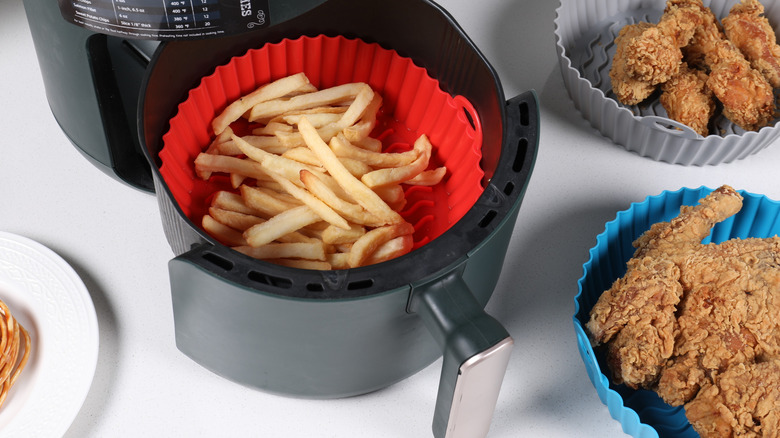
If you don't like cleaning out your air fryer every single time you use it, you may want to invest in a set of liners. Not only do they protect the basket from getting absolutely covered in grease, but they can also trap those pesky food particles, in turn making cleanup a breeze. There are numerous different types of liners, including disposable ones made with parchment paper and reusable ones made with silicone. However, one of the biggest myths with these liners is that they are all safe to use. "Not all liners are designed for the high heat and airflow of an air fryer," says Andreas Hansen, who recommends folks look for products that are explicitly air fryer-safe, that are suitable for the appliance's heat rating, and that have perforations or holes so that they don't block the heating apparatus (remember, that's what moves the heat around in the appliance).
"Avoid parchment or liners that are loose, lightweight, or not anchored by food, as they can shift, burn, or interfere with the cooking," Hansen says. He recommends opting for the least number of layers between whatever you're cooking and the basket for an optimal cook and heat circulation. Coco Morante, on the other hand, eschews liners entirely. "I don't really use air fryer liners — I don't find them necessary and more often than not, it's just obnoxious to worry about the edges lifting up and getting singed by the heating element."
9. Myth: You need to thaw foods before cooking them in an air fryer
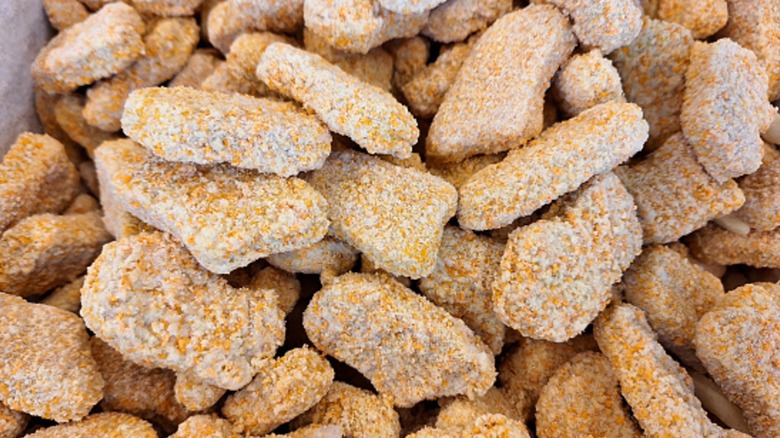
To thaw or not to thaw? That is an important question, especially when it comes to one of the most popular uses for air fryers: frozen appetizers and bites such as nuggets, fries, and tots. Coco Morante says that you can indeed cook many foods from frozen in an air fryer because of how fast it heats up and cooks. "The hot air circulates evenly, so things crisp up nicely without needing to thaw first. It's one of the reasons people rely on them during busy weeks," she says.
Of course, there is going to be some variability in which products you need to thaw before cooking, so be sure to check the package instructions or recipe first. Luckily, many frozen food brands have caught on to the fact that more and more people are using air fryers rather than cooking their foods in standard ovens. "Most frozen foods have air fryer instructions printed right on the bag or box these days, making it so easy," Morante says.
10. Myth: Air fryers are a fad
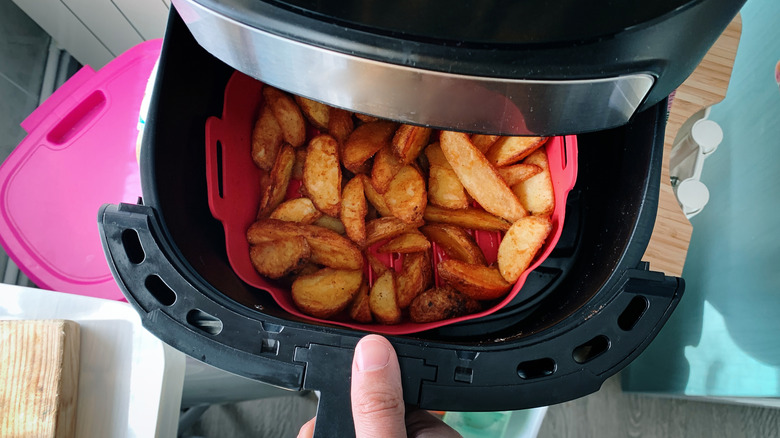
Air fryers had their heyday in the late 2010s — and during the COVID-19 pandemic — but it's false to think that our fascination with these nifty tabletop appliances has faltered. "Everyone loves a solution that saves time and makes food more delicious, and doesn't take up a whole lot of space," says Coco Morante, noting that you can buy an air fryer in the right footprint to suit your needs. "I think people also like how it doesn't heat up the kitchen in the way a traditional oven does, and there's a big energy savings too."
Andreas Hansen attributes their popularity to the fact that they solve three main kitchen problems: mess, time, and consistency. "As designs improve and materials get better, they'll keep evolving. But the core idea isn't going anywhere," he says. And now, equipped with these expert tips, you will find ways to use your own air fryer to its fullest potential.