

9 Costco Hot Dog Facts Only A True Food Court Fan Would Know
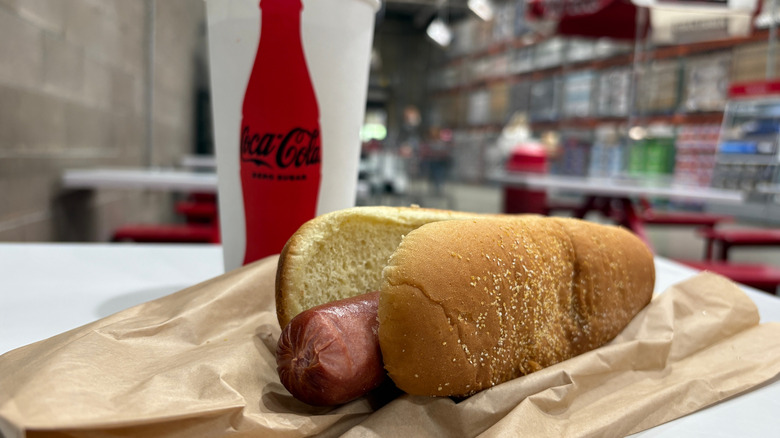
There is a reason Costco boasts millions of loyal members worldwide. Beyond the thrill of finding bulk snacks at unbeatable prices and the satisfaction of a cheaper fill-up at the gas station, one stop has become a near-sacred part of the Costco experience: the food court. And the shining star of the food court, beloved by bargain hunters and grill masters alike, is the lauded $1.50 hot dog and soda combo meal — a deal that has barely changed in decades.
What started as a modest hot dog cart outside the San Diego Costco in 1984 has grown into a member-favorite food court icon that keeps competing club-style warehouses on their toes and keeps members coming through the doors. Whether you are partial to a dog before navigating the warehouse's cavernous aisles or after wrangling a mile-long receipt, you're not a true food court devotee unless you know these 9 facts about the Costco hot dog.
1. The hot dog and soda combo has been $1.50 for more than 40 years
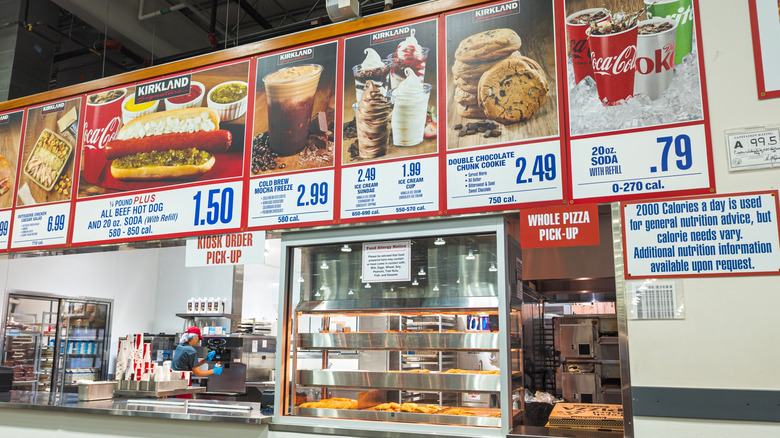
If $1.50 seems incredibly affordable for a fully prepared meal, that's because it is. The Costco hot dog and soda combo's price is essentially a time capsule straight from the '80s. If the deal was to keep up with the rising cost of consumables nationwide, Costco members could expect to pay $4.78 for their quarter-pound combo meal, according to the Bureau of Labor Statistics. Thankfully, it doesn't seem likely in the near (or distant) future.
In a 2018 interview with 425Business, Costco's then-CEO Craig Jelinek brought up the rising cost of goods to Costco co-founder James Sinegal, suggesting that the food court prices may do well to reflect modern-day inflation. Sinegal's colorful response to Jelinek's intimation further sealed the meal deal's fate. According to Jelinek, Sinegal told him, "If you raise the effing hot dog, I will kill you. Figure it out." With that lighthearted threat in mind, Jelinek agreed that there were better cost-cutting measures than eliminating a decades-old deal that tastes great and draws customers through the warehouse doors.
2. The price hasn't changed, but the deal has gotten bigger
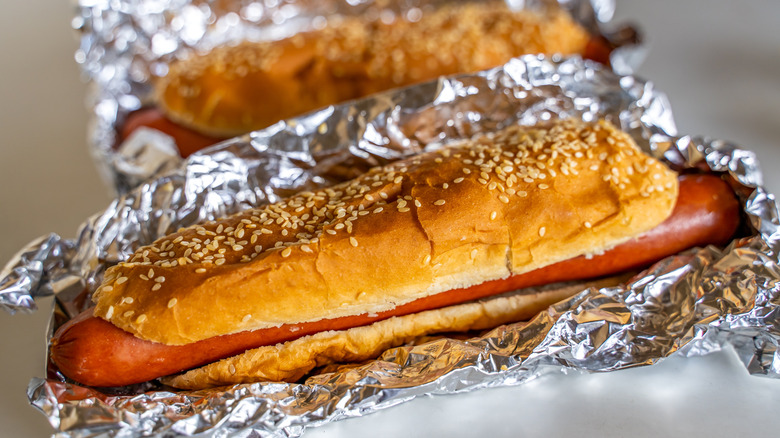
Shrinkflation, the phenomenon of products becoming smaller while prices rise, can't touch the $1.50 hot dog deal, and better yet, the actual substance of the deal has only gotten sweeter. What used to buy a quarter-pound hot dog and a 12-ounce can of soda now gets customers a 10 percent bigger dog with free-refill fountain sodas.
If there were any concerns about the meal price tag growing, Costco's former CFO Richard Galanti doubled down on Sinegal's fixed price wishes and all but squashed the possibility of a price hike during a 2022 company earnings call. With profit margins tightening, Galanti was asked whether the price of the famous food court staple would increase. His response? Costco would "hold the price on the hot dog and the soda a little longer — forever." That seems pretty well set in stone, so members can heave a sigh of relief and plan their food court excursions for all their shopping trips to come.
3. The hot dogs are produced under Costco's store brand, Kirkland Signature
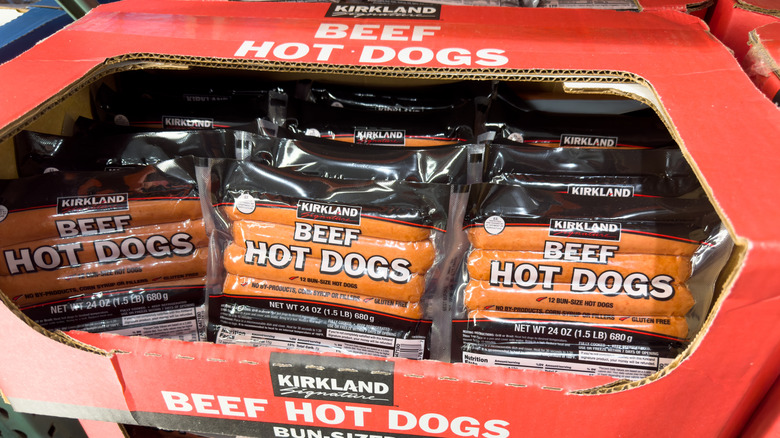
Costco hadn't always planned to produce its own hot dogs, but the success and sheer number of sales had the company rethinking its production strategy after decades of food court success. Costco explained the need for a new product in the March 2009 issue of their membership magazine, Costco Connection: Hebrew National, the original hot dog supplier for Costco, produced a kosher quarter-pounder that made its mark on members across the country. But the early aughts saw material prices for kosher hot dog production skyrocket, and Costco hopped on the opportunity to develop its very own signature frank under its popular store label, Kirkland Signature.
The hot dog of today's food court was dubbed the Kirkland Signature ¼ Pound Plus dog when it debuted in 2008. To keep up with the constantly increasing demand for food court hot dogs, Costco opened a processing facility in Tracy, California quickly followed by an additional facility in Morris, Illinois. The two facilities pump out Kirkland's ¼ Pound Plus dogs using 100% USDA Choice or better beef, but unlike the Hebrew National original, they are not kosher.
4. Costco sells more hot dogs than the MLB
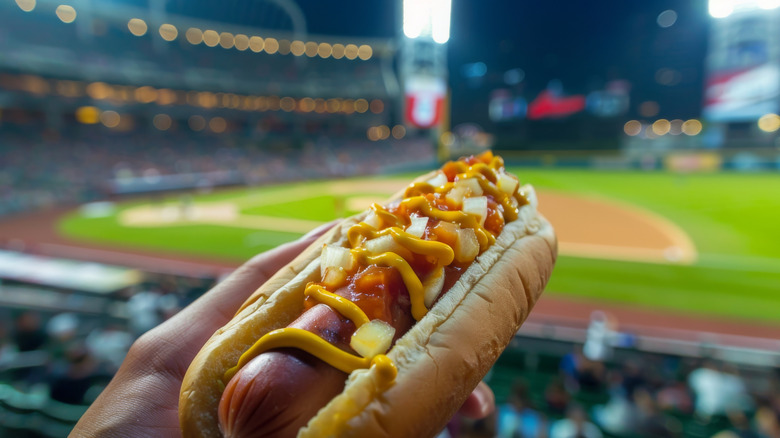
Hot dogs and baseball are a pure Americana match made in the dog days of summer, so it may come as a shock to learn that Costco's food court regularly outsells America's favorite pastime in hot dogs; Sales in all major league baseball stadiums combined can't loosen Costco's chokehold on the hot dog market. According to Costco regulatory filings perused by The Motley Fool, the warehouse consistently sells over 100 million hot dogs annually, with sales quadrupling the MLB's in 2015.
Next time you are enjoying a ballpark frank at a painful upcharge, know that you could have enjoyed up to five Costco hot dogs PLUS soda (minus the great view and stadium camaraderie, of course) for the same price. Executive VP & CFO Gary Millerchip revealed in Costco's fourth quarter earnings call in 2025 that hot dog combo sales topped 245 million and investments were being made to increase production for the coming year.
5. Social media reveals non-standard toppings and secret order hacks
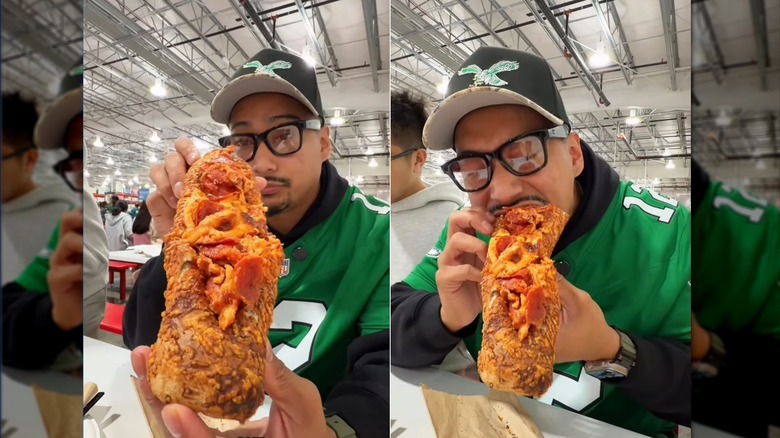
Though the hot dog combo meal became insanely popular long before anyone dared call themselves a social media content creator, the chronically online did eventually find ways to... enhance the food court specialty. Among the Frankenstein'ed fusions constructed by hot dog superfans are dogs stuffed into hollowed-out chicken bakes –- purportedly called the "Forbidden Glizzy" — or dressed in disassembled pizza slices. Too far?
For the upgrade-curious, the Costco food court online community is full of tips and tricks for less invasive hot dog enhancements. Condiments like ketchup, mustard, relish, and chopped onions are typically available self-serve style in all Costco warehouse food courts, but according to social media users, sauerkraut is occasionally available upon request. Others online suggest keeping your eyes peeled for sample stations while en route to giant tubs of mixed nuts or glistening rotisserie chickens. A small-portion cup of kimchi or pesto could transform your $1.50 dog into an entirely new dining experience.
6. Julia Child loved Costco hot dogs
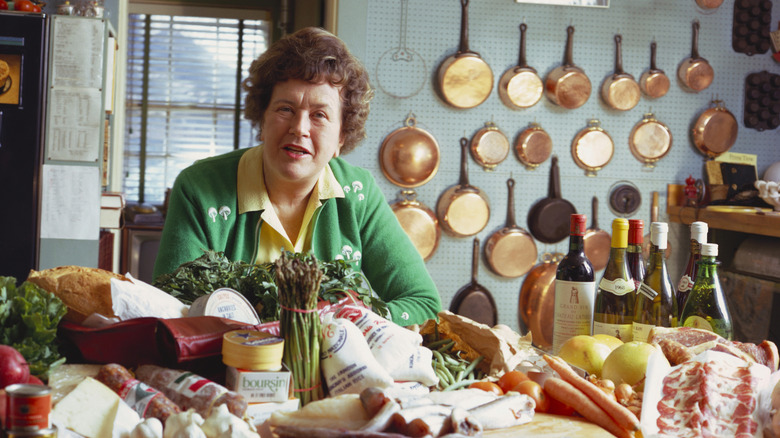
The late celebrity chef Julia Child, known for her French cuisine and instructive cooking shows, was a frequent Costco shopper according to "Dearie: The Remarkable Life of Julia Child" written by biographer-to-the-stars Bob Spitz. While her personal cooking leaned toward the upscale dining experience and her approachable teaching elevated home meals across the country, Child was no stranger to simple human pleasures — Costco being one of them. Perhaps this isn't a surprise from the non-fussy queen of Americanized French cooking; Costco is loaded with wholesale bulk ingredients at reasonable prices taken advantage of by many chefs.
But further yet, Spitz revealed that the food court was a staple in Child's Costco shopping trips after checkout. Child was enamored with the hot dog and soda deal, he writes, and loved it "as much as a fine French meal." Though Child never experienced the Kirkland Signature upgraded hot dog, as she passed in 2004 about five years shy of its unveiling, we like to think she would have embraced the change. Whether she would have ventured into Forbidden Glizzy territory is another question altogether.
7. Costco dogs are made to eat on site
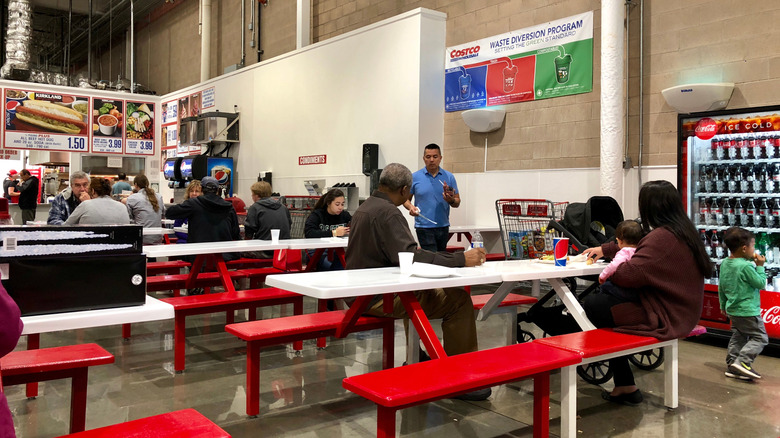
The folks sitting in the food court at your local Costco club are enjoying the hot dog meals in their prime. The Kirkland Signature Pound Plus franks are free of by-products, artificial colors and flavors, corn syrup, fillers, and phosphates, which shortens their shelf life once cooked.
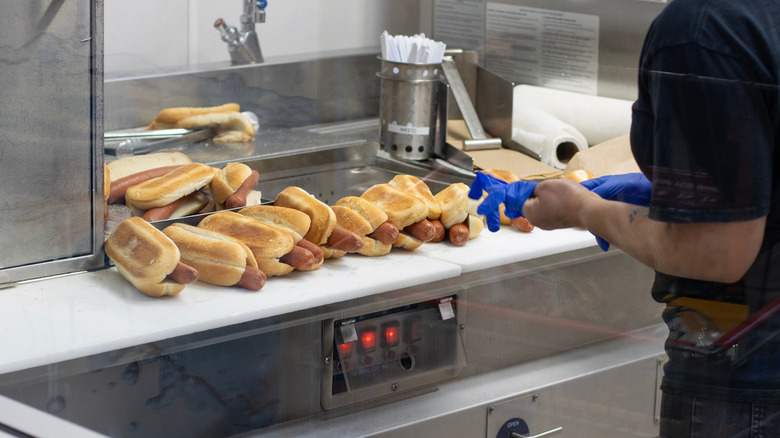
According to one food court worker on Reddit, Costco's hot dogs are brought to an internal temperature of 165 degrees Fahrenheit in hot, but never boiling, water. They are then placed in a bun and steamed before they make their way to your cart. The warming and steaming process maximizes freshness, but keep a dog any longer than your shopping trip and the bun may get a bit soggy. It is highly recommended you take a seat and enjoy that steaming hot dog on site for the best bang for your buck, literally. Plus, those sodas come with free refills, so stick around long enough to refill your cup before you load up your shopping trip spoils and heading home.
8. Costco probably doesn't make money on hot dogs — for a smart reason
Costco keeps its hot dog and soda combo meal profits close to the chest, not publicly disclosing whether it profits on its hot dog deal. But it is safe to assume that the inflation-resistant meal functions similarly to a loss leader, or a way for the club to draw in consumers with an eye-popping but nonprofitable deal knowing that warehouse members will likely spend a lot more on Costco's bulk-style goods.
The deal is simply an unmovable perk of membership, which runs customers $65 a year at its lowest tier. While former CFO Richard Galanti would not confirm hot dogs as a loss leader, he told the Wall Street Journal in 2022, "Needless to say we aren't making a lot or any [money on the food courts]... At the end of the day, the whole value of our warehouse club includes a great value on that hot dog and soda."
9. Costco is worldwide, but the hot dog deal varies
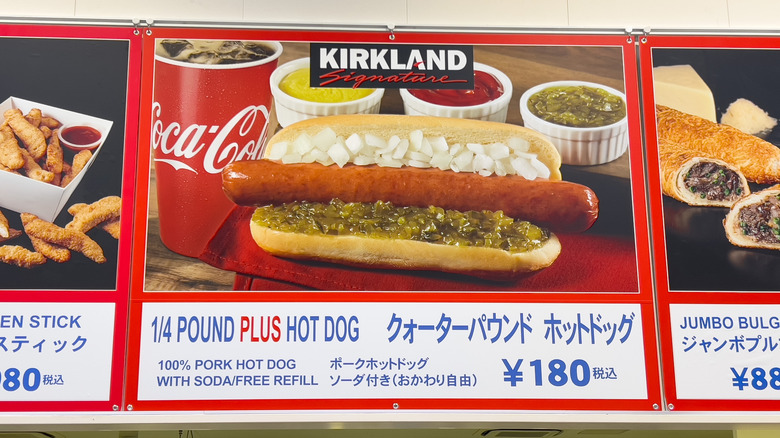
Like many U.S.-based companies that expand internationally, Costco's global food courts cater to the tastes of their countries' club members. If you're traveling abroad and find yourself in a Costco food court, the variety of garnishes, prices, and hot dog ingredients may surprise you.
You can find the legendary hot dog at Costcos worldwide, but the $1.50 all-beef hot dog and soda meal is an America-only staple. In Asia and Australia, social media users report that the hot dogs are made of pork rather than beef. One content creator, on a mission to try Costco hot dogs around the world, found toppings like pickled jalapeños in Mexico and fried onions and mayonnaise in Sweden, as well as Polish-style hot dogs available in some countries including Canada. Another international warehouse visitor noted price differences between countries, with deals ranging from the American $1.50 to the Mexican 35 pesos (or about $1.91 in USD at the time of reporting).