

Never Skip These 10 Vintage Wine Glasses At The Thrift Store
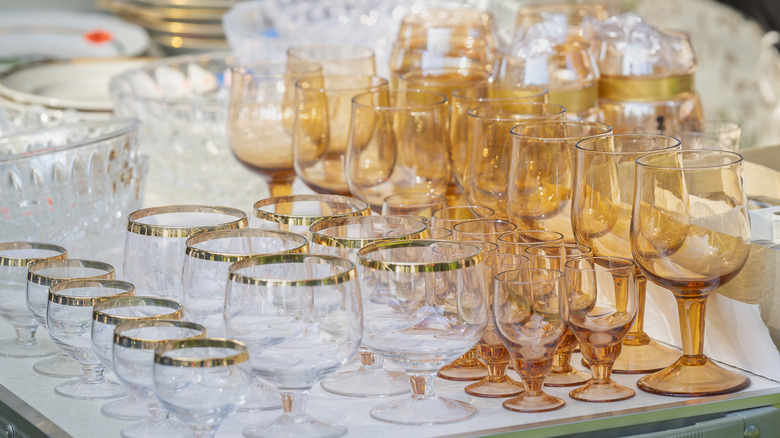
The drinkware section of any thrift store is a place of chaos. If you aren't so intimidated by disorder that you bypass it altogether, you'll find everything from coffee mugs bearing the logos of technology companies you've never heard of to mismatched sets of cheap tumblers and plastic champagne glasses. Hidden within all that jumbled second-hand glass and porcelain, though, there might be a gem. This gold-lined glassware, for example, may be worth grabbing at the thrift store. Beyond that, if you like entertaining, drinking wine with your significant other, or the thrill of vintage finds, knowing exactly what to look for can help ensure you never miss out on a great buy or waste your time wondering over something that turns out to be a cheap dollar store knockoff.
There are a few qualities that can separate vintage and antique glassware, which are somewhat different, from all the junk, so you don't necessarily have to memorize makers' marks to score big at the thrift store. Old glass is typically heavier than modern glass, for example. And modern glassware tends to be perfect, while vintage glassware is more likely to have flaws such as bubbles, lines, and "pontil marks," the latter of which is a round spot on the bottom of a piece of hand-blown glass where it was held by a metal rod as it was being made. Vintage glass sometimes also has a mold line that feels like a seam running up both sides.
Knowing makers' marks and the qualities that specific brands and styles have can also help. Here are a few things to look out for.
1. Ruby red glassware
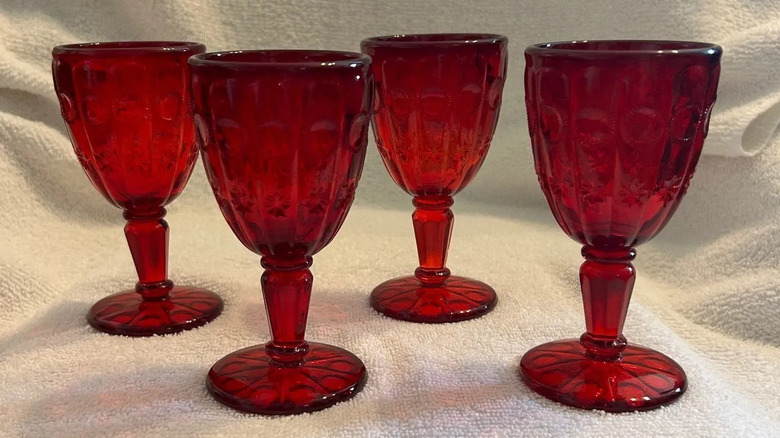
Ruby red glass differs from a lot of modern red glassware because the color goes all the way through the glass. If you find red glass in a thrift store with color that's scratched, worn, or flaked away, it's not ruby red glass. Ruby red glass can be traced to the Roman Empire before the technique was lost and rediscovered in the early 17th century; early examples were made with metallic oxides like gold chloride, which produced the deep, rich, red color. Lots of famous glass companies made ruby red glass, but Anchor Hocking made more of it than anyone else. Its version was colored with copper and was called "Royal Ruby." (Modern red glass is made with selenium.)
You're much more likely to find vintage pieces in your local thrift store (versus antiques), but real ruby red glass — even the stuff that was produced in the 20th century — can be tricky to identify. It's often unmarked because manufacturers at the time usually labeled pieces with stickers that could be easily removed rather than adding permanent marks.
You might also find a variation of ruby red glass called "cranberry glass," which is a pinker variety glassmakers created by simply dialing back the amount of gold chloride. Cranberry glass is scarcer than other kinds of ruby glass, which means it's also more valuable.
2. Murano glass
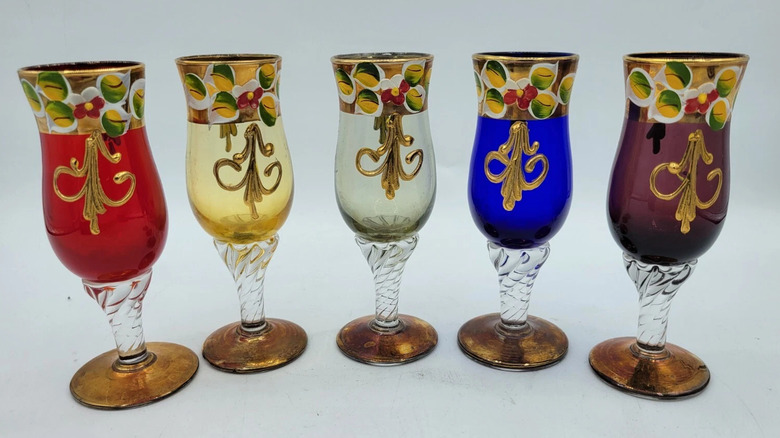
Murano is not a brand name. It's a term used to describe glassware that originates from Murano, Italy. For a piece to be true Murano glass, it has to have been made on the island; even a very good, handmade piece crafted in the same style with the same techniques could not claim to be Murano glass if it was not made on Murano. With a long history dating all the way back to the 13th century, Murano glass reached a peak in popularity during the 16th century, and its popularity surged again in the mid 20th century.
Though many glassmakers have worked on the island of Murano, all Murano glass tends to have a certain look: vibrant colors, unique patterns, and bold shapes. Murano glass is often unmarked, so it's important to develop an eye for it, though you may be able to find vintage pieces that still have their stickers or pieces that have been signed by their maker. Since Murano glass is handmade, look for imperfections like bubbles and other irregularities. Murano glass will also feel hefty in your hand.
Murano glass is highly sought-after, so if you find it while thrifting, it's a bit like winning the lottery. And it really does happen sometimes — in 2023, a Virginia woman bought a Murano glass vase at a local Goodwill for $3.99. A Facebook group helped her identify it, and she contacted an auction house that sold it for her for more than $100,000.
3. Waterford Crystal
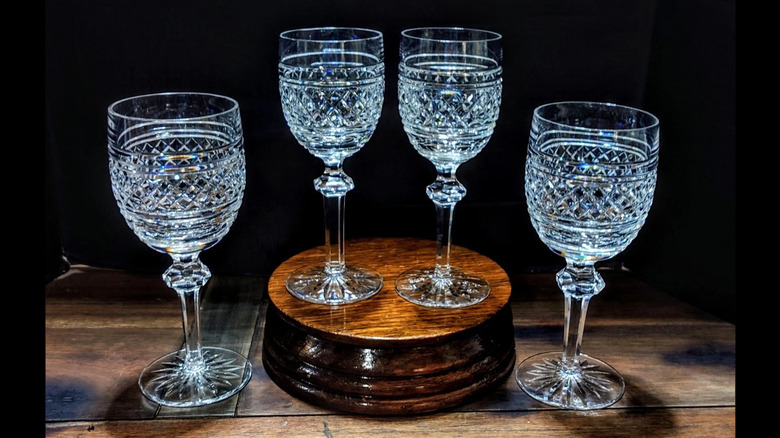
Waterford is a glassware brand that originated in Waterford, Ireland, in 1783. The company has humble roots: At the time of its establishment, glass excise duties made it expensive to make glass in England, but the same limitations didn't exist in Ireland. Brothers George and William Penrose figured they could capitalize on that, even though they evidently didn't know anything about glassmaking. Waterford Crystal is still in business, though today it is owned by Fiskars Group, the same company that makes those familiar orange-handled scissors, gardening shears, and pet grooming tools.
Waterford Crystal made during or after the 1950s is easier to identify, since it will usually have an acid-etched Waterford logo on its base. A seahorse above the name "Waterford" indicates a newer piece, from the 1990s to present. Older examples don't have any mark, which makes identifying them trickier, but look for pieces that are clear, have sharp, deep cuts in the glass, have a heavy weight, and have a nice ring sound when tapped with your fingernail.
Waterford glassware is popularly faked, so it's helpful to look for signs of counterfeiting before you drop money on a wine goblet you only think might be genuine. Fakes will lack that crystal-clear, sparkly look and will feel much lighter in your hand. The cuts might look sloppy, and the logo may not look quite right, either. Most telling, though, when you flick a fake with your fingernail, it will produce a dull sound instead of that resonant, musical ring.
4. Baccarat glassware
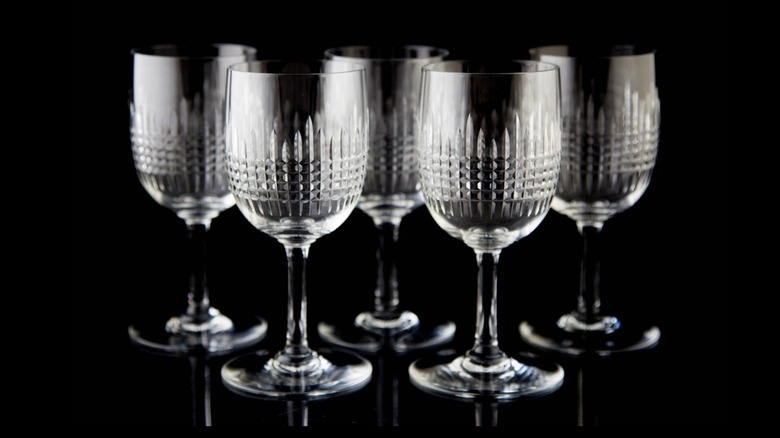
Baccarat is a French glassware brand with roots in a 1764 partnership of craftsmen who were basically trying to perfect the art of glassmaking. They were a patient lot, evidently, since it wasn't until 1816 that the art was officially deemed perfected. Baccarat didn't really start to gain traction until 1855 when it exhibited its wares at the first World Fair in Paris.
Vintage and antique Baccarat glassware is a little easier to identify than other brands. The company has been marking its products since 1860. If a piece is inscribed "Baccarat France" or "Baccarat," you've lucked out — that engraving was used on older pieces. Newer examples have a laser-etched logo.
Like Waterford crystal, genuine Baccarat glassware will be clear, with no trace of cloudiness. The cuts will have precise, sharp edges and the patterns will be symmetrical. But like other types of vintage glassware, it can take some time to develop an eye. Collectors will familiarize themselves with Baccarat's signature patterns and cuts such as "diamond" and "fern." Knowing what these patterns looked like can help these pieces stand out from the deluge of lesser glassware on thrift shop shelves. And while you're browsing, be sure to keep an eye out for this classic vintage dishware brand.
5. Orrefors glassware
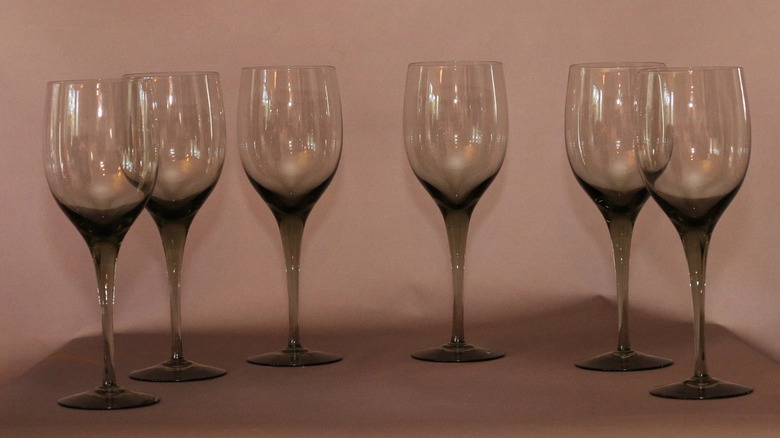
Orrefors of Sweden is another glassware company that's been around since the 1800s, though only just. Established in 1898, Orrefors began life making glass for regular people, you know, those of us who can stand to lose a glass or two to a clumsy friend or a cat that enjoys pushing things off of elevated surfaces. Eventually, Orrefors transitioned to making higher-value pieces, not just drinkware and tableware but also art glass, chandeliers, and decor.
Like other fine crystal, Orrefors glassware has a heavy feel and will have that musical ring when struck with a fingernail. Familiarizing yourself with the different colors and designs made by the company over the years will help you spot it in the chaos of a thrift store shelf. Orrefors is also known for "Graal" patterns, which are colored designs that appear to float inside the glass (often fish) and "Ariel" patterns, which are colorful, layered designs encased inside the glass such as patterned bubbles, swirls, geometric shapes, and animals.
Genuine Orrefors glass can be identified by the Orrefors signature on the base — an acid-etched mark indicates an older piece, and a laser-etched mark is more modern. Some pieces also include the designer's initial or serial numbers. And don't be fooled by counterfeits. Fake Orrefors glass tends to have sloppier craftsmanship than genuine pieces do, and they may also have a signature that doesn't look quite right.
6. Bohemian glass
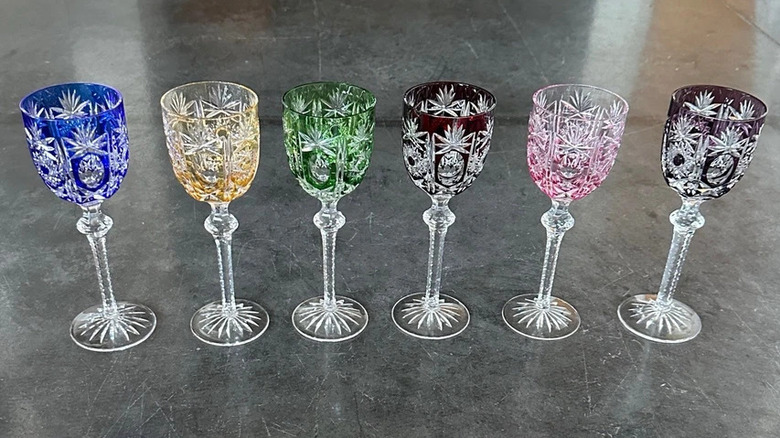
Bohemian glass is a style that originated in the region now known as the Czech Republic (for that reason, you may also hear it called Czech glass). Like Murano glass, Bohemian glass has a very long history that began in the 13th century. Early Bohemian glassmakers developed techniques that produced a hard glass that lent itself to decorative flourishes like deep cutting and engraving, and many more recent pieces still have this characteristic style.
Bohemian glass is sometimes also enameled or gilded and often features bold, primary colors like red, green, and cobalt blue. Some Bohemian pieces have floral patterns or hunting scene designs.
Bohemian glass brands to look out for include Loetz and Kralik — both known for making Art Nouveau style pieces with iridescent "papillon" or "bacillus" patterns, and Moser, famous for its "cut-to-clear" glass, which is a technique in which colored glass is layered over clear glass and the color is "cut away" to create a pattern. You may be able to find brand signatures or other marks on some pieces, but Bohemian glass is a fairly large category, and not all pieces will be identifiable this way. If this is a style you like, it's worth familiarizing yourself with the colors, patterns, and styles that Bohemian glassmakers favored. When in doubt, remember that high quality glass feels heavy in the hand and sparkles in the light.
7. Depression glass
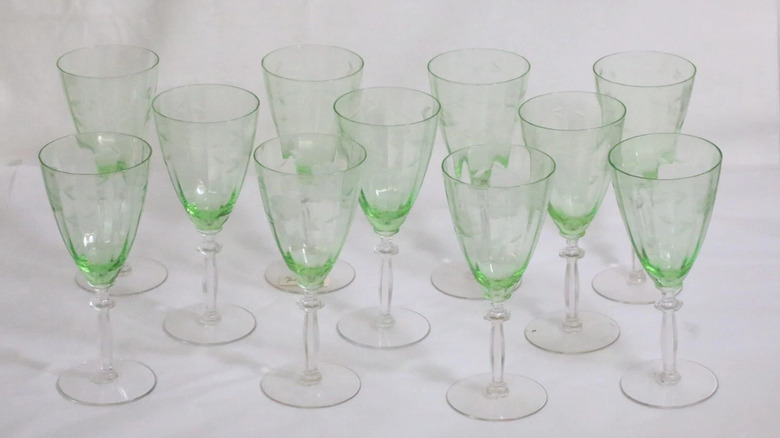
Depression glass describes a style of glassware that was produced during the Great Depression. It was mass-produced and characteristically, well, cheap, out of necessity, since the average person lacked the means to buy fine crystal (or anything else). In fact, a lot of Depression glass was given away for free, and it was produced in bright, cheerful colors because hey, if the only thing you've got in your pantry is brown beans and potatoes, maybe serving it on a pink plate will make your family forget how hungry they are.
Ironically, what was cheap or free during the Depression is now highly sought-after by a lot of collectors, so it's worth knowing what this stuff looks like in case you happen upon some while out thrifting. Depression glass was almost always colorful. Pink and green were popular, but Depression glass came in almost every color, including uranium. If you find yellowish green glass that glows when you put your phone light on it, that's "Vaseline glass" or "uranium glass," which was literally made with uranium oxide so it would glow in the dark (fear not, the radiation levels in uranium glass are low and the stuff is generally harmless, though you probably shouldn't eat off it since swallowing chips or other particles is not advisable).
Depression glass brands to look out for include Anchor Hocking, which (among other styles) made the "bubble" style glassware featuring a pattern of raised bubbles or dimples, Indiana Glass Company, which produced patterned glassware, and others like the Federal Glass Company, Jeanette Glass Company, and Hazel Atlas Glass Company.
8. Milk glass
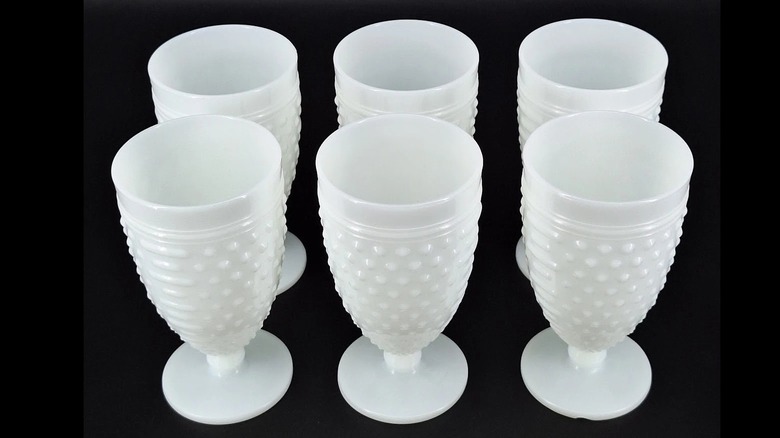
This type of glassware was popular during the Depression, but all milk glass is not Depression glass. It is pretty easy to spot, though, which is both a good and bad thing if you're a collector. You might find milk glass in a thrift store, but you'll have to be quick to buy since it's so easily recognized that it isn't likely to sit on the shelves for long.
Milk glass is distinctive because, as the name implies, it's opaque and often white (though it's also been made in colors such as blue, green, and pink). Milk glass enjoyed more than a century of popularity beginning in the 1830s until it finally started to fall out of favor in the 1980s. Older milk glass was made with arsenic, so if uranium glass sounds troubling to you, well, avoid vintage milk glass that has a grayish tint as well. You should also avoid putting milk glass in the dishwasher, which can ruin it.
Milk glass often featured raised patterns: Bubbles (known as the "hobnail pattern)," diamonds, grapes, and leaves were common. By the mid 20th century, milk glass was so popular that companies were mass-producing it, so there's a lot of it still in circulation and, as collector's items go, it tends to be affordable. If you like the look of it but haven't been able to score any at a thrift store, you'll likely find some at larger venues like flea markets or in antique stores or estate sales.
9. Steuben glassware
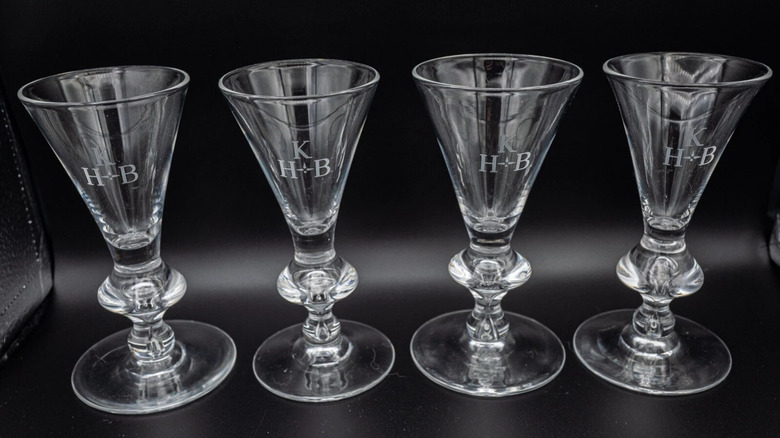
Steuben Glass was founded in 1903, and you can still buy new luxury Steuben glass pieces including stemware, decor, bowls, vases, and the like. Vintage Steuben glass is still very sought-after, and it's possible to find underpriced examples in thrift shops since some older Steuben glass is quite understated and likely to be overlooked.
Early Steuben glass is more likely to be colored — the company didn't start making clear glass until 1933. The company had an Art Nouveau era during which it produced opalescent, decorated pieces and iridescent glass similar in appearance to Bohemian iridescent glass (but produced using a different technique). In the 1930s, it started making lead crystal, much of which was minimalist in design (but not always), so this is another example of a brand that will be easier to spot if you know what you're looking for. Like other crystal brands, Steuben glass is often faked, so if a piece has mold seams, if the glass isn't flawless, or if it's lopsided, it's probably not genuine.
Steuben glass might be signed "Steuben," but sometimes it isn't. The only genuine Steuben mark for pieces made after 1933 is a small signature written with a diamond-tipped pencil. If it's a fake, the mark is generally much larger than an authentic signature. Older pieces might have a mark noting the brand and/or glass type, such as "Steuben Aurene" or just "Aurene."
10. Carnival glass
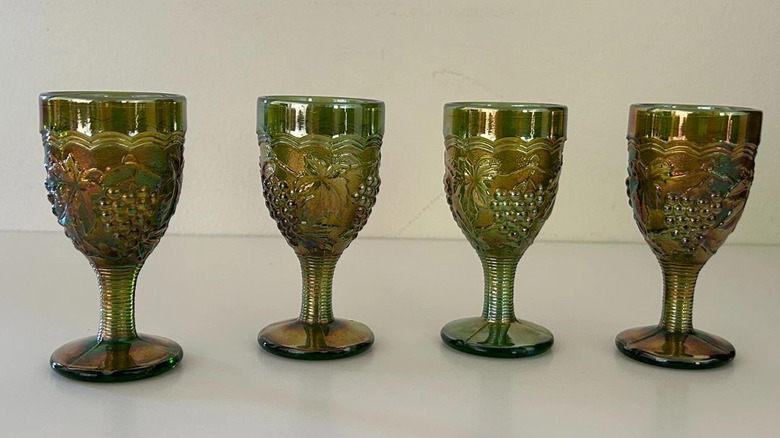
Carnival glass is so named because you used to be able to win it at carnivals, much in the same way as you can win giant Pikachus, rubber ducks, or doomed goldfish today. Carnival glass is famously iridescent like those Art Nouveau styles that were popular in the late 19th and early 20th centuries. But like most midway prizes, it was cheaply made compared to the stuff you bought at a store (though, ironically, you might spend a small fortune trying to "win" it). Carnival glass is molded, pressed glass sprayed with metallic salts to give it that iridescent sheen. In other words, it's basically fake Tiffany glass.
Carnival glass was originally made by Fenton Glass, but lots of glassmakers wanted in on the fake Tiffany market, and Fenton had competition from other companies such as Northwood, Imperial, and Cambridge. The competition led to a decline in carnival glass prices until companies basically had to dump their excess inventory — which is how it eventually ended up in carnival midways.
Like Depression glass, what was once cheap is now highly sought-after, but it can be hard to identify specific pieces of carnival glass since it was cheaply made, often unmarked, and mass produced in literally thousands of different styles and patterns. Manufacturers often copied each other, too, so just because a piece looks like a Fenton doesn't necessarily mean it is. Besides the characteristic sheen, look for seams (mold lines) and a base color (the unglazed portion).